Quite the hole the Edmonton Oilers have dug themselves into, having now lost three straight games to the Anaheim Ducks. And unsurprisingly, the penalty kill sits at the center of the problem.
In my end‑of‑season post, I summarized the Oilers’ penalty kill as sketchy, and the numbers supported that. They finished the regular season with the 12th‑highest rate of goals against while short‑handed (8.16 per hour). That result was largely driven by poor underlying process – Edmonton allowed the ninth‑highest rate of shots against (54.64 per hour) and the ninth‑highest rate of expected goals against (9.57). Put another way, this team struggled to disrupt opposing power plays and consistently failed to keep the puck out of high‑danger areas.
Now that weakness has been fully exposed in the postseason—and things have gone from bad to worse, and could cost them another critical season. Through just 17 minutes of penalty‑kill time against the Ducks, the Oilers have surrendered six power‑play goals. That translates to a goals‑against rate north of 20(!) per hour. Once again, the underlying numbers tell the same story: a massive spike in shots against (89.83 per hour) and expected goals against (14.87 per hour). The Ducks are basically having no issues generating chances.
Worth noting that the penalty kill had been a recurring concern throughout the regular season, particularly after Adam Henrique went down with injury for an extended stretch. The 34‑year‑old centre was a significant contributor short‑handed, and his absence was felt. Now that he’s injured again, the drop‑off is even more pronounced.
What I also didn’t realize was just how poorly the Oilers penalty kill performed late in the regular season, particularly in terms of the volume and quality of scoring chances allowed.
The chart below shows the Oilers’ expected goals against per hour on the penalty kill across the regular season, broken into rolling five‑game segments. The goal was to determine whether Edmonton had previously allowed scoring‑chance rates comparable to what we’re now seeing against Anaheim. I suspected they had—but I didn’t realize just how severe the spike was over the final few weeks of the season.
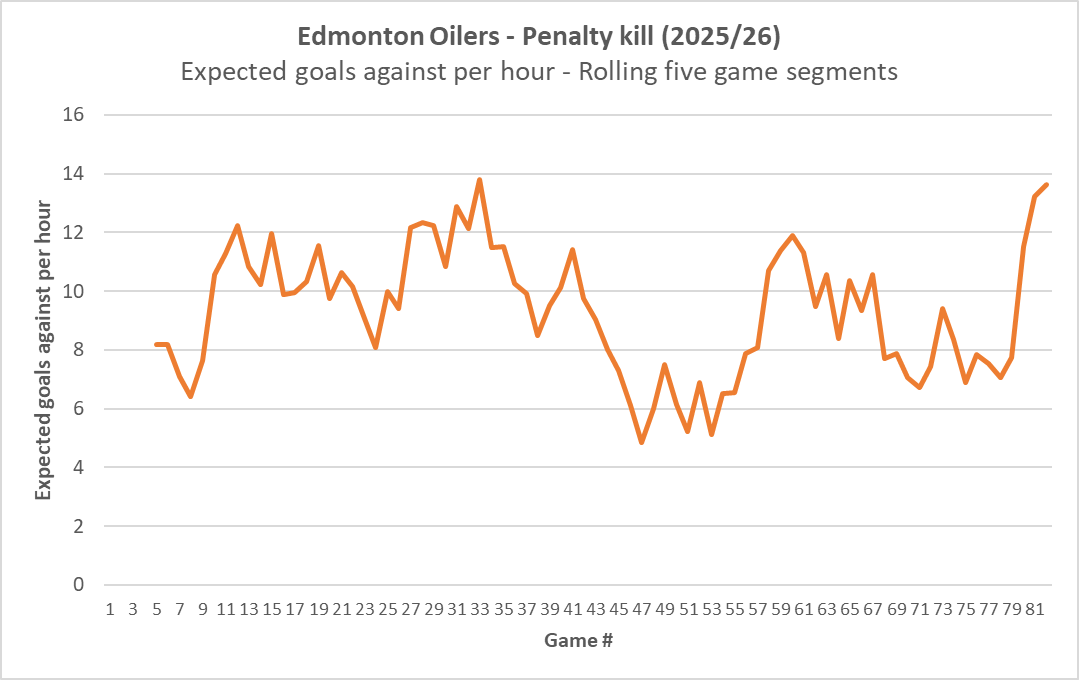
Given those trends, you’d expect the coaching staff to have been aware of this vulnerability heading into the playoffs. Either they weren’t aware of the data or they chose not to address it with urgency. Neither explanation reflects particularly well on any of them – specifically Knoblauch and Mark Stuart.
After seeing this data laid out, it’s hard to be completely surprised that the Oilers now find themselves down 3–1 in the series. What’s most alarming is that this feels entirely preventable—an issue that was clearly brewing long before game one of the post-season.
Data: Natural Stat Trick
Related articles:
- How the Oilers’ top line is struggling as they face early elimination – TSN (2026, April 27)
- A closer look into Edmonton’s defensive issues to begin the 2026 Playoffs – NHL_Sid (2026, April 27)
- ANA-EDM Game 3: A tactical review – Bruce Curlock (2026, April 25)


Pingback: Re-capping the Oilers 2026 playoff jog | The SuperFan