Not overly surprising that the Edmonton Oilers are already dealing with injury issues. The team is fairly committed to an aging core, with a lot of key defencemen and forwards in their thirties now. That’s a risk the Oilers were willing to bet on, largely because they don’t have a lot of top-end prospects in the system.
Nugent-Hopkins in particular is going to be out now for a few weeks. Do wonder if he was dealing with something in the two pre-season games he played this fall. The team got absolutely caved in with him on the ice (31 percent Corsi for percentage, 34 percent Expected goals for percentage). Yes, it’s only pre-season, but if you look at his historical pre-season numbers, he’s always had shot-share numbers above 50 percent.
This does force the coaching staff to have McDavid and Draisaitl on seperate lines, which always makes the team more competitive. It does also give others a chance to fill the minutes RNH would have played. And maybe there’s someone who can have a bigger impact than the 33 year old forward.
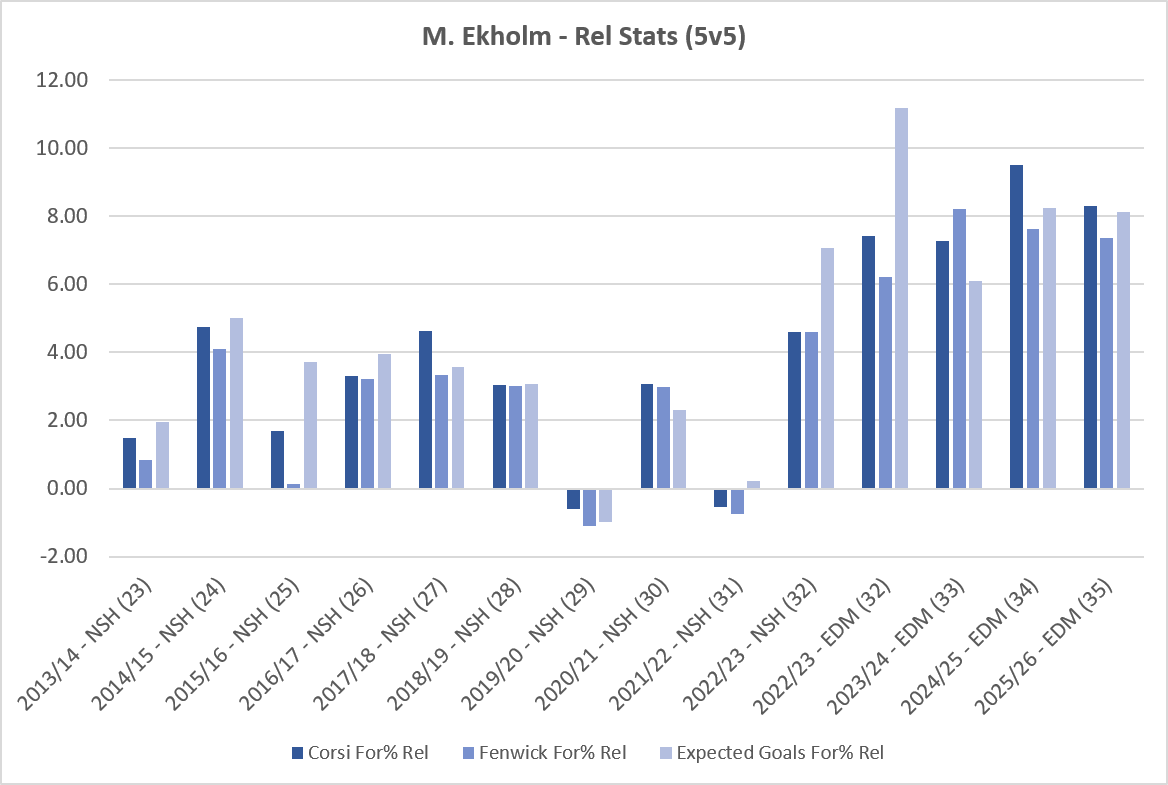
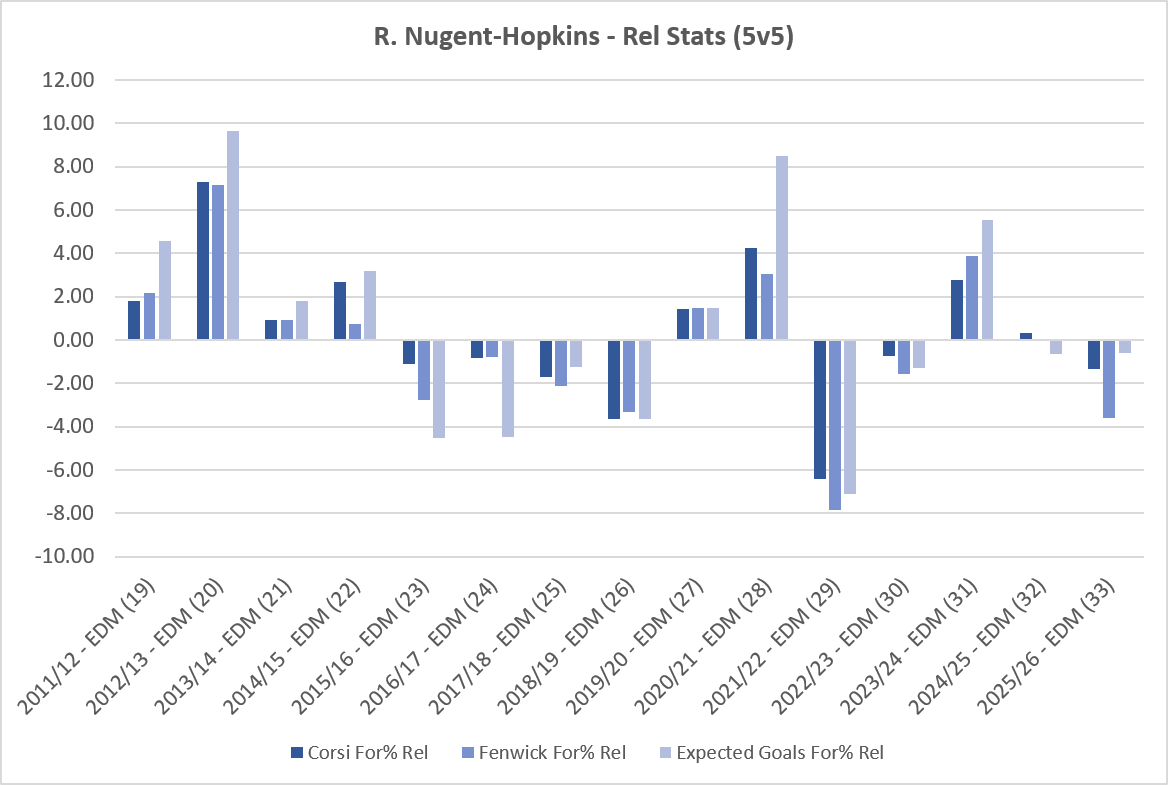
Below is a quick snapshot of RNH’s on-ice shot share numbers relative to the team over the course of his career. What we see here is that while there have been seasons where the team has controlled the flow of play and scoring chances with him on the ice (i.e., when it’s above 0.00), there’s an ongoing, concerning trend of the team doing better without him than with him. Put another way, RNH isn’t any sort of play driver at evens at this point of his career and absolutely needs to be playing with one of McDavid or Draisaitl to be of any value to the team.
Last year, RNH played 375 even-strength minutes away from the two star forwards. And his numbers, along with pretty much every other forward, took a major drive. He finished with an on-ice Corsi For percentage of 47 percent and an Expected goal share of 46 percent. And that played a major role in his on-ice goal share of 37 percent (10 GF/17 GA).
Management also appears to be trying to move RNH off of the penalty kill, which was poor last season. And it makes a lot of sense when you look at his on-ice numbers. With RNH on the ice, the team’s rate of shot and scoring chances against would often spike and it was fairly consistent the last few seasons. He did often play against first power play units, but the rate of shots and chances against were above normal levels. After playing the most shorthanded minutes among Oiler forwards over the last three seasons, it appears the Oilers are looking to others to take on his minutes.
Nugent-Hopkins can still be an asset to the team, and deserves to call his shots with a franchise he’s played 1,000+ games for. But there has to be a plan to eventually fill his on-ice roles. Maybe we’ll who can take on this opportunity in the next few weeks.
Data: Natural Stat Trick