Sharks Under McLellan IV – Systems and Tactics

montreal-canadiens-v-san-jose-sharks1While digging through a lot of the data, I spent some time looking at game footage of the Sharks and came away with the same observation as most: holy sh*t, this team is good. Thankfully there are very bright minds who have taken the time to break it down system-wise and provide some great insight.

Unique Team Traits: When the Sharks enter the O-zone, there’s a good chance they’re getting a shot – The Score (October 3, 2014)

This first article is on shot generation and really how quickly the Sharks shoot once they make a zone entry. Justin Bourne and Thomas Drance do an outstanding job explaining some of the Sharks tactics and how they’re able to control the play.

They also posted a league best mark of .77 shots per controlled entry (the Rangers were second with a .75 shots per controlled entry mark, and only eight teams managed a rate of .7 or better) and were also the most efficient dump and chase team in hockey, managing .37 shots for per dump in (the Kings were second best with a .35 shots per dump in mark, and only nine teams managed a rate of .3 or better). Source

I found in my last post that the Oilers rely more on their forwards for shot attempts and scoring chances compared to the rest of the league. I think we’ll see the defencemen taking on a bigger role, not only getting more scoring chances, but also making more passes that lead to controlled zone entries. This is where Andrej Sekera is going to shine, as he’s proven to be that type of player in the past.

Examining the Sharks’ offensive-zone forecheck – Fear the Fin (March 17, 2014)

This next one is from Patrick D. of Fear the Fin, who looked at how the Sharks forechecked the opposition and the role each player played to support one another. A very aggressive style, but one that controlled the play along the boards.

The Sharks’ defensemen are very active in this forechecking system, pinching in anticipation of a pass up the boards. If the opposition makes a successful D-to-D pass, and then rim the puck past the Sharks F2, the playside D will pinch down sealing that puck off. F3 will be recovering towards center ice when he sees the play is going away from him, and if the defenseman pinches, F3 will replace him at the blueline. Source

The Sharks were very good at not only generating shot attempts, regardless of the score, but also blocking shots. That indicates to me that they they didn’t let the opposition set up plays as often as other teams, thanks in small part to their effective forecheck. What’s become obvious is how much pressure they apply to puck carriers and position themselves to take away the options when they don’t have the puck. I think this will be the most difficult tactic to implement for McLellan.

San Jose’s Neutral Zone Backside Pressure – Pension Plan Puppets (December 5, 2013).

Lastly, J.P. Nikota of Pension Plan Puppets looked at how the Sharks’ forwards apply backside pressure (different from backchecking!) and force the opposition into either dumping the puck or turning it over.

There are a number of issues at play here, including the San Jose forechecking strategy and the way they kept sticks in passing lanes in the offensive and neutral zones. As Carlyle pointed out, they lined a three or four guys up at their own blue line if they could to head off rushes. This forces a lot of dump-ins, which we all know isn’t the most effective way to generate scoring chances, especially if you’re the Leafs. But when the Leafs rushed from their own zone, San Jose forwards often had to chase them (i.e. apply backside pressure), and they did so very effectively. Source

This is going to be critical for the Oilers if they want to continue getting contributions from their defence. We know Schultz took a high percentage of the grade-A scoring chances when he was on the ice, but it always came at a cost. The Oilers faced a lot of two-on-ones the other way with Schultz caught up the ice, with very little help from the wingers. If McLellan has the forwards applying effective backside pressure in this type of situation, we might see fewer grade-A scoring chances coming the other way.

Thoughts

We know that Todd McLellan is an elite coach, but it’ll be interesting to see how he works and transforms the Oilers roster into a legitimate, dare I say, NHL team. I think we can expect him to employ some of the tactics he has used in the past, but without the skill and experienced roster he had in San Jose, he may need to make some adjustments. The good news is it sounds like McLellan wants to pare down the roster quickly, probably because the players will need time adopting the new system and the expectations that come with it.

If there are other articles that are worth checking out, let me know.
Sharks Under McLellan III – Contributions from Defencemen

Watching some of the Sharks games, I noticed how often the defenceman would make shot attempts. A lot of times, they would do a dump-in, and have  two forwards scrum to get the puck. Other times, the puck would be sent on goal, a rebound would come out, causing a lot of chaos and limiting their opponents ability to set up any sort of defensive scheme. It changed shift to shift, and was something to watch as they would often win battles along the boards and made smart, almost set, plays to lead to another shot attempt.

Just to confirm what I was seeing, I looked at what percentage of the Sharks shot attempts at even-strength were from defenceman and compared that to how the Oilers defenceman have done. My only issue here is Brent Burns who has played wing and defence over the past few years, so I can’t stand by the numbers 100%. In this post, I’ve considered him a defenceman, except in 2013/14 when he appears to have been on wing full time. The numbers might be slightly off, since I could not find exact dates for when he might have played defence or forward.

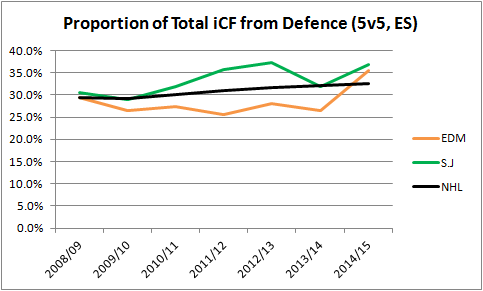
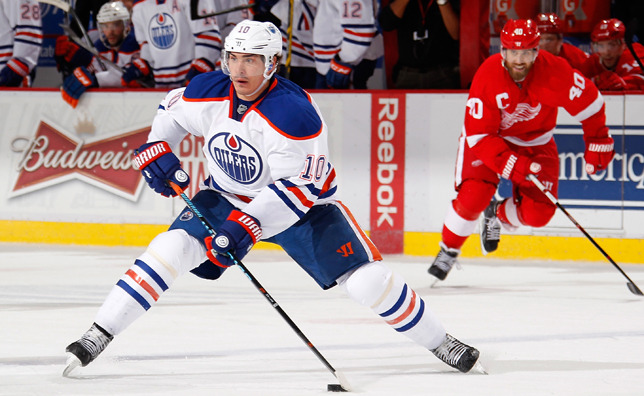
We know the Sharks have been a strong possession team under McLellan, typically out-shooting their opponents at even-strength. The Oilers have been the opposite, often trailing in games and still struggling to generate shot attempts.  Below we see that the Sharks defencemen generate a larger proportion of their teams shot attempts compared to the rest of the league, which kinda confirms what I’ve been seeing in their games (Source: War on Ice).

TM3-CF

There’s a drop in 2013/2014 for San Jose, which might be because I considered Burns a full time winger that season. Regardless, we can see the Sharks get a higher proportion of their total shot attempts from their defencemen than the Oilers. If you’re an Oilers defenceman heading into training camp, you have to be liking this. If McLellan can instill the same game plan he had in San Jose and have the team buy-in to the system, there’s a good chance defencemen will be more involved in the play. I don’t think the Sharks had any big shooters, instead relying on simple shots towards the net that could lead to additional higher quality scoring chances.

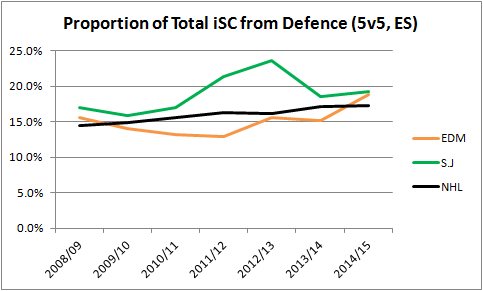
I decided to take it another step and see what proportion of the Sharks individual scoring chances came from defenceman when McLellan was head coach. Scoring chances are defined by War on Ice as:

  • In the low danger zone, unblocked rebounds and rush shots only.
  • In the medium danger zone, all unblocked shots.
  • In the high danger zone, all shot attempts (since blocked shots taken here may be more representative of more “wide-open nets”, though we don’t know this for sure.)

Below are the results.

TM3-SC

Again, the Sharks get a higher proportion from defencemen, which tells me that the Sharks not only got their defencemen shooting more often, but they often got set up to make an impact. You can see the Oilers scoring chances from the blueline has increased over the past three season. We’ll call this the Justin Schultz Effect.

We can take it even one-step further and see how often the Sharks defencemen got individual high danger scoring chances. Below are the results.

TM3-HSC

Justin Schultz has a lot of these, as demonstrated wonderfully by Travis Yost, which is why he’s often caught up-ice, leading to an odd-man rush against. But it looks like the Sharks didn’t hesitate getting their defencemen involved in these high probability scoring chances either. I’ll have to dig in a little more to see which players in San Jose got to be involved here (my guess is Dan Boyle, who played in San Jose from 2008-2013) and how successful they were at converting on their chances.

This should be encouraging to someone like Justin Schultz who would probably love to continue getting regular deployment and the  sweet zone starts . We can’t say for sure that McLellan will rely on his defenceman the same way he did in San Jose when it comes to shot attempts and scoring chances. But we can at least start to see where he had success and the type of players he relied on to be a strong regular season team.

Talking Oilers, Powerplay, Shooting Options and Defence on Lowdown with Lowetide

I joined Lowetide on Thursday morning to discuss the Oilers and some of their shooting options up front. Here’s a link to the audio. Worth checking out Lowetide’s article that frames the discussion first.

Couple notes:

  • It’ll be interesting to see how the team adapts to Todd McLellan, who knew how to generate shot attempts when he was with San Jose. If you’re interested, I’ve also begun looking at how often those shot attempts would get through and how good the team was at blocking shots. A bit of a work in progress, but any feedback is welcome.
  • Highly recommend reading Jonathan Willis’ article that looks at how McLellan ran the powerplay in San Jose.
  • My case for bringing back Shawn Horcoff can be found here: Part I, Part II, and, yes, Part III. I also looked at bringing in Mike Santorelli over at Copper & Blue. Oddly enough, the Anaheim Ducks picked up both players for cheap and solidified their bottom six. I still think the Oilers need a veteran centerman that can give guidance to the young wingers and move up the line up in case of injury.
  • I mentioned the passing data collected by Ryan Stimson from In Lou We Trust. I compiled the information on Oilers defenceman here, and included a chart on Andrej Sekera. He’s one of the best at making passes that lead to a controlled zone entry.
  • I really do think Nikita Nikitin can bounce back. More on that over at Copper & Blue.

Thanks again to Lowetide for having me on. Always enjoy chatting with him.

Sharks Under McLellan II

ThorntonI recently started looking at some of the underlying numbers the Sharks posted with McLellan behind the bench, mainly to get a sense of what we can expect next year from the Oilers. Without a doubt, McLellan is one of the elite coaches in the NHL, leading San Jose to a lot of regular season success.

What we know so far is that his club’s have been strong possession teams that took a lot of shots. The other day, I also found that his teams blocked a lot of shot attempts against, which shouldn’t be surprising considering some of the strong two-way players on the roster like Marc-Édouard Vlasic and Joe Pavelski.

I also started digging into how often the Sharks had their shot attempts blocked. Having re-watched some of their games from last season, it became obvious to me that the Sharks love taking shots as soon as they enter the zone and look for second chances. They make a lot of short passes moving up-ice and really don’t let the opposition set up defensively, creating a lot of havoc.

Here’s a graph showing what percentage of the Sharks’ shot attempts (i.e., Corsi For) were blocked when the score was close during McLellan’s tenure. I also included the NHL average as well as the Oilers performance.

CorsiForBlockedScoreClose

What we can see here is that the Sharks were quite good at getting their shot attempts through. It could be that the team was good at setting up their plays and creating smart lanes to the net. It also confirms what I saw in some of their games: the Sharks were getting their shots in quickly before the opponent could set up, increasing their chances of their shot making it through.

On the flip side, you can see that the Oilers were brutal at getting their shot attempts through and were often one of the worst in the league when the score was close. This will be area that McLellan has to focus on, but it’s anyone’s guess if the current Oilers roster can handle the new attack plan.

I don’t think it’ll be as easy as just shooting more often. The plays that a team uses to advance the puck through the neutral zone and then gaining the zone will one of the critical factors. The good news is McLellan has a successful formula, but it’ll be up to him to deploy the right players at the right time to execute those tactics.

Sharks Under McLellan

oilers-sharks-14-12-09aBringing in an elite level NHL coach is going to go a long way in turning this franchise north. The addition of Todd McLellan and his coaching staff, along with the continued development of the young core, is worth getting excited for heading into the 2015/16 season.

Over the past seven years, McLellan posted some very nice possession numbers, as the Sharks consistently out-shot their opponents and won a lot of regular season games. One thing to note is that the Sharks were a bit of a high event team when it came to shot attempts. In the last four years, the Sharks finished in the top four when it came to the total number of Corsi events (for and against) per 60 minutes at even-strength (score adjusted).

San Jose Sharks (Even-strength, Score adjusted)
Metric 2008/09 2009/10 2010/11 2011/12 2012/13 2013/14 2014/15
CF% 55.1
(5th)
51.6
(11th)
54.5
(1st)
51.9
(9th)
51.4
(11th)
54.6
(4th)
51.5
(14th)
CP60 98.8
(27th)
104.9
(16th)
107.3
(13th)
107.9
(4th)
107.3
(8th)
109.8
(4th)
110.6
(3rd)
Shot Attempts Blocked 23.2%
(19th)
21.4%
(29th)
25.3%
(15th)
27.5%
(4th)
26.6%
(10th)
26.6%
(5th)
26.2%
(9th)

I don’t think this is too concerning since they would still win a lot of games  (except for the most recent year). What’s also worth noting is that the Sharks blocked a high percentage of shot attempts against, typically finishing in the top 10 league-wide.

Team - SA Blocked

What does it all mean?

What I’m thinking is that the Sharks block a high percentage of shots because they cut off passing lanes and forced teams to take weaker shot attempts that the defenceman anticipated. And when they’re on the offensive, they’re either shooting early or finding their shooters and getting as many pucks towards the net as quickly as they can.

Watching the Sharks beat the crap out of the OIlers every year, I’ve noticed that they never have a lot of pinching defenceman and quite often let their forwards shoot the puck on net as soon as they enter the zone. If McLellan brings along some of his set plays, we should see the centers take on a more prominent role and have defenceman playing, you know, defence. If McLellan had his players blocking a high percentage of shot attempts against, it’s likely because players stay in position and read the play.

The Oilers have historically been a high event team but for the wrong reason. It’ll be interesting to see how McLellan will generate shot attempts and which players he’ll rely on to drive the play. And if he is successful, we should expect the Oilers blocking a higher percentage of shot attempts than they have done in the past. It’s obviously a big part of McLellan’s game plan, so I’d expect to see it happen in Edmonton.

We know that the Oilers have really lacked some of the key fundamentals to being a decent possession team. A combination of poor roster construction (especially on defence) and weak coaching tactics have made the Oilers an easy team to play against. With McLellan behind the bench, we should see an improvement in the team’s possession metrics and (hopefully) see the results on the score sheet and standings. This will of course depend on how well the current group of prospects develop, especially when it comes to defence.

Curious to hear what others think and what tactics/plays we should expect next season with McLellan. This will likely be part one of a series of post as I dig into the numbers and get a better sense of McLellan’s coaching style. Feel free to leave a comment below or send me an email at sunilagni23@gmail.com.

Developing and Deploying Youth on Defence

There’s a good chance that the Oilers will have a lot of youth on defence next season. Both Oscar Klefbom (22) and Justin Schultz (25) will definitely be on the opening night roster. Darnell Nurse (20) and Griffin Reinhart (21) will be in the mix, while prospects like Jordan Oesterle (23), David Musil (22) and Brandon Davidson (24) hope to leave an impression as well. That’s a lot of youth pushing for roster spots on defence, something that Todd McLellan didn’t really have to deal with during his seven seasons as head coach of the San Jose Sharks.

Now this isn’t to say that McLellan has no experience with developing defenceman. Three players, in fact, were young and inexperienced during McLellan’s tenure in San Jose, and have since established themselves as regular defenceman: Marc-Edouard Vlasic, Justin Braun and Jason Demers.  To get a sense of what McLellan might do with the Oilers defence this coming season, I thought it’d be interesting to dig into these three players to see how they were brought along and how well they performed under McLellan’s tutelage.

Full article is at The Copper & Blue.

Talking Oilers Defence on Lowdown with Lowetide

Had a chance to discuss the Oilers defence with Lowetide this morning on TSN 1260. We talked about my recent article at the Copper and Blue where I used passing data to assess the Oilers defence. Below is a link to the audio.

Couple notes:

.Many thanks to Al for having me on and the kind words. Always enjoy chatting with him.

Bringing Back Horcoff (Part 3)

C7G6458_slideI should probably change the name of this post, as Horcoff has officially signed with the Anaheim Ducks for one year at $1.75 million. But since this ties in with Part 1 and Part 2, I’ll leave it as is.

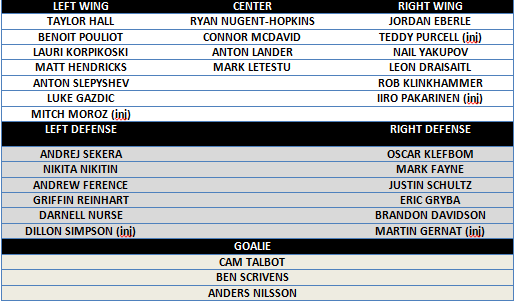
Once the Oilers acquired winger Lauri Korpikoski for Boyd Gordon, I figured there’d be no chance of Horcoff returning. The Oilers left wing roster chart was filled before the free agency window opened with Hall, Pouliot, Hendricks, Pakarinen and now Korpikoski signed to play next season. Horcoff had success as a center for the Oilers, but in his past two seasons, he’s been primarily a winger in Dallas.

The Ducks, it appears, have signed him as a centerman. Their left wing roster already has Perry, Maroon, Sekac and now Hagelin who was acquired from New York. Down the middle is where they’ll likely use Horcoff as Nate Thompson is out until December. Ahead of him will be Getzlaf, Kesler and young Rickard Rakell, who the Ducks are probably looking to develop over the next year as he heads into restricted free agency.

It’s obvious Horcoff really wanted to join a cup contender for next season, which is fair considering his age. He’s likely to start as the third/fourth line center until December when Thompson comes back, and then be fighting for a roster spot.. It’s a good, low risk signing for the Ducks, who have added experience to their roster and have flexibility setting their lines.

It’s worth noting that the Ducks replaced Beleskey’s production on left wing with relatively cheaper options in Horcoff and Hagelin, who were both productive last season for Dallas and New York, respectively. (Oddly enough, Beleksey appeared in my list of comparables in my last post on Horcoff). Here’s how all three did at even-strength, when the score was close (Source: War on Ice).

2014-2015, Even-strength, Score Close
Statistic M. Beleskey (ANA)
LW
S. Horcoff  (DAL)
LW/C
C. Hagelin  (NYR)
LW
Games 65 76 82
Goals 12 5 10
Assists 7 11 12
Points 19 16 22
TOI/Game 7.65 6.20 7.70
Points/60 2.29 2.04 2.09
Player Shooting % 15.79 12.20 11.36
Zone Starts (Offensive)% 51.44 50.55 48.44
ZSO%Rel 2.54 0.11 -2.30
Corsi For% 53.22 53.13 49.21
CF%Rel 3.09 1.02 -0.72
Scoring Chances For% 53.85 57.08 48.43
SCF%Rel 2.46 4.79 -2.46
Shots For% 51.22 52.20 49.92
SF%Rel 0.47 0.04 -1.27

Not bad potential replacements, considering the cost. Hagelin played mostly with JT Miller and Kevin Hayes in New York, and my guess is he’ll play with Kesler and Silfverberg, who were often Beleskey’s linemates (Source: Hockey Analysis). Haglelin had slightly more points this past season, but his possession stats and shot-share don’t show too well. Horcoff is definitely nearing the end of his career, but he’s a nice option for the Ducks who should be at the top of the division again this season.

Thoughts on the OIlers: Draft, Reinhart, Talbot, Marincin

Source: Hockey's Future

Source: Hockey’s Future

Lots to look forward to now that Connor McDavid is officially an Edmonton Oiler.

The actual announcement on Friday night was a little anti-climatic however, as the impact of McDavid’s impending arrival was already felt weeks ago. Soon after the Oilers won the lottery, the club improved their front office with the additions of Nicholson and Chiarelli. And behind the bench, they quickly moved to bring in one of the top coaches in the game in McLellan. I thought it would have been nice to have Wayne do the official announcement, but the release of the new third jersey made up for everything.

As for the rest of the draft, I’m still battling with a few things.

Leading up to the draft, it felt like the Oilers were progressing and were going to be different than years past. But over the draft weekend, a few moves were made that gave me flashbacks to the past nine years. We’re coming off some bad, bad management eras. And over these years, a lot of questionable deals went through, most of which fans knew were terrible the day they were announced. I’ll touch on this a bit more in the post.

Here we go.

Reinhart

The deal for Griffin Reinhart was an absolute over payment. I think he’s a good young prospect who definitely has a legitimate chance of becoming an NHL player. My issue is that he likely won’t be a full-time NHL player in the next year or two. I realize the Oilers will likely push him into the roster anyways, but the fact remains that NHL defencemen take a long time to develop. The two picks that the OIlers gave up should have been used to get an established top four defenceman who you could pencil in to your roster for the 2015 season. Another reason why I don’t like this deal is because it gave me flashbacks to the Tambellini era. If I recall correctly, the Oilers really wanted Reinhart in 2012 (thanks Oil Change). Plus Tambo took a gamble on another high pick in Cam Barker in 2011. Brutal.

There had to have been teams that wanted the 16th pick, considering some of the major talent available there. It does appear that the Oilers really had their second first-rounder and their second rounders earmarked for a player chasing Hamilton earlier and settling on Reinhart. That to me is encouraging. It’s just too bad they still haven’t solidified any component of their defensive unit with this acquisition.

Marincin

Once the Reinhart deal went down, I knew it was the end of the line for our boy Marincin. The young Slovak has progressed nicely as an Oiler, really showing well early on in his career. The Oilers did a very nice job bringing him along, letting him develop at the AHL level under Todd Nelson’s staff and giving him a shot at the NHL level. He took on a lot of tough competition for a 22-year old, and still managed to hold his own. He’s a rangy guy that broke up plays and did a lot of good things on the ice.

Seeing this deal go down made me think back to MacTavish’s track record dealing with defencemen. For whatever reason, this club has a hard time developing defencemen. And when they get it right, they have no idea how to retain them. Plus, the club picked up a former Marlie, which made me think back to the Acton, Fraser and Aulie acquisitions that all failed.

What annoys me is that it was the Leafs that were smart enough to see his potential and acquire him for next to nothing. Toronto has a strong management team in place with analytics experts. They also made a few of those 2-for-1 draft pick deals, which demonstrates their understanding of pick values. They’re obviously in rebuild mode, but I’m fairly confident they’ll turn it around if they keep making smart moves like these ones.

Talbot

Absolutely loved this deal.

I originally thought Talbot would be a good fit for the club as he did well as a backup and I figured he’d come cheap, I poked through his numbers and felt he’d be a bit of a gamble, and maybe they club might rather keep Scrivens as the “goalie-with-potential” and add someone like Brian Elliott through trade or sign Enroth or Neuvirth through free agency.

Of course, all my thoughts went into a spiral when Darcy “Woodguy” McLeod put together a case for acquiring Talbot, while Bruce McCurdy put a nice argument for Eddie Lack. And when rumors swirled about the acquisition cost going up (something about a first rounder), I started looking at other expensive options like RFA Jonathan Bernier. I’m just glad the Oilers landed a good goalie for lower draft picks.

I seriously learned a ton about goalies during this whole discussion on who the Oilers should acquire. It was also a fantastic example of how strong of a discussion you can have when data is available. I know most of us are using War on IceHockey Analysis and others, which is great. But if the NHL wants their fans to drive discussion, and in a way promote the game, they have got to take a serious lead in collecting and providing accessible, high quality data. Work with the existing companies if you have to. Just collect as much as data as possible and get the data out there and keep it free.

Recommended Links

Harvest Moon 2015 – Lowetide

Meet the Newest Edmonton Oilers – The Copper and Blue

What do the Edmonton Oilers Come Away With From the 2015 NHL Draft? – Cult of Hockey

Tangled Up in Blue – OilersNation

Bringing Back Horcoff (Part 2)

_C7G6458_slideLast week I put together a short case on Shawn Horcoff and how he could potentially help the Oilers next season. Over the past two years in Dallas, Horcoff played fewer minutes than he did as an Oiler and took on weaker competition. Last season, Horcoff notched 29 points, with 22 coming at even-strength. He was a decent possession player at even-strength (52.68 Corsi For%, +0.73 CorsiRel), despite having fewer offensive zone starts relative to his teammates. He played mostly wing, but finished 6th on the team in faceoff attempts (going 50.2%), meaning he did play center as needed.

Thanks to War on Ice, we can dig into those 22 even-strength points a little more and see in what score situations (i.e., whether the game was tied or if a team was leading) Horcoff got his points. Before digging into his individual production, it’s worth looking into how his team did last season.

The Stars finished with a respectable score-adjusted Corsi of 52.4%, which was 9th overall in the league. Goaltending appears to have been an issue for them as their keepers finished with the third worst on-ice save percentage at even-strength, finishing ahead of only the Oilers and Hurricanes. Here’s a quick snapshot of their Corsi For% at different score situations, and NHL rank (Source: Puck on Net):

Dallas Stars (2014-15, Even Strength)
Down 2 Down 1 Tied Up 1 Up 2
Time Spent Corsi Time Spent Corsi Time Spent Corsi Time Spent Corsi Time Spent Corsi
10.6% 62.9
(1st)
18.9% 60.1
(4th)
33.8% 51.6
(13th)
21.9% 45.7
(18th)
14.8% 43.2
(17th)

So what we know is that the Stars were a good possession team that did well when the game was tied or when they were down a goal. What might get overlooked is which forwards on the roster produced at different times of the game. Here’s a summary of how Horcoff produced at different score situations.

Shawn Horcoff (2014-15, Even Strength)
Situation TOI % of Total TOI Points P/60 Corsi For % Corsi Rel
Down 2 52.36 7.5% 3 3.44 61.68 0.05
Down 1 143.14 20.6% 6 2.51 60.8 1.61
Tied 255.92 36.9% 8 1.88 55.43 3.82
Up 1 171.4 24.7% 2 0.70 45.05 -1.22
Up 2 71.66 10.3% 0 0.00 41.96 -6.17

Couple things to note here. Among the Stars forwards who played a minimum of 200 minutes, Horcoff had the best CF% and Corsi Rel when the game was tied. He also had fewer offensive zone starts compared to his teammates, but still managed to produce at a third line level. When the team trailed by one or two, in the limited minutes he played, he finished in the top three when it came to points/60.

If we look at how Horcoff produced when the game was close at even-strength, as in the game was tied or within one goal in the first or second period or tied in the third, we see a few more interesting numbers.

Shawn Horcoff (2014-15, Even Strength)
Situation TOI % of Total TOI Points P/60 Corsi For % Corsi Rel
Close 471.42 67.9% 16 2.04 53.13 1.02

So 16 of Horcoff’s 22 even-strength points came when the game was close. He produced at a very nice clip and held his own possession wise in this situation, with fewer offensive zone starts. Among his teammates playing forward, he finished 6th in points/60 and Corsi For%. Not too shabby for a 36 year old, bottom six forward.

Here’s a list of players who played between 450 and 500 minutes when the score was close, had fewer zone starts and produced more than 2.00 points/60.

Horcoff Comparables (2014-15, Even Strength, Score Close
Name TOI P P60 CF% CF%Rel ZSO%Rel
V. Fiddler (DAL) 491.02 19 2.32 50.63 -2.04 -8.26
J. Fontaine (MIN) 472.39 18 2.29 49.40 -1.66 -10.32
M. Beleskey (ANA) 497.11 19 2.29 53.22 3.09 2.54
S. Horcoff (DAL) 471.42 16 2.04 53.13 1.02 0.11
C. Sceviour (DAL) 456.07 18 2.37 53.00 0.16 -1.92
J. Beagle (WSH) 456.69 16 2.10 52.48 1.01 -7.21

I guess we shouldn’t be too surprised that Horcoff’s linemates (who always did better with him) made the list.  But so too did an unrestricted free agent that will likely cash in on a heavy, long term deal. Beleskey is definitely much younger, but I find it interesting that his production when the score was close is quite similar to that of Horcoff’s.

Thoughts

The Oilers will definitely need to acquire depth at center this off-season, as an injury to RNH, Lander or Gordon would be absolutely devastating to the club. McDavid and Draisaitl are on their way, but we won’t know until training camp if they’ll start the season on wing and ease their way into center. It’s a tough position to play, and the Oilers can use all the experience they can find to help the prospects along. Horcoff would be a good candidate as he can start on the wing and move to center as needed. He shouldn’t be an expensive acquisition and I’m sure if the Oilers don’t sign him, he’ll be picked up by another club this summer.