Quality Starts Percentage

neuvirth

Adjusted Save Percentage, developed and published by War on Ice, is a very well thought out stat, and I’ve relied on it heavily the past few weeks looking at goalies. Darcy put together a fantastic post recently that looked into the history of the available goalies and found some interesting stuff. Highly recommend checking out his assessment.

I decided to use Darcy’s list of goalies and focus on their percentage of Quality Starts over the past five years. I’ve also included the number of games started in parentheses. Please note, QS% relies on traditional save percentage data (not adjusted) and factors in all situations (even-strength, powerplay, penalty kill).

From Hockey Abstract:

In order to record a Quality Start, the starting goalie must stop at least a league average number of shots (typically 91.3% prior to 2009-10, and 91.7% since), or play at least as well as a replacement-level goalie (88.5%) while allowing two goals or fewer.

The average QS% is 0.530, with anything lower than 0.500 being pretty bad. Having a QS% above 0.600 is very good (Source: Hockey Reference). More on Quality Starts can be found on Habs Eyes on the Prize.

Unrestricted Free Agents
Player Age 2010/11 2011/12 2012/13 2013/14 2014/15
Antti Niemi 31 0.617 (60) 0.529 (68) 0.674 (43) 0.469 (64) 0.542 (59)
Devan Dubnyk 28 0.545 (33) 0.548 (42) 0.541 (37) 0.355 (31) 0.685 (54)
Jhonas Enroth 26 0.538 (13) 0.682 (22) 0.778 (9) 0.538 (26) 0.429 (42)
Karri Ramo 28 0.514 (37) 0.452 (31)
Michal Neuvirth 26 0.477 (44) 0.500 (30) 0.583 (12) 0.692 (13) 0.531 (32)
  • Antti Niemi is a good to average goalie, but he’s too old at this point to invest in. He’ll get paid this summer, but I don’t expect him to get better with age..it just does not  happen.
  • Look at that: Dubnyk was right around the average QS% until that horrendous 2013/14 season. Glad to see he has bounced back.
  • Jhonas Enroth has done well historically, but his value may have taken a hit this past season. This guy has to be a legit target for a number of teams.
  • Ah, and there’s our good friend Michal Neuvirth. He’s only 26 and has put up some nice numbers over the past three years but hasn’t started a lot.
Goalies Under Contract Who Could Be Acquired
Player Age 2010/11 2011/12 2012/13 2013/14 2014/15
Antti Raanta 25 0.545 (22) 0.667 (12)
Ben Scrivens 28 0.455 (11) 0.588 (17) 0.629 (35) 0.373 (51)
Brian Elliott 29 0.333 (51) 0.778 (36) 0.600 (20) 0.600 (25) 0.600 (45)
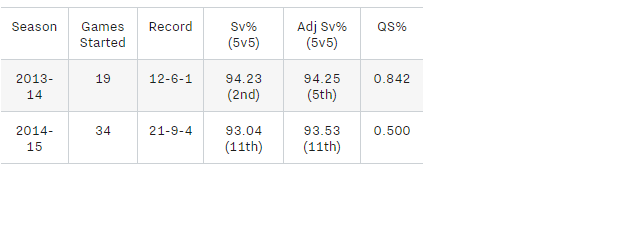
Cam Talbot 27 0.842 (19) 0.500 (34)
Corey Crawford 30 0.618 (55) 0.491 (55) 0.679 (28) 0.554 (56) 0.696 (56)
Craig Anderson 33 0.592 (49) 0.567 (60) 0.708 (24) 0.500 (52) 0.571 (35)
Jimmy Howard 30 0.476 (63) 0.614 (57) 0.619 (42) 0.500 (50) 0.531 (49)
Jonas Hiller 32 0.565 (46) 0.542 (72) 0.56 (25) 0.540 (50) 0.512 (43)
Jonathan Bernier 26 0.636 (22) 0.462 (13) 0.667 (12) 0.612 (49) 0.481 (54)
Jonathan Quick 29 0.617 (60) 0.632 (68) 0.556 (36) 0.531 (49) 0.58 (69)
Kari Lehtonen 31 0.559 (68) 0.610 (59) 0.600 (35) 0.563 (64) 0.462 (65)
Martin Jones 25 0.722 (18) 0.455 (11)
Robin Lehner 23 0.200 (5) 0.800 (5) 0.833 (12) 0.633 (30) 0.458 (24)
  • I included Ben Scrivens since he’s penciled in, at this point, to be the backup next season.
  • Guys like Annti Raanta and Martin Jones have talent, but just haven’t had enough experience, in my opinion, to make a reasonable bet on.
  • Brian Elliot has been pretty steady when it comes to QS%, but his adjusted save percentages have been all over the map historically.
  • Crawford, Howard, Lehtonen and Anderson are getting up there in age, but they’ve been playing well recently. Their current clubs are going to have to make changes because of the cap, making for an interesting off-season.
  • Jonathan Bernier is another interesting goalie. He’s put up decent numbers and is only 26. He’d be at the top of my wish list.
  • Robin Lehner is another good, young prospect, but I’d be concerned about his health as he’s recovering from a significant concussion. At this point, the Oilers need a legit starter or someone that has enough experience to push for a starting position. Worth noting that he along with Devan Dubnyk and Eddie Lack were impacted by the rule changes around stick length in 2013.

Between what I’ve read and what Darcy has put together, I really don’t know what to think anymore. I’d stick with Scrivens as the backup as I think he can bounce back, similar to other goalies in the past. The starting position has to go to someone that’s in their prime (26-30) and has at least 300 games of NHL experience. I don’t like the idea of over spending on goaltending, so Niemi, to me, is out of the question. If a trade can’t be made to acquire someone like Corey Crawford or Jonathan Bernier, the Oilers may have to push hard for Devan Dubnyk or sign Michal Neuvirth or Enroth to value contracts. Lots of options, so here’s hoping Chiarelli takes a “measured approach”.

Goalies and Voodoo Magic

Jan 29, 2014; Edmonton, Alberta, CAN; Edmonton Oilers goalie Ben Scrivens (30) stops a shot during the third period against the San Jose Sharks at Rexall Place. The Oilers won 3-0. Mandatory Credit: Candice Ward-USA TODAY Sports ORG XMIT: USATSI-138256 ORIG FILE ID:  20140129_lbm_wb4_281.JPG

Without a doubt, one of the weakest links of the Oilers in 2014/2015 was the goaltending. Both Scrivens and Fasth failed to lock down the starter position, finishing the season with adjusted save percentages in the bottom five (goalies who played 20 games or more).

One thing we know about goalies is that a  lot of voodoo is involved. One season, a goalie can be terrible and the next, he’s winning games in the playoffs. One could argue that even assessing goalies involves a lot of guess work and truthiness, as a lot of factors come into play. Which team is the goalie on, how does the team do possession wise, does the team have a strong defensive core, and so forth.

I really want to believe that Scrivens can bounce back. After a good college and minor league career, he had shown well in his NHL career. Unfortunately, things went sideways this past season, but I don’t think we can write him off just yet.

To make a case, I first looked at how he measures up against the average adjusted save percentage (at even-strength) among goalies who played 20 or more games. And secondly, I looked for other goalies who may have had a rough season (or two) and bounced back.

Performance

Let’s start off with Ben Scrivens’ history.

Season Team Gm Age GP W L T/O QS% AdSv%
2011/12 TOR 12 25 12 4 5 2 0.455 91.66
2012/13 TOR 20 26 20 7 9 0 0.588 92.33
2013/14 EDM/L.A 39 27 40 16 16 4 0.629 93.43
2014/15 EDM 57 28 57 15 26 11 0.373 90.88

This past season stands out as his worst in terms of adjusted save percentage (at even-strength) and the number of games he gave his team a chance to win (QS%). His adjusted save percentage, which factors in the quality of shot (low, medium, high danger), as well as his save percentage of high danger shots at even strength, was well below average.

Line-BenScrivens

Last season, and the year prior, he was alright when it came to adjusted save percentage at even strength…right around the average. His save percentage when it came to high danger shots at even-strength were slightly above average two seasons ago, and not too far off the average last season. I should also note that his save percentage when it came to high danger shots was at 82.96 when Eakins was head coach in 2014/2015, and 79.82 when Nelson was head coach. Scrivens’ adjusted save percentage did not change after goaltender coach Freddie Chabot was fired, but his high-danger save percentage went from 83.84 under Chabot to 79.92 under Schwartz (Source: War on Ice). Maybe it was the team tactics under one coach or the fact that Petry was dealt at the deadline, I’m not sure. But those are all factors at play here.

Comparables

In a previous post, I used the percentage of quality starts to find other goalies who had terrible seasons, similar to Scrivens. Goalies that also had QS% below 0.400 since 2007 include well-established netminders like Brian Elliott, Mike Smith, Devan Dubnyk and Semyon Varlamov (Source: Hockey Abstract). I decided to graph each goalies adjusted save percentage compared to the average as well as their high-danger save percentage along with the average. Again, this is for even strength situations and includes netminders who played 20 or more games in a season.

Line-BrianElliott

Line-MikeSmith

Line-DevanDubnyk

Line-Varlamov

Couple notes:

  • I think it goes without saying that goalies can be hard to predict. But when goalies have a bad season, they typically bounce back the following year.
  • Man, Elliott and Smith are all over the map.
  • Our boy Devan Dubnyk was trending well before he had that bad season in 2013/2014. So happy to see him bounce back and get recognized for his accomplishments.

Thoughts

Ben Scrivens has a lot of work to do this summer if he wants to get back to an acceptable performance level. He’s in the last year of a two-year contract and will likely be in the AHL next season if he has another sub-par season. There are only so many roster sports for netminders.

The good news is other goaltenders have had seasons with a QS% below 0.400 but have managed to bounce back and maintain employment at the NHL level. These goalies have also seen their adjusted save percentages take a hit throughout their careers, but have still managed to remain as starters in the NHL. At the end of the day, it’ll be up to Scrivens to put this past season behind him, make the right adjustments in the off-season and put together a solid campaign as an Edmonton Oiler. The club would be wise to assign him the backup role, but I really think he could push for that starter position in 2015/2016.

Goalies with Potential

Source: Edmonton Oilers

Source: Edmonton Oilers

I’m of the mindset that having a young goalie with starter potential would be a smart move by the Oilers. Initially, I thought a goalie like Cam Talbot or Martin Jones, who are currently serving as backups, would be smart acquisitions, similar to how the Leafs acquired Jonathan Bernier in June of 2013 for a second round pick. If a goalie has been successful at the AHL level and has shown well in a limited role at the NHL level, that to me is good enough to warrant at least an assessment.

Alex Thomas, who does excellent work at the Oilers Rig, recently put a case together for acquiring Cam Talbot from the Rangers. The 27 year old played well while Lundqvist recovered from an injury. But his stats and style of play, to me, aren’t anything outstanding. In fact, his numbers at the NHL level and other leagues are somewhat similar to that of current Oilers netminder Ben Scrivens.

Here’s their NHL seasons to date. (Source: Hockey Reference)

Cam Talbot
SEASON TEAM LEAGUE GP W L OT  PCT SO
2013-14 NY Rangers NHL 21 12 6 1 0.941 3
2014-15 NY Rangers NHL 36 21 9 4 0.926 5
Ben Scrivens
SEASON TEAM LEAGUE GP W L OT PCT SO
2011-12 Toronto NHL 12 4 5 2 0.903 0
2012-13 Toronto NHL 20 7 9 0 0.915 2
2013-14 Total LA/Edm NHL 40 16 16 4 0.922 4
2014-15 Edmonton NHL 57 15 26 11 0.890 1

Here’s a summary of each netminders overall stats by league:

Cam Talbot
LEAGUE GP W L OT MIN. PCT SO
NHL 57 33 15 5 3306 0.931 8
AHL 116 54 52 5 6611 0.914 8
ECHL 2 1 0 1 122 0.921 0
CHA 70 15 44 3861 0.909 2
Ben Scrivens
LEAGUE GP W L OT MIN. PCT SO
NHL
129
42
56
17
7135
0.905
7
AHL 94 49 34 7 5547 0.923 8
ECHL 13 10 3 0 779 0.938 0
ECAC 117 65 37 6708 19

Both goalies have come through the college ranks and have performed well at the AHL level. There’s no denying that they both have potential to be decent at the NHL level. The issue for Oilers fans is that Scrivens faltered badly last year in his first real attempt to be a starter, while Talbot appears to be ready for his first shot.

In my opinion, if you want a “goalie with potential” for next season, stick with Ben Scrivens. Two reasons:

One, Scrivens won’t cost you anything. He”ll make a very reasonable $2.3 million next year becoming a free agent in July of 2016 (Source: NHL Numbers). Talbot, on the other hand, will likely cost the Oilers either a draft pick or a young prospect in return. Goalies are not worth first round picks. And goalies are not worth high end prospects like Nail Yakupov. Nothing of that calibre should be in play. Goalies should never command that kind of return as there are a limited number of goalie jobs and more than enough professional goalies available. If the price for Talbot is high, the Oilers could always consider trading for similar “starter potential” goalies like Martin Jones, Antti Raanta or Andrei Vasilevskiy. But it’d be much wiser to spend existing assets on positions that are harder to fill such as defence.

Secondly, I’m fairly confident that Scrivens will bounce back from his horrific 2014/2015 season. Good to average goalies like Scrivens are susceptible to bad seasons, and typically get back to their standard level of performance soon after. We know Scrivens can play at the AHL level and he has done well in the three seasons prior at the NHL level.

One stat that’s worth paying attention to is the percentage of quality starts. Here’s a summary of the metric from from Habs Eyes on the Prize:

A Quality Start (QS) is a goaltending statistic that is awarded to a goaltender who gave his team a reasonable chance to win a game. This is quantified by the goaltender’s save percentage within an individual game itself and comparing it to the league standards for an average SV%, and the established ‘replacement level’ SV% if the goalie faces a low amount of shots faced in a given game (usually less than 20). If a goalie outperforms the league average save percentage, he is awarded a quality start. Additionally, a goalie is awarded a quality start if he allows 2 goals or less while keeping his save percentage above the expected performance of a replacement level goaltender.

Scrivens finished with a QS% of 0.396 this past season, which was second last among goalies who played a minimum of 20 games. In last place: Victor Fasth at 0.375. The league average for goalies is around 0.530. Worth noting that Scrivens has had a respectable QS% in the past. (Souce: Hockey Abstract).

Ben Scrivens
Season Team GS SV% QS%
2011-12 Toronto 11 0.9063 0.455
2012-13 Toronto 17 0.9116 0.588
2013-14 LA/Edmonton 35 0.9262 0.657
2014-15 Edmonton 53 0.8879 0.396

The good news is that other good goalies have had horrific seasons similar to Scrivens’ 2014/2015 campaign. Of those that finished with a QS% below 0.400 since 2007, the vast majority have bounced back and managed to have decent careers. A few of the notables.

Brian Elliott
Season Team GS SV% QS%
2007-08 Ottawa 1 0.9655 1.000
2008-09 Ottawa 30 0.9024 0.500
2009-10 Ottawa 48 0.9100 0.563
2010-11 Ottawa/Colorado 51 0.8940 0.333
2011-12 St. Louis 36 0.9401 0.778
2012-13 St. Louis 20 0.9034 0.600
2013-14 St. Louis 25 0.9237 0.640
2014-15 St. Louis 45 0.9170 0.578
Cam Ward
Season Team GS SV% QS%
2007-08 Carolina 67 0.9042 0.567
2008-09 Carolina 68 0.9158 0.618
2009-10 Carolina 45 0.9162 0.556
2010-11 Carolina 73 0.9223 0.589
2011-12 Carolina 68 0.9151 0.559
2012-13 Carolina 16 0.9075 0.438
2013-14 Carolina 28 0.9004 0.393
2014-15 Carolina 50 0.9085 0.560
Devan Dubnyk
Season Team GS SV% QS%
2009-10 Edmonton 16 0.8870 0.313
2010-11 Edmonton 33 0.9155 0.545
2011-12 Edmonton 42 0.9172 0.548
2012-13 Edmonton 37 0.9199 0.541
2013-14 Edmonton/Nashville 31 0.8895 0.355
2014-15 Arizona/Minnesota 55 0.9300 0.673
James Reimer
Season Team GS SV% QS%
2010-11 Toronto 35 0.9202 0.571
2011-12 Toronto 34 0.9004 0.353
2012-13 Toronto 31 0.9235 0.516
2013-14 Toronto 32 0.9108 0.469
2014-15 Toronto 27 0.9056 0.444
Mike Smith
Season Team GS SV% QS%
2007-08 Tampa Bay 32 0.9040 0.469
2008-09 Tampa Bay 40 0.9151 0.625
2009-10 Tampa Bay 36 0.9035 0.389
2010-11 Tampa Bay 20 0.9021 0.500
2011-12 Arizona 66 0.9294 0.636
2012-13 Arizona 34 0.9104 0.441
2013-14 Arizona 61 0.9152 0.574
2014-15 Arizona 61 0.9044 0.475
Semyon Varlamov
Season Team GS SV% QS%
2008-09 Washington 5 0.9216 0.800
2009-10 Washington 23 0.9068 0.478
2010-11 Washington 25 0.9239 0.720
2011-12 Colorado 52 0.9125 0.577
2012-13 Colorado 33 0.9027 0.333
2013-14 Colorado 60 0.9284 0.733
2014-15 Colorado 57 0.9213 0.579

Obviously, each goalie had their own unique situation, and there are always 1,001 factors that impact goalie performance. But the general trend is that goalies who have a poor QS% one year, tend to bounce back soon after. Scrivens has his work cut out for him this summer if he wants to improve. But in my mind, the Oilers should retain him as their “goalie-with-potential” paired with an established netminder this coming season, and avoid sending away assets for guys like Cam Talbot.

Goaltending for the 2015-2016 Season

ranford-maskIssue: The Edmonton Oilers must solidify their goaltending for the upcoming 2015-2016 NHL season.

Background

The Oilers finished 28th this past season. allowing the most goals at even-strength, while finishing 26th in goals-for. Their Corsi-for (at even strength, score adjusted) was 47.3%, 24th in the league, while their percentage of scoring chances was 45.6%, ranking them 26th in the league.

Goaltending was a key contributor to the Oiler’s issues this past season. The tandem of Ben Scrivens (28 years old) and Victor Fasth (32) finished last in adjusted save percentage at even strength. Of the 48 goalies who played a minimum of 1,000 minutes in 2014/2015, Scrivens and Fasth finished 46th and 48th, respectively (Source: War on Ice). Below is a summary of their performance.

Age Games Save % (Adj) QS%
B. Scrivens 28 57 90.88 0.373
V. Fasth 32 26 90.36 0.417

Please note, adjusted save percentage takes into account the location of the shots faced by the goalie. Quality starts calculates what percentage of games the netminder gave his team a  chance to win (Source: Hockey Abstract). The league average is roughly 0.530.

Current Status

  • Scrivens has one year remaining on his contract with the Oilers, who will pay him $2.3 million in 2015/2016. Fasth will be an unrestricted free agent as of July 1, 2015, coming off a contract that paid him $3.4 million in his final season (Source: NHL Numbers).
  • The Oilers have the following goaltenders in their system:

Key Considerations

  • The salary cap will be increasing from $69 million to $71.5 million starting next season. Teams like Chicago, Boston, New York and St. Louis, who have players with sizable contracts, as well as prospects needing new contracts, may struggle with cap issues.
  • Goaltending does not have to be a large financial commitment to ensure success. Anaheim, Washington, Detroit and Tampa Bay were in the bottom five in terms of spending on goalies, and managed to make the playoffs this past season (Source: NHL Numbers)
  • Goaltending performance tends to decline with age (Source: Globe and Mail). According to one review, “goaltending development tends to peak around 23 and maintains in top form until 26” (Source Pension Plan Puppets).
  • The acquisition and eventual signing of Scrivens was based on his potential, as he had performed relatively well in LA and Toronto. There is a chance that Scrivens can bounce back next season and challenge for the starting position.
  • The Oilers have not established an NHL-calibre defence core for the 2015-2016 season yet. At the end of last season, Justin Schultz (23 years old) and Oscar Klefbom (20) were handling top pairing minutes, with the former struggling to produce despite the favorable deployment.

Option 1: Acquire an experienced goalie through free agency.
Risk: Low        Cost: Medium/High

To assess the options, I searched for the free agent goalies who played more than roughly 1,000 minutes and had respectable save percentages and/or quality starts. The cost of free agency is typically high due to the volatility of the market.

A. Niemi
Season Team Age Games TOI Save %
(Adj)
Save %
(High and Medium
Danger Shots)
QS%
2010/2011 S.J 27 60 2,813.8 93.45 88.84 0.617
2011/2012 S.J 28 68 3,166.2 93.25 88.62 0.529
2012/2013 S.J 29 43 2,034.5 93.08 88.14 0.674
2013/2014 S.J 30 64 2,949.1 92.37 86.78 0.469
2014/2015 S.J 31 61 2,899.2 92.83 87.17 0.542
M. Neuvirth
Season Team Age Games TOI Save %
(Adj)
Save %
(High and Medium
Danger Shots)
QS%
2010/2011 WSH 22 46 2,069.1 92.57 87.86 0.477
2011/2012 WSH 23 38 1,593.2 92.02 86.92 0.500
2012/2013 WSH 24 13 576.3 91.46 84.80 0.583
2013/2014 BUF/WSH 25 15 650.5 92.69 89.18 0.692
2014/2015 NYI/BUF 26 32 1,477.0 93.13 87.66 0.531
J. Enroth
Season Team Age Games TOI Save %
(Adj)
Save %
(High and Medium
Danger Shots)
QS%
2010/2011 BUF 22 14 619.3 92.94 86.25 0.538
2011/2012 BUF 23 26 1,098.0 93.13 89.46 0.682
2012/2013 BUF 24 12 490.5 93.7 89.93 0.778
2013/2014 BUF 25 28 1,241.1 93.45 89.78 0.538
2014/2015 DAL/BUF 26 50 2,302.4 92.34 87.33 0.429

Option 2: Acquire an experienced goalie through trade.

Risk: Medium        Cost: Medium/High

Because teams are either up against the cap or have an excess of capable goalies, established netminders may be available this summer, so it would be worth assessing the potential trade options. This option would require dealing existing assets, either players or draft picks, and may leave a gap in other areas of the roster.

C. Anderson
Season Team Age Games TOI Save %
(Adj)
Save %
(High and Medium
Danger Shots)
QS%
2010/2011 OTT/COL 29 51 2226.8 92.45 87.56 0.592
2011/2012 OTT 30 63 2724.6 93.02 87.64 0.567
2012/2013 OTT 31 24 1086.2 94.59 89.33 0.708
2013/2014 OTT 32 53 2321.2 92.85 88.06 0.500
2014/2015 OTT 33 35 1597.1 93.63 89.81 0.571
B. Elliott
Season Team Age Games TOI Save %
(Adj)
Save %
(High and Medium
Danger Shots)
QS%
2010/2011 COL/OTT 25 55 2362 90.96 83.33 0.333
2011/2012 STL 26 38 1737.8 94.73 91.29 0.778
2012/2013 STL 27 24 1029.8 92.68 87.79 0.600
2013/2014 STL 28 31 1293.8 92.29 87.92 0.600
2014/2015 STL 29 46 2021.7 92.83 88.84 0.600
C. Crawford
Season Team Age Games TOI Save %
(Adj)
Save %
(High and Medium
Danger Shots)
QS%
2010/2011 CHI 25 57 2686.5 93.46 89.09 0.618
2011/2012 CHI 26 57 2538.8 92.41 87.06 0.491
2012/2013 CHI 27 30 1372.1 93.98 89.39 0.679
2013/2014 CHI 28 59 2738.6 92.98 89.12 0.554
2014/2015 CHI 29 57 2676.9 93.83 88.73 0.696

Option 3: Acquire a goalie that has limited experience but has potential upside.
Risk: High       Cost: Low

This option would involve the most risk, and would involve extensive collaboration with the scouting department and possibly further data analysis. A number of unproven goalies have excelled in the right situation such as Ben Bishop (TB), Devan Dubnyk (MIN) and Jonathan Bernier (TOR). The key will be to keep the cost low and refrain from dealing high-end prospects or future first round picks.

C. Talbot
Season Team Age Games TOI Save %
(Adj)
Save %
(High and Medium
Danger Shots)
QS%
2013/2014 NYR 26 21 961 94.24 90.32 0.842
2014/2015 NYR 27 36 1689.5 93.51 89.65 0.500
M. Jones
Season Team Age Games TOI Save %
(Adj)
Save %
(High and Medium
Danger Shots)
QS%
2013/2014 L.A 23 19 862.3 95 93.2 0.722
2014/2015 L.A 24 15 626.5 92.31 87.84 0.455
A. Raanta
Season Team Age Games TOI Save %
(Adj)
Save %
(High and Medium
Danger Shots)
QS%
2013/2014 CHI 24 25 1115.1 90.59 84.35 0.545
2014/2015 CHI 25 14 659.5 94.54 90.8 0.667

Recommendations

The Oilers must solidify their goaltending in order to compete for the playoffs next season. This will be costly as the team lacks organizational depth, and has failed in developing a netminder on their own. The team must explore all options, including free agency and trade.

Having reviewed the options and the players available, it would be best if the Oilers moved forward with one established goalie, supported by a netminder that has the potential to be a starter. The team will have to keep the cost of goaltending low as the team must acquire defencemen this summer, likely through free agency.

Ben Scrivens is a good-to-average goalie with numbers to indicate that he has the potential to bounce back and possibly push for the starting position. It would not make sense, at this point, to acquire another goalie like Talbot or Martin, who are in a similar situation as Scrivens.

B. Scrivens
Season Team Age Games TOI Save %
(Adj)
Save %
(High and Medium
Danger Shots)
QS%
2011/2012 TOR 25 12 545.2 91.66 87.80 0.455
2012/2013 TOR 26 20 808.5 92.33 86.34 0.588
2013/2014 EDM/L.A 27 39 1728.3 93.43 89.59 0.629
2014/2015 EDM 28 57 2650.4 90.88 86.20 0.373

The Oilers must acquire a proven netminder such as Neuvirth through free agency, or Elliott through trade. Both Niemi and Crawford would be expensive acquisitions, with the former likely commanding a term that takes him to retirement. It may be beneficial for the Oilers to acquire a player that has familiarity with the western conference, and can handle a higher proportion of high-quality shots and scoring-chances against.

Whichever goalie the Oilers acquire must be placed in a position to succeed. The team must improve the defense by acquiring at least two established defencemen this summer and find an experienced coach that can maximize this teams potential. Moving forward the team has to establish a long term plan and developmental strategy for prospects to ensure that the club is not in this situation again.

The McDavid Effect

BklbK7ICQAEfipd

Source: TSN.ca

When Bill Daly turned the golden card, I honestly didn’t even hear the words (might have zoned out). I just saw the card and laughed maniacally for a good 15 minutes, frightening my kids in the process. I was happy to hear McDavid would be coming to Edmonton. But I was laughing at what the fallout would be for the roster, for the fans and for the city. And especially what the perception and outrage would be outside of Edmonton.

The negativity towards the team by outsiders is warranted. This team has been pitiful for almost a decade, so the thought of McDavid heading to a poorly managed organization will fire up a lot of people. And the negativity will grow similar to how the Penguins get taunted because they have Crosby and Malkin. The hate towards Edmonton is real folks, and it’s gonna get worse once McDavid in the lineup.

Getting a talented player like McDavid is going to put pressure on management to get their act together. Get a goaltender. Get a couple defencemen. And get a coach. Surround this “generational talent” with the right players, because the entry-level years are going to fly by. And like Darcy mentioned in the Lowdown with Lowetide roundtable, McDavid will be commanding good money once the three years are done, and it’ll be around the time that Hall and Eberle are finishing up their mega-contracts. The pressure will be from fans and from the entire league to ensure this player does well, so the Oilers have moved towards adding experience to the front office.

What the addition of McDavid also does is improve the Oilers chances of signing some free-agents who may not have considered Edmonton a possible destination. And the Oilers increased their chances even more by bringing in Chiarelli, who can leverage his network to connect with players, or even rival GMs if he chooses to go the trade route.

The roster will have to be revamped as soon as possible, pushing those that were MacTavish’s acquisitions (i.e., Schultz, Nikitin) towards the exit. I’m hoping that Chiarelli moves forward building off the success of the existing minor league program, and refrain from bringing in say, his Boston/Providence connections. Lateral moves, something that happened when Eakins was coach, really aren’t necessary.

Chiarelli as GM gives me a lot more confidence in Oilers management. He’s the first GM hired by the Oilers who has past experience as GM. Plus he has a familiarity, and a relationship, with managers across the league, something MacTavish was still in the process of building towards. I didn’t mind the hiring of MacTavish as I thought he’d be able to bring some new ideas and apply something from his graduate school experience. But really, he should’ve been placed in an assistant GM role first before making the jump. Similar to what Steve Yzerman did with Detroit before moving on to Tampa Bay.

A lot of changes have been made because of McDavid and the kid has yet to play a game. We’re already feeling the impact as fans, and I think there’ll be even more to come especially with player personnel  this summer. And if the off season changes are this big, imagine what impact McDavid will have on his teammates and the overall success of the on-ice product when the season starts.

This should be fun.

Recommended Links

Old Boys Club Pronounced Dead – Copper and Blue

Beautiful Sunday – Lowetide

Bottoms Up: The Kool-Aid Kid – Oil Acumen

Is…Is This Happiness? – Black Dog Hates Skunks

Edmonton Oilers Shouldn’t Expect Connor McDavid to Match Sidney Crosby’s Rookie Scoring – Cult of Hockey

Mieux Respirer – Lowetide

Oilers Defence in HERO Charts

Oilers_superheroBelow are the HERO (Horizontal Evaluative Rankings Optic) charts for the Oilers defencemen. These charts have been created and maintained by Domenic Galamini and serve as a fantastic visualization tool. He’s clearly put some thought into what metrics are used and how the data is laid out for forwards and defencemen.

As with any analytics, these charts do not serve as an end-point for discussion and really should be used as a starting point for further analysis. Please note, the charts include the past three seasons (2012/13, 2013/14, 2014/15).

I found that the charts were pretty accurate in labeling the Oilers defencemen as first, second or third pairing. Obviously there’s other factors to consider, but I think the metrics give some good insight into the players.

One note from the Own the Puck:

What does vTO mean? It stands for “versus Teammates and Opposition”. For example, GF60 vTO is calculated as follows… ( GF60 – Teammate GF60 ) + ( League Avg GF60 – Opposition GA60 ). All stats used in the calculation of vTO metrics are adjusted for zone starts by nixing play that occurs within 10 seconds of off and def zone faceoffs.

Andrew Ference

FerenceHERO

Nikita Nikitin

NikitinHERO

Justin Schultz

SchultzHERO

Oscar Klefbom

KlefbomHERO

Mark Fayne

FayneHERO

Martin Marincin

MarincinHERO

Talking Oilers, Laurent Brossoit, OKC Barons and Schultz on the Lowdown with Lowetide

laurent-brossoit-03252014Had a chance to discuss the Oilers with Lowetide last Friday. We covered a wide range of topics including the goaltending moving forward, the Barons and the draft, among others. Check out this post from Lowetide that frames some of the discussion first.

The full segment is here, but unfortunately it doesn’t load properly right now. I’ll make sure I update this post once the glitch is corrected by TSN.

Couple notes that I thought would be worth sharing:

  • Laurent Brossoit was outstanding against the Sharks making 49 saves in his NHL debut. It was definitely one of the rare highlights of the year, but I think it’d be wise to temper our expectations until he really proves himself at the AHL level. Jonathan WIllis has a nice piece on him, describing Brossoit’s history and development.

  • I mentioned that I thought Anton Lander was the most impressive call-up from the Barons this season. He’s taken on the tougher minutes this year and has produced reasonably well. He’s got some job security now, signing a 2-year deal, so I’m hoping he can take full control of that second/third line center.
  • Todd Nelson had done a lot to demonstrate his ability to coach at the NHL level. If the Oilers don’t retain him as head coach, I can see another NHL club reaching out to him either as a head coach or an associate. And whatever the Oilers decide to do, they have got to start the season with an NHL roster. We’ve seen a lot of coaches, experienced and knowledgeable men, come and go, each having a poor roster to work with. The Oilers have to do a better job this summer assembling a roster.
  • My knowledge of the draft this year is limited to the top 10 or so prospects. I don’t watch junior hockey, so a lot of what I know is based on what the experts say and what the stats are telling me. And based on what I think the Oilers should do, I’m thinking the club should pursue a center with the third pick and consider moving either him or Leon to acquire a top defenceman. I’d prefer drafting another defenceman like Noah Hanifin, letting him develop for a few years and then reaping the benefits. But this is MacTavish’s third year as GM, so he may choose to pursue assets that can be moved right away to get NHL talent now. Defencemen, in my opinion, take a lot longer to develop, so a prospect at center might be more attractive to a rival GM. Just my thoughts.
  • The thought of the Oilers signing an expensive, veteran netminder like Niemi this summer makes me absolutely cringe. One, it brings up memories of Khabibulin getting dehydrated in his first game with the Oilers. And two, it’ll push the club against the cap when those dollars should really be spent on defence. I mentioned purusing goalies like Cam Talbot or Martin Jones, with the former being preferred, as possibilities. Both are young with some upside, but this may scare away MacTavish who already gambled on Fasth and Scrivens based on similar logic, and failed. The issue with goalies is that they typically don’t age gracefully, and you probably want to avoid guys like Niemi who have been in decline.
  • I also shared my thoughts on Justin Schultz, who I really believe can still be an NHL defenceman. Unfortunately, the club has pushed him into the first pairing, taking on tougher opposition, and his deficiencies are on display nightly. The Oilers have got to push both Schultz and Klefbom down the depth chart by bringing in at least two defencemen who are in their primes. There are far too high expectations on Schultz, all due to what the team has said about him and how they’ve used him. If you’re interested, I wrote about the Oilers mishandling of Schultz here and here.

A big thank you to Allan for having me on his show. His blog is always a must-read and I’m looking forward to his Realistic Expectations series this month.

Oilers’ Coaching History

renney

Source: Edmonton Journal

I thought it’d be interesting to compare the past five seasons to assess how the team has done under different head coaches. I’ve learned more about War On Ice’s “score-adjusted” filter recently and think this’ll be how I analyze possession stats from now on. If you’re looking to understand how score adjusted is calculated, definitely check out Micah’s article Adjusted Possession Measures.

Basically, it factors in the score throughout the game. Teams play differently when they’re leading or trailing, and their possession stats (Corsi/Fenwick) reflect that. Trail, and your game plan changes to attack more. Lead, and you might shut down a bit.

Just to give a sense of how often the Oilers were tied, trailing or leading over the past five seasons, see below. Source: Puck on NetOne quick note: I consider Nelson’s coaching reign to have started on December 30th, 2014. That was his first game without MacTavish with him behind the bench.

Down 2 Down 1 Tied Up 1 Up 2
  Time Spent Corsi Time Spent Corsi Time Spent Corsi Time Spent Corsi Time Spent Corsi
Renney
(2010-11)
22.9% 55.7% 22.0% 47.7% 32.2% 44.2% 13.2% 38.6% 9.6% 42.5%
Renney
(2011-12)
15.3% 52.6% 18.7% 52.5% 38.6% 47.4% 15.5% 41.1% 12.0% 39.0%
Krueger
(2012-13)
17.3% 50.7% 19.3% 47.8% 33.6% 42.3% 13.3% 41.0% 16.4% 42.6%
Eakins
(2013-14)
22.1% 50.6% 20.8% 46.4% 33.3% 44.0% 14.6% 40.2% 9.2% 38.0%
Eakins
(2014-15)
23.6% 54.7% 22.1% 53.6% 39.3% 51.2% 12.4% 39.9% 2.6% 36.3%
Nelson
(2014-15)
17.3% 51.5% 17.7% 53.5% 35.3% 45.5% 22.1% 43.0% 7.6% 43.9%

Here we see that Eakins’ club was trailing more this year, so they might have been playing more aggressively, thus inflating their overall possession metrics. He still did a good job suppressing shots, which we’ll get to in a minute, but we should apply the score-adjusted filter to get a true sense of his team’s performance.

Below is a high-level breakdown for each coach at even strength. Consider this a starting point, since there are some obvious factors such as the actual roster and individual player performance.

2010/11 2011/12 2012/13 2013/14 2014/15 2014/15
  Renney Renney Krueger Eakins Eakins Nelson
Number of games 82 82 48 82 31 46
Pts% 0.378 0.451 0.469 0.409 0.306 0.456
PDO 99.1 100.2 100.7 99.4 97.1 98
On ice shooting % 7.8 8.2 8.3 8.0 6.7 7.4
On ice save % 91.3 92.0 92.4 91.4 90.4 90.6
Offensive Zone Starts 49.8 50.4 47.4 44.3 50.8 49.6
Corsi For % 45.1 47.0 44.2 43.2 49.1 46.4
Goals For % 42.1 47.6 47.1 41.8 39.3 41.1
Goals +/- -46 -14 -10 -50 -25 -33
Goals For/60 1.9 2.1 2.1 2.0 1.8 2.0
Goals Against/60 2.7 2.4 2.4 2.8 2.8 2.8
Shots For % 44.8 47.0 44.9 43.6 48.0 47.1
Shots +/- -364 -213 -218 -466 -56 -128
Scoring Chances For % 44.2 46.4 44.2 44.9 49.0 43.7
Scoring Chances +/- -396 -246 -252 -360 -26 -280
Scoring Chances For/60 23.8 24.7 25.8 24.5 24.4 24.9
Scoring Chances Against/60 30 28.6 32.5 30.1 25.4 32.2

Source: War on Ice

Couple thoughts:

  • Tom Renney made some very nice improvements in his second year as head coach. At the time, I thought he was going to be back for a third year, but Tambo had other plans. I thought he would’ve made a good long-term coach considering what he was able to accomplish with such a brutal roster.
  • I know there’s this perception that Ralph Krueger was a great head coach and should not have been fired to make way for Eakins. I think people tend to forget about some of the losing streaks that year, including the brutal April they had. I really think the hiring of Eakins, who wasn’t liked very much by the local media, increased Krueger’s popularity.
  • Eakins somehow managed some decent possession stats this season and had a way of suppressing shots and scoring chances. I’d be interested in how he did it and where the weaknesses were from his point of view.
  • Nelson did an okay job given the roster he had and the lack of experience on the blueline. He’s done an excellent job with guys like Lander and the other OKC grads. Based on his past experience at the minor league level, he should definitely be considered for a head coaching spot somewhere in the NHL, if not in Edmonton.
  • That goaltending this year. Just. Brutal. Worst save percentage at even strength in the NHL.

Something  to consider when reviewing these stats is how poorly the rosters were built each year. This year, for instance, it was obvious that the Oilers were going to struggle as they didn’t have enough centermen to start the season and the lack of experience on defence. Each coach hired came to the team with decent resumes and experience. Eakins and Nelson both coached for a few years in the AHL and had assistant coaching experience at the NHL level. Krueger was the head coach of Swiss Hockey and played a key role in the national teams growth. And Renney had just finished four seasons as head coach of the Rangers, making the playoffs each year. Unfortunately for all of these coaches, the management failed to provide them with a complete and balanced roster.

Here’s hoping the next coach of the Oilers will be put in a situation to succeed by management. That means adding experience to the blue line, adding a centermen or two, and finding good goaltending this summer.

Eberle, RNH and “Star” Status

Source: National Post

Source: National Post

From my point of view, both Eberle and RNH have had excellent seasons. We knew what Eberle was capable of, having scored 76 points in 2011/2012 and 65 points last season. RNH had a few more question marks, as he still needed to develop physically to really reach that next level we expect of a number one pick. Both guys produced well and look to be part of the Oilers future going forward.

Craig MacTavish made a few comments about these two before the start of the season (original interview is no longer available, so thanks to Robin Brownlee for transcribing part of it):

“We all know Nugent-Hopkins and Eberle are really good players but what we don’t know is whether they are star players,” MacTavish told McKenzie as part of a wide-ranging interview you can read here.

“They have a lot of room for growth…but they’ve had enough experience and enough time. I think, in fairness to them, they want this more so than anybody else. We need to see whether they’re going to be good players or whether they’re going to be star players.” 

Source: Oilers Nation

To me, star players are those that not only finish in the top 10 in scoring within their position, but are also productive at even-strength where the majority of the game is played. A player’s time on ice has to be considered to really gauge their talent relative to their peers, as well as their zone starts. Taylor Hall for instance, is a star player because he’s been in the top 10 when measuring his total points and point production per 60 minutes of play at even strength.

I decided to breakdown the numbers for both Eberle and RNH to see if they’ve reached star status, or if they’re still working towards it. Here’s how Eberle has done over his five years with the Oilers (even-strength):

Jordan Eberle 2010-11 2011-12 2012-13 2013-14 2014-15
Games 69 78 48 80 81
Points 29 54 27 38 41
Points/60 1.8 3.1 2.3 2.0 2.0
Corsi For %(All, score adj) 47.4 47.7 50.0 44.8 50.0
Corsi For % Rel 4.1 1.7 8.7 2.4 4.0
Scoring Chances For % 48.7 49.7 51.6 46.2 49.0
Shots For % 47.3 47.6 51.7 45.3 49.3
Offensive Zone Starts % 48.5 59.7 49.3 55.2 62.7

Source: War on Ice

What’s encouraging about Eberle is his consistency when it comes to point production (P/60) over the past few years. And good things tend to happen when he’s on the ice…something we’ve come to expect of him. He’s also received a higher percentage of offensive zone starts this year, and he often plays with star players. He was 14th in even strength scoring this season among right wingers (minimum of 250 minutes played), up from 15th place last season. But he’s 36th overall in terms of points per 60 among right wingers, up from 41st the year before.

And here’s how RNH has done over his four years with the Oilers (even-strength):

Ryan Nugent-Hopkins 2011-12 2012-13 2013-14 2014-15
Games 62 40 80 76
Points 28 11 31 37
Points/60 2.0 1.1 1.6 1.9
Corsi For %(All, score adj) 48.2 49.2 43.8 49.3
Corsi For % Rel 1.9 7.0 1.1 2.8
Scoring Chances For % 50.5 51.0 46.2 48.5
Shots For % 49.2 50.5 44.9 49.2
Offensive Zone Starts 61.5 50.9 58.1 61.8

RNH’s even-strength stats have definitely improved, but not as dramatically as I thought they would’ve just based on what I saw on the ice. He has received a lot more offensive zone starts, thanks to guys like Boyd Gordon and Anton Lander doing some heavy lifting. His overall point total including powerplay points are identical from last season (56 total points), but his even strength production has definitely improved. At even strength, he ranks 17th overall in points among centers, up from 42nd last season. In terms of point production, he ranked 38th among centers, up from 80th the year prior.

For comparison’s sake, here are Taylor Hall’s numbers.

Taylor Hall 2010-11 2011-12 2012-13 2013-14 2014-15
Games 65 61 45 75 52
Points 25 31 33 53 24
Points/60 1.6 2.1 3.0 2.8 1.8
Corsi For % 47.5 51.2 49.8 43.2 49.0
Corsi For % Rel 4.8 5.6 8.2 0.2 3.5
Scoring Chances For % 47.2 50.3 49.3 45.2 47.9
Shots For % 46.0 50.4 51.4 44.8 46.2
Offensive Zone Starts % 51.2 56.7 54.0 56.6 55.7

He finished 2nd overall among left wingers at even strength last season, and 3rd overall in points per 60. In 2012-2013, he was 3rd overall in points and points per 60 at even strength. He’s obviously had a rough season this year, but I think we can expect him to bounce back to star-level status soon. Let’s hold off on those trade rumors, shall we?

Thoughts

I’d be curious to hear what MacTavish thinks of RNH’s and Eberle’s 2014/2015 season. I don’t think they’ve reached that “star-level” status that he alluded to back in September, but I think, with RNH especially, that potential is still there. We also can’t overlook the consistency of Eberle’s play, who really has established himself as a top line NHL winger.

I see both players as integral parts of the Oilers future and hope that they, along with Hall and Yakupov, could be that core to build around. Here’s hoping the club can solidify a coaching staff for next season, get some help on the blueline, and really put these young forwards in a position to succeed.

Recommended Links

RE 14-15 Jordan Eberle: Blue Sky – Lowetide

Thoughts on the Oilers: Goaltending, Coaching, Personnel, Mo’ Money

Source: Edmonton Oilers

Source: Edmonton Oilers

This season can’t end soon enough. The Oilers are 24-43-13 with two games remaining, and are destined to finish 28th.

Goaltending

The Oilers will be looking for a new goaltender this summer with Fasth heading to free agency and Scrivens settling into a backup role. I thought Fasth would be the guy to take over, but alas, the Oilers will likely dump a pile of money at someone like Antti Niemi. His numbers are nothing great, but because of his experience and Stanley Cup ring, the Oilers, or another desperate club, will make a pitch for his services.

Good/average goaltending is really all a team can ask for from their netminder. It’s really more important to have an experienced defence core, which to me, makes or breaks a goalies career. If the Oilers want average goaltending, they really should save the money and avoid someone like Niemi. Instead the club should pursue someone younger with upside like Cam Talbot (NYR) or Martin Jones (LA). Unfortunately, MacTavish tried this last season with Scrivens and Fasth, and failed, so it’s likely he’ll chase an experienced goalie. I’m hoping the Oilers’ analytics team can uncover a goalie whose career has been good, but value has dropped because of a poor year. Darcy Kuemper (MIN) comes to mind.

Coaching

This is going to be a tough decision for MacTavish. Do you go with Nelson who has done an okay job as interim head coach or do you chase one of the top coaches who might be available after their respective playoff runs? MacTavish struck out once going with a younger coach, so my guess is he’ll make sure his next hire is a veteran guy. Not to say that Nelson or Eakins aren’t good candiates. Both have done excellent work at the AHL level providing guidance to developing players, and are worthy of NHL positions. I just imagine MacTavish going down a safer route, so he faces less criticism if/when things go south.

Size

It seems every time the Oilers lose, I come across comments online and the radio about how the Oilers need to be bigger.

Chasing a single trait like size, or even speed or skill, is extremely short sighted and is often influenced by our own personal biases and experiences. When assessing anything, whether it be a player or a car or an idea, it’s critical to remain open minded. The Oilers, for whatever reason, have chased size (i.e., coke machines) drafting or acquiring players who had limited potential (JF Jacques and Brad Isbister immediately come to mind). It’s easy to find size..just sort the list by weight and height. But it’s harder to get a big player with strong complementary traits like skating, puck control and endurance. It’ll be interesting to see how the scouting staff does this summer.

Katz

A lot has been made of how terrible the Oilers have been since Katz officially took over the club in 2008. David Staples from the Cult of Hockey put some numbers to it to highlight just how bad they’ve been relative to the rest of the league.

At the end of the day, there really is nothing we can do with who owns the team. The NHL, and other professional leagues are just a time-filler for owners. They all have other legitimate businesses running, and pro-teams are really just for fun for them. It always makes me laugh when someone refers to hockey as a “business”. It’s a cartel. Similar to the drug trade. They have their own rules, their own measure of currency, and their own economy and operational structure. So to hope that another owner comes along and takes the game more seriously is just wishful thinking. You can hope Katz can hire the right managers and staff, but it’s clear that he goes with people he knows personally and has an attachment to. Can’t do much about that, so we kinda have to roll with it.

Side note: I’ve come across a lot of interesting research on social behavior and norms, cognitive psychology stuff. One thing that’s apparent is how money impacts our decision making, the norms that guide our behavior and our relationships with others. It’s possible that Katz’ deep pockets, and early promises to spend to the cap,  may have altered how the Oilers assess and acquire players. There was a time when the Oilers actually pieced together a nice roster (see 2005/2006, Oilers). But something changed along the way where they now rely heavily on free agency and less on true scouting and asessement. Just a thought.

Recommended Links

Don’t Worry, It’s Almost Over – The Copper and Blue

The Character of the Oilers – Oilers Rig

Patience and Prudence in Development – Lowetide

Edmonton Oilers Player Grades, Game 71-80 – The Cult of Hockey

Corsi Didn’t Help Tyler Dellow or Kyle Dubas – Hockey in more than 140 Characters

Money Changes Everything – Dan Ariely