North division review

This had to have been one of the most entertaining regular seasons in a long time. I’ll admit, I was completely fixated on the North division for obvious reasons, and totally lost track of the teams and players in other divisions. For me, every game had that nationally-televised feel, and being the race that it was in a condensed season, almost every match mattered.

And scoreboard-watching so often, it was an opportunity to learn more about the opposing teams, their players and performances, which definitely changed the regular season experience. Hopefully the league looks to integrate more of these multi-game series when regular seasons become regular again.

Here’s the final look at each team in the North division, and how well they performed at even-strength (5v5). As always, the table below is sorted by points percentage, with a basic heat map applied to the shot-share numbers and goal-share to see which teams did well, and whose results may have been influenced by player-driven outcomes (i.e., team shooting percentage and team save percentage). Note that the shot-share numbers (Corsi, Fenwick, Expected Goals) are always score and venue adjusted. A description of each metric is at the end of this article.

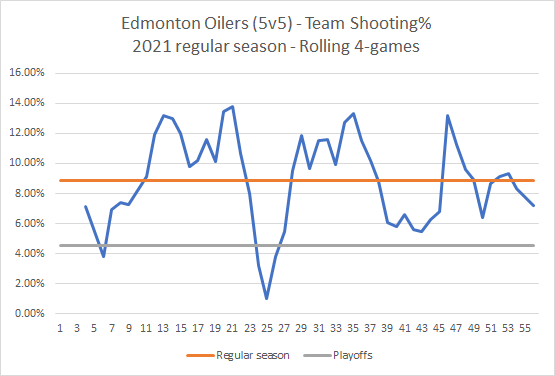
The Oilers are one of the rare teams to finish their season with a points percentage above 0.600 and have a 5v5 goal-share below 50.0% – only better than Ottawa and Vancouver in the North division. The annual top teams in the NHL have an average goal-share of 53.58%, with a Corsi For% and Expected Goals For% around 52.0%. The Oilers weren’t in that range, and as I wrote about a couple weeks ago, they rank quite low among all the other 2021 playoff teams. Regardless, they finished with one of their highest points percentages in franchise history thanks in large part to their franchise player and their success on special teams.

Metric (5v5)Top TeamsLeague AverageBottom Teams
Goals For%53.5850.0146.72
Corsi For%51.8449.9948.29
Expected Goals For%51.7250.0147.86

The Oilers basically fell into that middle-of-the pack range for generating shots and scoring chances, close to where Ottawa and Vancouver ranked for some of the shot metrics. But they had the high-end talent to propel them to seventh in the league when it came to team shooting percentage, second only to the Leafs in the North, finishing with the tenth highest rate of goals-for in the league. Defensively, they were again in that middle-of-the-pack range, allowing shots and scoring chances at rates only slightly better than Winnipeg, Vancouver and Ottawa. And their goaltending finished 20th in the league, only ahead of Montreal, Vancouver and Ottawa. Toronto had the lowest rates of shots and scoring chances against, while the Jets finished with the best goaltending in the North and sixth-best in the league.

Head-to-head

Seeing these overall results, I was curious to know who the Oilers had success against, and which teams they had issues with. Below are their numbers at even-strength (5v5) against each team, sorted by how their opponents finished in the North.

Remember, the Oilers finished with a -1 goal differential at even-strength this season, just a hair under a 50% goal-share, and shot metrics around that level as well (49.12% Corsi For%, 49.90% Expected Goals For%). When it came to actual results (i.e., goal-share), they did have the most trouble against the Leafs. But what might get overlooked is the fact that the Oilers actually played them pretty well as reflected by their share of shot attempts and scoring chances (again, these are score/venue adjusted). Similar results against Vancouver, of all teams. The Oilers appear to have run into some hot goaltending and couldn’t buy a save, as they generated a good share of shots, but finished with a -5 goal differential to end the season against the Canucks. The Oilers also had a negative goal-differential against Calgary and Montreal, which shouldn’t be too surprising considering they were out-shot and out-chanced in those matches.

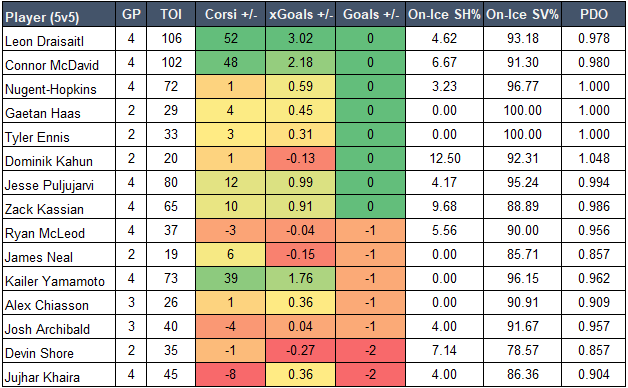
What also stands out is the Oilers 104 PDO against the Jets, which is why I’m tempering my expectations just a little for the first round of the playoffs and expect the series to be a little closer than I think most are expecting. Remember, the Jets finished with one of the best save percentages in the league. If they can even have league average goaltending and maybe implement some of the tactics other North division teams used to slow down McDavid, they could be a lot more competitive in the playoffs. The other issue is that while the Oilers did well in terms of shot-shares against the Jets, it was, as we’ll see below, largely driven by McDavid.

Depth

We know one of the ongoing issues for the Oilers is their even-strength play without McDavid on the ice. Here’s how the group did against each team, sorted by how their opponents ranked in the North division.

The Oilers without McDavid had a Corsi For% around 45.38% this season, and an Expected Goals For% of 45.18%. And they were out-scored 51-68, a goal-share of 42.86%. Using these as a baseline, we see that they struggled without McDavid against pretty much everyone, unable to post a goal-share above 40% against any team except for Ottawa. When it came to controlling the flow of play and scoring chances, they had the most issues against Montreal and Calgary. They couldn’t even muster much against Ottawa, but were able to take advantage of some poor goaltending. What’s interesting is that they did play a lot better against Toronto, but couldn’t convert on their chances enough. It’s clearly an area that management needs to address this off-season if they want to be competitive.

Special teams

Here’s how each of North division teams did on the powerplay and penalty kill this season. Table is sorted by their overall results in the standings.

The Oilers once again had an excellent powerplay, scoring 48 goals, ranking first in the league in terms of goals per hour (10.54) and second in terms of shots per hour (60.36) only behind Colorado. Note that the average rate of shots per hour is typically around 53.0, with the average rate of goals per hour is around 7.0. The Oilers penalty kill results were excellent as well, finishing with the best rate of goals against in the North, good for ninth in the league. Their shorthanded success was largely due to their goaltending, as they allowed the eighth highest rate of shots against, only better than Winnipeg and Montreal in the North.

Toronto’s an interesting team – their powerplay was looking good early on in the season for similar reasons as Edmonton. They continued generating shots throughout the year, but things just cooled off. Their penalty kill was great suppressing chances as well, but didn’t get league average goaltending and finished 22nd in the league. Wonder how Calgary and Montreal are feeling about their special teams. Both clubs had positive goal differentials at even-strength, but were sunk by their power play and penalty kill results.

Back to Edmonton – they scored 48 goals on the powerplay with 31 of those against the non-playoff teams, so about 69% (nice). Toronto did a pretty solid job shutting the Oilers powerplay down, only allowing 38.65 shots against per hour (much lower than the 60.36 shots-for the Oilers averaged all season) and only allowing four goals against. Montreal had similar success against the Oilers powerplay, only allowing five goals, but it was mostly their goaltending that bailed them out. Looking at the Oilers rates of shots-for per hour, the Oilers did a pretty good job against everyone except for the Leafs.

The Oilers penalty kill also had issues against Toronto, allowing their highest rates of shots and goals against per hour. Again the Oilers had their most success on the penalty kill against the lower end teams, with 20 of the 27 total goals against being scored by the playoff teams (about 74%). Worth noting too that the Jets generated a pretty good rate of shots against the Oilers penalty kill, something worth watching in their upcoming series.

Summary

  • The Oilers were an average team at even-strength (5v5). They had a negative goal-differential against every North division team except Winnipeg and Ottawa.
  • The Oilers without McDavid were pretty much owned by every team in the North, posting a goal-share below 40% against each club except for Ottawa.
  • The Oilers powerplay was excellent, generating lots of shots against every team except for Toronto. The Leafs and Habs allowed the lowest rate of goals against versus Edmonton. The Oilers powerplay scored 69% of their powerplay goals against non-playoff teams.
  • The Oilers penalty kill was excellent, largely due to their goaltending. The Leafs and Jets powerplay had the most success against the Oilers. 74% of the Oilers goals against on the penalty kill were scored by playoff teams.

One final thought. I get that it’s hard to complain about the overall results this season considering their in the playoffs, but it’s definitely worth knowing where the team excelled and where they had issues. Knowing how critical the next off-season is, it’ll be important to address the problems that might be getting masked by the overall success, such as the 5v5 play, the depth scoring without McDavid on the ice, and even the penalty kill which again allowed a high rate of shots against. The last thing the Oilers can afford are shoddy roster decisions that hamper the chances of winning games and long-term success – especially in the McDavid era.

Data: Natural Stat Trick, Hockey Reference

Related:

Glossary:

  • Points-percentage (Point%) – The total points accumulated divided by the points that were available, including extra time.
  • Corsi For percentage (CF%) – The proportion of all the shot attempts the team generated and allowed that the team generated (i.e., Corsi For/(Corsi For + Corsi Against). This is used as a proxy for possession and is the best at predicting a team’s future share of goals (GF%). (Source: Hockey Great Tapes – Draglikepull)
  • Fenwick For percentage (FF%) – The proportion of all the unblocked shot attempts the team generated and allowed that the team generated (i.e., Fenwick For/(Fenwick For + Fenwick Against). This is used as a proxy for shot quality and considers shot blocking a repeatable skill.
  • Expected Goals For percentage (xGF%) – This is a weighting placed on every unblocked shot based on the probability of the shot becoming a goal. This depends on the type of shot, location and uses historical shot and goals data to come up with the probability for each unblocked shot.
  • Goals For percentage (GF%) – The proportion of all the goals that the team scored and allowed that the team generated (i.e., Goals For/(Goals For + Goals Against).
  • Shooting percentage (SH%) – The percentage of the team’s shots on goal that became goals (i.e., total goals divided by the total shots on goal).
  • Save percentage (SV%) – The percentage of the team’s shots on goal against that were saved (i.e., 1-(totals goals allowed divided by the total shots on goal against)

Shallow depth

While there were signs of life during the regular season, the Oilers results without McDavid on the ice at even-strength (5v5) were once again poor.

With McDavid deployed, the Oilers outscored opponents 64-48, an elite level goal-share of 57.14%. He typically plays for about 35% of the team’s total time, within which the Oilers tend to out-shoot and out-chance opponents, spending longer periods of time with the puck in the offensive zone. Without him, for about 65% of the total time, the Oilers were outscored 51-68, a goal-share of 42.86% – similar to what Detroit, Columbus and Buffalo finished their seasons with.

A big reason why the Oilers were outscored so badly without McDavid was because they were regularly out-shot and out-chanced. They posted a Corsi For percentage of 45.38% and an Expected Goals For percentage of 45.18% (score-adjusted), which was actually the lowest numbers posted in the McDavid era. And it was really on the offensive side of things where the club struggled. While their rates of shots against and goals against were around league average without McDavid on the ice, their rates of shots-for and goals-for were worse than the bottom-feeders of the league.

There was a point in the season where the Oilers shot-share numbers and goal-differential without McDavid at even-strength was starting to improve thanks to some roster adjustments and the improved defensive play of the club. But as we see below, things really went downhill from about the middle of the season. Over the final 25 games of the year, the Oilers were regularly outshot and getting outscored 15-28 (a 34.88% goal-share) – making it difficult to have much confidence in the club’s depth heading into the playoffs.

Thankfully, McDavid went absolutely supernova in his pursuit of 100-points to close out the season and bailed out the roster, but it should be yet another warning sign for management that they need to do a better job of identifying talent and building a stronger roster around their star player. It’s been a problem that the franchise has struggled with since McDavid’s arrival, not even once being able to reach the 50.0% break even-mark for goals and shot metrics without him on the ice. As mentioned above, this season the Oilers depth posted their worst shot-share numbers (i.e., Corsi For% and Expected Goals For%, score-adjusted) in the McDavid era.

As I’ve written in the past, measuring the team without McDavid is a pretty good way to evaluate the general manager’s work. We know McDavid is going to be dominant when he’s on the ice. But can Holland and his management group figure out how to build a roster that can get positive results, even break-even results, when he’s on the bench? The best teams in the league have figured it out, why can’t the Oilers?

Right now the issue comes down to proper roster evaluation and construction. Taking a look at the forwards who played at least 100 minutes this season, and what their numbers were like without McDavid on the ice with them, it becomes apparent that it’s the professional-level players that management has trouble identifying and acquiring to surround their internally developed players with.

This table sorts all of the forwards by their on-ice Corsi For percentage, with a heat map applied. Keep in mind, 45.0% is the team average Corsi For% without McDavid on the ice. What stands out are the players with shot-share metrics in the red, as all of them except one are professional players that Holland either acquired or re-signed to new contracts. Some of these players even spent time with McDavid over the last couple of seasons, but weren’t productive enough to stay in the top six.

The main takeaway from all of this is that McDavid has yet to have a strong supporting cast around him, and the blame falls squarely on management, the professional scouting department and the teams’ evaluation and decision making processes. The fact that these professional-level players spent more time without the puck and getting out-chanced – and out-scored this badly – should be driving change within the organization.

The Oilers desperately need to figure this out ahead of what should be a busy off-season. The ability to identify talent that can drive offence to replace those that can’t is paramount if the Oilers want to build a championship contender. It’s great the Oilers are in a playoff spot and the potential is there for them to win a couple rounds. But until they figure out how to properly construct a roster, their success is unlikely to be sustainable.

Data: Natural Stat Trick

CBC Radio Active: Oilers, playoffs, goaltending, depth and more

I joined Rod Kurtz on CBC Radio Active on Tuesday to talk Oilers, playoffs (!) and more. Full segment is here: CBC Radio Active (2021, May 4).

Topics we covered:

  • The Oilers clinching a playoff spot and how they’ve exceeded my regular season expectations.
  • Goaltending and the season Mike Smith has had.
  • Team depth and some of their underlying issues.
  • Potential playoff matchups against Montreal and Winnipeg.
  • Expectations from the team over the last week of the season.

Thanks as always to everyone at CBC for putting it all together!

Tracking the top teams

Something I’ve been tracking this season is how close the Oilers are to being a top team in the league.

The good news so far is that their results have them in that range. A 0.600+ points percentage is what the top ten teams in the league often finish their regular season with, and the Oilers are there ranking 12th in the league and 2nd in the North with a 0.633 points percentage.

The issue is that while the results have been great, their underlying numbers – things like goal-share, Corsi For% and Expected Goals For% – are below what top teams have posted on average in the past.

What I had done before the season began was look at the top teams from the past few seasons and determine what the average numbers were for this group (Source). I also looked at what the league average levels were as well as what the lower quality teams had posted. Nothing overly scientific, but I got some basic thresholds to measure the Oilers against, and really get a sense for if the team is real or not. It was also something I wanted to keep in mind around trade deadline time to gauge if the team should be all-in or not for the playoffs.

Metric (5v5)Top TeamsLeague AverageBottom Teams
Goals For%53.5850.0146.72
Corsi For%51.8449.9948.29
Expected Goals For%51.7250.0147.86

Using these thresholds, I found that after the first 25 games, the Oilers were great but they weren’t quite at the levels that top end teams post and they were hovering closer to leave average rates. And they’re still not quite there after 49 games.

But what about the other teams who have a points percentage above 0.600 this season? How well do those clubs compare against these thresholds.

Lets start with goal-share. Below are the twelve teams that currently have a points percentage above 0.600 with their actual numbers in parentheses. I’ve added horizontal lines to represent the average goal-share for the top teams, average teams and bottom teams in the past. Here we see that ten of the twelve teams are where they should be, with Boston just missing the cut. The team that sticks out is Edmonton, who have barely broken even at even-strength (5v5), posting a goal-share of 50.76% and right around league average levels.

Here’s how the top team’s are doing in terms of Corsi For% this season. The Oilers are again rank near the bottom among this group, with Toronto closer to what previous top teams have posted. Not sure what’s happening in New York and Minnesota, but something to watch for in the playoffs.

And finally, here’s how the top teams are doing in terms of Expected Goals For%. The Oilers are closer to league average levels, but again, they rank near near the bottom among this group.

The point of all of this isn’t to ruin your day or diminish the Oilers chances of making a run in the playoffs. It’s really to emphasize that while the results have been great, the Oilers aren’t quite a top team just yet. It’s also information I would want to know as an owner before a manager blows millions of dollars on assets and to evaluate their overall work.

There’s a lot of work to be done in the off-season, a lot of roster issues to be addressed and it would be unfortunate if management fooled itself into thinking that they’re a piece or two away from being a long-term contender. I suspect that management is somewhat aware considering they didn’t make any major moves at the trade deadline. But they should be feeling pressure to get things right this coming off-season and do a better job than they did last off-season.

Data: Natural Stat Trick

Related:

The SuperFan Podcast – Episode 25 – Daniel Wagner (@passittobulis)

This week on the podcast, very happy to be joined by Daniel Wagner (@passittobulis), who covers the Canucks for Vancouver is Awesome.

We discussed the Vancouver Canucks season, what the warning signs were coming off of a pretty good 2019/20 season and where things have gone wrong for the club. We discussed management’s approach to building the Canucks roster, what they’ll need to do differently to be competitive next year, and if Travis Green is the right coach for the team. Daniel also shared his thoughts on the key prospects for the team and the potential roles they could play.

Full segment below:

Podcast channels:

Music: Anitek. “Show me.” Anitek Instrumentals Vol. 4, 2010. Jamendo.com

The SuperFan Podcast – Episode 24 – Zach Laing (@zjlaing), OilersNation

Joined by Zach Laing (@zjlaing), news director for OilersNation and the Nation Network to talk all things Oilers.

We talked about our experiences covering the Edmonton Oilers and how the league can reach more communities and improve the fan experience. We discussed the Oilers season, which players have been the key drivers and who we want to see more from. We also covered the upcoming off-season, how to approach Nugent-Hopkins’ contract and how the defence core could potentially look next year – with or without Adam Larsson.

Full segment below:

Podcast channels:

Music: Anitek. “Show me.” Anitek Instrumentals Vol. 4, 2010. Jamendo.com

The SuperFan Podcast – Episode 23 – Dennis King

Joined by Dennis King (@DKingBH) to talk Oilers, the trade deadline and the direction the club appears to be heading with Ken Holland as general manager. We looked at the current roster construction, where the deficiencies have been, and what we’re expecting to happen this coming off-season. We also looked at the North division, how the Oilers compare with the Leafs, Canadiens and Jets and how things could shake out in the playoffs.

Pretty packed show with lots of great insight from Dennis who even took some listener questions.

Full segment below:

Podcast channels:

Music: Anitek. “Show me.” Anitek Instrumentals Vol. 4, 2010. Jamendo.com

The SuperFan Podcast – Episode 22 – Ryan Batty (@ryan_batty)

Ryan Batty (@ryan_batty) joined me on the podcast to talk Edmonton Oilers, the trade deadline activities and expectations for the Oilers in the North division as they head towards the playoffs.

We discussed the acquisition of Dmitry Kulikov, how it impacts the current roster and how he could potentially help the club. We also shared our thoughts on the current management group, their decision-making and their short term and long approach to building the roster.

Full segment below:

Podcast channels:

Music: Anitek. “Show me.” Anitek Instrumentals Vol. 4, 2010. Jamendo.com

Stalling

Connor McDavid nets game winner, leads Edmonton Oilers to victory over  Calgary Flames - TSN.ca

The Oilers are in a great spot right now, sitting third in the North division with a points percentage of 0.625% after 40 games. Thanks to the Flames absolutely crashing and burning over the last few weeks, and with the Jets and Canadiens being pretty mediocre recently, the Oilers are a near lock for a playoff spot.

Now while the overall results have been excellent, their play at even-strength (5v5) hasn’t been great. And it’s these current numbers that the Oilers front office should probably be aware of heading into the trade deadline and the playoffs.

RecordCorsi For%Fenwick For%Expected Goals For%Goals For%Sh%Sv%PDO
24-14-248.90%49.18%50.05%50.89%9.21%91.56%1.008

Starting with goal-share, the Oilers have outscored opponents 86-83 at even-strength so far this season, which translates to a goal-share of 50.89%. They’re scoring at an elite level, generating 2.65 goals per hour, ranking ninth in the league and third in their division. The problem is that they’re giving it all back, allowing the tenth highest rate of goals against in the league – 2.56 per hour – which is just barely better than Calgary and Vancouver.

It’s the last ten games that have probably been the most concerning. They’ve been outscored 21-23, a goal-share of 47.73%, doing just fine generating goals (2.53 per hour), but struggling to keep the puck out of the net, allowing 2.63 goals per hour. One issue is that the goaltending has been below average, posting a team save percentage of 90.84%. The other problem is that the Oilers are spending a lot of time without the puck at even-strength and regularly getting outchanced. Over the last ten games, they’ve posted a score-adjusted Corsi For% of 45.62%, a Fenwick For% of 45.37% and an Expected Goals For% of 45.71%.

Over the course of the season, the Oilers were trending well, posting a ten-game stretch where they controlled over 52.0% of the total shot attempts (score adjusted) – a level that top end teams with points percentages above 0.600 typically finish a season with. But things have gone downhill for the Oilers recently, largely due to their offence drying up. At one point, they had a stretch of ten games where they were generating 56.75 shot attempts per hour, which is nothing great and closer to league average levels. But that rate has dropped by 28% over the last ten games, with the Oilers generating only 44.33 shot attempts per hour. For context, that’s worse than what Detroit and Buffalo have mustered over the season. Whether it’s the offensive rate of shot attempts, unblocked shot attempts, expected goals – the Oilers rank either 30th or 31st when looking at the last ten games for every team.

One issue that’s returned again is the performance of the depth forwards. There were signs that things were turning around as the team improved their shot-share and goal-share numbers without their star players on the ice, but it seems things have gone south again. Over the last ten games, without McDavid or Draisaitl on the ice at even-strength, the Oilers have been outscored 5-10 (a goal share of 33.33%). And it’s largely due to spending the majority of the time without the puck and getting outchanced as reflected by a Corsi For% of 38.93%, a Fenwick For% of 40.37% and an Expected Goals For% of 37.82%. Similar to the team-level numbers, the Oilers depth players are okay defensively. But they struggle to generate much offensively, and it appears things have become worse.

Something worth digging into if you’re the Oilers are the defence pairings and how they could be adjusted to improve the team’s overall offence, especially with those that are counted on to provide offence. Nurse in particular is having a great year, playing predominantly with McDavid, but I’m starting to wonder if all of the ice-time is starting to catch up to him. He’s played the second highest numbers of minutes in the league among defencemen, averaging 25:44 per game, which is the fourth highest. and two minutes more than his career averages. In his first 30 games of the season, Nurse was posting an on-ice Corsi For% of 52.72% (score-adjusted), but over the last ten games, he’s posted an on-ice Corsi For% of 46.68%. Barrie as well has seen his numbers slide over the course of the season. His on-ice Corsi For% has dropped from 50.17% to 45.09% – hardly numbers you would expect from an offensive defenceman who also gets a lot of the cherry minutes with McDavid.

PlayerCorsi For% (Games 1-30)Corsi For% (Games 31-40)Difference
Ethan Bear52.9355.222.29
Kris Russell47.1446.25-0.89
Caleb Jones51.0749.77-1.30
Tyson Barrie50.1745.09-5.08
Darnell Nurse52.7246.68-6.04
Adam Larsson46.7039.82-6.88
William Lagesson47.0530.76-16.29

At this point, I think it’s obvious that the Nurse-Barrie partnership needs to end. Over the full season, the two have had excellent results together, posting a goal-share above 60.0%, again due in large part of having McDavid or Draisaitl with them for the majority of their ice-time. But their on-ice shot-share numbers have been fairly mediocre with a Corsi For% of 50.39% and an Expected Goals For% of 47.91%. What’s interesting is that Nurse’s on-ice shot share numbers improve quite a bit when he’s played without Barrie and the team still has positive results with a goal-share above 52%.

Oilers (5v5) – 40 gamesTOICF%FF%xGF%GF%
Nurse + Barrie49750.3948.7347.9160.05
Nurse, no Barrie33552.6052.5056.7352.60
Barrie, no Nurse19445.6745.2948.1425.17
Neither92147.2249.0248.6346.70

Barrie on the other hand struggles mightily without Nurse (45.67% Corsi For% and a Goals For% of 25.17%). And it’s been even worse over the last ten games with Barrie appearing to be a negative influence on Nurse’s performance.

Oilers (5v5) – Last 10TOICF%FF%xGF%GF%
Nurse + Barrie15644.8641.0136.0362.54
Nurse, no Barrie6450.9652.3358.4351.33
Barrie, no Nurse1048.1650.2470.760.00
Neither27644.4846.1146.6138.60

The two together over the last ten games have seen their Corsi For% drop down to 44.86%, while their share of Expected Goals For% is down to 36.03%. Again it’s on the offensive side of things, as the Oilers are generating less than 48 shot attempts per hour with them on the ice, and that’s playing predominantly with McDavid or Draisaitl. Keep in mind, 80% of their total ice time is with one or both of these guys. In roughly 27 minutes playing with depth players over the last ten, Nurse and Barrie have shot-share numbers under 20%, which is incredible considering their reputations of being offensive drivers this season.

The team’s overall results are masking these underlying issues. And I can’t imagine the team continuing to have success if their top pairing is posting numbers like this. With the Oilers accumulating points, now might be the time to replace Barrie with Bear on the top line, with the expectation that he and Nurse can find that chemistry they had last season when they regularly played against top lines. Bear is already seeing a higher proportion of his total ice time against elite competition increase this season (refer to Appendix A). The Oilers also have young Bouchard on the active roster, and you have to wonder how the Oilers expect to evaluate him at the NHL level and know what his value is if he’s not getting ice-time. And Barrie might actually benefit from fewer minutes, recover from any injuries he’s dealing with, and be rested for a playoff run.

Whatever adjustments the Oilers make, it should probably be done sooner rather than later so they know what they have for the post-season and heading into what should be an important off-season.

Data: Natural Stat Trick, Puck IQ

Appendix A: Edmonton Oilers 2020/21, Defencemen TOI% against elite competition (PuckIQ)

Digging into the depth II – Improved defensive play

338 Gaetan Haas Photos and Premium High Res Pictures - Getty Images

Over the course of the season, the Oilers have done a much better job at limiting the numbers of shots and scoring chances against at even-strength (5v5).

Over the first 15 games, the team was allowing 57.2 shot attempts per hour, which was fifth highest in the league and only slightly better than Vancouver and Ottawa in the North division. They were also allowing 42.13 unblocked shot attempts, a proxy for scoring chances, which was eighth highest in the league. This poor defensive play was a key factor in the team allowing the fifth highest rate of goals against (3.07) and why they were fifth in the North division in terms of points percentage.

Thankfully things have turned around since then. Since game 16 in early February, the team has seen their rates of shots and scoring chances drop down to league average levels, with the team allowing a rate of 51.84 shot attempts per hour (a drop of 10.3%) and 39.11 unblocked shot attempts per hour (a drop of 7.7%). And it’s been part of the reason why the team has seen their rate of goals against drop down to 2.09, again closer to league average levels. And it’s been a factor in the team’s resurgence in the standings.

Oilers (5v5)Corsi Against/60Fenwick Against/60Expected Goals Against/60Goals against/60
Games 1-1557.2042.132.353.07
Games 16-3451.8439.112.182.09
% Change10.3%7.7%7.8% 46.9%

One reason for the Oilers improved defensive numbers has been the play of the depth players. Early on in the season, the team depth was the reason why the Oilers rate of shots and scoring chances were so high and why they were getting badly outscored. Without McDavid or Draisaitl, the Oilers were getting crushed allowing over 61 shot attempts per hour and over 48 unblocked shot attempts per hour. That’s what the worst teams in the leagues typically allow in a season – unacceptable in any situation, especially when you’re not able to generate even close to that much offensively.

Since early February, the Oilers depth players have done significantly better, cutting their rate of shot attempts against per hour by 25% and their rate of unblocked shot attempts by over 30%. And most importantly, and with the help of some improved goaltending, the team is allowing more than half the rate of goals against.

Oilers Depth (5v5)Corsi Against/60Fenwick Against/60Expected Goals Against/60Goals against/60
Games 1-1561.7946.802.403.97
Games 16-3449.3935.011.911.85
% Change25.1%33.7%25.7% 114.6%

One player who likely played a role in the team’s improved defensive play this season is forward Gaetan Haas. Last season, the team saw a significant drop in shots and scoring chances against when Haas would be on the ice at even-strength. Among the 18 forwards who played at least 100 minutes in 2019/20, Haas ranked in the top three for any on-ice defensive metrics. Offence was completely sacrificed with Haas on the ice as the team didn’t generate much, but his defensive play was valued by the coaching staff as shown by his increased usage this season, especially on the penalty kill.

Haas has played in the past 17 games for the Oilers this season, following a stint on the injured reserve after playing two games in late January. His defensive numbers are pretty much identical to what they were last season. Among 15 forwards who have played at least 100 minutes this season, Haas is first in all defensive categories – including goals against per hour.

With Haas on the ice this season, the Oilers are allowing less than 20 shots against per hour at even-strength, while the team as a whole allows close to 30. He’s clearly the best defensive option among the depth forwards too. If the Oilers don’t have him, McDavid or Draisaitl on the ice, they’ve allowed 27 shots against per hour.

This strong defensive play has also translated well to the penalty kill, where Haas is for the first time in his NHL career getting regular minutes shorthanded. He currently ranks second on the team in average ice-time per game (2:09) among eight forwards (minimum 10 minutes played), and has posted the second lowest on-ice rate of unblocked shot attempts against and shots against – only behind Yamamoto.

What has to be especially pleasing for the coaching staff is Haas’ on-ice rate of goals against per hour – 2.97. He’s only been on the ice for two goals against in his 40 minutes of penalty kill time, a rate which has him seventh in the NHL among 112 forwards who have played at least 40 minutes this season. Keep in mind, the Oilers penalty kill as a whole is currently 20th in the league, allowing over eight goals against per hour and allowing some of the highest rates of shots and scoring chances. So don’t be surprised if Haas plays in every remaining game and sees his overall ice-time increase.

Haas’ defensive success has to make you wonder what the first 15 games could have looked like had he been healthy. He might not generate much offence, but they were clearly in need of defensive help as they were getting outshot at a 2:1 clip early on and crushed on the scoreboard. Also makes you wonder if the Oilers really knew what they had in Haas going into the season, considering they did hand Turris a two year deal to be their depth centerman and a regular option on the penalty kill. We might not know how Haas would have been deployed had he been healthy, but I would assume Turris with his draft pedigree and his familiarity with the head coach would have still received a long look. Classic example of the availability heuristic concept.

Thankfully things have worked out much better recently and the Oilers are back on track. Just remains to be seen how the team evaluates players at the trade deadline and off-season, and if someone like Haas will a contract extension or if another ‘known’ player is brought in.

Data: Natural Stat Trick, Hockey Viz

Related: