Something that I’ve been thinking about this off-season is how to best assess the work that’s been done and being done by Oilers general manager Peter Chiarelli. It’s been a fairly low-event summer, and considering the success the Oilers had in 2016/17, it’s a little surprising to me that the management team has thus far taken such a passive approach.
Now the signings of Jussi Jokinen and Yohann Auvitu are nice bets and address the Oilers’ depth issues, and its reasonable to think they could contribute next season. The acquisition of Strome, I’m not so sure about. He’s a depth winger at this point with lots to prove and has a chance to do well. I just haven’t seen anything in his numbers that indicates he can be a difference maker. And losing Eberle, arguably for financial reasons, only makes sense if they re-allocated those dollars towards an asset that could make a significant impact. Instead, it looks like the money saved was to (over)pay Russell, an okay depth defenceman, but one who’s likely past his prime and often drags down his team’s offence. How these trades and signings impact the team’s ability to win games remains to be seen.
In the end, we need to assess Chiarelli’s work, the easiest way being to look at the team’s win totals and goal-share.
| Season | Record | Points | Goal-share (5v5) | Shot-share (5v5) | Save% (5v5) |
| 2015/16 | 31-43-8 | 70 | 44.66 | 48.81 | 91.44 |
| 2016/17 | 47-26-9 | 103 | 54.25 | 49.99 | 92.72 |
Nice jump from last season. But the problem I see with this type of assessment is that both of his seasons were impacted by things largely out of his control. The Oilers dealt with major injury issues, losing both McDavid and Klefbom for extended periods in his first season, and their goaltending was one of the worst in the league. And Chiarelli got a bit of a free pass as it was his first year and there was plenty of players on the roster that were from the previous regime. And in Chiarelli’s second season as Oilers GM, Talbot and McDavid were outstanding, and the defence core, lead by Klefbom and Sekera, was able to stay healthy. So really, how much credit can you give the general manager for the success and failures?
The other factor to consider is McDavid, arguably the best player in the world and the driving force behind the Oilers 103 point season. With him on the ice, the Oilers had a +30 goal differential at even-strength, a 62.1% goal-share. The shots and scoring chances took a massive jump thanks to McDavid, and his impact was evident when looking at his teammates production with him and without him.
In my opinion, the best way to measure Chiarelli as a general manager is by looking at the team’s results when McDavid isn’t on the ice.
McDavid is going to make things happen and we can fully expect the goal-share and shot-share to be well above 50% with him on the ice. There’s no development time needed, no extra coaching or helping him find his niche. He’s a superstar today and for the foreseeable future. What management has to do now is fill out the rest of the roster and ensure that when McDavid is on the bench, the team gets more than half of the even-strength goals, and more than half of the even-strength shots. Teams that reach the finals often had strong support around their best players in the regular season, and it’s going to be critical for the Oilers to do the same.
Last season, without McDavid, the Oilers had a -4 goal differential at even-strength (a goal-share of 48%), and a shot-share of 47%. And it’s worth noting that the shot-share dipped down to 45% at certain points and only gradually improved. This is why I’m not feeling too great about the Oilers moves this summer. Eberle and Pouliot, for instance, were one of the few players that posted good shot-shares away from McDavid. And while Jokinen could give a boost to the tough minutes line with Nugent-Hopkins, I’m skeptical that his play will have a massive impact on the team’s shot and goal-shares. In my mind, he’s the new Pouliot, so if anything, at best the team made more of a lateral move.
At this point, the best-case scenario is that Draisailt emerges as a scoring threat as a second-line center and Benning takes another step forward and helps create more offence. The team would also have to hope that one of their younger forwards like Puljujaarvi or Strome or even Yamamoto solidify a spot on the roster and capitalize on more opportunities. I just don’t know if it’s wise to bank on so many what-ifs when the time to contend for a championship is now. And considering the cap crunch the Oilers will be in after this season having to pay McDavid and Draisaitl, you’d think management would be all in in 2017/18.
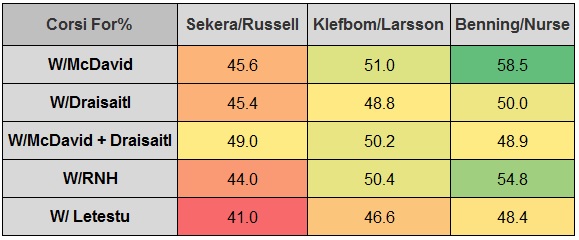
Chiarelli also has to ensure that no one on the team is dragging down McDavid’s offensive production. There’s no reason why the offence should get stalled when McDavid is on the ice, and it’s critical that the right players are deployed with him. This is also a big reason why I dislike the Russell signing. The only time the team’s goal scoring rate went down with McDavid was on the ice last season was when Russell was on the ice with him. This should have been a red flag, but management chose to ignore it instead.
While team results will be important, it’s the results without McDavid and the process upon which key decisions are made that will define Chiarelli’s tenure as the Oilers general manager. How he builds a winner around an elite talent will be a critical piece of the championship puzzle. So far, management hasn’t done enough to help the team generate offence, and it remains to be seen if the smaller bets they’ve made and the young players they have can help push the needle this upcoming season.
Data: Natural Stat Trick