Over the course of the off-season and training camp, I thought more and more about what’s worth tracking this regular season based on the decisions that were made by Edmonton Oilers management. Just based on the following observations:
- There was a major influx of depth forwards to help with secondary scoring and the penalty kill.
- New goalies, new goalie coach and new approach to address the issues in net last year.
- Significant change among the defence core to be less of a liability and more of an asset.
- Brand new coaching staff to make better in-game decisions and increase the odds of winning hockey games.
Through what’s been said by Oilers management and what they’ve actually done since being eliminated by Anaheim in round one, it’s clear that the team identified defensive play (5v5 and shorthanded), goaltending and depth scoring as the issues holding them back from a championship. These are all basic things that align with outscoring opponents and winning games, so it’d require a fairly straightforward assessment
If everything goes to plan, we should see the following this upcoming season, which should translate into more wins.
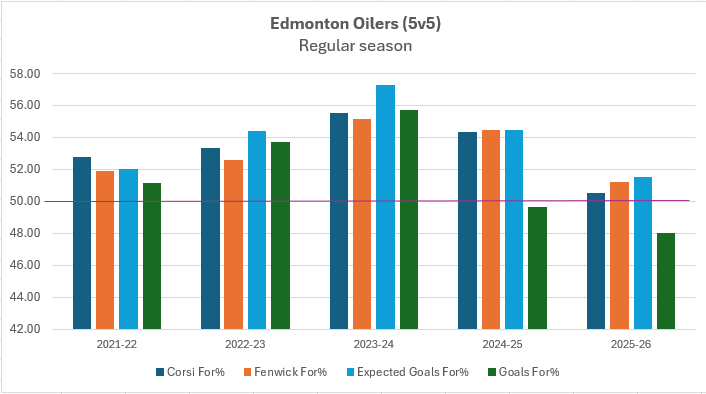
Shot-share metrics bounce back to top-end levels
The Oilers posted some fairly mediocre shot-share numbers last season, relative to previous seasons, which played a role in their negative goal differential. Their expected goals dropped off significantly, especially without their star players on the ice. If management built the roster well this off-season, the team should be controlling the flow of play at a top-end level, and it should be reflected in their Corsi For percentage and Expected Goals percentage at 5v5. Shot-share targets should be 53 percent, which is what they cleared the previous three seasons (thanks in large part to Woodcroft’s tactics, but I digress).
The team doesn’t get destroyed when McDavid or Draisaitl aren’t on the ice
Written a lot about this issue, so we’ll keep it simple. The goal should be for the team to post a Corsi For percentage and Expected goal share above 51% when the depth forwards are deployed. And the goal differential has to be at or above 50 percent. Anything worse than that, and we can confirm the Oilers scouting staff needs an upgrade.
The Oilers penalty kill is top ten league wide in shot attempts and scoring chances allowed
No guarantees with how the goalie does, but it makes life a lot easier if you’re keeping the volume of shots against low and the rate of high-end chances against to a minimum. And because it felt like every acquisition this summer included key messaging about the player’s penalty killing abilities, I would expect things to be better than last season. In 2025/26, the Oilers allowed the 12th highest rate of goals against, largely because they allowed 82 unblocked shot attempts per hour (10th highest in the league) and the ninth highest rate of expected goals against (9.57 per hour). Their playoff numbers were somehow significantly worse.
The Oilers should target to be top ten in shot attempts and expected goals against. So less than 75 unblocked shot attempts per hour and less than 8.50 expected goals against per hour. That increases your odds of doing well on the penalty kill, but depends on another major issue that the Oilers were desperate to address this off-season.
Team save percentage gets to league average levels at even-strength and on the penalty kill
The Edmonton Oilers finished dead last in 5v5 team save percentage last season, with 88.95 percent and 17th in the league on the penalty kill (85.06). A rotation of goalies who are at different stages of their careers is a nice way to spread your risk, but at the end of the day the cumulative team save percentage at evens has to have a target of 90.50 percent – which is what the league average was last year.
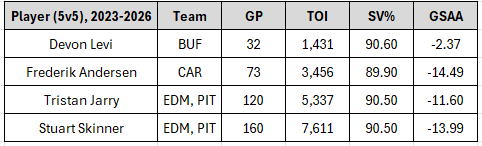
I do remain a little skeptical that the team will get to league average levels. If you look at the 83 goalies who had played at least 1,000 minutes at even-strength over the last three season (2023-2026), you see the following:
- Andersen ranked 71st with an 89.90 save percentage and 73rd with a -14.49 goals-saved above average (GSAA).
- Jarry ranked 57th with a 90.50 save percentage and 63rd with -11.60 GSAA.
- Levi ranked 50th with a 90.60 save percentage and 45th with a -2.37 GSAA.
- Skinner, for a fun reference, ranked 60th with a 90.50 save percentage and 72nd with a -13.99 GSAA.
.
Feels like a lot is riding on Levi to emerge as the starter, with Jarry and Andersen taking on more of the mentorship roles. Levi has had plenty of experience in the American league, so there’s definitely potential for him to be a league-average guy. And if the team can do a decent job controlling the flow of play as mentioned above, it should at least improve his odds of reaching that level. We’ll see how he manages the workload and adjusting to a new team that’s had quite the overhaul this off-season.
Data: Natural Stat Trick
Related:
- Tactics and The Edmonton Oilers: A 2026/27 Regular Season Preview – Bruce Curlock (2026, September 29)

