CBC Edmonton News (TV): Previewing game five between Vegas and Washington and discussing the latest Oilers trade rumors

cbc edmonton logoI joined Adrienne Pan on the CBC Edmonton News to discuss the Stanley Cup finals and recent Oilers news. Clip is here and starts at the 16:55 mark: CBC Edmonton News (2018, June 7)
Topics we covered:

  • Re-cap of game four of the Stanley Cup Finals
  • Strengths and weaknesses of Vegas and Washington, and what to expect in game five.
  • Trade rumors involving the Oilers, including speculation about Oscar Klefbom and Milan Lucic

CBC Edmonton News (TV): Stanley Cup finals analysis, Chiarelli’s recent comments about Oilers off-season strategy

cbc edmonton logoI joined Adrienne Pan on the CBC Edmonton News to discuss the Stanley Cup finals and recent Oilers news. Clip is here and starts at the 17:45 mark: CBC Edmonton News (2018, June 1)

Topics we covered:

  • Re-cap of game two between Vegas and Washington, and what areas the Capitals improved on.
  • How the Golden Knights and Capitals have matched up statistically over the first two games, and a preview of what to expect in game three on Saturday night.
  • Peter Chiarelli’s recent comments about the Oilers off-season strategy, and why targeting a powerplay defencemen might not be very wise. We also touched on the importance of hanging on to that 10th overall pick.

Looking into the Ducks penalty kill under Trent Yawney

yawney

After posting some very dreadful penalty kill numbers in 2017/18, it was pretty much guaranteed that the Edmonton Oilers were going to make some changes to the coaching staff. The club managed to make some tactical adjustments late in the season to improve their penalty kill but it was too late. They had allowed the fifth highest rate of goals against per hour, thanks in large part to the high number of quality chances they were regularly allowing.

Related: The Oilers penalty kill was finally addressed – The SuperFan (2018, April 2)

I mentioned this in the article posted above, but had the Oilers paid any attention to some of their underlying penalty kill numbers in previous seasons, they may have looked for a way to get Talbot more rest, and more importantly adjusted their tactics to cut down the rate of shots and scoring chances against.

Instead the Oilers continued to rely on goal-data, a poor predictor of future success and one that doesn’t give you an accurate assessment of whether the results are sustainable or not. That’s where we use shot metrics, which gives us a better sense of if the process and tactics a coaching staff implements are working.

What’s troubling is that to find a suitable replacement for Jim Johnson to run the penalty kill next season, it appears the Oilers may have been looking at goal-data again.

Now Trent Yawney, in my opinion, was targeted and hired by the Oilers for good reason. Along with having head coaching experience at the NHL and AHL level, and experience serving as an assistant to McLellan in San Jose, Yawney has had a lot of experience working with and developing the young defencemen in the Ducks system – many of which are turning into useful NHL players.

But what probably drew the Oilers attention the most about Yawney is his solid track record running the Ducks penalty kill. In short, it’s been outstanding based on the actual results (i.e., goals against). But digging into the Ducks underlying numbers, there may be some areas for concern.

Below are the Ducks numbers from the last four seasons, including the rate of goals against, the rate of expected goals against and the team save percentage. I’ve also included the Ducks league ranking in parentheses (Source: Corsica Hockey)

Season GA/60 xGA/60 Save%
2014/15 5.45 (3rd) 6.61 (19th) 88.92 (3rd)
2015/16 4.15 (1st) 5.79 (10th) 91.27 (1st)
2016/17 4.86 (2nd) 7.44 (28th) 90.80 (1st)
2017/18 5.48 (4th) 7.23 (18th) 90.35 (3rd)

Couple quick notes:

  • I regularly use the rate of goals against per hour (GA/60) rather than the standard penalty kill efficiency percentage to measure a teams success. I think it’s important to factor in the amount of time a team is killing penalties to know how truly efficient they are. Quite often, how a team ranks in terms of GA/60 is close to their penalty kill efficiency, but I think GA/60 is a more accurate measurement.
  • I’m using the rate of expected goals (xGA/60) which is a weighting placed on every unblocked shot based on the probability of the shot becoming a goal. This depends on the type of shot, location and uses historical shot and goals data to come up with the probability for each unblocked shot. This has been found to be a better predictor of future goals than Corsi and Fenwick. (Detailed explanation can be found at Corsica Hockey)
  • Comparing the actual rate of goals against with the expected rate of goals against also makes it easier to compare and interpret the two metrics. Rather than comparing say, the penalty kill efficiency as a percentage to the rate of shots or scoring chances against.

So what we see in the table above is that in the four seasons with Yawney running the penalty kill, the Ducks were outstanding ranking in the top five across the league when it came to the rate of goals against per hour.

However, the team was not so good limiting scoring chances, often ranking below average, and it’s reflected in the rate of expected goals against (xGA/60). The last two seasons had been especially bad. Based on the high quality chances they were allowing on the penalty kill, the Ducks number of expected goals against (based on historical probability) was 54 in 2017/18 and 58 the season prior – the highest numbers in the league. Instead, their penalty kill only allowed 41 goals in 2017/18 and 38 goals in 2016/17 – some of the lowest numbers in the league and well below the number of expected goals.

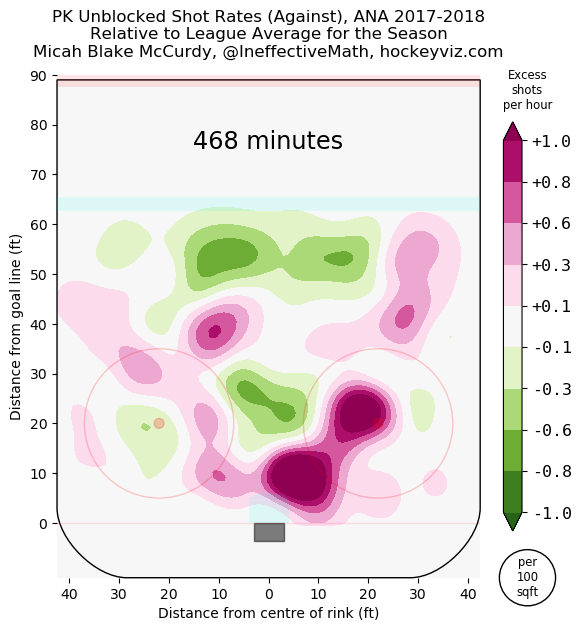
You can also see how bad things were on the Ducks penalty kill over the last two seasons using the shot location maps from HockeyViz. Notice the dark purple in front of the Ducks goal, which indicates that they were well above the league average.

DucksPK20172018

DucksPK20162017

Now compare those two maps above with the map from 2015/16 when the Ducks had one of the better rates of expected goals against on the penalty kill. You’ll notice a lot less purple around the goal.

DucksPK20152016

I’d be curious to know what the Ducks did differently in 2015/16 when they not only got great results (lowest rate of goals against per hour), but they also did really well limiting shots and chances as reflected by the expected goals metric. I’d rather apply the tactics (and possibly player deployment) that Yawney used in 2015/16 than the ones that were in place in 2016/17 and 2017/18.

My main takeaway from the numbers and the maps is that the Ducks have been pretty blessed with some outstanding goaltending on the penalty kill over the last few seasons. More specifically, it’s been the play of netminder John Gibson that’s really driven the Ducks success.

A quick glance at the 63 goalies who have played at least 250 minutes at 4v5 over the last four seasons, and John Gibson ranks near the top across a number of metrics. This includes the best save percentage, the sixth best high-danger save percentage, and  also number one when it comes to goals saved above average (GSAA), the background of which you can find here.

So while it’s easy to give the coach credit for the success a team has had on the penalty kill, it’s worth splitting out the areas where the coach has actual control over the outputs. In this case, Yawney’s performance should be evaluated using the shot metrics to know if his group is actually good at keeping shots outside and out of danger areas. From the looks of it, the tactics he’s used over the last two seasons on the penalty kill haven’t been working, and he regularly relied on Gibson to bail the team out. Unfortunately, Yawney won’t have that luxury in Edmonton, as Talbot’s penalty kill numbers, while respectable, aren’t close to Gibson’s.

Data: Corsica Hockey, HockeyViz


CBC Edmonton News (TV): Discussing the Oilers’ changes behind the bench and the Vegas-Washington final

cbc edmonton logoI joined Min Dhariwal on the CBC Edmonton News to discuss the playoffs and the upcoming changes behind the Oilers bench. Clip is here and starts at the 14:10 mark: CBC Edmonton News (2018, May 24)

Topics we covered:

  • The upcoming addition of Glen Gulutzan and Trent Yawney to the coaching staff and where we can expect them to contribute. We also touched on the coaching history of Manny Viveiros, who is also expected to join. (Source)
  • The performance of goalie prospect Stuart Skinner at the Memorial Cup.
  • The Capitals game-seven win against the Lightning.
  • The final series between Washington and Vegas.

CBC Edmonton News (TV): Discussing the Jets and previewing game seven between Winnipeg and Nashville

cbc edmonton logoI joined Alicia Asquith on the CBC Edmonton News to discuss the playoffs and preview game seven between Winnipeg and Nashville. Clip is here and starts at the 17:30 mark: CBC Edmonton News (2018, May 10)

Topics we covered:

  • The Jets draft/development history, an area of the game that the Oilers still struggle with.
  • Head to head match-up between the Jets and the Predators, and what the numbers have been like over the first six games of the series.
  • The Vegas Golden Knights and what’s made them successful this post-season.

Losing the long-term perspective

Peter-Chiarelli-Edmonton-nationalpost

Peter Chiarelli is in a position of weakness this off-season.

Having missed the playoffs, there’s going to be a lot of pressure for the Oilers to make the necessary adjustments to ensure that what happened last season doesn’t happen again in 2018/2019. Pressure will be felt from the fans and sponsors, but also the league which would desperately want Connor McDavid, one of the league’s premier players, playing meaningful games in the spring.

After finishing 23rd in the league, posting a -29 goal differential, and ranking near the bottom when it comes to the powerplay and penalty kill – there’s just so many issues that can’t be ignored. And every other team knows it.

This is also going to be an important year for Chiarelli and his career as a general manager. If for whatever reasons the team misses the playoffs again, Chiarelli would most likely be out as general manager of the Oilers, and I think would have a tougher time finding another GM position elsewhere. As much as hockey men get recycled in this league, there are only 31 general manager positions. And it would be hard for an owner or executive group to justify bringing in an individual who could only make the playoffs once in four seasons, with Connor McDavid on an entry-level contract, and bled considerable talent along the way.

It’s for these reasons that I think the Oilers are going to force themselves to make changes to their roster – and in doing so will not keep a long-term perspective in mind.

The team was obviously bad last season, but it’s important to keep in mind that Klefbom was playing hurt, Larsson missed time and Sekera missed training camp and wasn’t 100% healthy when he returned. Those were the Oilers top three defencemen the previous season but neither played more than 66 games. Keeping this in mind, I don’t think the team should feel pressured to overhaul the defence core. If anything, the club could potentially look for a cheaper, specialist-type option that could quarterback the powerplay. But to move out, say, the 10th overall pick and roster players for a bigger ticket defencemen would be short-sighted and negatively impact the long-term goal of winning championships.

This is where I hope someone above the general manager has a long-term strategy or plan that requires any decisions made by the general manager to align with it. We’ve seen the role and aura of general managers gradually decline with nearly every team having a level of executive(s) above it. But it’ll be interesting to see how things will shake out: will they make decisions for short-term gain, or will they be smart enough to keep the long-term objectives in mind?

In my opinion, you can let Chiarelli have a plan to build a roster, negotiate contracts and develop prospects. But a higher-level plan or strategy would cover a wider spectrum of hockey operations, including the fundamental values of the organization, the shared mission/vision and a proper structure that includes the supporting departments around the general manager. In my mind, this would include the scouting department, player development, information analysis/innovation group, and a research and development team. [Should note, this is just based on my own experience working in the corporate world and from the research I did in school.] You win games by finding good players and keeping good players – so have the people, process and tools in your organization to do this.

Without a long-term, overarching plan or model for a general manager to make decisions within, you can expect more of the same short-sighted decisions that the Oilers have already made to continue. And that’s with or without Chiarelli in the general manager’s chair.

It’s about time the Oilers start to operate like a real business, one that has a well defined  long-term strategy, and a structure that supports strong decision-making and execution. The Oilers sit in a position of weakness at a time when they should be chasing championships. And it’s disturbing that at such a critical point in their franchise’s history, they lack the structure and mentality to become a real contender in the league.

CBC Edmonton News (TV): Oilers drafting 10th, signing Koskinen, asset management and NHL playoffs

cbc edmonton logoI joined Adrienne Pan for my weekly segment on the CBC Edmonton News to discuss the Oilers and the playoffs. Clip is here and starts at the 19:00 mark: CBC Edmonton News (2018, May 3)

Topics we covered:

  • The importance of drafting 10th overall and why the Oilers should not be trading the pick away.
  • The signing of Mikko Koskinen and how other teams like the Avalanche are approaching their back-up goaltending position.
  • Things the Oilers management needs to do this off-season and why a long-term perspective is needed when it comes to asset management.
  • Re-cap of game four between the Sharks and Golden Knights.
  • What the Oilers can learn from the Winnipeg Jets, including the importance of drafting and developing their own talent.

CBC Edmonton News (TV): Oilers coaching changes, addressing goaltending, draft lottery and playoff previews

cbc edmonton logoI joined host Adrienne Pan on the CBC Edmonton News today to talk all things Oilers. Clip is here and starts at the 18:00 mark: CBC Edmonton News (2018, April 27)

Topics we covered:

  • The Oilers potentially signing KHL goaltender Mikko Koskinen to a two year deal.
  • Changes behind the bench, and the pros and cons of having Jay Woodcroft as the head coach of the Bakersfield Condors.
  • Draft lottery this weekend, and the importance of holding on to the pick.
  • Re-cap of last night’s playoff games, including the Golden Knights thrashing the Sharks.
  • And previewing tonight’s match-up between Winnipeg and Nashville.


CBC Edmonton News (TV): Off-ice decisions, goaltending and playoff match-ups

cbc edmonton logoI joined Min Dhariwal on the CBC Edmonton News today to talk all things Oilers. Clip is here and starts at the 22:30 mark: CBC Edmonton News (2018, April 12th)

Topics we covered:

  • Peter Chiarelli’s press conference and his comment on the forwards being adequate.
  • Potential coaching changes, as alluded to by Bob Nicholson in his press conference.
  • Goaltending struggles this season and the importance of finding a suitable backup for Talbot that could also be a potential starter in the future. Also wrote about it back in December 2017 (Copper & Blue).
  • Playoff match-ups from last night including the Jets-Wild and Golden Knights-Kings.
  • Tonight’s match-ups including the Leafs-Bruins and Devils-Lightning.

Big thanks as always to the crew at CBC for putting it all together!

Squad goals

920084196

After such a dreadful season there’ll be plenty to dissect, with the end goal being to determine what happened and what the potential course of action should be this offseason.

The most important thing to do is look at the goals for and against, the end results, and how the team did in different situations. Goals and winning are after all the most important things, and it’s pretty remarkable to see what kind of insight you can get from such simple stats. From there, we can look at the underlying shot-share numbers and our proxy for possession (i.e., Corsi), as well as the on-ice shooting percentage and on-ice save percentage to see if the results were real or not.

Starting from a very high level, the Edmonton Oilers scored 229 goals this season in all situations, and alllowed 262, giving them a goal-differential of -33. Taking a peek at the NHL standings from this season and previous seasons, we know that you’re at risk of missing the playoffs with a negative goal differential, with the best teams often above a +25 goal differential. That was the case for Edmonton last season when they finished with a +36 goal differential (243 goals for, 207 against) and second in the Pacific.

What really should be bothering the Oilers management group this offseason is the drop in goals, from a +36 goal differential last season to -33 this season.

But let’s dig in a little deeper.

Here’s a comparison of their 2017/18 season to the season prior when it came to the goals for and against at even-strength (5v5), as well as the goals scored on the powerplay and the goals allowed on the penalty kill.

Situation 2016/17 2017/18 Difference
5v5 Goals For 166 163 -3
5v5 Goals Against 140 176 36
5v4 Goals For 51 30 -21
4v5 Goals Against 38 56 18

In a nutshell, the Oilers scored slightly fewer goals at even-strength, but allowed a ton more this season, 36 to be exact. They also scored 21 fewer goals on the powerplay and allowed 18 more on the penalty kill compared to last season.

Now for the issues with the Oilers special teams, I recently did a couple posts on the penalty kill and powerplay.

My key takeaway was that it’s largely on the coaching staff’s shoulders for (1) not adjusting the penalty kill sooner when it was struggling and (2) tinkering with a powerplay that was effective last season. Injuries to Klefbom and Sekera didn’t help, and neither did Talbot’s struggles under a heavy workload – so management should be held accountable as well for not addressing these depth issues on defence and with goaltending when they had the chance last offseason.

As for even-strength, a big reason why their numbers took a hit this season was because of how poorly the team produced without McDavid on the ice. In 2017/18, when McDavid was on the ice, the Oilers outscored opponents 81 to 61, a goal differential of +20. Without him, the Oilers had a goal differential of -33, scoring 82 goals and allowing 115. Secondary scoring was a major issue.

You may recall there were similar issues at even-strength last season, but not nearly as bad. The Oilers finished the 2016/17 season with a +30 goal differential with McDavid on the ice (77 goals for, 47 against) and a -4 goal differential when he was on the bench. That -4 goal differential should have raised red flags in the offseason, as we know and expect the best teams to often have a positive goal differential even when their best players aren’t on the ice. What made things worse for the Oilers was how often the team would get out-shot and out-chanced without their best player.

But instead of addressing the issue and looking for more offence to add to their depth, the Oilers went the opposite direction, removing the players who actually had success away from McDavid, including Eberle, Pouliot and Maroon, and betting on younger players like Strome, Caggiula and Slepyshev to generate offence.

Here’s how the Oiler forwards did in 2017/18 without McDavid on the ice with them. I’ve included each players time on ice, the team’s share of shot attempts as a proxy for possession (CF%), the team’s goal share, including the goal differential, the on-ice shooting percentage, the on-ice save percentage and the PDO as a measure of luck. The table is ranked by Goals For% (GF%).

Player TOI CF% GF% (goal diff) On-Ice SH% On-Ice SV% PDO
Maroon 318.82 49.85 53.85 (+2) 7.45 93.68 1.011
RNH 634.03 49.92 46.94 (-3) 6.76 92.12 0.989
Strome 917.27 50.28 45.31 (-6) 6.11 92.72 0.988
Slepyshev 469.55 51.13 43.33 (-4) 5.1 93.68 0.988
Khaira 699.48 50.24 42.86 (-7) 6.23 91.64 0.979
Draisaitl 620.97 50.42 42.42 (-10) 8.28 88.27 0.966
Lucic 680.13 50.04 41.82 (-9) 6.44 91.33 0.978
Puljujarvi 549.70 49.03 41.46 (-7) 5.96 92.48 0.984
Kassian 685.07 48.41 38 (-12) 5.88 91.32 0.972
Caggiula 621.58 49.33 37.78 (-11) 5.31 91.38 0.967
Cammalleri 527.17 47.49 37.5 (-10) 5.68 91.1 0.968
Letestu 497.35 50.68 32.5 (-14) 5.37 88.89 0.943

One thing we really need to emphasize first is the team’s PDO of 97.8 without McDavid on the ice this season. Even though the team did alright in regards to their Corsi For% (49.59%) without McDavid, they had a fairly low team shooting percentage of 6.02%.

That might explain why Draisaitl struggled without McDavid on the ice with him, as the team was outscored 38 to 28 (-10 goal differential) even though the possession numbers were just above 50%. Same goes for Khaira and maybe even Lucic, who we know struggled mightily this season. But it’s at least somewhat encouraging that the team’s possession numbers were respectable without McDavid on the ice with him. I suspect that the team will have a better goal differential without McDavid next season just based on the low on-ice shooting percentages for guys like Draisaitl and Lucic. But it’d also help if the team brought in players with a history of strong individual shooting percentages to improve their chances of scoring goals.

It’s also worth knowing how the defencemen did without McDavid. The results are similar to the forwards in that pretty much everyone, except Auvitu, posted a poor goal-share and goal-differential, which appears to have been impacted by some poor on-ice shooting percentages, and in some cases a poor on-ice save percentage.

Player TOI CF% GF% (goal diff) On-Ice SH% On-Ice SV% PDO
Auvitu 306.03 50.85 58.06 (+5) 10.91 92.17 1.031
Nurse 987.97 49.74 46.25 (-6) 7.09 91.7 0.988
Benning 764.28 50.43 45.10 (-5) 5.60 93.14 0.987
Russell 853.25 47.63 42.19 (-10) 6.51 91.9 0.984
Larsson 735.45 48.98 42 (-8) 5.77 92.64 0.984
Klefbom 692.37 50.15 31.25 (-18) 4.21 90.78 0.950
Bear 196.57 42.93 26.67 (-7) 4.88 91.2 0.961
Sekera 350.07 48.59 10.53 (-15) 1.17 90.66 0.918

One player that stands out for me in the list above is Klefbom. Despite playing hurt for most of the season and continuing to play top pairing minutes against the best competition, Klefbom still posted a respectable on-ice Corsi For% of 50.15. He finished with the second lowest PDO without McDavid, which I would expect to correct itself next season. Definitely a player worth keeping long-term when you consider how well he played the season before and the value-contract he’s carrying.

Thoughts

Goal-scoring was a major problem this season thanks in large part to the decisions made by Oilers management and the coaching staff. Make no mistake – the poor results were completely self-inflicted.

The fact that the team posted a goal differential of -33 at even-strength when McDavid wasn’t on the ice should make it obvious that the team needs help with secondary scoring. As mentioned above, the possession numbers were okay over the full 82 game season. But over the last 25 games, the Oilers had a 46.96% adjusted Corsi For% without McDavid on the ice, a number that had been steadily declining for some time. It’s a very obvious issue that needs to be addressed by the team this offseason.

The penalty kill was another area that had red flags from the season prior but were ignored by the Oilers. The rate of scoring chances were finally reduced this season, but it was far too late. And goaltending, which has been good for the most part, was bound to take a hit considering the workload Talbot was under and the lack of short-term and long-term options behind him.

The Oilers missed the warning signs when it came to secondary scoring. They missed the warning signs from their previous results on special teams. And they missed the warning signs when it came to goaltending. All of this would’ve been avoided if they had done the proper research and analysis, even just looking at simple shot and goal metrics and at what other successful teams have done, and took action on them to construct their team. Instead, the Oilers made poor decisions building their roster, failing to secure depth to handle injuries, and failed to optimize their line combinations and deployment for success.

What we’re left with now is a team that can’t score enough goals to make the playoffs. If this doesn’t get the team’s attention and forces them to change how they assess their roster and make decisions, I don’t know what will.

Related articles:

Data: Natural Stat Trick