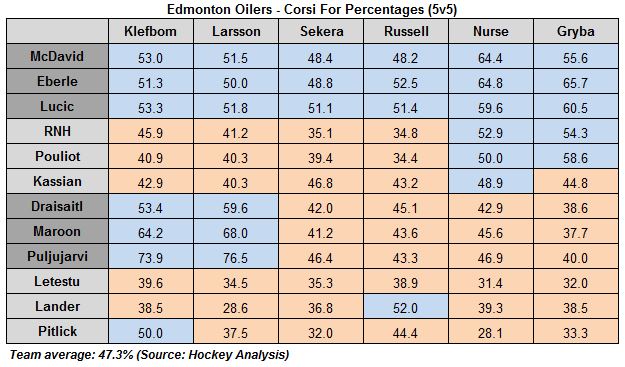
Corsi Percentage Combinations Between Forwards and Defencemen

Following the loss to the Rangers on Thursday night, the Oilers appear to be shaking up their forward line combinations. Prior to the game, I had looked into how the four most common lines have done thus far and found that three of the four lines have actually done reasonably well together when looking at possession and expected goals. Draisaitl’s line with Maroon and Puljujarvi was the one that I thought would show poorly in my analysis, but it appears that they have had some bad luck finishing their chances and should be expected to bounce back. Looks like the team is making changes regardless.

One thing I like to do periodically through a season is see how each defenceman has done with each of the forwards when it comes to their share of total shot attempts (i.e., Corsi For percentage, CF%). This is just a quick way to see if there are any patterns and any areas for concern when it comes to player deployment.

cb-20161105

Full article is at The Copper & Blue.

Oilers Looking Better Than Last Season

Originally part of the Good, Bad and Ugly post over at The Copper & Blue.

Coming off of a shootout win against the Islanders, the Oilers have now collected 17 points (0.708 points percentage) and sit on top of the Pacific Division, five points ahead of the Sharks, Ducks and Kings. Their +8 goal differential (all situations), ranks them third in the Western Conference, only behind Chicago (+12) and Minnesota (+11). After scoring twice on the powerplay in three attempts, the Oilers now rank 15th in the league with the man-advantage with 19.4%. They also rank 2nd overall when it comes to the penalty kill, sitting at 91.7%. Special teams performance fluctuates throughout the season, but that’s a nice way to end the week.

This team might cool off over the course of the month, especially with a tougher schedule coming up, but up until this point the Oilers are actually posting some numbers that indicate that they might be contending for a playoff spot in March. The Oilers rank 16th in the league when it comes to score adjusted Corsi For percentage (CF%), at 49.27%. This is up by a 1.18% from last season, when it was 48.09%, 20th in the league. (Source: Natural Stat Trick)

Why is Corsi For percentage important this early in the season? Because, as Charlie O’Connor of Broad Street Hockey demonstrated recently, it’s a good predictor of rest-of-season Corsi For percentage. And Corsi For% over a number of games is a good predictor of goals, which I hear is important for winning games. Here’s a list of the top 10 teams from 2015/16, ranked by their adjusted Corsi For percentage.

TEAM CF%
Los Angeles Kings 56.85
Anaheim Ducks 53.07
Pittsburgh Penguins 52.92
Nashville Predators 52.73
Dallas Stars 52.66
Tampa Bay Lightning 52.65
St Louis Blues 52.38
San Jose Sharks 51.9
Detroit Red Wings 51.78
Washington Capitals 51.52

We can also have a little more confidence that we’re looking at the ‘real’ Edmonton Oilers now as their PDO sits at 100.3. Both their shooting percentage (7.87%, 15th) and team save percentage (92.41%, 14th) at even-strength is right around league average again.

Having a CF% of 49.27% puts them right around where some of the playoff bubble teams, like Boston, Philadelphia, New York Islanders and Florida, were sitting last season. This doesn’t guarantee teams anything, but it increases their chances of making the playoffs considerably by having good possession numbers. Carolina, for example, had a great possession numbers throughout last season, but they also had the second worst team save percentage. Toronto was in a similar situation as they did well possession-wise, but they were sunk by poor goaltending and the worst shooting percentage at even-strength. The Oilers are a in a good spot with good goaltending from Cam Talbot (as long as he stays healthy), and enough skill up front to finish their scoring chances. If they can maintain a good CF%, by using the right on-ice tactics and deploying players properly, they should be able to compete for a playoff spot.

Reviewing the common line combinations this season and if changes are required

With the OIlers in a two game losing streak, and the looming regression hovering over them, I thought it would be worth looking into the current line combinations up front and to see if any changes are needed. Outside of the top line of Lucic, McDavid and Eberle, there hasn’t been consistent production, especially from forwards Maroon, Draisaitl and Puljujaarvi. I’m giving Nugent-Hopkins, Pouliot and Kassian a bit of a pass as they’ve been taking on the opposing team’s best players, and are doing a nice job playing on both sides of the puck. But I’ve still included them in this analysis to see how they compare to the other line combinations.

After 10 games, the Oilers have played four combinations with regularity at even-strength. Below is each line’s adjusted possession numbers, their expected goals (xGF%), which is a weighted shot metric, as well as their actual share of goals at even-strength. I’ve also included the difference between the lines actual share of goals (GF%) and their expected share of goals (xGF%) to see how far they might be from their expected levels. I’ve also included each line’s PDO, which has been used to measure their overall luck as both shooting and save percentage can be somewhat unpredictable. The data and the methodology behind expected goals is from Corsica Hockey.

cb-20161103

Full article is at The Copper & Blue.

Checking in on the Pacific Division

The Oilers are in a nice spot right now with a record of 7-2-1, good for second in the league, and fifth in the league when it comes to goal differential with +9. Their points percentage, which is their total points divided by the maximum points available, is second in the league, only behind Montreal, with 0.750 (Source: Hockey Reference).

What’s worth looking at this point is not only where the Oilers rank in the league, but also where they rank in their division. Please note, all data is for even-strength situations only. I’ve included Corsi For% as a proxy for possession, expected goals (xGF%), which attaches a goal probability to each shot, the actual share of all of the goals (GF%), as well as the team shooting and team save percentage. (Source: Corsica Hockey)

Full article is at The Copper & Blue.

Talking Oilers and their great start on CBC Edmonton (TV)

sunilcbc20161101

Joined Adrienne Pan on the CBC Edmonton news this evening to talk about the Oilers, their great start and if they can sustain their success.

Clip starts around 20 minutes in.

http://www.cbc.ca/player/play/798721603601

Also happy to announce that I’ll be a regular analyst on CBC Edmonton! Looking forward to working with some really great people. Big thank you to Adrienne Pan and Paul Moore for the opportunity.


Keeping an eye on the shots against

Oilers head coach Todd McLellan talked about areas of improvement yesterday, focusing on the number of shots the team is currently allowing.

In my opinion we’re still giving up too many shots. It’s a catch-22. Because I’d like us to be a volume shooting team, which means you get some from bad angles, from really, non-scoring areas, but it keeps the other team on its toes. I think we’ve been giving up some of those perimeter shots. We’ve also been giving up a lot of shots on our penalty kill, which has to get better in certain areas. A lot of shot  attempts are from face off losses, which is an area of concern. So I think there are three or four areas that we can tighten up and bring that shot total down. (Source: Inside Sports, 630 CHED)

First, let’s verify McLellan’s claims.

If we look at all situations over the first seven games, the Oilers have allowed 61.28 shot attempts per hour, which is the fourth highest in the league only behind  Long Island, Columbus and Dallas (Source: Corsica Hockey). Of the 420 minutes they’ve played, they’ve played 47 minutes killing penalties, which is the 5th most in the league. And when it comes to shot attempts on the penalty kill, they have the sixth highest rate of shot attempts against. The Oilers are also 19th in the league when it comes to faceoffs in all situations.

Full article is at The Copper & Blue.

Couple thoughts on the Oilers shot metrics, scoring chances + Radio spot

Something of interest this early in the season has been the Oilers scoring chance numbers, as they currently sit 5th in league with a 58.3% share of the total chances at even-strength (Source: Corsica Hockey). Obviously an encouraging number as the Oilers have been under 50.0% historically when it comes to this metric.

cf-and-scf-20161025

What’s interesting is that even though the Oilers are getting a higher share of the scoring chances after six games, (light schedule, only one game on the road, two against Calgary…minor details) the Oilers are still posting an adjusted Corsi For% less than 50%. This doesn’t seem like a sustainable output, as you’d think that generating scoring chances would be dependent on how often your team has the puck (with shot attempts being a good proxy for this). One thing I was curious about was how often teams have posted a below average adjusted Corsi For%, yet still had a higher share of scoring chances.

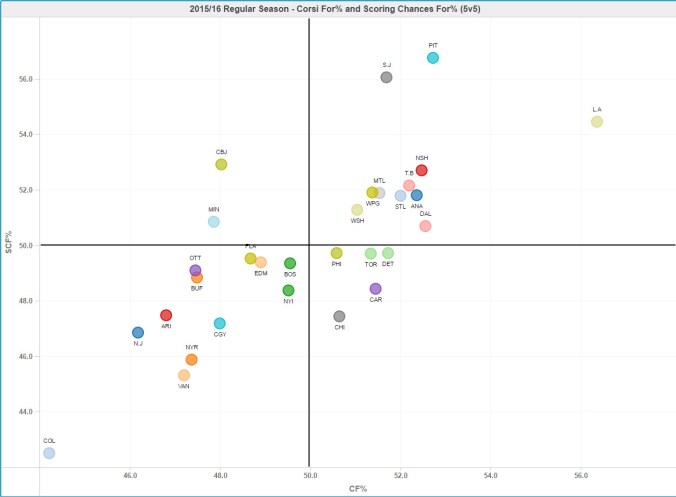
Below is a graph of every team and how they performed when it came to Corsi For% as well as their share of scoring chances last season, as defined by Corsica Hockey. I’ve added a black line for each metric to show the average.

cf-scf-2015-16_2


Here we see a pretty good correlation between possession and scoring chances. Most of the top teams from last season that finished with a higher winning percentage and/or did well in the playoffs are in the top right quadrant (i.e., >50% CF% and >50% SCF%). And in the bottom left are most of the clubs that missed the playoffs or were eliminated early on. Only two teams posted below average possession numbers and above average scoring chance numbers last season: Columbus and Minnesota.

So while you could interpret the Oilers early 2016/17 numbers as the team doing a better job at converting their shot attempts into scoring chances, the truth is that it’s hard to sustain and does not guarantee any success. I fully expect the Oilers share of scoring chances to come back down to earth if they continue to post below-average possession numbers, just based on how teams did last season. But if McDavid can continue dominating, creating chances on his own, and the team continues to ride out their higher-than-average shooting percentage to win more games, I’ll be thrilled.


Thoughts on the Oilers: Winning, Larsson, Russell and “Blue Collar”

adam-larsson-6of-the-edmonton-oilers-against-the-anaheimGreat start to the season for the Oilers winning four of their first five games. Big win over St. Louis tonight, and hopefully they can continue their streak heading into Winnipeg for Sunday. Worth noting, since I can’t recall this ever happening, that the Oilers are sending fans into their second weekend in a row in a good mood. Last week, the Oilers beat the Flames twice before Saturday rolled around. This week, a win over the Hurricanes and Blues. Enjoy this.
The concern for the Oilers should be that their possession numbers haven’t been the strongest over the first five games, but their share of scoring chances has been higher than their opponents at 5v5 (Source: Natural Stat Trick).

201617-cf-and-scf-20161020

Here were see that only against Buffalo and Carolina, the Oilers posted a Corsi For % (or  share of all shot attempts at even-strength) above 50%. It’s a little troubling that they got outshot in back to back games against the Flames, who have thus far played very poorly. On the flip side, the club is getting a higher share of the scoring chances, or quality shots, something that the Oilers have struggled to do for years now. I’d rather see the team start to get better possession wise, and develop a sustainable strategy to win games, including more regular contributions from lines outside of the McDavid line. Until they sort that out, I’d be happy to take these wins. For more on the correlation between Corsi and scoring chances with goals, definitely check out Stephen Burtch’s article at Hockey Prospectus. I do put more emphasis on Corsi as a predictor of future success, as there are more occurrences of it. But we’ll have to revisit all the metrics throughout the season.

Please note that Natural Stat Trick uses War on Ice’s definition of scoring chances (Source):

“So based on these measures, the average probability of a goal given the type and locations, and the consideration of team defense, we have these conditions for a “scoring chance”:

In the low danger zone, unblocked rebounds¥ and rush shotsƚ only

In the medium danger zone, all unblocked shots.

In the high danger zone, all shot attempts (since blocked shots taken here may be more representative of more “wide-open nets”, though we don’t know this for sure.)

Larsson

For me, the best player for the Oilers, aside from McDavid, has been Adam Larsson. Obviously it’s early in the season, but I think he’s been very effective with Klefbom. I would like to see a little more offence from him, but maybe that will come over time. He’s a better skater than I expected, and still plays an efficient physical game. To be honest, he reminds me a lot of Jeff Petry, in that he could make smart plays out of his zone and won’t be caught out of position often.

I’ve also been happy with the play of Russell, and his effectiveness playing alongside Sekera. As I noted last week, just based on Russell’s play in Calgary, and the underlying numbers derived from his 500+ games, my expectations were certainly low. The Oilers can spin their own version of analytics to justify the signing, but we already have a handle on what this player is capable of. If Russell can continue playing at the level he’s been at over the first five games, I’ll be thrilled. Having said that, his PDO is pretty high right now, and his possession numbers have been alright, so I don’t have my hopes up.

One other thing: I honestly wonder if Dallas hadn’t traded for him at the 2016 deadline, would Russell have this much support from fans and media members, especially from those that don’t value analytics. It’s almost like he instantly became the go-to example to argue against the value of shot-metrics and analysis that’s becoming more and more common. The fact is 29 other teams stayed clear of Russell when he hit free agency, as he had to wait until after training camps opened to land a one-year contract. I’m still hoping for the best for him as a fan, but the quest to dispel analytics using Russell as the centerpiece is bizarre.

Watching him play in Calgary and Dallas, and his overall performance in the defensive zone, I didn’t see anything that made him effective. He’s never driven offence for his teams, he’s never been able to suppress shots or keep the majority of shots outside. Just based on those viewings alone, I’d agree completely with Ferraro. If you haven’r already, I highly recommend checking out Matt Henderson’s recent piece on Russell over at OilersNation.

“Blue Collar”

The Oilers have a new opening video for the 2016/17 season that plays before each game. It’s really well produced, something different than years past, and is worth checking out:


Here’s my issue though: try as they may, the Oilers, and every other billion dollar professional sports franchise needs to stop trying to connect with the “blue collar” concept and culture. It’s painful to see shots of Edmonton’s inner city, and the rough train yards, and the gritty bridges, when the Oilers have completely priced out the people they’re trying to align their identity with. The average cost of an Oilers game is one of the highest in the league right now and merchandise continues to be out of the reach of many fans. It was also amusing to see the Oilers include shots of the city that could use some repair, considering how much money the city of Edmonton diverted to the new arena for a billionaire  owner. I don’t mean to take anything away from the production of the video. It’s excellent. But some of the narratives the team tries to create, and even what McLellan mentioned about playing in Alberta, is pretty disingenuous and somewhat condescending.

Thoughts on the Oilers: Current roster, offseason moves and the upcoming season

larssonLooking forward to getting the regular season started. The Oilers made a lot of significant changes with trading away Hall and Yakupov, and brought in some new assets like Larsson and Lucic that will hopefully right the ship of this bottom-feeder franchise.

The other good news is that it looks like Klefbom has recovered from his staph infection from last season, and that McDavid might actually be faster than last season. If these two can stay healthy, and if Talbot can start and finish the season strong, the club will make progress. My guess is that the Oilers land around the 80-85 point mark, and will finish somewhere between 10th and 12th in the Western Conference. And make no mistake, if the Oilers do take a step forward, it’ll be because of superstar performances from McDavid, Klefbom and Talbot. Lucic and Larsson are good additions, I think both can contribute next season, but the club has too many weaknesses to be a competitive team.

I’ve harped on this before, but the goaltending tandem could’ve been better, as I don’t think Gustavsson is an NHL goalie. There were better options available, yet the Oilers paid a million to a guy who wasn’t exactly in high demand. Talbot has been a fine acquisition, but twice now he’s struggled once taking over a starting position (once in New York, and last season with Edmonton). The Oilers are banking on Talbot starting well and starting often.

The defence is better than last season, but there are still too many question marks for my liking. I may not have liked the trade to acquire him, but I am looking forward to seeing Larsson paired with Klefbom in a top four role that can play in all situations. Sekera will probably be his steady self, but the rest of the defence core I’m a little unsure about. Fayne I’m a fan of, and he played well with Sekera last season, and really should be paired with him agais, but the Oilers don’t seem to want him around. Davidson was great last season in a depth role, and that’s where I’m hoping the Oilers continue to play him this coming season. There really is no reason the Oilers should be eager to push him up the chart. If injuries happen, sure. But why not play him at his established playing level? I’m also a fan of Nurse, but I’d prefer to see him spend a full season in Bakersfield and get him lots of ice time there in different situations. The team admitted that they had to rush his development last season because of all of the injuries (and their weak depth on defence), so I don’t understand what their excuse is this year. Russell is another average to below-average defenceman that doesn’t really push the needle, but he does bring experience. More on him in a second.

As for the forwards, the team has plenty of skill and a range of ability. McDavid is really the only driver among the group who has the ability to carry a line on his own. Lucic, Eberle, RNH, Pouliot are all established forward, and we know what we can expect from this group. I’d love to see Draisaitl take a step forward (as a center) this coming season. He’s up for a contract, so there should not be any sort of sheltering. The team should know what they have in him before signing him long-term or opting to bridge him. There’s a little more uncertainty among the rest of the forwards. In my mind, Caggiula and Puljujärvi should be in Bakersfield for at least 30 games so that they can adjust to the professional game and for the Oilers to get a better read on what they have. The scouts have obviously seen what these two can bring, but there’s no way they can be certain of it until they see them in a setting and system that the Oilers are familiar with. I never understand the hesitation in sending guys away to develop. Chiarelli was fine doing that in Boston with guys like Pastrňák, but appears to be embracing the Oilers way.

The Oilers should be focused on establishing a window, a 5-7 year period, where they can compete for the Stanley Cup. Winning the cup requires a lot of luck, so if they can be in the hunt for an extended period, I would consider that a success. Chiarelli really only built a two year window in Boston, something a lot of teams can do, and was fortunate to have elite goaltending and a hall-of-famer defenceman to build around. Hopefully he does better than that in Edmonton.

Here’s what I learned about the Oilers this summer: the current management group aren’t going to be outside the box thinkers, which is extremely disappointing. And I’m not just referring to utilizing analytics to contribute to their decision making. I’m talking about exploiting inefficiencies, finding value contracts, controlling assets, leveraging their strengths, that sort of stuff. The things that teams like Florida and Carolina are doing, or trying to do. The Oilers can easily use their resources (outside of the cap) to get a step on their competition, but it appears they’re going to do what’s tried and true. I was hoping that the acquisition of Maroon (and that sweet value contract) was a sign of things to come, but it appears at this point to be an anomaly.

Because of the controversial moves this summer (Hall vs Larsson, etc), and really the divisive nature of social media, we’re going to see a lot more of this type of trolling. And lets make one thing clear: the “analytics” don’t say anything, (it’s a process to find meaningful patterns and correlations in data), but the individuals who interpret and analyze the data will have a voice. If you have an issue with someone’s analysis, go after that individual rather than clumping everyone together; it pushes a specific topic along and adds more to the overall discussion. Believe it or not, there is plenty of debate among those within the analytics community, so it doesn’t make sense to group everyone together.

I’m also finding the growing support of Russell to be suspiciously quick. I’d be all for adding someone with 500+ NHL games, but only if it meant prospects like Nurse and Reinhart would be both pushed down to the AHL. Russell is a below average defenceman (doesn’t push a team’s offence, doesn’t suppress shots and chances against), who can play in your bottom four with limited, often sheltered, minutes. So all of the hype of him being anything above average is nonsense. And if you’re going to talk about his micro-stats (i.e., puck retrieval counts, preventing zone entries), (1) demonstrate it’s repeatability, (2) demonstrate it’s correlation to shots and goals (or things that are important to winning games), and (3) make your data available so it can be reviewed. I’ve seen enough of this player’s on-ice ability and his underlying number to have formed an opinion on him. If he can play better than his previous performances, I’ll be thrilled.

Recommended links:

Will Kris Russell Help? – Beer League Heroes

A Few Words – OilersNation

What Could Have Been vs What Might Be – Copper & Blue

Puljujarvi Gifted a Spot? – OilersNation

Mission Accomplished – Black Dog Hates Skunks