Checking in on Mark Fayne

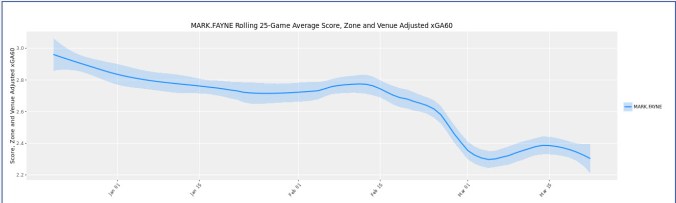
FaynexGA60Rolling25At the start of the season, it appeared all hope was lost for defenceman Mark Fayne. He was clearly struggling with the new system, as foot speed and reaction time appeared to be an issue. His numbers reflected it, as the shot attempts against and the shots on goals against often increased when Fayne was on the ice. This translated into a higher expected goals against/60, which factors in shot type, distance and angle, and if the shot was a rush shot or a rebound. More on how shot quality is calculated can be found at Corsica Hockey.

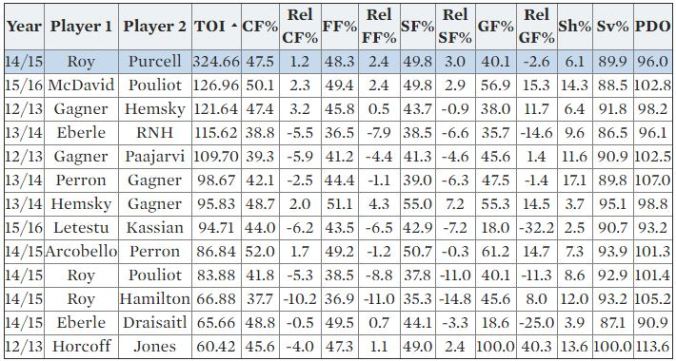
Here’s how the most common Oilers defenceman did as of December 9th, 2015, the day that Fayne was demoted to Bakersfield. I looked into the defensive rates (i.e. “per 60”) metrics: shot attempts against (CA/60), unblocked shot attempts against (FA/60), shots on goal against (SA/60) and expected goals against (xGA/60). Please note that the stats are score, zone and venue adjusted, based on Corsica Hockey’s methods, to give a more accurate assessment of player performance. Tables are sortable.

Full article is at The Copper & Blue.

Talking Oilers powerplay, developing defencemen and centers on The Lowdown with Lowetide

Joined Lowetide this morning on TSN 1260 to talk Oilers. Full audio below:

Related Links:

Oilers Performance When Trailing and When They’re Leading

Earlier this week, I looked into how the Oilers have done this season when they have a one goal lead. I was at the Nashville game and watched the team blow two one-goal leads and eventually lose the game. The majority of the chatter online and on the radio afterwards was about the goaltending and Laurent Brossoit’s poor play. But when I dug a little deeper, I found that the Oilers as a whole absolutely crater when they have a one-goal lead, a trend since the start of the season. When it comes to possession, generating scoring chances and most importantly scoring/preventing goals while the team is leading, the Oilers see a significant drop from their usual performance levels.

I received some positive feedback about the analysis, and was asked by a reader how the Oilers do when they’re actually trailing in a game. Based on how they’ve played and the lack of wins overall, combined with their injury issues, my guess was that the Oilers were not very good when trailing in games. I could only recall a few games where they played well while trailing, so I thought it’d be worth looking at the data.

First up, I created a new graph that compares how the Oilers do in all-score states at even-strength, with how they do when they’re leading in a game. My previous article looked specifically at when the Oilers lead by one, so this expands the dataset slightly. Unfortunately, we still see that compared to the NHL average, the Oilers take a significant drop from their standard level of play when it comes to possession, scoring chances and goals. They don’t lead in a game often (they rank 27th in the league in ice time) and sit near the top of the league when it comes to how big of a drop they take from their typical performance levels (Source: War on Ice).

Full article is at The Copper & Blue.

Exploring the Oilers’ Powerplay Issues

The Oilers powerplay has received extensive criticism this season as the club sits 19th in the league with a 17.5% success rate. The expectations were high as Todd McLellan and Jay Woodcroft ran very good powerplays in San Jose, even finishing in the top three in the league a few times. At the start of the season, Woodcroft discussed some of the concepts the coaching staff were going to instill and what would make them successful.

Everything for us comes off of the shot so we want to encourage our team to shoot the puck and we have clear retrieval points of how to get the puck back once the shot is taken. Teams in the NHL are very good on the kill, they bring a lot of pressure and so it’s very important that everyone is on the same page, but again, no set plays. We have principle and structure rather than set plays. (Source: OilersNation)

We know from past research that the generation rate of unblocked shot attempts (i.e., Fenwick For/60) is a good predictor of powerplay success (Source: Objective NHL). Unfortunately, this aspect of the game has been an issue all season for the Oilers as they don’t generate enough shot attempts on the powerplay, and often have their shots blocked. While premier powerplay teams like the Capitals, Ducks and Bruins also lead the league in Fenwick For per 60 (FF/60), the Oilers rank 19th (at 62.04) with little progress since October. Below is their 10-game rolling average of FF/60 on the powerplay this season (Source: Corsica Hockey).

Full article is at The Copper & Blue.

Playing For Jobs

Some interesting comments from Todd McLellan this morning, who talked about the importance of players doing well over the last stretch of games. McLellan specifically mentioned those who will be restricted and unrestricted free agents this summer and referenced players from last seasons roster.

I did a study the other day and went back and looked at Edmonton’s roster from last year and the number of players that played in an Oiler jersey at one point. And, if I’m driving home in my car and I’m saying to myself “well if it’s not in Edmonton it’s going to be somewhere else”, I’d go do that homework. Because for a lot of them it wasn’t somewhere else, it was nowhere. And we’re in 28, 29, 30 range. Those players aren’t quite as desirable as Stanley Cup champs even if it’s on par. (Source: 630 CHED)

For reference, here’s the list of UFA’s and RFA’s this summer (Source: General Fanager). McLellan did mention that even the top players need to do well over this last stretch, but we know moving guaranteed contracts is a lot tougher.

Full article is at The Copper & Blue.

The Oilers and One-Goal Leads

After blowing two one-goal leads last night against the Predators, I thought it would be worth looking into the underlying numbers to see what might be going on with the Oilers. This wasn’t the first time the Oilers played so poorly with the lead as it’s felt like a reoccurring issue since the start of the season.

Now you could make the case that the Oilers have poor underlying numbers in all score situations at 5v5 to begin with. And that it shouldn’t come as a surprise that they’re bad with a one goal lead, which is fair. Below are the Oilers numbers when it comes to their share of shot attempts, scoring chances, and goals for, along with shooting and save percentage (5v5) this season in all score situations and when they lead by one (Source: War on Ice).

METRIC ALL SCORES LEADING BY 1
Corsi For% 49.3% (18th) 44.2% (22nd)
Scoring Chances For% 49.3% (21st) 42.1% (25th)
Goals For% 43.7% (29th) 34.8% (29th)
Shooting% 7.0% (21st) 7.7% (12th)
Save% 91.5% (27th) 88.7% (30th)


Full article is at The Copper & Blue.

Getting Shots Through From the Blueline

Last week, I looked into how the Edmonton Oilers were doing when it came to generating rebounds, and found that overall, the team is doing better compared to previous seasons. It likely has to do with McLellan’s tactics as he and his coaching staff have preached about the importance of shot volume and attacking the blue paint since October.

What’s also become critical for the Oilers to generate scoring chances is getting the initial shot on goal from the defence, something that the OIlers have been struggling with since the start of the season. As of today, the Oilers have 27.6% of their shot attempts blocked at 5v5, one of the worst percentages in the league, ranking them 27th overall. This is definitely something the Oilers’ coaching staff is aware of and was even pressing when it came to Justin Schultz’s performance back in December.

The one area we continue to emphasize with Justin is the willingness to continue to shoot the puck. The ability to hit the net when you do shoot the puck. And letting him know that, and encouraging him that, when you do shoot that creates offence for everybody. Even if that first shot doesn’t get in, if it gets through, that’s what leads to the second chance or third chance. But it’s vital that that shot gets through from the top. – Assistant Coach Jay Woodcroft on Inside Sports (Source)

Lately, I had been noticing that Andej Sekera’s shots in particular were getting blocked more often than his teammates, but figured it was because he was on the ice so often and taking plenty of shots to make up for it. When I came across a few tweets from fellow bloggers, I thought it would be worth looking into.

Full article is at The Copper & Blue.

Talking Oilers, lineup changes, unknown Finnish players on The Lowdown with Lowetide

Joined Lowetide this morning on TSN 1260 talk Oilers. Audio below:

Couple notes:

  • For those interested, a great new source of hockey data is Corsica Hockey. War on Ice is shutting down after this season, but Manny Elk is looking to replace it and introduce some pretty neat tools. Definitely check it out and consider donating to support his work. His project is going to be very transparent, and is intended for public use and knowledge development (things that are critical for modern day fans…can’t say enough about it).
  • I mentioned Patrick Maroon as being very good at getting to rebounds (defined by Corisca Hockey as shots taken within two seconds of the original shot). Rebounds are only part of the game, but they can still give us insight on which players are getting to rebounds, and also which are on the ice for rebounds against (good way to analyze defenceman). I looked into this last week at Copper and Blue.
  • If you’re interested to learn more about the Oilers newest signing Jere Sallinen, definitely check out Bruce McCurdy’s work as well as Jeff Velilette’s. I’ll admit my knowledge of European leagues is limited, so I tend to look to others for insight.
  • I also mentioned the Oilers Nation podcast, North by NorthGretz, which you can listen to here.

The Oilers and Rebounds

An area that I expected the Oilers to improve upon this season was overall shot generation and creating chances around the opponents net. This was mainly due to the fact that Todd McLellan had a lot of success in San Jose relying heavily on volume shooting to control the possession battle and win games.

Volume shooting, I don’t know what that does to Corsi or Fenwick because I don’t even know what those things are, but volume shooting is important. I think it breaks down defensive zone coverages, gets players out of position, taxes the opposition, makes them play more minutes in their zone. – Todd McLellan (Source)

Couple things to keep in mind when it comes to McLellan’s volume shooting. From my own analysis last summer, I found that a higher proportion of shot attempts (i.e., Corsi) came from the defence core in San Jose when McLellan was coaching. It was also found in the data from zone entry projects that McLellan’s Sharks weren’t very strong in the neutral zone, but found success by dumping the puck frequently and generating chances off of that (Source: Hockey Graphs).

So far it looks like the Oilers have implemented McLellan’s tactics and have improved when it comes to overall shot attempts per 60 minutes at 5v5. The issue is that they still allow a lot of shot attempts, so they haven’t exactly seen their share of shot attempts improve much (Source: Corsica Hockey).

Full article is at The Copper & Blue.

Scrappy, Meat and Potatoes Hockey

Since the disastrous home-stand a few weeks ago where the Oilers lost five straight, the club has been playing much better, going 4-3 and posting some respectable numbers. Of the three losses, I’d say that the only one that really stung was against the Blue Jackets. The other two losses were tight games, on back-to-back nights, against Los Angeles and Anaheim, who at this point are two legitimate Stanley Cup contenders. All in all, it’s been a solid run, but one in which the Oilers have been getting a 94.5% save percentage from their goaltending at even-strength (Source: War on Ice).

What I’ve found odd is the teams emphasis on being “scrappy” over this recent stretch of games. I honestly can’t think of a day where Todd McLellan or one of the players haven’t mentioned the word “scrappy” or “meat and potatoes”. This just doesn’t jive well since it;s obvious that the team is relying on some outstanding goaltending and haven’t really improved much in other facets of the game like team defence or shot generation.

I get that the team has been playing some physical games, with plenty of fights and after-the-whistle events. But if these things don’t translate into goals and wins, I tend to overlook it. But I figured it’d be worth looking into the numbers a little more to see was if I was missing something that would suggest that this team might be turning a corner and actually playing a “scrappy”, hard-to-play-against style. And if they are in fact playing a new style, then it should show up in the numbers, especially the ones that measure the different events against.

Full article is at The Copper & Blue.