CBC Radio Active: Oilers are back in town

I joined Jessica Ng on CBC Radio Active to talk Oilers and preview their fifth game against the Los Angeles Kings. Full segment is here: CBC Radio Active (2023, April 25)

Topics we covered:

  • How the Oilers have started in each of their first four games, and what needs to improve.
  • The Oilers overall performance, what they’ve done well and where they’ll need to improve. Had posted an article last night on this as well.
  • Why Stuart Skinner should remain as the starting goalie for the Oilers.
  • The Oilers scoring issues, and how the Oilers depth players can make an impact.
  • The penalties being called and why we should expect the volume of calls to drop. Referenced this piece by Cam Charron from The Athletic.
  • The idea of Dylan Holloway getting some minutes in the playoffs.

Thanks as always to the team at CBC for putting it all together.

Check engine

Tied at two-games apiece, a quick glance at the Edmonton Oilers performance and results in their first round series against the Los Angeles Kings and what their strengths and weaknesses have been.

Starting with even-strength (5v5), the Oilers have done everything they can to increase their odds of out-scoring the Kings and winning games. They’ve controlled the flow of play for the majority of the series, spending more time with the puck as reflected by their 58% Corsi For percentage, and getting a higher proportion of the total shots and scoring chances. The Oilers are currently generating the highest rate of shots on goal in the playoffs with 38 per hour, while keeping the Kings under 28 shots per hour (ranking 11th among the sixteen playoff teams). For context, the Oilers and Kings generated around 32 shots per hour in the last twenty-five games of the regular season, which had them in the top ten league-wide.

Edmonton Oilers Games 1-4 (5v5) Los Angeles Kings
57.75 Corsi For% 42.25
59.04 Fenwick For% 40.96
55.87 Expected Goals For% 44.13
7-7 GF-GA 7-7
5.06 Shooting% 6.99
93.01 Save% 94.94

Using Natural Stat Trick’s methods of calculating expected goals (which uses shot type, shot location and historical scoring data to determine the probability of a shot attempt becoming a goal), the Oilers – in theory – should have scored twelve even-strength goals in the first four games. But because the Kings goaltending has been solid, ranking second in the league with a save percentage of 94.94%, they’ve only mustered seven goals. Had the Oilers converted 9.09% of their shots against the Kings into goals like they did over the full regular season, instead of the 5.06% shooting percentage they’re sitting at right now, they’d easily have scored twelve, and I highly doubt three of the four games would have gone into overtime.

Worth noting too that the Oilers goaltending at even-strength has been good enough this playoff series. posting a 93% save percentage so far. Again using the expected goals method from Natural Stat Trick, the Kings should have scored nine goals based on the scoring chances they’ve had – but they’ve only scored seven. Part of that is missing some of their better scorers like Kevin Fiala for the first three games of their series. But the Oilers goaltending has been decent as well, ranking 6th in the post-season, just behind Boston.

As for special teams, the Oilers powerplay has continued to amaze, generating the highest rate of of shots and scoring six goals in the four games – a rate of 25 goals per hour which is almost double what they posted in the regular season. Worth noting that despite having the puck for the majority of the series, the Oilers have somehow drawn the second lowest rate of penalties in the post-season (3.19). The Kings who took the thirteenth highest rate of penalties in the regular season have apparently changed their ways – amazing, really.

The Oilers have really needed their powerplay to be incredible as their penalty kill has struggled against the Kings, largely because the goaltending has been poor when shorthanded. The Kings had one of the best powerplays in the league this regular season, and the Oilers skaters are doing everything they can to limit their chances. Edmonton’s penalty kill has so far only allowed 21 shots shorthanded, a rate of 46.7 shots per hour, which is the sixth lowest among playoff teams and well below the rate the Oilers were at in the regular season (58.31). Unfortunately, the goaltending is currently posting a 76.19% save percentage, which ranks 13th among playoff teams. If the Oilers struggle to score at even-strength, the powerplay is going to need to bail them out. But if the penalty kill is going to bleed goals like this, it won’t matter. The goaltending needs to be better.

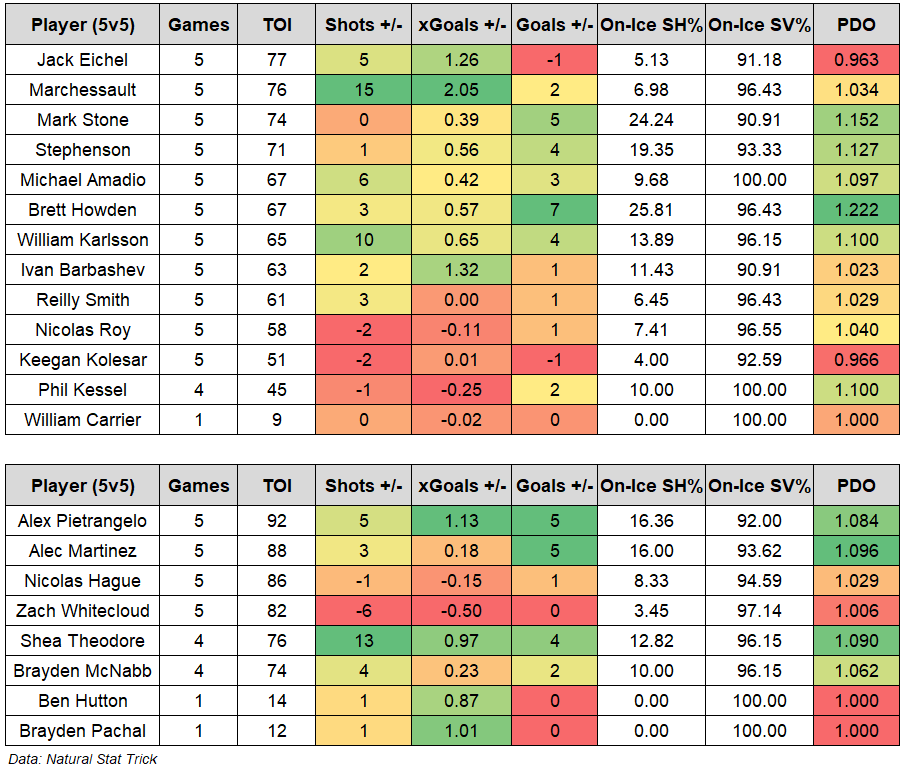
Back to even-strength. It’s really important to emphasize how well the Oilers are performing with and without their star players. In 81 minutes so far without McDavid or Draisaitl on the ice – or about 38% of the team’s total time – the Oilers have posted a 57% Corsi For percentage and Expected Goals For percentage. As we’ll see below, players like McLeod, Foegele and Ryan are really taking advantage of the Kings third and fourth lines. The problem of course is that the Oilers depth players haven’t scored a goal (0 GF, 3 GA) despite having the puck more often and getting a greater share of the shots and scoring chances. Unless Draisaitl, who has been on the ice for every Oilers goal scored this series, is getting double-shifted with the depth players, there isn’t much happening on the score sheet.

Below is a breakdown of each player’s on-ice numbers at even-strength in the first four games, sorted by time on ice. I’ve split the table into forwards and defencemen and added a simple heat map to show how each player compares relative to their teammates.

The concerns I would have for the Oilers is their defensive play, and some of the breakdowns when things get chaotic in their own zone. We’ve seen the Kings sustain pressure in the Oilers zone a few times now largely because of the mistakes the Oilers were making. Really have to wonder if this group can keep it together for an entire post-season, and if they can cut-down their recurring mistakes especially by some of the defencemen. There really aren’t any other options for the coaching staff, as this is the group of seven defencemen we’re going to be seeing the rest of the way.

There should also be a little concern with the Oilers depth players. The Oilers posted great numbers without McDavid or Draisaitl in the regular season, but they’ve gone completely dry in this first round. We know the top six group will find ways to score, especially if Draisaitl and McDavid remain healthy. The problem is that a lot of the depth guys posted career individual shooting percentages in the regular season, so this might be when we see the regression. And their decline isn’t completely surprising. Over the full course of the season, the Oilers shooting percentage without McDavid and Draisaitl on the ice was 8.34%. But in the last twenty five games, it had dropped to around 7.01%.  This is hockey, so things can turnaround with a lucky bounce or two. But the coaching staff may need to tinker with the line combinations to get something out of the depth (i.e., non top-six) players.

Also worth keeping an eye on the goaltending situation and if the coaching staff has some doubts with Skinner’s play and begins to develop more confidence with Campbell – especially after his performance in game four. Skinner has had a solid season, but his numbers did take a slight dip near the end of the season. He’s always been right around league-average, but with the workload he’s had in his rookie season it’s not totally surprising to see him struggle. The workload of course was driven by the fact that the coaching staff didn’t have as much confidence in Campbell, especially as the season winded down and the Oilers were pushing for a higher playoff seed.

Data: Natural Stat Trick, NHL.com

Previewing the Oilers vs Kings (2023)

With the first round of the playoffs set to begin, I wanted to get a sense of how both teams finished the season, what their key drivers were and how individual players performed.

The Oilers we know have been outstanding this year, going 20-4-1 in their final twenty-five games of the regular season, a points percentage of 0.820 – second best in the league only behind Boston who went 21-4-0 in their last twenty five games. The Oilers had the second highest all-situations goal-share in the league to finish the season, posting a +42 goal differential due in large part to their outstanding play at even-strength (offensively and defensively), and their production on the powerplay and penalty kill.

The Kings had excellent results as well over their final twenty-five games, going 15-7-3 – which translates into a 0.660 points percentage that ranked ninth highest in the league. Similar to the Oilers, they posted an excellent all-situations goal-share in this period, with a +21 goal differential that was sixth highest in the league. A lot of their success was at even-strength, as well as their powerplay.

Even-strength (5v5)

Here’s how the two teams performed at even-strength (5v5) over their final twenty-five games. Both clubs ranked near the top of the league for the majority of the metrics.

Team Oilers Kings
Points% 0.820 0.660
Corsi For% 56.03 54.91
Fenwick For% 55.60 56.01
xGoals For% 57.19 55.64
Goals For% 56.03 57.61
Shooting% 9.64 8.05
Save% 91.14 92.10

The two clubs are fairly evenly matched when it comes to shot-share metrics, with both teams posting a Corsi For% and Fenwick For% around 55% – right around what top teams typically post. Where the Kings have struggled recently is finishing their chances, as their 8.05% shooting percentage ranked 25th league-wide. The issue has been the absence of Kevin Fiala, who the Kings need healthy and ready for the playoffs. With him on the ice this season, the Kings have a 9.77% team shooting percentage at even-strength. And without him on the ice, it drops down to 7.60%. Full details on how the Oilers and Kings rank within the western conference can be found here. 

Goaltending (5v5)

Both teams got decent goaltending to end the season, with the Oilers ranking 13th with a 91.14% team save percentage, while the Kings ranked slightly better at 11th. Below are the Oilers and Kings goalies from the last twenty-five games, with their rankings for each metric among the 59 goaltenders who played at least 250 minutes.

Goalie (5v5), last 25 GP TOI Save% GSAA High-danger Save%
Joonas Korpisalo 11 501 93.2%
(8th)
2.36
(21st)
87.1%
(8th)
Pheonix Copley 14 641 92.1%
(19th)
2.65
(19th)
83%
(28th)
Stuart Skinner 20 943 91.9%
(23rd)
3.65
(15th)
82.2%
(31st)
Jack Campbell 6 273 89.5%
(44th)
-2.34
(40th)
80.4%
(37th)

Among the four goalies, Korpisalo appears to have had the strongest stretch at even-strength, with his save percentage and high danger save percentage among the top ten league wide. Skinner on the other hand has been slightly above average for the most part, and should be able to get the job done. Concern I would have is with his high danger save percentage, which might be a problem against a Kings team that generated the eighth highest rate of high-danger shot attempts in their last twenty five games.

Special Teams

The Edmonton Oilers powerplay had a strong finish to the season, generating the second highest rate of shots per hour (68.40) in the league over the final twenty-five games, and scoring over 14 goals per hour – the best in the league. These numbers were consistent with their full-season results on the powerplay, largely driven by their top end players and their overall tactics.

While not at the Oilers superhuman levels, the Kings did have some success on the powerplay, generating 8.39 goals per hour in their last twenty-five games, which ranked ninth in the league. The Kings team shooting percentage was one of the best in the league with 17.71%, which was critical considering they generated some of the lowest rates of shots and scoring chances.

Powerplay (Last 25 games) Oilers Kings
Shots for/60 68.40 (2nd) 47.37 (26th)
Goals for/60 14.32 (1st) 8.39 (9th)
Team shooting% 20.93% (1st) 17.71% (5th)

Neither team had anything special going on with their penalty kill, with the Oilers rate of goals against ranking 11th, while the Kings ranked 19th. Both teams were around average when it came to allowing shots against, with the Oilers getting the better goaltending as the team posted the ninth best save percentage in the league with 88.79%.

Penalty Kill (Last 25 games) Oilers Kings
Shots against/60 52.50 (17th) 50.03 (12th)
Goals against/60 5.88 (11th) 7.77 (18th)
Team save% 88.79% (9th) 84.47% (23rd)

The Oilers did score nine shorthanded goals over their last twenty-five games, a rate of 4.07 goals per hour which is more than what the best teams score at even-strength. Nice little competitive edge if the Oilers have figured out how to make this repeatable.

Skaters (5v5)

Another thing I wanted to see ahead of the series was how the players on each team did in terms of on-ice shot and goal differentials at even-strength (5v5) over their teams final twenty-five games. Just to get a sense of which players are playing well, but might not be getting the results.

Below are all of the Oilers skaters, sorted by their on-ice goal differential (Goals +/-), with the Oilers top end players leading the way.

As mentioned in my previous post, one of the Oilers strengths this season has been their depth scoring. In their last twenty-five games, the team has posted a Corsi For percentage of 53% and an Expected Goals For percentage of 56% without McDavid or Draisaitl on the ice. Unfortunately, they just broke even when it came to goal-differential, something that should improve with McLeod now back from injury.

On the back-end, the Oilers have an excellent tandem in Bouchard and Ekholm, which has helped alleviate some of the workload that was on Nurse and Ceci. It’ll be worth monitoring how the two pairs will be deployed on home ice, and with which of the top two lines they spend more of their time with. Both Ceci and Kulak are going to be critical for the Oilers; both struggled to close the season so it’ll be interesting to see how the coaching staff deploys them.

Up front, I’d have some concerns with guys like Kane and Janmark, who have received plenty of opportunity but can’t seem to break even when it comes to shots, scoring chances and goals. The Kings can definitely target the lines these two will be on when the series moves to Los Angeles. Suspect the line that could have the biggest impact for the Oilers is the one McLeod and Foegele are on. They were gradually getting more ice time to close the season, and I suspect they’ll get a lot more responsibility.

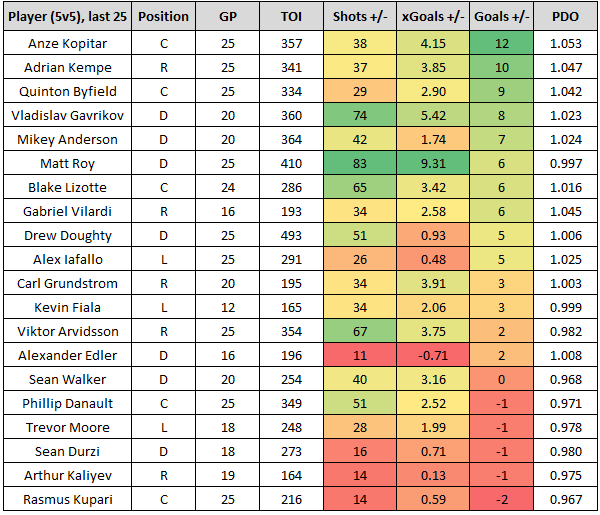
And here’s a quick glance at the Kings skaters.

Thoughts

While the Oilers should be favorites to win this series, I think it’ll be a lot more competitive than people expect. The Kings were very good defensively, allowing the fourth lowest rate of shots against in the league and the second lowest rate over their last twenty-five games. If it does become tighter checking, with low-event hockey on both ends of the ice, I do wonder how much will come down to goaltending where the Kings have a slight edge.

My other concern would be with the Oilers coaching staff over-thinking things like they did last season, trying to play inferior players higher up in the line-up to solve problems that don’t exist. And when issues do come up, hopefully they’re identified faster than they were in the past. We saw last post-season that the Kings, and even the Flames, controlled the flow of play against the Oilers – especially the depth forwards. Teams did figure out the Oilers in every facet, even after they posted excellent shot-share numbers and special team numbers in the regular season. Whatever happens, the Oilers have put themselves in an excellent spot, and they should be expected to win more than a round this time.

Data: Natural Stat Trick

The SuperFan Podcast – Episode 52 – Previewing the Edmonton Oilers post-season with Dennis King (@dkingbh)

Joined by Dennis King (@dkingbh) on the show to talk about the Edmonton Oilers finish to the regular season, and what to expect in their first round series against the Los Angeles Kings. We also covered the rest of the western conference, who the contenders are and what the Oilers will need to do right to make a deep run.

Full segment below:

Related articles:

Podcast channels:

Music: Anitek. “Show me.” Anitek Instrumentals Vol. 4, 20

Tracking the Western conference – As of April 14, 2023

Last check-in on the western conference before the 2023 playoffs begin next week.

The Oilers finished second in the Pacific division, going 18-2-1 since my last check-in at the end of February. They’re easily one of the best teams in the league, and should be considered one of the favorites coming out of the west this post-season.

Couple reasons for optimism.

The Oilers have consistently posted some of the best shot-share numbers in the league, ranking highly when it comes to the rate of generating shots and scoring chances as well as preventing them. I think that’s something that tends to get overlooked – the Oilers have over the course of the full season been a pretty solid defensive team, doing everything they can to help their goaltending.

The Oilers actual results have been very good. They finished with the second highest number of regulation wins in the league with 45 – a good indicator that they’ve been winning games decisively and not leaving things to chance in overtime and shootout. Three other teams in the west rank amongst the top ten teams with the highest number of regulation wins – Dallas ranks 6th with 39, Vegas ranks 7th with 38 and Los Angeles ranks 10th with 37.

The Oilers have also been able to control the flow of play really well, as reflected by their shot-share numbers. And they’ve actually outscored opponents without McDavid or Draisaitl on the ice at even-strength. In 1,831 minutes without one of both of them on the ice, or 46% of the team’s total time, the Oilers posted a Corsi For percentage and an Expected Goals For percentage of 53%. And they posted a +14 goal differential (74 goals for, 60 against).

The one area that could be an issue is goaltending. It’s been a great story this year with Stuart Skinner, and how he had to take on a starting role with Campbell struggling. But the team’s 91.34% save percentage finished 16th in the league and 8th in the western conference. Among the eight teams from the west that have qualified for the playoffs, their save percentage is only better than Los Angeles’ and Seattle’s. It could be good enough for the playoffs, but I don’t expect the Oilers goaltending to win the team any games if games get tighter.

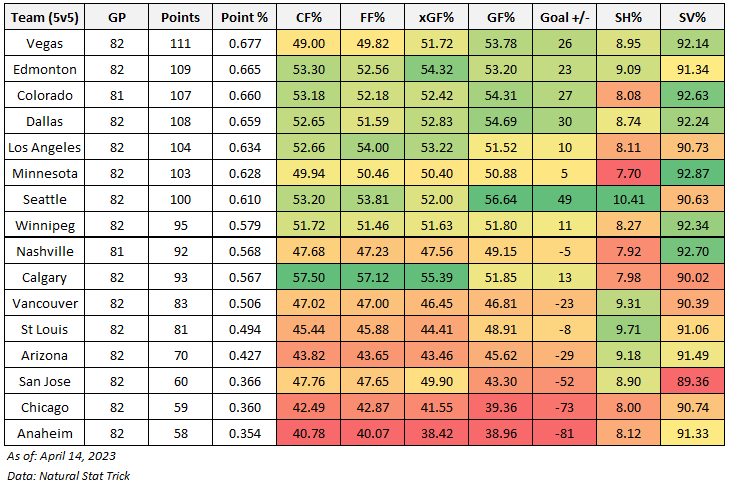
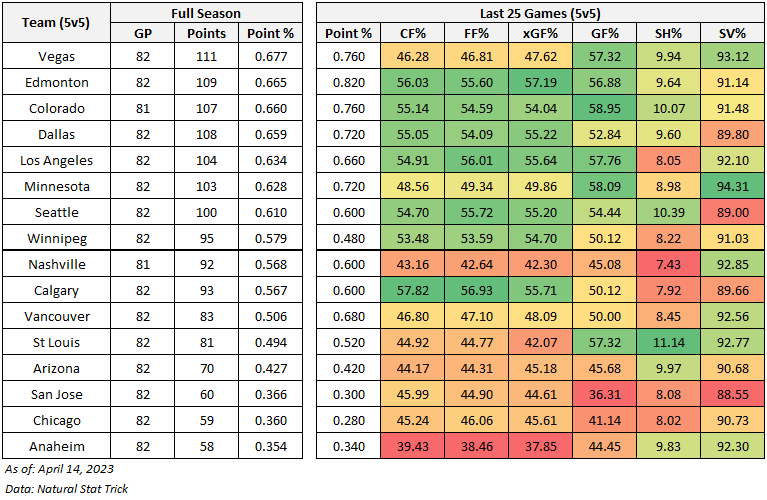
Quick glance into how each team played in their last twenty five games (since around mid-February). Helps get a sense of what each team’s strengths and weaknesses are and how it could translate into their post-season results.

The team that stands out is Vegas, as it appears their possession numbers have slipped significantly and are relying on their goaltending to bail them out. They might be okay, considering how much of an impact goaltending has on playoff results. Plus they do also have Mark Stone coming back into the lineup. Winnipeg does have their own x-factor in net with Connor Hellebuyck, so it should be a good first-round match up.

Seattle is another team that might have some issues in the playoffs, especially with their goaltending which hasn’t performed well recently. They still have a good balance of forwards and can outscore you with different lines, as reflected by their 56% goal-share this season (second best in the league). But they lack that high-end talent to match some of the more offensive teams in the west.

The rest of the top teams in the western conference really turned it up in this last stretch of the season. Suspect, based on the table above, that some of the weaker teams knew they were out by the all-star break, and maybe didn’t dress their optimal rosters to increase their odds of landing Connor Bedard.

Data: Natural Stat Trick, NHL.com

CBC Radio Active: The Oilers are looking for another win tonight

I joined Jessica Ng on CBC Radio Active to talk Oilers and their push for first place in the Pacific division tonight. Full segment is here: CBC Radio Active (2023, April 13)

Topics we covered:

  • What needs to happen for the Oilers to finish first in the Pacific division.
  • The key players for the Oilers this season, including goaltender Stuart Skinner.
  • What the key factors have been for the Oilers success this season.
  • Potential first-round matchups, and teams that could give Edmonton some problems.
  • Reasons for optimism heading into the playoffs.
  • Also made an appearance on CBC Edmonton News segment on the Oilers.

Thanks as always to the team at CBC for putting it all together.

Thoughts on the Oilers: Team defence and goaltending are two separate things

One of the Oilers best traits this season has been their ability to control the flow of play and scoring chances,  spending more time with the puck and the offensive zone. And that’s been with and without their best players. Their Corsi For% and Expected Goals For% remains one of the best in the league, and it’s been that way since late November.

This has translated to success defensively, as the Oilers spend less time in their own zone, and have limited the rate of shots and scoring chances against at even-strength – a positive sign heading into the playoffs. Over the course of the season, this rate of shots against had gradually decreased and has been better than league average for some time now. In their last twenty five games, the Oilers are one of the best teams in the league when it comes to preventing shots and scoring chances against.

The chart below displays the Oilers rate of unblocked shot attempts (Fenwick) at even-strength, which can be used as a proxy for scoring chances. You can use shot attempts against (Corsi), shots on goal, scoring chances, expected goals – they all have a similar trend of gradually declining over the course of the regular season and being slightly better than league-average levels.

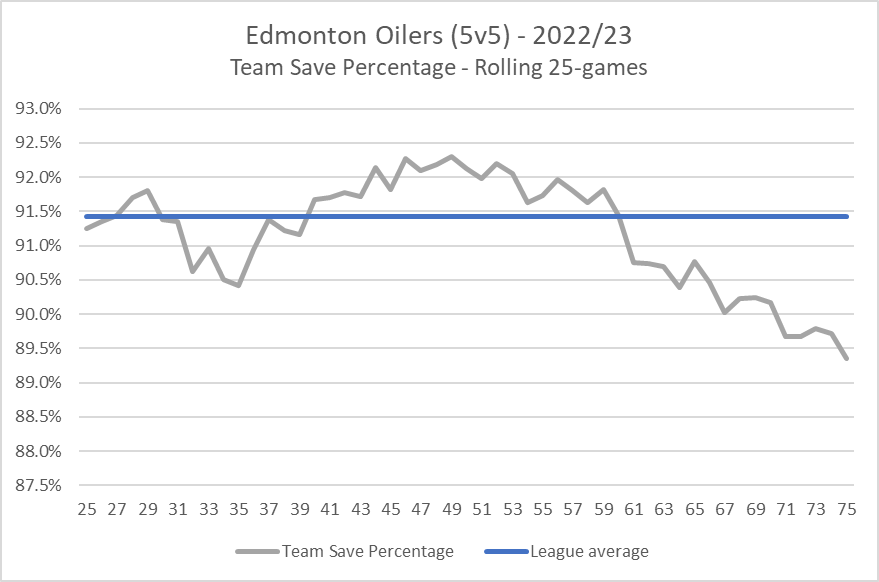
The obvious problem for the Edmonton Oilers is that while they’re doing everything they can to limit chances against, their goaltending has gradually been getting worse. The graph below shows the team’s save percentage at even-strength over rolling 25-game segments, with the blue line representing the league average.

Now while it is true that goaltending is taking a hit league-wide, it appears the Oilers goaltending has been impacted even more. Looking at each team’s last 25 games, the Oilers team save percentage at even-strength ranks 29th league-wide with 89.35%. That’s only better than Seattle in the western conference.

Put another way – based on Natural Stat Trick’s expected goals model that factors in shot quality and location, the Oilers should have allowed 2.38 goals against per hour at even-strength in their last 25 games, so about 48 goals against. But because of the goaltending, they’ve allowed 62 goals, a differential of 14 goals. That translates to about two wins in the standings, which would have had them first in the Pacific division.

Sixty goalies have played at least 250 even-strength minutes over the last 25 games. Campbell’s played in nine games, and his save percentage ranks 57th and his goals saved above average ranks 58th. Skinner is around league average levels in his 17 games, ranking 31st in save percentage and 36th in goals saved above average.

Skinner is the obvious starter for the Oilers, but you do have to wonder if the extra workload in his rookie season is impacting his recent performance. Earlier in the season, especially in the first 20 games or so when the team struggled, he was very good – posting numbers slightly above league average levels. But now his performance levels have come back down to earth, due in large part because a suitable back-up goalie hasn’t been available for the coaching staff. Not an ideal situation heading towards the playoffs, and something that needs to be addressed better in the off-season if the team wants to remain competitive.

Data: Natural Stat Trick

CBC Radio Active: The Oilers are hot heading in to the playoffs

I joined Min Dhariwal on CBC Radio Active to talk Oilers and their performance heading towards the playoffs. Full segment is here: CBC Radio Active (2023, March 29).

Topics we covered:

  • The Oilers win against Vegas last night.
  • The outstanding play of Leon Draisaitl, and his improvement over the season.
  • Ryan Nugent-Hopkins and the career-year he’s having.
  • Issues around goaltending and why it’s a weak spot heading towards the playoffs.
  • How the Pacific division is shaping up with the Oilers competing against the Golden Knights and Kings for top spot.

Thanks as always to the team at CBC for putting it all together.

Thoughts on the Oilers: Performance since the trade deadline, goaltending and special teams

Things have certainly turned around for the Pacific division teams since the trade deadline, with Los Angeles, Vegas, Vancouver (!) and Edmonton being the top four teams in the league when it comes to points percentage. Edmonton continues to perform well at even-strength (5v5), posting a 53% Corsi For percentage and Expected Goals For percentage in the 13 games since the trade deadline – which has them in the top-ten league-wide. Los Angeles’ shot-shares however have been better in this stretch, ranking second in the league with a 58% Corsi For percentage and first overall with a 61% Expected Goals For percentage. Vegas, while having excellent results, is over-performing a bit, as their shot-share numbers are well below league average, ranking 24th in Corsi For percentage (46%) and 30th in Expected Goals (44%).

What’s concerning for Edmonton is the goaltending, which hasn’t been great at even-strength since the trade deadline. They rank 22nd in this recent stretch with an 89.69% save percentage, while Los Angeles ranks third (93.76%) and Vegas ranks seventh (92.75%). And it’s been trending downward for some time now. Below is the Oilers team save percentage this season over rolling 25-game segments. The orange line represents the league-average save percentage.

Over this recent stretch since the deadline, Campbell ranks 56th among 61 goalies (minimum 100 minutes) with a 85.9% save percentage at even-strength. Skinner ranks 31st with a 91.2% save percentage.

It appears league-wide, goaltenders have seen their numbers take a hit with goal-scoring rates increasing; and the Oilers have been no different. The issue is that Los Angeles and Vegas (with multiple goalies) have been able to weather the storm and rank higher in the league, with their goaltending giving them a competitive edge heading towards the playoffs.

Where the Oilers do have a slight competitive advantage is their powerplay, which continues to perform well despite the departure of Tyson Barrie. They haven’t missed a beat with their rate of shots and goals remaining around the same levels, and at the top of the league. This wasn’t overly surprising as the Oilers powerplay has historically done exceptionally well with and without Barrie, who while is a useful player, isn’t one of the key drivers for the team’s powerplay success.

Oilers powerplay Games Shots per hour (rank) Goals per hour (rank)
Pre Trade deadline 62 65.77 (2nd) 13.08 (1st)
Post Trade Deadline 12 69.47 (3rd) 13.68 (2nd)

The penalty kill has been slightly better, going from costing wins to being good enough. Since the deadline, the Oilers have done a slightly better job reducing the rate of shots against, but the goaltending has declined and remains below league average.

Oilers penalty kill Games Shots against per hour (rank) Goals against per hour (rank) Save% (rank)
Pre Trade deadline 62 60.17 (25th) 9.31 (26th) 84.53% (25th)
Post Trade Deadline 12 55.08 (18th) 9.53 (22nd) 82.69% (21st)

Finally here’s a quick look at the on-ice numbers for the skaters at even-strength since the trade deadline. The tables below are sorted by the player’s time on ice.

Among the defencemen, the Ekholm-Bouchard partnership continues to excel. And they’re the only two defencemen with positive on-ice goal-differentials in this period. The Oilers tend to spend more time with the puck when they’re on the ice, playing just under 30% of their time against elite competition. It’s not the same proportion against elites as Nurse and Ceci, but it’s still a trusted pairing that’s performing very well.

Among the forwards, McDavid’s numbers stick out a little as he’s only posted a +1 goal differential at even-strength and a shots for percentage around 45%. The good news is that his on-ice Corsi For percentage and Expected Goals for percentage are around 50%, so I don’t think it’s the end of the world. But it does make you wonder how many points he could have accumulated had he had some better linemates and spent more time playing offence. Kane isn’t performing well at all, posting some of the worst shot-share numbers on the team, but still getting top six minutes. Part of it is the injuries he’s dealing with, but he’s also a fairly one-dimensional player that struggles defensively.

On the flip side, Draisaitl has been playing much better lately at even-strength and appears to be rounding into form ahead of the playoffs.  Before the trade deadline, Draisaitl was posting some of the lowest shot-share numbers on the team, just breaking even when it came to shots and scoring chances. Keep in mind too that Draisaitl is spending less time with McDavid in this recent stretch – only 20% of his total 5v5 time have they been together. McDavid’s numbers away from Draisaitl have been concerning – as he’s posted a 46% Corsi For percentage and a 47% Expected Goals For percentage.

Only 10 games left, so it’ll be important for the roster to stay healthy and for the coaching staff to figure out which combinations will perform well in the playoffs. And they’ll need the goaltending to bounce back and stay at league average levels. The western conference is looking far more competitive than earlier this season, with teams like Colorado and Los Angeles  emerging as legit contenders. Will dig into each club’s strengths and weaknesses later this week.

Data: Natural Stat Trick, Puck IQ

Western conference star power and depth

Dom Luszczyszyn wrote a great piece at the The Athletic where he looked at the impact the star players have on their team’s playoff success and the impact depth players have. Using extensive metrics, what he found was that while depth players are important, it’s the top end players that drive success for a team.

Hockey may be the ultimate team game where every role, player and role player matters. But within that dynamic, there’s an opposing truth that they only matter as much as the players at the top of the hierarchy dictate.

Even in the playoffs, like it or not, it’s how bright the stars shine that decides who wins and who loses.

The Athletic

This article made me think about the western conference and how the Oilers compare with the other seven teams who are currently in a playoff spot. Specifically, I wanted to know how the Oilers top players compare with the other teams during even-strength play, as well as how the Oilers depth players compare.

To do this analysis, I took the forward with the highest ice-time at even-strength and used their on-ice numbers this season as a proxy for the team’s top line, which always features one or two of the team’s higher-end forwards. I then looked at how each team has performed without their top forward to evaluate the team’s depth. Below are the forwards from each team that were used in this analysis. Note that some players with the highest ice time may not be their team’s best player, but they do often play with the team’s higher end forwards. For example, Chandler Stephenson’s most common linemate in Vegas this season has been Mark Stone, while Mats Zuccarello’s most common linemate in Minnesota has been Kirill Kaprizov.

  • Vegas – Chandler Stephenson
  • Los Angeles – Anze Kopitar
  • Colorado – Mikko Rantanen
  • Dallas – Jason Robertson
  • Minnesota – Mats Zuccarello
  • Edmonton – Connor McDavid
  • Seattle – Yanni Gourde
  • Winnipeg – Mark Scheifele

First a look at how the team’s in the west compare with one another when their top players are on the ice at even-strength. Included in the table below is each team’s even-strength performance numbers (i.e., shot-share metrics that measure how well a team controls the flow of play and the total chances) as well as each team’s goal-share and goal-differential. I’ve applied a simple heat map to each metric to show how each club compares to the rest of the western conference. The table is sorted based on the team’s current points percentage.

If it’s a team’s top end talent that drives results in the playoffs, the Oilers appear to be in pretty good shape. While their goal-share is slightly lower than this group’s average, the Oilers top line has consistently been a handful for opponents controlling over 53% of the shot attempts when they’re on the ice and just under 58% of the expected goals (which factors in shot quality). Dallas, however, appears to be the team to beat as their top line has had the best results supported by the highest share of shots and scoring chances.

And here’s how the depth of each team compares with one another; again this is without their top line on the ice at even-strength. It’s important to note that this depth is going to contain some of the higher end forwards as well, which will impact the team’s success going forward.

Here the Oilers depth ranks around the group’s average levels, posting around a +3 goal differential and a shot-shares also at the break-even mark. Los Angeles’ depth, while having poor results relative to the other teams, has been more difficult to play against posting shot-share numbers closers to 53%. Colorado’s depth looks pretty good here too. They just need their top-end forwards to get and stay healthy, and they’re probably going to be a handful. Seattle has nice balance across their roster too, just need goaltending to not lose them games. The problem for them is they lack the least number of star players, according to Dom’s model. Edmonton and Colorado have the most star players (7) among western conference playoff teams, which is probably why they currently have the highest probability of making it to the western conference finals.

It’ll be worth taking a look at these numbers again prior to the playoffs, maybe with a focus on the more recent 25 games or so.

Data: Natural Stat Trick