Thoughts on the OIlers: Draft, Reinhart, Talbot, Marincin

Source: Hockey's Future

Source: Hockey’s Future

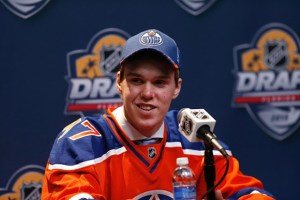
Lots to look forward to now that Connor McDavid is officially an Edmonton Oiler.

The actual announcement on Friday night was a little anti-climatic however, as the impact of McDavid’s impending arrival was already felt weeks ago. Soon after the Oilers won the lottery, the club improved their front office with the additions of Nicholson and Chiarelli. And behind the bench, they quickly moved to bring in one of the top coaches in the game in McLellan. I thought it would have been nice to have Wayne do the official announcement, but the release of the new third jersey made up for everything.

As for the rest of the draft, I’m still battling with a few things.

Leading up to the draft, it felt like the Oilers were progressing and were going to be different than years past. But over the draft weekend, a few moves were made that gave me flashbacks to the past nine years. We’re coming off some bad, bad management eras. And over these years, a lot of questionable deals went through, most of which fans knew were terrible the day they were announced. I’ll touch on this a bit more in the post.

Here we go.

Reinhart

The deal for Griffin Reinhart was an absolute over payment. I think he’s a good young prospect who definitely has a legitimate chance of becoming an NHL player. My issue is that he likely won’t be a full-time NHL player in the next year or two. I realize the Oilers will likely push him into the roster anyways, but the fact remains that NHL defencemen take a long time to develop. The two picks that the OIlers gave up should have been used to get an established top four defenceman who you could pencil in to your roster for the 2015 season. Another reason why I don’t like this deal is because it gave me flashbacks to the Tambellini era. If I recall correctly, the Oilers really wanted Reinhart in 2012 (thanks Oil Change). Plus Tambo took a gamble on another high pick in Cam Barker in 2011. Brutal.

There had to have been teams that wanted the 16th pick, considering some of the major talent available there. It does appear that the Oilers really had their second first-rounder and their second rounders earmarked for a player chasing Hamilton earlier and settling on Reinhart. That to me is encouraging. It’s just too bad they still haven’t solidified any component of their defensive unit with this acquisition.

Marincin

Once the Reinhart deal went down, I knew it was the end of the line for our boy Marincin. The young Slovak has progressed nicely as an Oiler, really showing well early on in his career. The Oilers did a very nice job bringing him along, letting him develop at the AHL level under Todd Nelson’s staff and giving him a shot at the NHL level. He took on a lot of tough competition for a 22-year old, and still managed to hold his own. He’s a rangy guy that broke up plays and did a lot of good things on the ice.

Seeing this deal go down made me think back to MacTavish’s track record dealing with defencemen. For whatever reason, this club has a hard time developing defencemen. And when they get it right, they have no idea how to retain them. Plus, the club picked up a former Marlie, which made me think back to the Acton, Fraser and Aulie acquisitions that all failed.

What annoys me is that it was the Leafs that were smart enough to see his potential and acquire him for next to nothing. Toronto has a strong management team in place with analytics experts. They also made a few of those 2-for-1 draft pick deals, which demonstrates their understanding of pick values. They’re obviously in rebuild mode, but I’m fairly confident they’ll turn it around if they keep making smart moves like these ones.

Talbot

Absolutely loved this deal.

I originally thought Talbot would be a good fit for the club as he did well as a backup and I figured he’d come cheap, I poked through his numbers and felt he’d be a bit of a gamble, and maybe they club might rather keep Scrivens as the “goalie-with-potential” and add someone like Brian Elliott through trade or sign Enroth or Neuvirth through free agency.

Of course, all my thoughts went into a spiral when Darcy “Woodguy” McLeod put together a case for acquiring Talbot, while Bruce McCurdy put a nice argument for Eddie Lack. And when rumors swirled about the acquisition cost going up (something about a first rounder), I started looking at other expensive options like RFA Jonathan Bernier. I’m just glad the Oilers landed a good goalie for lower draft picks.

I seriously learned a ton about goalies during this whole discussion on who the Oilers should acquire. It was also a fantastic example of how strong of a discussion you can have when data is available. I know most of us are using War on IceHockey Analysis and others, which is great. But if the NHL wants their fans to drive discussion, and in a way promote the game, they have got to take a serious lead in collecting and providing accessible, high quality data. Work with the existing companies if you have to. Just collect as much as data as possible and get the data out there and keep it free.

Recommended Links

Harvest Moon 2015 – Lowetide

Meet the Newest Edmonton Oilers – The Copper and Blue

What do the Edmonton Oilers Come Away With From the 2015 NHL Draft? – Cult of Hockey

Tangled Up in Blue – OilersNation
Bringing Back Horcoff (Part 2)

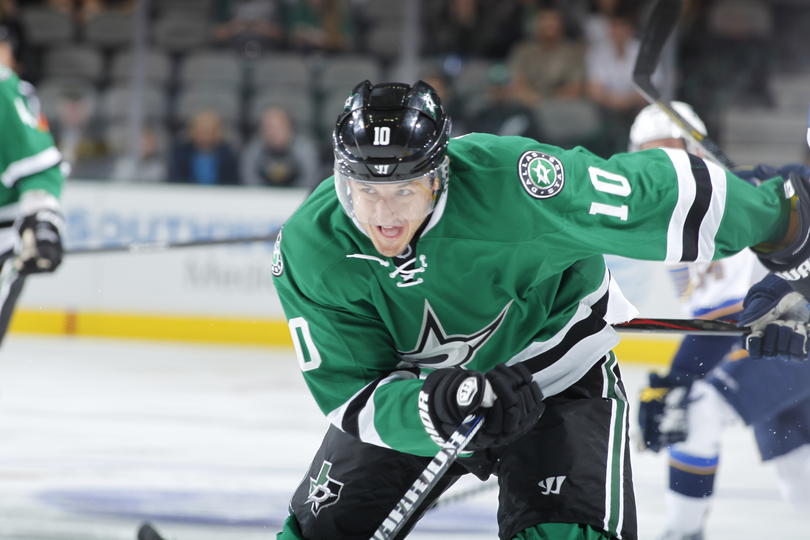
_C7G6458_slideLast week I put together a short case on Shawn Horcoff and how he could potentially help the Oilers next season. Over the past two years in Dallas, Horcoff played fewer minutes than he did as an Oiler and took on weaker competition. Last season, Horcoff notched 29 points, with 22 coming at even-strength. He was a decent possession player at even-strength (52.68 Corsi For%, +0.73 CorsiRel), despite having fewer offensive zone starts relative to his teammates. He played mostly wing, but finished 6th on the team in faceoff attempts (going 50.2%), meaning he did play center as needed.

Thanks to War on Ice, we can dig into those 22 even-strength points a little more and see in what score situations (i.e., whether the game was tied or if a team was leading) Horcoff got his points. Before digging into his individual production, it’s worth looking into how his team did last season.

The Stars finished with a respectable score-adjusted Corsi of 52.4%, which was 9th overall in the league. Goaltending appears to have been an issue for them as their keepers finished with the third worst on-ice save percentage at even-strength, finishing ahead of only the Oilers and Hurricanes. Here’s a quick snapshot of their Corsi For% at different score situations, and NHL rank (Source: Puck on Net):

Dallas Stars (2014-15, Even Strength)
Down 2 Down 1 Tied Up 1 Up 2
Time Spent Corsi Time Spent Corsi Time Spent Corsi Time Spent Corsi Time Spent Corsi
10.6% 62.9
(1st)
18.9% 60.1
(4th)
33.8% 51.6
(13th)
21.9% 45.7
(18th)
14.8% 43.2
(17th)

So what we know is that the Stars were a good possession team that did well when the game was tied or when they were down a goal. What might get overlooked is which forwards on the roster produced at different times of the game. Here’s a summary of how Horcoff produced at different score situations.

Shawn Horcoff (2014-15, Even Strength)
Situation TOI % of Total TOI Points P/60 Corsi For % Corsi Rel
Down 2 52.36 7.5% 3 3.44 61.68 0.05
Down 1 143.14 20.6% 6 2.51 60.8 1.61
Tied 255.92 36.9% 8 1.88 55.43 3.82
Up 1 171.4 24.7% 2 0.70 45.05 -1.22
Up 2 71.66 10.3% 0 0.00 41.96 -6.17

Couple things to note here. Among the Stars forwards who played a minimum of 200 minutes, Horcoff had the best CF% and Corsi Rel when the game was tied. He also had fewer offensive zone starts compared to his teammates, but still managed to produce at a third line level. When the team trailed by one or two, in the limited minutes he played, he finished in the top three when it came to points/60.

If we look at how Horcoff produced when the game was close at even-strength, as in the game was tied or within one goal in the first or second period or tied in the third, we see a few more interesting numbers.

Shawn Horcoff (2014-15, Even Strength)
Situation TOI % of Total TOI Points P/60 Corsi For % Corsi Rel
Close 471.42 67.9% 16 2.04 53.13 1.02

So 16 of Horcoff’s 22 even-strength points came when the game was close. He produced at a very nice clip and held his own possession wise in this situation, with fewer offensive zone starts. Among his teammates playing forward, he finished 6th in points/60 and Corsi For%. Not too shabby for a 36 year old, bottom six forward.

Here’s a list of players who played between 450 and 500 minutes when the score was close, had fewer zone starts and produced more than 2.00 points/60.

Horcoff Comparables (2014-15, Even Strength, Score Close
Name TOI P P60 CF% CF%Rel ZSO%Rel
V. Fiddler (DAL) 491.02 19 2.32 50.63 -2.04 -8.26
J. Fontaine (MIN) 472.39 18 2.29 49.40 -1.66 -10.32
M. Beleskey (ANA) 497.11 19 2.29 53.22 3.09 2.54
S. Horcoff (DAL) 471.42 16 2.04 53.13 1.02 0.11
C. Sceviour (DAL) 456.07 18 2.37 53.00 0.16 -1.92
J. Beagle (WSH) 456.69 16 2.10 52.48 1.01 -7.21

I guess we shouldn’t be too surprised that Horcoff’s linemates (who always did better with him) made the list.  But so too did an unrestricted free agent that will likely cash in on a heavy, long term deal. Beleskey is definitely much younger, but I find it interesting that his production when the score was close is quite similar to that of Horcoff’s.

Thoughts

The Oilers will definitely need to acquire depth at center this off-season, as an injury to RNH, Lander or Gordon would be absolutely devastating to the club. McDavid and Draisaitl are on their way, but we won’t know until training camp if they’ll start the season on wing and ease their way into center. It’s a tough position to play, and the Oilers can use all the experience they can find to help the prospects along. Horcoff would be a good candidate as he can start on the wing and move to center as needed. He shouldn’t be an expensive acquisition and I’m sure if the Oilers don’t sign him, he’ll be picked up by another club this summer.

Finding Keepers

I really do respect what goalies do for a living. I would just much rather spend extra money and assets on defencemen and centers. There should rarely be a high acquisition cost for goalies as there are always options available to general managers. Ideally a team should be able to draft and develop a netminder or two, but teams can leverage various channels to enhance or replace their goalkeeping as needed. Whether it be through trade, free agency or dipping into the AHL or overseas pool, there will always be goalie options for general managers.

This off-season is absolutely a buyer’s market for those seeking a goaltender. With plenty of options available in free agency, and the fact that other teams are looking to off-load a goalie, the price of acquiring a netminder should not be high. Cam Talbot is one of the options out there as he’s done well in New York as the backup to Henrik Lundqvist, and has shown some very promising underlying numbers. But the thought of sending a first round pick or two second round picks for someone like Cam Talbot, who at 27 has only started 53 NHL games, to me at least, is bewildering.

But lets say the Oilers acquire Talbot. That would mean they give up an asset or two, maybe a high draft pick and a prospect. And then they would have to wait until January 1, 2016 to be able to negotiate a new deal with him. If he does even remotely well from October to December, you can assume he’ll command a significant contract as free agency is only six months away for him at that point. That would mean the Oilers will hand out a heavy, long-term deal to someone who hasn’t even played 100 NHL games.

If the Oilers value goaltending that much and are ready to spend that much for a player with that little of experience, I would suggest taking a look at an option that has less risk.

Jonathan Bernier

Last week, the Maple Leafs filed for club-elected salary arbitration with their number one goalie. Jonathan Bernier will be a restricted free agent as of July 1 and was seeking a long-term contract with the Leafs. This arbitration ensures that Bernier will get a one-year deal, which the Leafs cannot walk away from as they were the ones that filed the arbitration (Source: Winging it in Motown).

The 26-year old is coming off a rough season, one in which the entire team struggled both in point production and possession metrics. Finishing in the bottom five has ensured that the club will receive a very good prospect, one who’ll serve as a cornerstone for their rebuilding efforts. The question now is if the Leafs want to invest in Bernier or if they would rather send him away for additional picks or prospects.

The Leafs filing for arbitration has more or less given Bernier leverage in his next NHL contract. If he does well in 2015-2016, he’ll command a lot more term and dollars and put the Leafs in a tough spot as he can start eyeing free agency. If he does worse, they could deal him, but for considerably less, or let him walk for nothing. Really, the best time, if they want to maximize their return, is to deal him before the arbitration hearing.

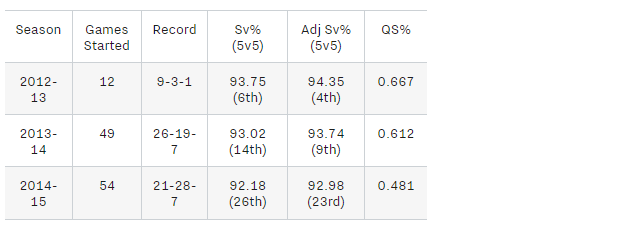
Here’s a high level summary of his performance since 2012-2013. Please note that the save percentages are for five-on-five even strength and have their rankings in parentheses (Sources: War on IceHockey Reference and Hockey Abstract).

What we see here is that Bernier had two fairly respectable seasons prior to the 2014-2015 season. His adjusted save percentage at even strength, which factors in the location of the shots, was in the top 10 among goalies who played a minimum of 950 minutes (minimum 600 minutes in the 2012-13 lockout season). His percentage of quality starts (QS%), which counts how many games he had a save percentage that met the league average, was above 0.600 which is considered to be very good.

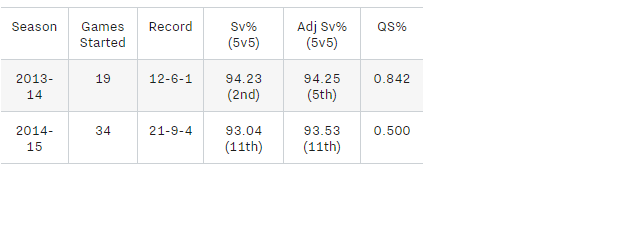
For comparison, below are the numbers for Cam Talbot.

Outside of the 0.500 QS%, which is considered below average, those are some nice numbers for Talbot. But is it enough to invest long-term? It depends of course on how much risk you’re willing to take and what the market will dictate this off-season. The acquisition cost of Jonathan Bernier should not be high, maybe even something similar to what Cam Talbot is being rumored to cost. The Oilers would likely have to sign Bernier to a bigger contract than what Talbot would command, but they would have a little more certainty with the former. It’s also worth noting that Talbot hasn’t had a major slump that every goalie has gone through, so he’d be due for one in the next year or two.

Goaltending is an important part of the roster, but it should not require heavy, long-term contracts as there are plenty of options available to general managers. Having said that, if the Oilers are seriously considering investing heavily in someone like Cam Talbot, it would be in their best interest to explore the possibility of acquiring a more experienced and proven goalie like Jonathan Bernier.

Full article is at The Copper & Blue.

Thoughts on the Oilers: Leadership, Goaltending and Schultz

Oilers-V.-YotesIt’s been a pretty busy off-season with a lot going on in almost every facet of the Oilers organization. And with that comes a staggering amount of speculation on coaching, defense and goaltending. It really seems like everything  and anything is possible, thanks in large part to Connor McDavid. All the speculation and analysis can be overwhelming, but it’s a key part of being a fan. And now that the team has a well qualified management group, I think there’s a lot more brainstorming among fans and media members.

Coaching and Leading

I really expect big things with Todd McLellan behind the bench. The roster still has to be flushed out, no question. But having a legitimate coach with NHL experience is going to do wonders for this club going forward. I really didn’t mind the hiring of Dallas Eakins. I thought he would bring some new ideas and tactics. But we knew there would be a learning curve as he adjusted to a new team and the gring of the NHL. The club had to surround him with coaches that knew the Oilers roster and experienced people like Craig Ramsay to provide guidance. That’s all good. It’s just with McLellan, not only is he experienced, but he can have a positive impact on the coaches that surround him., rather than the other way around.

In an interview last year, Mike Babcock talked about how he selected assistant coaches (like McLellan) and how he developed new ideas using their input. To me, that was a sign of a franchise’s maturity: a club that has a coaching staff so good that they can work on new ideas on a regular basis. When you’re new to the league and organization, you’re often getting guidance rather than really leading the charge. This isn’t to say that a rookie coach is a bad idea. You just have to have a strong franchise with managers that know what they’re doing.

Goalies and Information Overload

I’m pretty sure I can now put together a case for and against every single goalie option out there. There’s been an absolute flood of discussion around the goaltending situation. It’s overwhelming at times to parse through the data and trends to zero in on a goalie, but it’s definitely increased my own understanding of the evaluation metrics.

There is some information overload happening, but it’s encouraging to see a larger, more intellectual discussion about goalies. Thanks to the data sets available through War on Ice and Hockey Abstract, we can get past the high priced UFA goalies and look for some hidden gems that haven’t had an opportunity. What’s also become apparent is the wide range of value people put on goalies. Some would give up high picks for a goalie, while others like me, would rather spend pennies on them. I’m sure the range of opinion on goalie value is just as diverse in NHL head offices.

Whoever the Oilers acquire, it’ll be interesting to look back at some of the pieces written this summer to validate some of our predictions.

Schultz

Quick note on Justin Schultz. Without a doubt, he has struggled mightily as a defenceman. The club absolutely rushed him  into the NHL, boasted about his offensive potential and then handed him a ridiculous contract. In my opinion, there’s still a player there, but one who may have to leave Edmonton to have success.

The coaching staff did their best to put him in a position to succeed, handing him way too much ice time and offensive zone starts. Two reasons why they had to do that: the team trailed way too often at even-strength and secondly, he was seen as the only option. If the Oilers really wanted to utilize Schultz properly, they would’ve surrounded him with experienced players, including a top pairing. And they would’ve had enough strength throughout the rest of the lineup that would limit how often they were trailing. In my opinion, he wasn’t ready for the NHL and was not put in any position to succeed. That’s the fault of the player and the management team. The contract however, is on management.

It’d be great if he could bounce back, but it’s hard to tell at this point. He was in over his head and it’s shown in his performance and stats. But if the Oilers can solidify their top pairing and move Schultz further down the depth chart, the young defenceman might have  a productive career as more of a 2nd/3rd pairing, powerplay specialist.

Possession metrics under Todd McLellan

usa-today-7831719.0Aside from landing Connor McDavid, the Oilers biggest improvement for 2015-2016 will be behind the bench. After being released by the Sharks, finishing with an overall record of 311-163-66 (a 0.637 points percentage), McLellan joins an Oilers club that may not  have the experienced forwards and defencemen, but now has the potential to blossom under new management.

The Sharks were a very good team under McLellan. It helps to have guys like Joe Thornton and Logan Couture, along with a defense core that included Marc-Edouard Vlasic and Brent Burns. Combining an excellent coach like McLellan with a well-built roster produced some outstanding results, especially when it came to possession metrics.

Using score-adjusted Corsi, which factors in the score of the game to give a more accurate rating, we see that the Sharks have been quite good at even-strength (Source: War on Ice).

Full article is at The Copper & Blue.

Joining The Copper and Blue

coppernblue.com.full.54273Excited to be joining The Copper and Blue as a contributor. I’ve been a long time reader of the website and look forward to working with a great group.

My first post is up. I discuss the development of young Martin Marincin.

A lot of my ideas about the game come from articles at The Copper and Blue. A lot of writers have had a huge impact on me, especially people like Jonathan Willis, Bruce McCurdy and Derek Zona, all of whom have ties to C&B. So it means a lot to be writing for the website now. Should also note that C&B was a big inspiration for my final research paper in grad school. It’s a fantastic example of fan-generated content that has pushed the development of new information and ideas. Examples include the Top 25 Under 25 series and a lot of the early analytics work by Derek.

I’ll be posting every few weeks there, really expanding on what I currently do here at The SuperFan. So really, I now have two channels to push my Bring-Back-Horcoff agenda.

Appreciate all the support I’ve received recently. Big thanks to C&B managing editor Ryan Batty for the invite. The guy is a gem.

The Progress of Martin Marincin

usa-today-8468000.0Draft. Develop. Deploy.

Seems easy enough in professional sports, but it appears that some teams like theEdmonton Oilers are still figuring out how to build a team from within. Defense, especially, has been a challenge for the Oilers to solidify as over the past decade management has often rushed prospects into the NHL and forced players, including external hires, into positions that they’re not quite qualified for.

We’re in the midst of yet another summer where the Oilers are hoping to solidify their defense core either through trade or free agency. There is, however, some hope that a prospect or two can continue progressing in their overall development and maybe even make the jump to becoming a full time NHL defenceman in the next year. While Oscar Klefbom blossoms at the NHL level, and Darnell Nurse possibly heading (hopefully) to the AHL next season, both of whom appear to be part of the foundation of the club going forward, there is some question as to what role 23-year old Martin Marincin will have as an Oiler.

Full article is at The Copper & Blue.

Bringing Back Horcoff

horcoffHear me out.

For the first time in a long time, the Oilers are poised to start a season with four legitimate centermen. Ryan Nugent-Hopkins and Anton Lander made some very nice progress last season, while Boyd Gordon, who is in his last season of his three-year contract, played consistently in both ends of the ice. Connor McDavid will be in the starting line-up in October and at this point I’ll assume he’ll be at center.

We’ll also have Leon Draisaitl (truly) competing for a roster spot in training camp. I hope he flourishes and makes a huge push, but I would not be disappointed if Leon spends a season in the AHL to refine his game. Keep in mind, the AHL’s California teams will play less games next season and focus more on player development. Young prospects like Leon will get more ice time and more opportunities to play different situations.

As of today, the 2015-2016 forwards roster looks something like this:

LW C RW
Pouliot RNH Eberle
Hall McDavid Yakupov
Pakarinen Lander Purcell
Hendricks Gordon Klinkhammer

Not bad, right? And you can easily shift guys around and even entertain the idea of having Draisaitl somewhere on the wing.

My concern here is that the Oilers would be absolutely hooped if one of the centermen got hurt. The other issue is that Lander might regress or Gordon might start slowing down due to the workload. Plus, it might be best that McDavid ease his way in to the NHL by playing wing with an experienced centerman. Draisaitl could possibly be that replacement player, but it would make no sense to stunt his development because the Oilers weren’t deep enough at center.

What I propose is that the Oilers acquire an experienced centerman who could play wing, but shift to center as needed. Someone who could slide into that third line left-wing spot and play some special teams as needed. And with a young core, it’ll be imperative that the club bring in a proven leader to provide guidance.

The Candidate

Shawn Horcoff will be an unrestricted free agent on July 1, just completing his six year, $33 million contract that he signed with the Oilers in 2008. He’s 36 years old now, having played 946 NHL games and scoring 496 points. There is no question that his career will be coming to a close soon, but it’s his performance last season that has me thinking he could be a productive player for the Oilers next season.

Below is a summary of his play at even-strength over the past five seasons (Source: War on Ice).

Season Team Gm G P A TOI/Gm P60 CF% ZSO%
2010/11 EDM 47 4 14 10 13.83 1.29 48.42 50.73
2011/12 EDM 81 7 16 9 13.37 0.89 47.08 42.99
2012/13 EDM 31 4 8 4 11.3 1.37 42.38 40.57
2013/14 DAL 77 1 13 12 10.16 1.00 48.65 52.38
2014/15 DAL 76 6 22 16 10.06 1.73 52.68 50.99

Horcoff notched 29 points last season, with 22 of those points coming at even-strength. His offensive zone starts were down slightly from the previous year, but he managed to perform better in terms of productivity and possession. He played limited minutes in Dallas, and produced at a third-line level.

What should be noted is that Horcoff played a lot on the wing, as the Stars had Seguin, Spezza, Eakin and Fiddler as pivots. Horcoff still took a lot of faceoffs, but he was 6th on the team in faceoff attempts (Source: NHL.com).

Horcoff’s two most common linemates last season were Vernon Fiddler and Colton Sceviour (Source: Hockey Analysis). Here’s a quick summary of how they fared together and apart.

Corsi % (Even strength)
Linemate With Horcoff Without Horcoff
C. Sceviour 55.0 52.7
V. Fiddler 53.1 48.5

Horcoff away from these two had a decent Corsi. What’s interesting is how both his linemates posted slightly better Corsi’s when Horcoff was with them. Horcoff might be getting older, but he’s not at the point where he drags down teammates. It should be noted that Horcoff had reasonable zone starts and typically went against the other club’s bottom six forwards.

Dallas Stars 201415

The key thing to consider is that Horcoff filled the kind of role the Oilers really need this year: an experienced forward, who can produce on the third line, not be a drag on his linemates and make a seamless transition to center when needed. He did a little bit of everything, serving as a mentor to the younger players in Dallas.

And if you want some “toughness” and “grit” and whatever on the third line, he’s your guy:

I can’t imagine a lot of teams lining up to sign him due to his age, so the acquisition cost should be low. The other issue of course is whether Horcoff would want to sign in Edmonton, likely preferring to join a cup contender. My guess is that because of McDavid and the reputable management team in place now, Edmonton would be a prime destination for many, including Horcoff.

And if Horcoff doesn’t fit what the Oilers want, here’s hoping they strongly consider adding an experienced center through trade or free agency. It’s absolutely critical.

Comparing the Oilers by Position to the Rest of the League

rsz_game43rnh3Andrew Berkshire recently put together a nice piece comparing the point production of the Montreal Canadaiens to the rest of the league by position. He does a nice providing realistic expectation of players and setting benchmarks for different positions. I thought it’d be interesting to see how the 2014-2015 Oilers measure up with the rest of the NHL.

Below is a summary table of the point ranges by line and position. What Andrew did was find the range of points based on the top 30 players at the position. Second line range was based on players ranked 31st-60th at that position, and the third line range was based on the 61st-90th ranked players. Please note, I prefer evaluating players based on even-strength play, so I focused on those numbers.

Point Range (Even-strength)
Line Left Wing Center Right WIng
1 33-59 39-60 29-55
2 22-32 31-39 19-29
3 11-20 24-30 11-19

So how did the Oilers rank in 2014-2015?  Below are the points for each player, by position, at even-strength. I’ve also included the players’ points/60 and the average time on ice per game to provide some context (Source: War on Ice).

Centers (Even-Strength)
Name Gm P P60 TOI/Gm
Ryan Nugent-Hopkins 76 37 1.92 15.25
Derek Roy 46 16 1.50 13.92
Anton Lander 38 11 1.46 11.87
Boyd Gordon 68 10 0.86 10.23
Mark Arcobello 36 8 1.04 12.85
Leon Draisaitl 37 7 1.03 11.01
Left Wings (Even-Strength)
Name Gm P P60 TOI/Gm
Taylor Hall 53 26 1.86 15.83
Benoit Pouliot 58 24 1.98 12.55
David Perron 38 15 1.75 13.53
Matt Hendricks 71 10 0.79 10.75
Luke Gazdic 40 3 0.61 7.43
Rob Klinkhammer 40 3 0.40 11.14
Jesse Joensuu 20 2 0.63 9.57
Right Wings (Even-Strength)
Name Gm P P60 TOI/Gm
Jordan Eberle 81 41 1.98 15.30
Nail Yakupov 81 21 1.20 12.99
Teddy Purcell 82 20 1.11 13.23
Matt Fraser 36 7 1.10 10.65
Steven Pinizzotto 18 3 1.31 7.62
Andrew Miller 9 3 1.44 13.88
Tyler Pitlick 17 2 0.59 12.05
Iiro Pakarinen 17 1 0.36

9.75

Here’s where the Oilers fit compared to the ranges from Andrew’s piece.

Point Range (Even-strength)
Oilers 2014-2015
Line LW C RW
1 Eberle
2 Hall
Pouliot
RNH Yakupov
Purcell
3 Perron

Couple thoughts:

  • RNH made significant strides this past season and is well on his way to becoming a star. His point totals just missed the cut-off to be a first line center, but there should be no issues for him going forward.
  • Hall had an off-year, but you can be sure he’ll be back to elite status next season.
  • Eberle is the only player who falls into the first line category based on even-strength points. He’s not the most productive player, as in he gets a lot of minutes. But he’s become a very consistent player for the club.
  • My guess is if Lander had a full season, he’d make a push to fall under the third-line center category. It is good to know what the realistic expectations should be of him.
  • Since the guy played all the tough minutes last season, Gordon doesn’t have to show up in these tables. The guy is awesome.
  • Man, I cannot believe we’ll have McDavid, RNH and Draisaitl as our centermen in the near future. Good Lord.