Checking in on Jordan Eberle

The 2016/17 season has been a challenge for the 26-year old winger. Because of his cap hit and the fact that he played with McDavid early on in the season, and continues to play a top-six role, expectations are high. Unfortunately, Eberle’s goal and point production has been lower this season compared to his past season’s, which has drawn plenty of attention as the Oilers are desperate for secondary scoring.

Data: Corsica Hockey

While his 1.60 points per hour is lower than his career norms, it’s a slight improvement compared to where he was in late December after 37 games. At that point, Eberle had only 12 even-strength points, a rate of 1.40 points per 60, with only six of those points being primary (i.e., goals and primary assists).

When I dug into his numbers in late December, I had found that Eberle’s individual rate of shots per hour and his individual expected goals, which gives a weighting to each unblocked shot based on the type and distance, were in line with his past numbers. The Oilers were also a better team when it came to their share of total shot attempts (Corsi For%) and scoring chances when Eberle was on the ice. The main issue for Eberle at the time was that his individual shooting percentage was 4.55%, well below the 12%-13% shooting percentage he had posted in the past three seasons. Knowing that player’s tend to regress towards their career averages over time, my thought was that Eberle’s shooting percentage would improve over the rest of the season, and the points would (hopefully) start to pile up.

Fast forward to today, and it looks like things are getting back to normal for Eberle. Below is a table that breaks out Eberle’s season into two periods: games prior to December 30, 2016, and games from December 31, 2016 onwards.

Before December 30, 2016 Since December 31, 2016
Games 37 28
TOI/Game 13.89 13.69
G/A/P 3-9-12 6-6-12
Points/60 1.40 1.88
Corsi For% (Rel) 53.07 (+2.57) 51.26 (+2.71)
xGoals For% (Rel) 51.51 (+3.23) 49.91 (+0.35)
Goals For% (Rel) 47.22 (-6.46) 62.96 (+10.33)
Individual Shots For/60 7.70 7.99
Individual xGoals/60 0.74 0.90
Individual Shooting% 4.55 11.76
On-ice Shooting% 6.05 8.54
On-ice Save% 92.91 94.29
PDO 98.96 102.83

Full article is at The Copper & Blue.


The Oilers Secondary Scoring Isn’t Getting Better

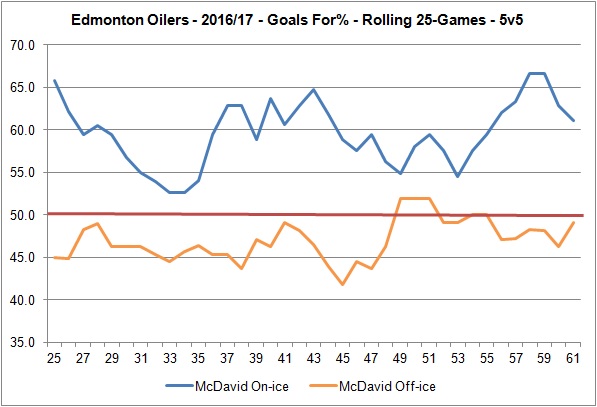
A key concern for the Oilers this season has been their inability to generate offence when McDavid is not on the ice. After 61 games, the Oilers rank 9th in the league, and 4th in the west, when it comes to goal-share at even-strength (5v5) play with 52.7%. With McDavid on the ice, the Oilers have outscored their opponents 52-34, a fantastic goals-for percentage of 60.5%. Without him, however, the team has been outscored 71-65, which translates to a 47.8% goal-share. While the club continues to do well as a whole, it’s largely riding on the shoulders of their young captain.

Here’s how the team’s goal-share has trended this season, broken out into 25-game, rolling segments. With McDavid on the ice, the team’s share of the total goals has typically been above 55%, which isn’t surprising considering his ridiculous skill and ability to generate offence. Without him, the team’s share of goals was initially pretty steady around the 45% mark over the first two months of the season, and that number has gradually increased towards the 50% mark over December and January as the other lines finally started producing goals. It’s worth noting that the team’s shooting percentage without McDavid on the ice was around 6.5% early on in the season, but that has since moved up to 7.5% in the more recent stretch of twenty five games.

20170224-gf97

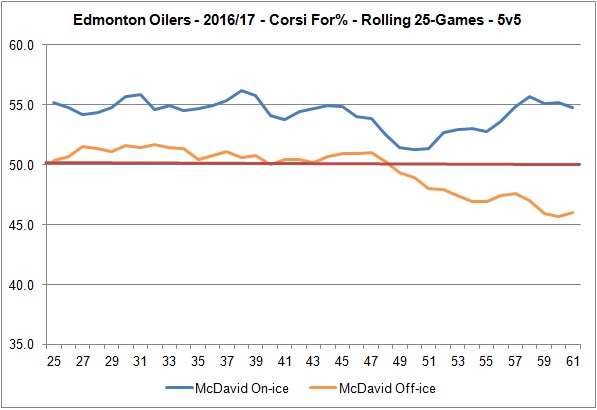
So by the looks of it, things appear to be getting better for the team without McDavid on the ice. However, when we look at the team’s share of shot attempts and how that has trended over the course of the season, we see that the improved goal-share may not exactly be sustainable. The club currently ranks 17th in the league when it comes to Corsi For% with 50.2%, a rather discouraging drop considering they ranked in the top 10 in the league at one point. With McDavid on the ice, the Oilers are golden with a Corsi For% of 54.2%; without him on the ice, that number drops down to 48.1%.

20170224-cf97

If we look at the 25-game rolling segments of shot-share, we actually see that there’s been a gradual decline without McDavid on the ice, with the team having posted a very troubling 45% Corsi For% over the last 25 games (which is since the end of December).

Full article is at The Copper & Blue.

The Oilers Powerplay is Good

With the trade deadline approaching, the Oilers will have the chance to make some key decisions that can not only impact their push for the playoffs, but also their long term goal of building a championship contender. It’ll be important for the Oilers to retain, and possibly acquire more draft picks and prospects, as those will be critical building blocks moving forward.

The Oilers could address a number of existing weaknesses, including the center and right-wing depth up front, as well as their back-up goalie position. One could also make the case that the team should look to add an offensive defenceman to improve the defence core and potentially quarterback the powerplay. But as General Manager Peter Chiarelli indicated earlier this week, that might not be high on the priorty list.

Yes it’d be nice to have a pure powerplay d-man but I’ve been satisfied with [Andrej Sekera and Oscar Klefbom] on their respective units. Yes we could always improve our powerplay, is that the solution? It’s one of them but that’s certainly not on my shopping list this trade deadline. [On follow-up question as to how expensive it might be] You saw what it took to get a Top Four right-handed D [Adam Larsson] and you can extrapolate from there. (Source: Cult of Hockey, Edmonton Journal)

One area that the team has done well in this season is their overall powerplay. Now, looking at their efficiency with the man advantage, typically recited on game broadcasts and posted at NHL.com, the team ranks 12th in the league with 20.4%. But, if you look at the actual goal scoring rate, as in how many powerplay goals they get per 60 minutes of powerplay time, they’re first in the western conference and sixth in the league with 6.85 goals.

powerplay-rolling-ff60-and-gf60

Full article is at The Copper & Blue.

The Oilers in Different Score-States

The Edmonton Oilers are sitting in a great spot right now as the club has an even-strength (5v5) goal-share of 52.28%, having outscored opponents 102-94, which ranks them 11th in the league, and 5th in the Western conference. The Oilers PDO isn’t anything out of the ordinary as the team is relying on league average goaltending and has had a normal team save percentage over the course of the year. This is good news and suggests that the team’s goal production should be sustainable, as long as their top players, including McDavid, Talbot and Sekera, stay healthy.

What’s interesting is at what score-state (i.e., tie game, Oilers trailing, Oilers leading) the Oilers are scoring their goals. According to Travis Yost’s analysis over at TSN, the Oilers are a much more dominant team when they’re trailing in a game, as they run at a goal-scoring rate of 3.11 goals per hour, and have outscored opponents 42-21, which translates into the second best goal-share in the league with 66.67%. It’s definitely encouraging to see that the team has the ability to turn up the offence, however it’s a bit alarming that  the Oilers play so poorly when the score has been tied this season.

Score State (5v5) Goals For% Goals For/60 Corsi For% Corsi For/60
All Scores 52.28% 2.35 50.52% 55.51
Tied 38.75% 1.74 48.58% 54.78
Trailing 66.67% 3.11 59.18% 62.93
Leading 55.56% 2.42 44.22% 48.47

With the score tied, the Oilers have a 48.58% share of the total shot attempts (Corsi For%), which, along with their 54.78 shot attempts per hour, ranks them 22nd in the league. And in this score state, the Oilers have been outscored 49-31, which translates into the second worst goal share of 38.75%, only ahead of the Colorado Avalanche. Their 1.74 goals per 60 ranks them 26th in the league.

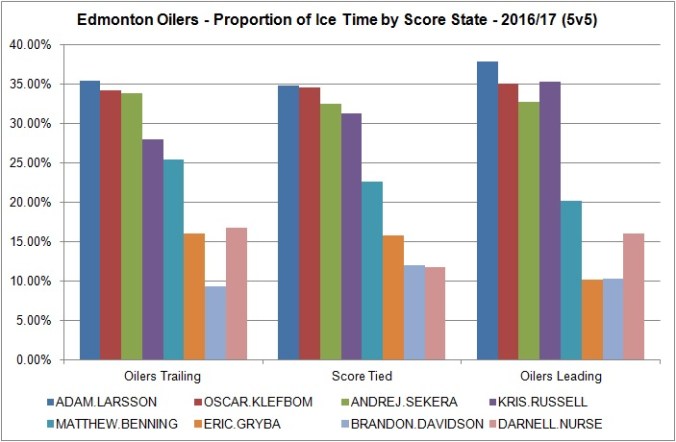
To get a sense of what might be going on here, it’s important to look at how the Oilers do with and without McDavid, who has been the team’s offensive driver all season. My initial thought was when the score has been tied, the team still does great with McDavid and does really poorly without him. But if we split out the numbers, we see that’s not exactly the case.

oilers-defencemen-toi-prop-by-score-state

Full article is at The Copper & Blue.

Finding Offence

With only four goals in their last five games, it appears that the Oilers might be having some scoring issues at even-strength. The good news is that the team still ranks 9th in the league when it comes to goal-share, as they’ve outscored opponents 103-94. And they rank 11th in the league when it comes to their goal-scoring rate, sitting just above the league average with 2.35 goals per hour at even-strength (5v5).

League Rank Team Goals For% Goals For/60
1 Pittsburgh 56.54 3.03
2 Washington 65.26 3.02
3 Minnesota 60.40 2.97
4 Toronto 50.94 2.76
5 Columbus 55.28 2.72
6 NY Islanders 52.15 2.72
7 NY Rangers 52.07 2.71
8 Montreal 56.68 2.50
9 Detroit 50.00 2.43
10 Nashville 53.59 2.40
11 Edmonton 52.28 2.35

The Oilers offensive outputs have been a big improvement from years past as the clubs rate of goal scoring was typically below the league average and often near the bottom of the league.

Data: Corsica Hockey

What’s also been encouraging is that over the course of the season, the Oilers rate of goal scoring has remained pretty steady, even up until now. Over the past 25 games, the team has seen their rate of goal production dip just below the league average of 2.31, but it doesn’t appear here, at first glance, that there are major issues.

Data: Corsica Hockey

Now a big reason for the Oilers offensive output this season has of course been Connor McDavid. When he’s been on the ice, the Oilers create a lot more offence and scoring chances, and have generated 3.11 goals per hour. Without him on the ice, the Oilers rate of goal scoring drops significantly to only 1.96 goals per hour, which is around what Buffalo (1.96), Arizona (1.91) and New Jersey (1.91) are currently generating as a team this season. It doesn’t help that the Oiler forwards paid to generate offence are struggling all at the same time. Players including Milan Lucic, Jordan Eberle, Ryan Nugent-Hopkins and Benoit Pouliot, all of which are experienced NHL players with past success, are below their historical averages when it comes to goal scoring and point production. If the Oilers intend on being a playoff team, with championship aspirations, they will need to find a way to generate more goals, especially with McDavid on the bench.

Full article is at The Copper & Blue.

Trading Kris Russell

With the NHL trade deadline one month away, the Oilers will have a chance to make some important decisions that could impact their short term goal of qualifying for the 2017 playoffs and the long term goal of establishing a window where they can be legitimate Stanley Cupcontenders.

In terms of short term needs, the Oilers could use an upgrade to their center depth as well as their right side up front. There’s also an obvious need when it comes to goaltending as Cam Talbot, who has arguably been the Oilers MVP, does not have a reliable backup that can give him a night off from time to time. There’s also a case to be made that the team could use an offensive defenceman to support the powerplay, but the team should probably refrain from spending significant assets to acquire. The issue for the Oilers is that they don’t have a lot to give up, as their own prospect pool isn’t very deep and the picks they have for the upcoming draft are needed to replenish it.

The Oilers do have veteran players like Benoit Pouliot and Matt Hendricks that could draw some attention at the deadline, but the Oilers are not likely to acquire significant pieces by moving either of these two. Both have struggled this season, although Pouliot does have a history of contributing to a team’s offence and could provide a team with skill and experience in a top six role.

Where the Oilers could tap into to address their short term and long term goals is their defence. For the first time in a long time, the Oilers have an NHL-calibre defence core, with Andrej Sekera, Oscar Klefbom and Adam Larsson signed with the team for the next four years on reasonable contracts. Add to that core Brandon Davidson, Darnell Nurse and Matt Benning, players that will be under team control for a while, and the Oilers have a group that should provide stability on the back end.

This brings us to Kris Russell who was signed by the Oilers to a one-year deal just days before the start of the 2016/17 regular season. Serving as a well-priced stop-gap, having Russell on the roster allowed the Oilers to keep some of their defensive prospects like Griffin Reinhart and Jordan Oesterle in the AHL to continue their own development. The Oilers have been able to rely on Russell quite heavily, as he’s led the team in average ice time per game and has a respectable goal-share of 51.6%. He has spent a significant amount of time with Connor McDavid this season, which would help his numbers, and he’s also been benefiting from a 94% save percentage when he’s on the ice for most of the season, which is not exactly sustainable.

We also know that a team or players on-ice goal-share is not a good predictor of future success, so we look at the share of shot attempts which correlates better with future goal-share. Russell currently ranks last on the team among defencemen when it comes to on-ice Corsi For% (score and venue adjusted) at even-strength (5v5), as the team has had 46.55% of all of the shot attempts with him on the ice. When he’s not on the ice, the Oilers have a Corsi For% of 52.37%, which is a significant jump. Now it can be expected that the share of shot attempts would improve when Russell isn’t on the ice as he has faced better competition, but it should not increase that significantly. For instance, when Adam Larsson, who has also been playing top lines, is on the ice, the team has a 50.31% share of all of the shot attempts. That share increases only slightly when Larsson is on the bench, going up to 51.52%.

russellwowycf-0

Full article is at The Copper & Blue.

Improving the Oilers Penalty Kill

The Oilers penalty kill (4v5) currently ranks 15th in the league, with an 82.1% efficiency. If we look at it in terms of actual goals scored per 60 minutes shorthanded, which serves as a more accurate assessment of a team’s success, the Oilers actually rank 9th best in the league with 5.13 goals against. This has been in large part to their goaltending shorthanded, which ranks 4th best in  the league.

Team TOI Goals Against/60 Fenwick Against/60 Save%
CAR 214.76 3.91 56.16 90.07
TOR 280.87 4.06 65.58 91.08
BOS 310.30 4.25 61.10 89.57
CBJ 248.45 4.83 64.96 89.47
WSH 318.89 4.89 56.45 86.53
ANA 328.82 4.93 70.80 89.93
L.A 278.60 4.95 54.49 86.71
MIN 234.89 5.11 67.69 88.95
EDM 269.08 5.13 68.01 89.59
FLA 279.85 5.15 60.68 88.35

Among the 25 goaltenders who have played at least 150 minutes shorthanded this season, Talbot ranks 3rd with a 90.45 save percentage, only behind Frederik Andersen and Roberto Luongo. He has faced the highest rate of shots on goals against among this group, and ranks around the middle of the pack when it comes to the average distance of the shots against.

Player Team GP TOI Shots Against/60 Save% Avg Shot Distance
FREDERIK.ANDERSEN TOR 39 236.67 45.38 91.06 18.01
ROBERTO.LUONGO FLA 32 159.07 45.64 90.91 16.45
CAM.TALBOT EDM 45 237.62 50.25 90.45 16.61
JOHN.GIBSON ANA 39 234.29 45.33 90.40 15.17
TUUKKA.RASK BOS 41 238.39 39.01 90.32 14.73
MARTIN.JONES S.J 42 209.64 45.79 90.00 13.19
SERGEI.BOBROVSKY CBJ 39 202.77 45.57 89.61 15.88
JAKE.ALLEN STL 35 195.07 42.75 89.21 18.69
PEKKA.RINNE NSH 37 175.05 49.01 88.81 18.16
DEVAN.DUBNYK MIN 38 185.71 46.20 88.81 15.02

When it comes to the rate of unblocked shot against (i.e., Fenwick) however, which serves as a better predictor for future success than actual goals against, the team ranks 21st in the league, allowing 68.01 per hour. This is definitely an area of concern as team’s that can contain shots and scoring chances against are the ones that are likely to have long term success.

What I’ve done below is list the players that have been deployed for at least 30 minutes on the penalty kill this season for the Oilers, and see how the team has done in terms of unblocked shots against with the player on the ice and without the player (i.e., relative to the team). I’ve also included the rate of actual goals against when each player is on the ice and how that number looks relative to the team.

Player TOI Fenwick Against/60 Fenwick Against/60 (Rel) Goals Against/60 Goals Against/60 (Rel)
MATT.HENDRICKS 40.12 58.33 -24.48 7.48 3.42
CONNOR.MCDAVID 53.41 50.55 -19.35 3.37 0.22
LEON.DRAISAITL 40.69 57.51 -11.23 4.42 1.48
ADAM.LARSSON 89.29 62.49 -5.86 6.72 4.23
OSCAR.KLEFBOM 91.99 63.92 -3.12 3.91 0.69
BENOIT.POULIOT 67.79 61.96 -1.99 5.31 3.05
ANDREJ.SEKERA 108.7 66.79 -0.46 4.97 1.11
DARNELL.NURSE 44.11 70.73 4.37 5.44 2.68
ZACK.KASSIAN 55.06 68.65 4.56 3.27 0.18
ERIC.GRYBA 42.71 66.03 8.03 2.81 1.08
MARK.LETESTU 108.65 75.10 19.54 5.52 1.70
KRIS.RUSSELL 108.63 78.98 20.00 5.52 1.24
NUGENT-HOPKINS 100.83 81.52 23.15 7.14 4.54
ANTON.LANDER 38.88 77.16 26.21 6.17 5.04

In terms of the rate of unblocked shots against, the team as a whole has allowed 68.01 per hour. When players like Hendricks, McDavid, Draisaitl, Larsson, Klefbom or Pouliot are on the ice, the team tends to allow fewer unblocked shots against (negatives are a good thing). On the bottom end of the table, we see that when current roster players like Letestu, Russell and RNH have been on the ice, the rate of unblocked shots against takes a significant jump. That’s pretty alarming considering that these three have been deployed the most shorthanded.

Of the three, it’s been Kris Russell’s numbers that are the most surprising and I suspect could be what is driving down the numbers of RNH and Letestu. The rate of shots against has reached just under 80 per hour with Russell is on the ice shortanded, which is odd considering he’s had plenty of experience playing on the penalty kill, with his past team’s often doing better with him on the ice than without him.

Season Team GP TOI Fenwick Against/60 Fenwick Against/60 (Rel)
2012/13 STL 33 25.52 44.67 -2.89
2013/14 CGY 68 67.40 55.19 -6.83
2014/15 CGY 79 112.46 61.36 1.87
2015/16 CGY 51 100.37 63.37 -7.07
2015/16 DAL 11 26.33 41.02 -10.14
2016/17 EDM 44 108.63 78.98 +20.00

Over the past five seasons, Russell has spent plenty of time on the penalty kill, but will likely reach a new high when it comes to total ice time this season. It makes sense if the team wants to rely on him to play shorthanded, as he has had success in terms of unblocked shots against in St. Louis and Calgary. But what the Oilers have failed to do is keep Russell on his natural side, something he often did in Calgary, and have instead paired him with Andrej Sekera and deployed him on the right. In Calgary two of his most common linemates were Deryk Engelland and Dennis Wideman, both of which were right handed options. Something the Oilers need to consider is getting Russell back on his natural side, especially if they want to continue deploying him on the penalty kill.

It’ll be up to the coaching staff to maximize each shift, whether it be at 5v5 or on special teams, especially as the team gets ready for the playoffs. For the first time in a long time, the Oilers have a competitive roster, but each player needs to be in a position to succeed, especially the defencemen.

Data: Corsica Hockey

Also posted at The Copper & Blue.

The January Hot Streak + Radio Spot on CBC Radio Active

The month of January has been excellent for the Oilers, as the team has collected critical points in their pursuit of a playoff berth. Outscoring their opponents 31-20 at 5v5, the Oilers went 9-4-0 in the 13 games and moved into a tie for first in the Pacific with San Jose. With 31 games remaining, the Oilers will need to secure another 36 points to get to 100 for the season, which is higher than what’s being projected to make the playoffs, but would guarantee them a spot.

If we dig into these 13 games in January, we see that the team posted a score-adjusted Corsi For% of 48.53, which is slightly lower what they posted prior to the month this season. In the month of January, the club generated a lower rate of shots-on-goal than the previous months, but posted a shooting percentage of 10.56%, which ranks them 5th in the league, and is a 3.0% jump from the shooting percentage they posted between October and December 2016. The team’s save percentage remained steady at around 92%, as the club has received reliable goal-tending from Cam Talbot, who could arguably be the team’s most valuable player this season. Worth noting that Talbot’s individual save percentage has historically been around 92%, but he’s posted a 93.5% save percentage in January.

Term Games Record Corsi For% (adj) Goals For% Shooting% Save% PDO
Pre January 1 38 19-11-8 51.63 51.47 7.48 92.62 100.11
Post January 1 13 9-4-0 48.53 60.78 10.56 92.94 103.50

It’s usually when a team’s PDO (the combination of the teams save percentage and the teams shooting percentage at 5v5) is below 98.0 or above 102.0 that typically warrants attention. The fact that the Oilers PDO has been over 103 in January, which ranks them 3rd highest in the league for this month, indicates that the club is getting a little lucky, and likely won’t sustain this level of production.

Now this is not a knock on the Oilers at all. NHL teams go through their hot and cold streaks throughout the regular season. The Oilers, over the course of the full year, have been a good-to-average team and fully deserve to be in the playoffs. They’ve held an above average share of shot attempts, which is used to predict future goals, and have posted an above average share of goals without having to rely on the more luck driven factors like shooting and save percentages.

Term Games Record Corsi For% (adj) Goals For% Shooting% Save% PDO
2016/17 Season 51 28-15-8 50.85 54.01 8.24 92.73 100.97

The concern here is that the Oilers will be making some important decisions now to sustain their success and push for the playoffs, and hopefully do some damage once they get in. As fun as January has been, it’s not likely that they’ll continue outscoring their opponents like they have over these past 13 games and continue getting over 60% of the total goals score at even-strength. But because of this great run, the coaching staff will likely want to keep the line combinations as is, even though specific players, like forwards Drake Caggiula and Matt Hendricks, have struggled. Caggiula is a good prospect that should be able to help the club in the future. But he’s struggled in his transition to center and is currently last on the team among forwards in points per 60 at 5v5 with 1.01, and just behind Milan Lucic who has 1.09 points per 60. And with Hendricks, it’s become pretty obvious that he’s lost a few steps and can’t bring any offence to the team. Both players have been part of the winning roster, no question, but the coaching staff has to make adjustments and maximize every shift, geared towards scoring goals. Depth will be critical today and in the playoffs, so the team has to make changes and could look to their AHL roster to meet their needs.

The other issue is the impact a hot streak like this can have on the Oilers long term goals of being a legitimate Stanley Cup contender. The Oilers may begin considering themselves as legitimate championship contenders today, and look into moving away assets in the form of picks and prospects to secure rental players. The team could definitely use a centerman to play in the bottom six or add depth to their right side. But decisions like these could hinder their options in the summer , when they should be targeting long term solutions for their roster and establish a proper window of opportunity to win championships. The team is definitely good enough to make the playoffs this year, but they should not be making decisions that will impact their long term goals based on their recent stretch of games.

Data: Corsica Hockey

Also posted at The Copper & Blue.

Volume Shooting

Early in his first season as head coach of the Edmonton Oilers, Todd McLellan emphasized the value of volume shooting, and its importance in generating offence.

Volume shooting, I don’t know what that does to Corsi or Fenwick because I don’t even know what those things are, but volume shooting is important. I think it breaks down defensive zone coverages, gets players out of position, taxes the opposition, makes them play more minutes in their zone. (Source)

Taking a look at the rate of shot attempts (i.e. Corsi For/60) the Sharks generated when McLellan was behind the bench, we see that they were always above the league average and typically ranked in the top five.

Season Corsi For/60 League Rank
2008/09 57.87 7th
2009/10 58.80 6th
2010/11 61.91 1st
2011/12 60.22 5th
2012/13 59.74 5th
2013/14 64.78 1st
2014/15 60.60 5th

It appears that the Oilers have gradually made progress when it comes to generating shot attempts under McLellan, as they currently rank 12th in the league, 5th in the Western Conference, with 57.18 shot attempts per hour at even-strength. The top five teams: Boston, Toronto, Montreal, Pittsburgh and Washington.

volume-shooting-cf60teams

As you might guess, one of the key drivers for the team’s rate of shot attempts includes Connor McDavid. When he’s been on the ice this season, the team has generated 62.66 shot attempts per hour, which is just below what Boston, who ranks first in the league in this metric, is generating. Without McDavid, the Oilers generate 54.55 shot attempts per hour, which is below league average, and would rank them 19th in the league. Also worth noting that the Oilers top line of McDavid, Maroon and Draisaitl is currently generating 71.12 shot attempts per hour.

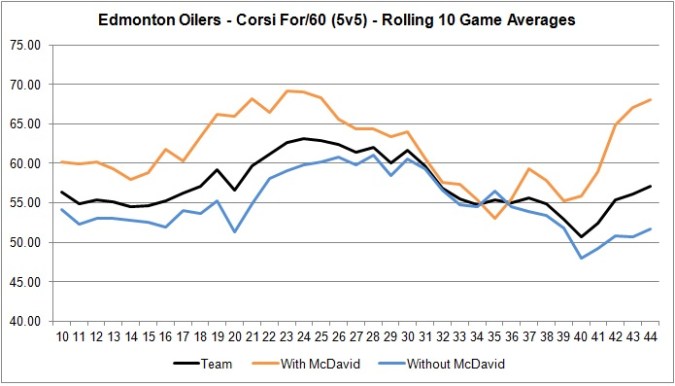
If we break out the Oilers rate of shot generation over rolling 10-game segments, we see that they had at one point been generating over 60 shot attempts per hour, but steadily declined starting around the end of November. As I mentioned in my previous article, I suspect this has to do with two things. One, the team lost Darnell Nurse, who was showing progress in his offensive game, to a long term injury at the end of November. And two, the team began giving more and more ice time to Kris Russell, who provides very little to a team’s offence. More on individual players later.

volume-shooting-rolling-10-game-averages

In the graph above I have the team’s rate of shot attempts, but I’ve also added two additional lines: one for the rolling 10-game averages of when McDavid is on the ice (orange line), and one for the rolling 10-game averages of when McDavid is off (blue line). The team is having issues this season where they’re relying heavily on one line, more so than other teams with elite players. Knowing his ability to escalate the play of his team, and the importance of having depth to win a cup, we’ll need to know how the rest of the roster is doing without McDavid on the ice.

What we can start to do is look at each player this season, and how the team does when it comes to generating shots with and without them on the ice. I’ve ranked the table below by Corsi For/60 Rel, which tells us how the team does with the player on the ice, compared to how the team does when they’re on the bench. So when Patrick Maroon is on the ice, the Oilers generate 65.65 shot attempts per hour. Without him, that number drops by 11.77 shot attempts.

Full article is at The Copper & Blue.

The Edmonton Oilers With and Without McDavid (Part III)

An area that the Oilers will need to address going forward is their scoring production when McDavid is not on the ice. The young captain is the offensive catalyst that drives play and elevates his team when he steps on the ice. But when he’s on the bench, there’s been a significant drop in the team’s goal-share at even-strength.

Heading into Tuesday’s night game against the Sharks, the Oilers had outscored their opponents 36-22 at even-strength with McDavid on the ice, which translates into a 62.07% goal share. Without him, the Oilers have been outscored 43-51, a goal-share of 45.74%. The Oilers do appear to have an okay proportion of the shot attempts (Corsi For%) without McDavid as they have a 50.51% share without him, and a 54.71% share with him. Corsi provides value here as it serves as a proxy for possession and predicts a team’s future goal share. When we look at the expected goals for percentage, which measures the quality of the shots generated and also predicts future goal share, the Oilers drop from a 56.25% share with McDavid on the ice to 45.71% share without him.

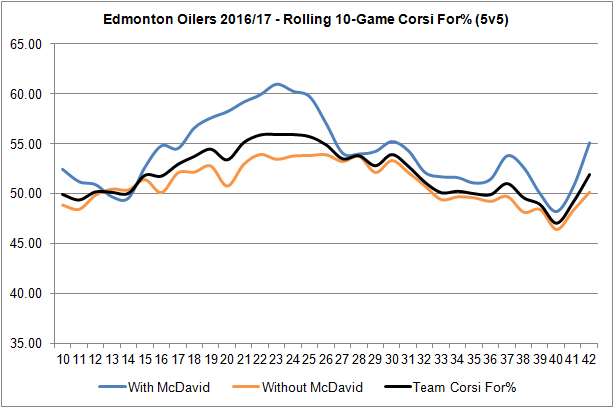
If we look at the rolling 10 game averages of the different metrics with and without McDavid, we start to see a pattern that should be of some concern for the team.

First up is a graph with the Oilers shot-share broken up into three lines: the team’s goal share with McDavid (blue), the team’s goal-share without McDavid (orange) and the team’s overall goal-share (black) (with and without McDavid).

mcdavid-wowy-cf

Full article is at The Copper & Blue.