Protecting leads with more offence

Quick follow-up to something I’ve been tracking this season, which has been around how aggresively the Edmonton Oilers play when protecting a lead. In my opinion, if you have the offensive talent the Oilers do, but a roster built by management that has defensive deficiencies, it’d be more efficient and conducive to winning if you protect your leads by possessing the puck more often and forcing your opponent to play defence.

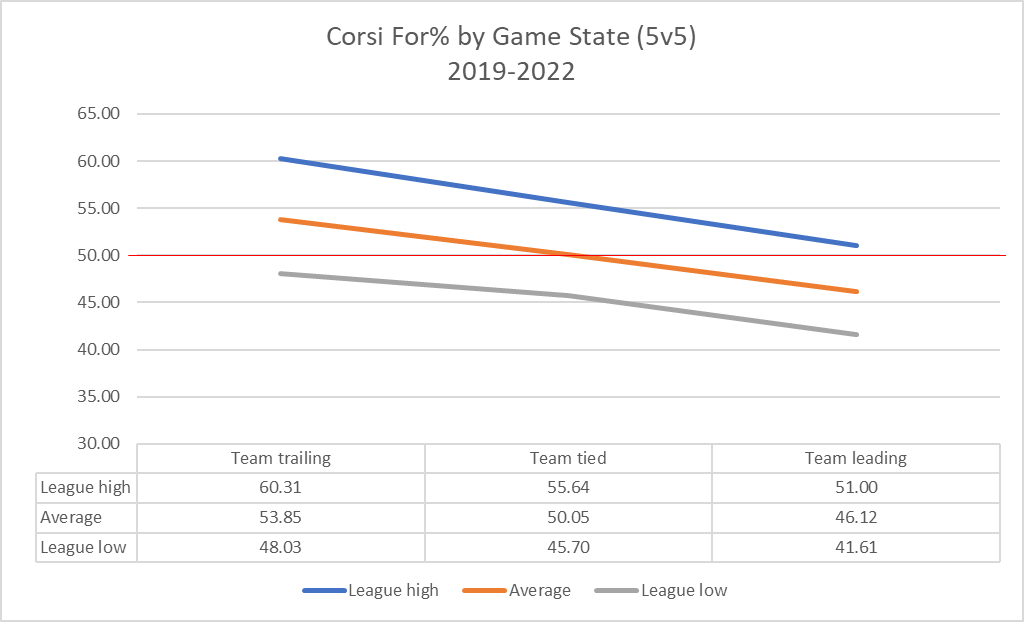
Using Corsi For percentage as a proxy for puck possession, we can see in the graph below how when the game is tied, team’s on average (between 2019/20 and 2021/22) control about 50% of the total shot attempts for and against. When trailing in a game and looking for the next goal, we see that the league average Corsi For% jumps to 54%. And when teams are leading in a game, they tend to take their foot off the gas, less likely to take risks that could cause scoring chances against – and we see the league average Corsi For% drop to around 46%. In the graph below, these league-average levels are indicated by the orange line. And for context, I also added the league-high (blue line) and league-low (grey line) Corsi For% for each game-state to show the range.

Last year, I found that when Todd McLellan, Ken Hitchock or Dave Tippett were coaching, the Oilers followed the usual league-wide trends. They would push for offence at a league average rate only when trailing in a game, and saw a significant drop in their puck possession numbers when leading in a game. Hitchcock especially had the Oilers pretty much playing in a defensive shell posting some of the lowest possession numbers in the league when the score was tied or when the Oilers were leading in a game.

That all seemed to change when Jay Woodcroft was hired as head coach at the end of the 2021/22 season. The team posted much stronger shot-share numbers overall, but what stood out to me was the team’s Corsi For percentage of 51.72% when protecting a lead. That was the third highest percentage in the league, and well above the league average share of 46.12%. They were clearly using their offensive talent to control the flow of play and more aggressively protect their leads.

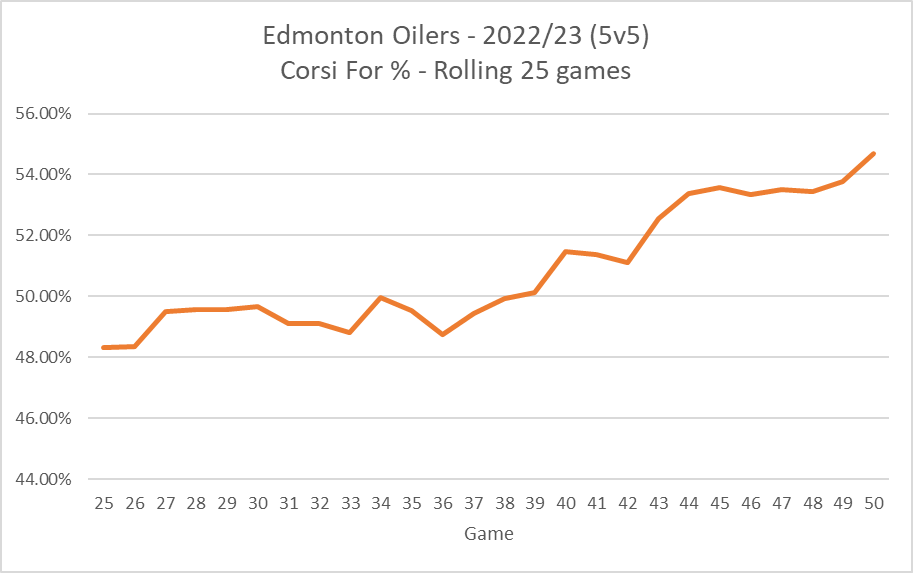
Considering the excellent results over the final 38 games last season, I assumed that going forward the Oilers would continue to play an aggressive style to protect a lead. But that wasn’t the case as after the first 16 games of the 2022/23 season, the Oilers were only posting a league average Corsi For percentage playing with the lead – 45.60%, ranking 18th in the league.

Looking at the numbers since that point in time (November 14, 2022), it appears the coaching staff has made adjustments (or perhaps the players have been more on-board), as the Oilers have posted a 49.40% Corsi For percentage protecting the lead, which is sixth highest in the league and only behind Carolina, Calgary, Boston, New Jersey and Dallas.

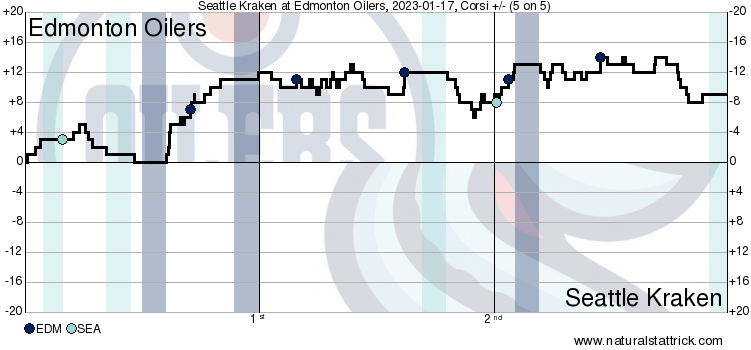
Their aggressive play also stood out in their recent win at home against Seattle – who have posted decent puck possession numbers at even-strength this season and have had a lot of success, especially on the road. The Oilers held the lead for most of the game, but didn’t seem to let up at all at even-strength (5v5), maintaining the puck well and continuing to push for offence.

Playing more aggressively when protecting a lead really goes against the norm, and is definitely driven by coaching tactics and philosophy. So I’d be curious to know what the issues were earlier on in the season from Woodcroft’s perspective and why the team is now playing more like they were at the end of last season.

Data: Natural Stat Trick

The SuperFan Podcast – Episode 48 – Checking in on the Edmonton Oilers with Dennis King (@dkingbh)

Joined by Dennis King (@dkingbh) on the show to discuss the Edmonton Oilers, Woodcroft’s performance managing the roster, the various drivers for their results and individual players who are standing out.

Full segment below:

Podcast channels:

Music: Anitek. “Show me.” Anitek Instrumentals Vol. 4, 2010. Jamendo.com

Vanity project

The Edmonton Oilers are a team in the National Hockey League. They currently rank fifth in the Pacific division and 20th in the league.

Despite having the best player in the world on their team for eight seasons now, and currently on a value contract for three more, the Edmonton Oilers will spend the second half of the 2022/23 regular season fighting for a playoff spot. A lot will need to go right for them to qualify for the post-season and for the Oilers to compete for a championship.

Of course there will be plenty of solutions the Oilers can pursue to improve their on-ice performance and improve their chances of winning games. You can make changes to the roster depending on what you think the team needs, whether it be on defence or up front on the wings. You can call for different tactics at even-strength and the penalty kill, where the Oilers performance and results have been poor this season. Maybe you go as far as replacing the manager who constructed this roster and has lost so much value for the team across numerous transactions. Or maybe you even replace the individual who hired this manager and had hired the previous manager who failed so spectacularly trying to build a competitive roster.

Identifying the problems, which are numerous, and looking through the team’s performance numbers and all of the decisions made that have led to this situation, I’m constantly reminded that the Edmonton Oilers do not operate as a proper business. This hockey club, to put it simply, is a vanity project for the owner. So a lot of the decisions made throughout the organization aren’t always geared towards winning.

The people, the internal processes and (hopefully) technology the Oilers have in place today – it’s not working. The decision-making processes they use when setting up their operations, hiring the right staff, finding the right players and constructing their roster – all in the hopes of winning hockey games – it’s not helping them progress towards being a contender. There’s clearly a flaw in how the owner is running things, and it’s hard to have faith considering the direction this hockey club is going. It’s embarrassing considering the progress other NHL clubs have made over the years, and how teams, including those outside of hockey, are finding success.

It’s a stark reality that the billionaires who own professional sports teams, including the Oilers, do so for fun and to build their reputations among their friends and the public. For some like Daryl Katz, just owning the team and getting to be associated with the legacy of former players and the dynasty years is good enough. But having a plan from the very top of the organization, building out the proper business operations, implementing sound decision-making processes to achieve big things – that all takes courage. That drive, that willingness, that creativity – it’s lacking at the ownership level. So it should be no surprise that it’s lacking across the executive, management and coaching levels as well.

We know the situation the Oilers are in and the expectations when you have the best player in the world on your team. And there’s plenty of changes that should be made throughout the organization to get things on track. But before making any decisions on the roster, the coaching staff or the front office, the owner needs to decide if owning the Oilers is a business or if it’s going to be operated as the vanity project that it is today.

Pacific depth

With the Oilers currently ranking fifth in the Pacific division and trying to gain some ground in the standings, I wanted to get a sense of the competition in the Pacific and how each team’s depth is performing at even-strength (5v5). None of the teams in the Pacific have been overly intimidating, with each having their own issues either at even-strength or on special teams, and enduring inconsistent play throughout the season. So the race is really going to come down to what edge a club could have over their competition and how aggressively their management moves to address their own deficiencies.

To get a snapshot of each Pacific division team’s depth, I took the forward from each roster who has played the most even-strength (5v5) minutes this season and used their on-ice numbers as a proxy for their team’s first line. I then looked at how each team has performed without that player at 5v5 to evaluate the team’s depth. On average, top lines are deployed for about 30% of a team’s total 5v5 time, leaving a lot of minutes for the depth players who can really make or break a team’s season. It’s also a great way to evaluate how well a general manager has constructed their roster.

Below are the forwards for each team who will serve as a proxy for their team’s first line. Included for reference is their proportion of their team’s total even-strength (5v5) time.

Team Top Line Player TOI%
Anaheim Trevor Zegras 32.6%
Calgary Nazem Kadri 28.2%
Edmonton Connor McDavid 33.6%
Los Angeles Anze Kopitar 30.1%
San Jose Timo Meier 31.9%
Seattle Alex Wennberg 29.0%
Vancouver J.T. Miller 28.9%
Vegas Mark Stone 29.7%

The first table below shows how each team’s top line has performed at even-strength this season, sorted by the team’s current ranking in the Pacific division (based on points percentage). I’ve included the team’s actual results (i.e., goal-share and goal-differential) along with the shot-share metrics like Corsi For percentage (CF%, a proxy for puck possession), and Expected Goals For percentage (xGF%, a proxy for scoring chances) to get a sense of which teams have the right processes in place and if the results are sustainable or not. I’ve also included the team’s shooting percentage and save percentage. A basic heat-map has also been applied to show which teams are doing well or struggling relative to their division rivals.

This second table shows how each team has performed at even-strength without their top line, and included the same data points as the previous table. Again keep in mind, this is for about 70% of the team’s total 5v5 ice time, and will have a major impact on the team’s final standings.

Edmonton isn’t looking too hot here, considering the expectations heading into this season. The top line results at 5v5 have been mediocre, struggling to outscore opponents (+3 goal-differential) and just barely controlling the flow of play. Edmonton’s number’s without their top line are similar to how it’s been the last number of years, with the club consistently getting outshot and outscored – and giving back the majority of the goals that the top line has generated. Their 45.36% goal share without their top line is only ahead of San Jose and Anaheim in the Pacific, and barely ahead of Vegas. It’s a clear indication that management has again done a poor job constructing a competitive roster around their superstar player.

At the top of the division, it appears Vegas is a top-heavy team – controlling the flow of play and outchancing and outscoring opponents with their top line, but giving back everything that’s been gained when their other lines are out there. Vegas’ 44.86% goal-share without their top line is currently only better than San Jose and Anaheim’s, and is the reason why Vegas’ overall 5v5 goal differential is only +1. Seattle is the opposite from Vegas as their top line is the one getting outscored – the third worst goal-share in the Pacific – but getting bailed out by their other three lines that have posted a +26 goal differential. Both Vegas and Seattle are doing a decent job creating opportunities with and without their top lines, a good sign that things should gradually improve. It’ll come down to their finishing talent with either individual players bouncing back or if their management starts exploring the trade market.

Los Angeles and Calgary are pretty similar to one another, doing well when it comes to shot-share metrics regardless of which lines are out there, but are getting sunk by their goaltending that currently ranks near the bottom of the league. They’re both hanging in there though, posting positive goal-differentials with and without their top lines and should continue to remain competitive down the stretch. Calgary’s depth especially should be seeing better results considering their 56% Corsi For percentage and Expected Goals For percentage, but it’ll come down to their finishing talent up front and goaltending. Of the other three clubs at the bottom of the Pacific division standing, San Jose is the most noteworthy as their top line is doing well, posting some of the best shot-share metrics in the division and a 52% goal-share. But they’re clearly lacking everywhere else as their other lines spend more time without the puck and getting outscored at a high rate.

It remains to be seen how Edmonton will make ground in the standings, but it doesn’t appear they’ll see much progress at even-strength, especially when other clubs are posting better shot-share numbers with and without their top lines. It’s again going to come down to what McDavid can do and hope that the rest of the roster can somehow break even in terms of shots and goals when he’s not on the ice. And it’ll be up to the coaching staff to first identify the issues and make the necessary tactical and line-up adjustments. The powerplay is likely going to be the reason Edmonton remains in the race, but it could be over quick if they continue to struggle at even-strength and if the penalty kill continues to be poor.

Data: Natural Stat Trick

Also posted at The Copper & Blue.

What’s going on with Leon? – Part 2

The last time we checked in on Leon Draisaitl a few weeks ago, he was getting lots of points on the powerplay but really struggling to produce at even-strength. His rate of points per hour was well below his career levels, and he was posting some of the worst on-ice numbers on the team with the Oilers getting badly outshot when he would be on the ice.

Likely recognizing Draisaitl’s issues at even-strength and the negative impact it was having on the team’s overall results, the coaching staff made some adjustments to get the forward’s even-strength production back on track. The solution: give Draisaitl more ice time with Connor McDavid.

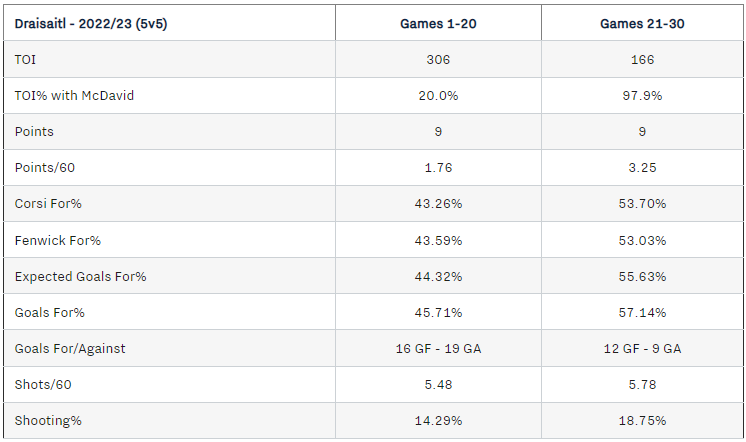
Over the last ten games, the coaching staff has deployed the two on a line together at even-strength more consistently and it’s done wonders for Draisaitl. In these ten games since November 26th, Draisaitl has posted nine points in 166 minutes of ice time – a points per hour rate of 3.25. That’s a significant improvement from the first 20 games of the season when he had nine points in 306 minutes – a points rate of 1.76 and well below his previous three year average of 2.68.

The table below breaks down Draisaitl’s individual and on-ice numbers in the first twenty games of the season where he spent about 20% of his ice time with McDavid, and the last 10 games where he’s been McDavid’s regular wing man, spending 98% of his ice time with the captain.

A big reason why Draisaitl has been so much more productive is the significant improvement in his on-ice shot-share numbers. Playing alongside McDavid, Draisaitl has seen his on-ice possession numbers (i.e., Corsi) and share of scoring chances (i.e., Fenwick) improve by about ten percentage points, going from around 43% all the way to 53% – levels you would expect from high-end talent. The team is spending far more time playing with the puck when Draisaitl has been on the ice in the last ten games, and the results have been much better as well. Prior to being McDavid’s regular winger, Draisaitl was posting an on-ice goal-share of 45% (a -3 goal differential). Since then, he’s posted a goal-share of 57%, a +3 goal differential in these ten games.

With Draisaitl needing to play with McDavid more often to remain productive, it does make the Oilers more vulnerable to getting outshot and outscored when the two aren’t on the ice. Instead of playing around 18 even-strength minutes per game without one of the two being deployed, the Oilers are now playing about 29 minutes per game without them. The Oilers play about 47 minutes per game at even-strength this season, meaning they won’t have one of their two star players on the ice for about 61.7% of their 5v5 time. Ideally, coaches are spreading out their offence and Draisaitl is a scoring threat on his own line, giving the coaching staff an advantage when it comes to even-strength matchups and overwhelming opponents. But if Draisaitl can’t put up even-strength points and becomes a defensive liability without McDavid, the Oilers coaching staff will need to figure out deployment and tactical strategies for the other three lines to ensure they’re not getting out-shot, out-chanced and out-scored without the two star forwards. This might also require some tweaks to the roster construction, something Oilers management has often struggled with.

Up until this point of the season (30 games in), the Oilers are posting a 49% Corsi for percentage and a 47% Expected goals for percentage when McDavid and Draisaitl haven’t been on the ice. These below-average shot-share numbers have lead to a 47% goal-share, or a -2 goal differential – a major issue for the team that has high playoff aspirations. And while the results without McDavid or Draisaitl on the ice have been better over the last ten games, it doesn’t appear to be sustainable considering they continue to get out-chanced regularly without their star players.

So while it’s great to see Draisaitl produce at even-strength again, it does come at a significant cost – one that could impact the Oilers chances of being a legitimate contender.

Data: Natural Stat Trick

Also posted at The Copper & Blue.

Dispirit

With the Edmonton Oilers currently struggling to break even at even-strength (5v5) this season, they desperately need their special teams to keep them afloat and competitive in a fairly mediocre Pacific division. And while the Oilers powerplay continues to dominate and remain one of the best in the league, the penalty kill is struggling mightily allowing one of the highest rates of goals against in the league, completely nullifying everything that their high-octane powerplay has produced.

Over the first 25 games of the season, the Oilers penalty kill has allowed 26 cumulative goals against (3 GF, 29 GA) – a rate of 12.60 goals against per hour, which is fourth highest in the league. One of the main drivers for their poor results is the team’s defensive play, as the club struggles defending the blue line for zone entries and keeping chances outside the high danger scoring areas. And this is reflected in the team’s rate of unblocked shot attempts against (a proxy for scoring chances), which is ninth highest in the league (82.98 per hour) and the rate of shots on goal against which is sixth highest (61.69 per hour).

The team’s defensive play is an issue that’s carried over from last season when they were posting similar numbers, but were being bailed out by the goaltending which posted the 10th best save percentage in the league (87.53%). This year, they’re not getting the same rate of saves on the penalty kill as the current Campbell-Skinner tandem has thus far posted a combined save percentage of 79.58% – which ranks 29th in the league. Campbell is especially struggling on a high-event penalty kill, something that was somewhat expected considering his previous team in Toronto allowed some of the lowest rate of shots against when shorthanded. Among 42 goalies who have played at least 45 minutes on the penalty kill this season, Campbell ranks 39th with a 78.90% save percentage and a -4.73 goals saved above average. Skinner isn’t faring much better, as he ranks 36th in the same pool of goalies with a 80.30% save percentage and 37th when it comes to goals saved above average with -3.21.

These results are especially frustrating when you consider the fact that everything the Oilers powerplay has done for the team has been completely offset by the defensive play and goaltending on the penalty kill. Consider the talent on the powerplay, the cost of these players, the practice time, and the chemistry that’s been developed for them to be one of the best units in the league. It’s all been washed away by a penalty kill that surrenders so many shots, chances and goals against – and preventing the powerplay from being an actual asset. Especially at a time when the Oilers are struggling at even-strength, posting a negative goal differential and below-average shot-share numbers, the Oilers can’t afford deficiencies of this scale.

The Pacific division is wide-open at this point with six of the eight teams currently posting negative goal differentials (in all situations). Fixing the penalty kill, either through tactical or deployment adjustments, has to be a top priority for the coaching staff if they intend on locking down one of the top three playoff spots.

Data: Natural Stat Trick

Also posted at The Copper & Blue.

Tracking the Pacific division – As of November 30, 2022

While the Edmonton Oilers aren’t having the greatest season, the good news is that most of the Pacific division is struggling as well. Six of the eight teams have a negative goal-differential at this point, with only Vegas and Seattle leading the pack. Worth noting too that four of the eight teams in the Central division are also posting negative goal-differentials, with only Dallas, Winnipeg and Colorado having solid seasons so far.

Team Record Points Point % Goal differential
Vegas 17-6-1 35 0.729 +20
Seattle 14-5-3 31 0.705 +16
Edmonton 13-10-0 26 0.565 -3
Los Angeles 12-9-4 28 0.560 -5
Calgary 10-9-3 23 0.523 -3
Vancouver 9-11-3 21 0.457 -8
San Jose 8-14-4 20 0.385 -15
Anaheim 6-15-2 14 0.304 -37

Despite their issues, the Oilers are still posting the third best points percentage in their division, largely driven by their powerplay which generates the third highest rates of goals per hour in the league. Everything else – even-strength play and results, their penalty kill, their goaltending – it all needs work if they want to qualify for the playoffs.

Below are the even-strength (5v5) numbers for each team in the Pacific division (sorted by points percentage) including goal-share results as well as the shot-share metrics that gives us a sense of which teams have the right processes in place and if the results are sustainable or not. I’ve also applied a basic heat-map to show which teams are doing well or struggling relative to their division foes. You can find a description of each metric at the end of this article. Also note that the shot-share metrics are score and venue adjusted based on Natural Stat Trick’s methodology.

Not much has changed for the Oilers since the last check-in at the end of October other than the goal-share dropping significantly, something that was expected considering their shot-share numbers and expected goal-share had been below average and some of the lowest in the division. And these numbers are still poor after 23 games, putting the Oilers at risk of losing ground to the Los Angeles and Calgary who are both posting some of the strongest Corsi for percentages and expected goal shares in the league. Issue for both teams is currently goaltending, which has somehow been worse than Edmonton’s, and it could sink their playoff chances if it doesn’t get sorted out. I’m also curious to see if Seattle’s powerplay, which currently ranks 7th in the league in terms of goals per hour, can continue to drive their overall results. They currently generate some of the lowest rates of shots and scoring chances on the powerplay, so I’m expecting things to cool off.

Back to the Oilers – it seems like the best idea that the coaching staff could think of to improve their 5v5 results (and to get Draisaitl going) is just putting McDavid and Draisaitl together on the ice as much as possible. In the first 19 games of the season, the duo only played 60 minutes together – or about 6.5% of the team’s total ice time. That’s still higher than what I was expecting considering they rarely played together after Woodcroft took over last season, but lower nonetheless. Over the last five games, however, McDavid and Draisaitl have played 69 minutes together – or about 29% of the team’s total ice time. In that time, the Oilers have posted a Corsi for percentage and expected goals for percentages closer to 60% and outscored opponents 5-3. Not sure how sustainable this is with both players averaging more total ice time per game, but it feels like the coaching staff is out of ideas and doing what they know will work. The concern of course will be the rest of the roster and if they can post positive shot-share metrics and goal differentials at 5v5 without their star players on the ice. Definitely something worth monitoring over the next month.

Data: Natural Stat Trick, Hockey Viz

Glossary:

  • Points-percentage (Point%) – The total points accumulated divided by the points that were available, including extra time.
  • Corsi For percentage (CF%) – The proportion of all the shot attempts the team generated and allowed that the team generated (i.e., Corsi For/(Corsi For + Corsi Against). This is used as a proxy for possession and is the best at predicting a team’s future share of goals (GF%). (Source: Hockey Great Tapes – Draglikepull)
  • Fenwick For percentage (FF%) – The proportion of all the unblocked shot attempts the team generated and allowed that the team generated (i.e., Fenwick For/(Fenwick For + Fenwick Against). This is used as a proxy for shot quality and considers shot blocking a repeatable skill.
  • Expected Goals For percentage (xGF%) – This is a weighting placed on every unblocked shot based on the probability of the shot becoming a goal. This depends on the type of shot, location and uses historical shot and goals data to come up with the probability for each unblocked shot.
  • Goals For percentage (GF%) – The proportion of all the goals that the team scored and allowed that the team generated (i.e., Goals For/(Goals For + Goals Against).
  • Shooting percentage (SH%) – The percentage of the team’s shots on goal that became goals (i.e., total goals divided by the total shots on goal).
  • Save percentage (SV%) – The percentage of the team’s shots on goal against that were saved (i.e., 1-(totals goals allowed divided by the total shots on goal against).

What’s going on with Leon?

The star forward is among the league leaders in points, but his production and on-ice numbers at even-strength are lower that expected. It’s critical for the coaching staff and management to figure out what’s going on with Draisaitl if they want their 5v5 numbers to improve.

There’s obviously a lot of team-wide issues right now for the Edmonton Oilers, as the club ranks fifth in the Pacific with a 0.526 points percentage and ninth in the western conference. Defensive play has been poor, the offence has dried up, and there’s plenty of questions about the roster construction and the potential internal solutions. It’ll be interesting to see how the coaching staff and management navigate things in such a high pressure season.

Even-strength (5v5) play is the biggest point of weakness for the club as they’re getting out-shot, out-chanced and out-scored regularly – ranking in the bottom third of the league when it comes to performance indicators that drive positive results. And it’ll need to improve if the Oilers want to keep up with the top teams in the league.

One player in particular that is currently struggling playing even-strength minutes is Leon Draisaitl. He’s a proven star in the league and can improve the team’s odds of winning games. And he’s among the league leader in points this season because of his dominance on the powerplay. But his even-strength numbers this season, including his personal numbers and his on-ice numbers, have been poor compared to his previous three seasons – and it’s part of the reason why the Oilers are struggling to win games.

Starting with his personal numbers, Draisaitl currently has nine even-strength points which ranks fourth on the Oilers – a points per hour rate of 1.85. That’s a drop from the 2.68 points per hour from his previous three seasons – a level that top line, star forwards typically produce at. Heading into this current season, Draisaitl’s rate of points ranked 17th among over 500 forwards who played at least 1,000 minutes since 2019, a period in which he’s accumulated the third highest number of points in the league. His current rate of 1.85 ranks 131st among 324 players who have played at least 200 minutes this year – not anywhere near where he should be considering his history.

What’s driving his drop in production is his individual rate of shots per hour which has decreased from 6.43 per hour over the last three seasons to 5.56. And his shooting percentage is also lower than expected, currently sitting at 14.81%. Considering his age and his talent, you would expect to see his rate of shots and his shooting percentage to gradually improve, resulting in better productivity over the course of the season. But there’s a couple other issues to consider.

One reason for his lower rate of shots per hour this season is the fact that the Oilers are spending a significant amount of time without the puck when he’s on the ice, as reflected by the team’s Corsi For percentage (a proxy for puck possession) of 42.83%. The team is also getting out-chanced more regularly when Draisaitl is on the ice with, as reflected by their 43.19% share of expected goals (a proxy for scoring chances and shot quality) – which again is a drop from the levels we’ve seen with him on the ice over the last three seasons. All of Draisaitl’s on-ice shot-share numbers (i.e., Corsi For%, Fenwick For%, Expected Goals For%) are some of the lowest on the team, only ahead of Holloway and Shore. And it’s on the defensive side of things where the Oilers are really struggling with Draisaitl, as they see more than a 17% increase in the rate of shot attempts, unblocked shot attempts and shots on goal against with their star forward on the ice. The rate of expected goals against this season – which factors in shot quality and scoring chances against – increases by 26% with Draisaitl on the ice, going from 2.78 per hour to 3.51.

Draisaitl’s poor on ice numbers at even-strength is pretty significant considering the expectations on him as a player and the team this season. The Oilers top six is supposed to be one of the best in the league, but it’s hard to accomplish anything when a star forward is struggling and the team is failing to control the flow of play and total scoring chances with him on the ice.

What’s worth noting is that Draisaitl is struggling with pretty much every linemate and defenceman on the Oilers, unable to post shot-share numbers like Corsi For% and Expected Goals For% above the 50% break-even mark, regardless of the player he’s with.

The one player that Draisaitl is having success with this season is Bouchard, as they’ve played 90 minutes together and posted a Corsi For percentage of 51.71% and an Expected Goals For percentage of 52.26 – both numbers being well above the team’s current averages. With Nurse having his own issues and posting some of his worst on-ice numbers in his career this season, it might be beneficial to the team, and especially for Draisaitl, if Bouchard saw an increase in his even-strength minutes and more time with the top lines.

Whatever the coaching staff and management decide to do to improve the team, whether it’s internal or external solutions, it’s important to have a firm grasp of the real issues plaguing the team and implementing changes that help improve the odds of winning games. Considering their poor results and underlying numbers at even-strength – where 80% of the game is played – it’s critical they focus here first and find tactical and deployment solutions as soon as possible.

Data and glossary: Natural Stat Trick

Also posted at The Copper & Blue.

Issue detection

Really can’t emphasize enough how much of a drop off there’s been when comparing this season’s results to last season after the coaching change occurred. One of the biggest improvements the Edmonton Oilers made after Jay Woodcroft took over in February 2022 – and what helped drive the overall results – was the team’s possession and scoring chance numbers at even-strength as the club went from around league-average levels to being one of the best in the league.

After the coaching change last season, the Oilers played more aggressively with leads, they spread out their offence across multiple lines and their depth players weren’t getting out-shot and out-chanced as much as they had been in previous seasons. All of these coaching-driven factors played a major role in the overall results at the end of the 2021/22 regular season, and the process behind it all was based on sound logic and reasoning.

Fast forward to this season, and the team isn’t anywhere near where they were in the final thirty-eight games of last season. Their possession numbers and share of scoring chances are currently some of the lowest in the league, with their Corsi For percentage dropping down from 53.71% last season to 47.76% this season. And their share of expected goals is down to 46.29% – which ranks 26th in the league only ahead of Anaheim in the Pacific division.

Now it’s understandable if the Oilers defensive play gets most of the attention as the results are what stands out first. They’re currently allowing the seventh highest rate of goals against at even-strength (2.78), and their penalty kill is allowing 12.04 goals against per hour – the third highest in the league. Management didn’t exactly build a strong, championship caliber defence core either and we’ve seen established players struggle throughout this season and some of the young prospects struggle to gain traction at the NHL level. The team also spent a lot of money on a new starting goalie who is struggling early on this season – which was also somewhat expected.

When we dig into the actual results, we see that they’re somewhat expected as the club is having all sorts of issues preventing shots and scoring chances at even-strength, with their rates all having increased by a significant margin compared to last season. For instance, the rate of expected goals against – which factors in shot quality and the probability of an unblocked shot becoming a goal – has increased by 17.4% this season. The table below shows the other defensive numbers from this season and the thirty eight games under Woodcroft from last season with percentage changes.

What’s further troubling are the issues up front.

With arguably one of the best top-six forward groups in the league, and with the powerplay having a lot of success and McDavid and Draisaitl leading the league in points – it can generally be assumed that the Oilers offence is and will be just fine. But if we take a look at the numbers at even-strength, that’s really not the case. And things have taken a significant hit compared to last season, similar to the levels experienced on the defensive side of things.

The Oilers are only scoring 2.26 goals per hour at even-strength, which ranks 24th in the league and last in the Pacific division. The biggest issue is that they generate some of the lowest rates of shot attempts, shots on goal and scoring chances – all of which have dropped over 10% compared to last season. The Oilers current offensive rates have them in the bottom third in the league for each category – a big drop off from the end of last season where they were closer to the top five in the league after Woodcroft took over.

You’d hope someone in the Oilers management group is aware of this situation and is questioning (a) how the roster was built the way it was, and (b) the coaching tactics and player deployment that is being implemented. There’s a significant problem in Edmonton both offensively and defensively, and it’s critical for the team to get things on track if they want to be considered a championship contender.

Data: Natural Stat Trick

Also posted at The Copper & Blue.

Bringing it home

When talking about the Oilers struggles this season at his media availability this afternoon, Woodcroft commented about the success the Oilers have had on the road this season and wanting to make their home arena a tougher place to play in for opponents.

The good news is that we’ve demonstrated a competitiveness, a will to win, a finding a way to win. Our level of simplicity and effectiveness on the road where we’re 5-2, we got to bring that home. And we got to figure out a way to make this the toughest arena in the National Hockey League to come into. We’ve done that in the past, we got to do it again. And I think that comes down to a level of consistency and building a level of consistency in your game. (Source)

Had to take a look at the data to see what exactly the difference was between the Oilers performance at home versus on the road, expecting to see some differences. But that’s not exactly what the data shows.

2022/23 Record Points% Goals For/Goals Against
Home 4-5-0 0.444 34-34
Road 5-2-0 0.714 25-24

While the Oilers have had more success on the road so far this season, there’s not much that you can take away and build off of or want to replicate at home. Their overall goal differential is only marginally better on the road, and it’s it’s worth noting that their underlying numbers at even-strength (5v5) inidicate that their results are unsustainable.

Oilers – 2022/23 (5v5) Home Road
Corsi For% 48.87 45.18
Fenwick For% 47.56 45.11
Expected Goals For% 48.61 43.18
Goals for/against 17-21 12-14
Goals for% 44.74 46.15
Shooting% 7.23 8.62
Save% 90.65 92.81
PDO 0.979 1.014

The Oilers are currently one of the worst teams on the road when it comes to controlling the flow of play and total scoring chances as reflected by their 45% Corsi For percentage and Fenwick For percentage. They have a -2 goal differential at even-strength as well, which again is only slightly better than their -4 goal differential at home.

The real reason they’re having success on the road is their goaltending, which is posting a 92.81% save percentage. Reason for that is Skinner who has played four of the Oilers seven road games while Campbell, who has struggled so far this season, has played seven of the nine home games. So if there’s anything the Oilers can take away from their road success, it’s that they should play Skinner more often at home.

Other than that, the Oilers don’t have any real strengths on the road. I’d be curious to hear Woodcroft elaborate on his comments and see if there’s anything tangible he’d like his team to improve on.

Data: Natural Stat Trick