Bloggers vs MSM

Some interesting discussion (Wyshynski, Mendes) about the whole mainstream media (MSM) versus bloggers topic lately. MSM would include the big networks such as TSN, Sportsnet, ESPN, etc. Bloggers would include those not employed by these networks and do not have the support of a corporation (check out the blogroll). We’ve seen recently some MSM types get into the blogging world and vice versa. But for the most part, an individual is perceived to be in one camp or the other.

MSM relies on the traditional model of information development. Information is created, distributed and then consumed by the customer. With internet technology and the development of social media, we’ve seen a major shift in this information development. Bloggers have emerged as they not only consume this information but then they use it to create their own content.

More recently however, these bloggers have taken it one step further and begun developing their own method of actually creating information. Instead of reading the boxcar stats for a game in the paper the next day, they’ll watch a game and analyze it themselves to determine their own stats. They can then aggregate this information, share it with an online community, and then have discussions to build on it even more.

A tension has developed between the two sides. Bloggers can be pretty critical of the MSM’s work and demand more from the regular reports available. Bloggers, on the other hand, tend to be viewed as those living in the confines of their parents basement without a real understanding of the game. Both have their strengths and weaknesses in terms of content and tend to feel separated from the other. There’s talk of how blogging could one day replace MSM to cover sports. But as long as professional sports remains the object of analysis, it’s hard to see this happening. It’s a powerful industry, includes large organizations and million dollar players. It’s a well oiled machine that has norms and practices in place, making it difficult to change. The information and data that comes from this can have major ramifications for individuals, organizations and the industry as a whole. How it works now, with official media covering the games, is what works best for the industry and their stakeholders.

Bloggers have grown in prominence and the quality of work is pretty remarkable. They are replacing MSM as the source of information and analysis for a lot of fans. But as long as professional sports is the topic, MSM will always have a role. There’s still value in their work but they have to recognize that blogging and getting into these online fan communities is going to be important for their success.
Oilers vs Oilogosphere!

Greg Wyshynski of the Puck Daddy blog broke a story regarding bloggers and their role covering NHL teams. According to Wyshynski, teams that do not grant any bloggers press credentials such as the New York Rangers and Edmonton Oilers, have requested that bloggers from other cities not be given access to their players. As it stands right now, a blogger covering the Washington Capitals does have access to the Oilers when they visit DC. Some interesting discussion happening online (Staples) about this including what the difference is between a journalist and a blogger.

Teams like the Oilers have the option and can choose what best suits their business goals. Unfortunately, shutting out all bloggers reduces the amount of information they can possibly use and share with their fans. Giving these bloggers access also gives a new perspective on the game and could potentially generate some new ideas. The blogs out there really represent the demand hockey fans have. For example, points and assist statistics are great, but fans want a lot more statistical analysis.

But is it best that they remain out of the mainstream press box and stay in their parents basement? If the Oilers were to grant them access, would it change the bloggers relationship with their own fans? What if a new set of bloggers emerges scrutinizing the now mainstream bloggers work?

If bloggers are granted press credentials at games, there might be some interesting ramifications. For one, their relationship with their own fan base would change. Becoming a part of the mainstream media panel could change the way their perceived. Instead of being that accessible individual, they may be seen as “one of them”. This could change how bloggers are received and if their work grants merit.

Also, their perceived motivations could drastically change. A blogger tends to function on intrinsic motivation. They do things for self-satisfcation, without the need for financial rewards. Becoming a part of the MSM segment might change the perceived motivation. The demand on them will be from external factors and may significantly increase. This in turn may discourage them or alter their blogging activity.

In my opinion, bloggers should be granted press credentials. Of course, not every single person with a website should be let in. A set of standards must be established and agreed upon by both sides. The Oilers can really benefit from having a new perspective on the game from people motivated by intrinsic factors. It remains to be seen what would happen in a market like Edmonton where hockey remains front page news even in the summer. Teams such as Washington do grant bloggers access, but Edmonton would be different just because of the Oilogosphere and their presence online.

Computer games

The prospect of including video gaming is going to haunt me until I either accept it or find a really good argument to avoid it.

First off, I’m going to use “computer games” to describe both video games,online games and of course the latest updates with virtual games, you can also review services by professional gamers here. Video games would include Mario Bros for Nintendo or Solitaire on your desktop. Pretty static games, single port to play and not much interaction with other players directly. Online gaming would include online checkers, where you play with another friend or stranger online or World of Warcraft, where you engage with milli When I’m playing League of Legends – I frequently need see folks using running services in competitive servers. ons of other users. For the sake of this posting, I’m going to wrap up all games under one debatable umbrella.

Without a doubt, it’s a huge industry with millions of players online. A ton of money is spent developing and promoting these games. A lot of interesting work has been done researching computer games well. Studies have examined its impact on society, how it’s used by various age groups, how it can used in schools and what lead to its popularity.

Sports computer games are pretty amazing right now. The amount of visual detail is something, but the intelligence of the computer is off the charts. Each ensuing version gets better and better, enhancing game play and realism. For example, at the start of the playoffs, a simulation using EA Sports NHL 2010 correctly predicted that the Hawks would win it. A.I. is defined here as well:

“artificial intelligence…uses real-life data from each team, such as player ratings and line combinations, and includes variances such as injuries and hot streaks to predict a realistic outcome of each game and series”

Online games are a way for the fan to learn more about the game/sport, get into roles they may never be in (game 7 of the finals), and get entertained. Computers games can work as that conduit between fans to generate ideas and collaborate. Information gathered from the game can be used, knowledge generated and ideas shared.

My goal is to examine an online fan community, and their interaction primarily through weblogs. Computer gaming technology is a great way for fans to interact with one another and create/share information. But the barriers to get into computer games and use information still exists. Fans rely on EA to create the game, they buy the gaming console and pay subscription fees. Sport video games don’t allow for much tinkering with the code to alter the game. Aside from creating and trading players, fans don’t have as much freedom as those that are using weblogs when it comes to “produsing” (Bruns, 2008). This could very well change dramatically in the next few years, so I can’t completely forget about it either.

Oilogosphere

Great to see that Oilogosphere has its own wikipedia page. A brief excerpt:

The Oilogosphere is the name collectively applied to blogs that cover the Edmonton Oilers ice hockey team. They are widely considered to be among the best and most popular hockey blogs on the internet, with Globe and Mail sportswriter James Mirtle estimating in late 2007 that “five or six” of the best hockey blogs were members of the Oilogosphere.

The Oilogosphere averages 10,000 hits per day not counting people who visit the official Oilers site or read the sports stories online.

The wiki cites work done by David Staples of the Edmonton Journal. David is pretty active himself writing about the Oilers and provides new ways to measure player performance on his blog The Cult of Hockey.

Blogs considered to be part of the Oilogosphere can be found in the links section to the right. It’s not just the blogs and their writers that make up this group. Regular fans have to be included as well since they do a lot of the reading and sharing of this information. The reason these blogs have been so successful is because they remain open to everyone and not just Oiler bloggers. Writers regularly respond to reader comments leading to some interesting discussions.

Online fan community and culture

Just wrapping up a great course called Digital Tribes. The concept of cyber culture will probably sneak into the final project for good reason.

The one thing that stuck out most is the fact that culture plays an integral role in online behavior. A culture that is open to ideas, welcomes both participants and observers will probably be more successful. If you want to get people to contribute and share ideas and knowledge, you have to provide an environment that is open and ready. This culture is formed by the technology being used, the structure, including norms and values, and of course the people.

Perhaps this is why the Oilers online fan community has grown to be what it is today. People spread all over the world are talking about the Oilers, sharing ideas and generating knowledge regularly. One thing you will notice when surfing these blogs is the openness to comments. Some comments last a couple sentences, others go on for paragraphs. But both are accepted and reflected upon by the blogging community. The comments that are vulgar, or may be irrelevant are often ignored and eventually get phased out. The majority of the comments have some thought behind it and are typically responses to previous ideas.

Digital Tribes

Thanks to Matheiu Reynolds for a nice summary.

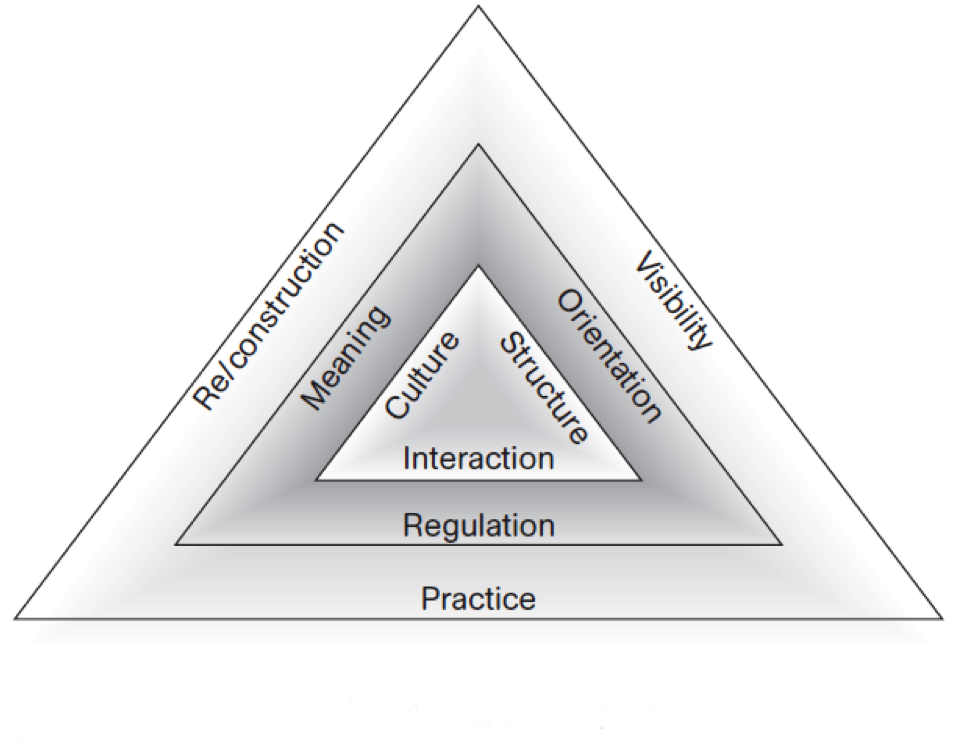
Gotved’s triangle attempts to encompass the entities that make up out cybersocial reality. The first three, culture, interaction and structure form the initial triangle. When time and space is added, each of the initial three entities evolves and is influenced in some way.

When looking at this triangle, I looked closer at the cybersocial reality for bloggers and fans interacting online. How is their reality formed online? Why have fans been able to take offline conversations and take them to a new digital arena? Were new rules created when fans developed this online community or did the same offline rules transfer over?

Gotved, S. (2005). The Construction of Cybersocial Reality. In D. Silver & A. Massanari (Eds.),
Critical Cyberculture Studies (p. 168-178). New York: NYU Press.

Abstract…on poster

Fans of professional sports support their teams and players by attending games, buying merchandise and expressing their passion for the sport. With a long history in the city of Edmonton, the game of hockey is deeply engrained within Canadian culture and has a large and passionate fan base.

With the development of various user-friendly communication technologies and the cost of using these tools decreasing, fans have been able to develop information regarding their sport and share their ideas within a broad community.

Why sports as a project for the MACT program?

It’s hard to ignore sports in Edmonton. Whether it’s hockey, baseball, football or basketball, there’s some history of it here in Edmonton. The majority of events, including soccer  and motorsports, at any level, can draw major crowds anytime.

The inspiration for this project is the amount of websites and fan generated information that have popped up in the past few years. Originally, if you wanted to get any hockey information, you would head to an established news outlet such as TSN or CBC.

Since the internet is now readily available to almost anyone, and the simplicity of the technological tools has increased, a lot of more people are getting involved in the development and maintenance of information. This links back to Clay Shirky’s work about group formation (EXT 503) and social media.

You can find a few blogs and websites of individuals who not only provide their commentary and opinions about hockey, but have also developed new and unique ways of tracking statistics. They’re great examples of individuals generating their own knowledge and information.