The Gryba and Davidson Partnership

I didn’t think I’d ever say this, but I’m okay with the Oilers signing Eric Gryba to a Professional Tryout (PTO) agreement. The 28 year old, right shooting defencemen is expected at training camp, with a pretty good shot at making the team. It’s a low risk move that creates competition for one of the depth spots on the roster. And it should, in my opinion, make it harder for both Darnell Nurse and Griffin Reinhart to make the opening night lineup I have no hesitation in saying that both Nurse and Reinhart, who I think are good prospects, need extended time to develop at in the AHL. There is no harm in having these two play top pairing minutes, in all situations, against AHL-level competition in Bakersfield, until they’re ready to contribute on a consistent basis.

Back to Gryba, the things that he has going in his favor are his performance numbers from last season playing with young Brandon Davidson. They were one another’s most common defence partner, having played a total 279 minutes together at even-strength, predominantly as the third pairing on most nights, but did move up into the top four on occasion. Their 53.48 CF% at even-strength was second best among all Oiler defence pairings that played more than 50 minutes together (18 defence pairs in total). Source: Corsica Hockey.

Full article is at The Copper & Blue.

Couple Thoughts on Shawn Horcoff

rsz_game25horcAny hopes of Shawn Horcoff playing one more season in the NHL were put to rest this morning as he officially accepted a new front office role with the Detroit Red Wings. While I do think he’ll eventually be part of a coaching staff one day, starting off in a player development role suits him just fine for now.

He was absolutely one of my favorite players, mostly because he was a solid centermen, but also because his work was often overlooked and taken for granted. He was also a reason why I got into shot-based metrics like Corsi and Fenwick around the time the advanced numbers were taking off. Many times, you would see him play against the best lines, prevent bad things from happening, and then skate off the ice with nothing really to show for it. But when we started getting access to time on ice numbers and started to see how much the team relied on him to play against the Sakic’s and Yzerman’s, you began to appreciate how much he meant to the franchise.

He also represents to me an era of the Oilers that will never get a lot of praise, but one that I’ll always be attached to. Now I have nothing against the dynasty Oilers and obviously appreciate and respect their accomplishments. But I was too young to really be into hockey in the 80’s, and really have zero attachment to that era and those players.

Instead it’s been the Oilers since 1997 that I’ve had an attachment to and identify with. Every move the team has made, every season, the players, I feel like I have my own story to tell and my own interpretation of the events. So following the career of Horcoff, from his draft day to the 2006 playoff run, to the trade to Dallas, to his season in Anaheim, there’s a sense of loss with the news of his retirement, but also a renewed sense of connection to a player that accomplished a lot over the course of 15 seasons.

Below are the links to articles I’ve written about Horcoff. Included in those links are the numbers he posted as an Oilers, but also a review of his performance in Dallas, where he was a solid depth player, and Anaheim, where he continued to be a reliable utility player and saw his ice time gradually increase.


Oilers Line Combinations from the 2015-2016 Season

Jordan+Eberle+Jujhar+Khaira+Edmonton+Oilers+RZEoGjuR3KUlWith training camp a few weeks away, the discussion around potential line combinations will begin to ramp up. With Milan Lucic joining the forward group, and new prospects like Jesse Puljujärvi  and Drake Caggiula entering the system, along with older prospects like Jujhar Khaira and Anton Slepyshevpushing for spots, the possibilities are endless.

But before putting together potential line combinations, I thought it’d be worth looking at how the different line combinations did last season. In particular, I looked at the combinations that played at least 50 minutes together at 5v5, and focused on their possession numbers (CF%), their share of quality shots/expected goals (xGF%) and their share of actual goals (GF%). I’ve sorted the table by Corsi For%, but you can click the table’s column headers to sort the other metrics. Also included in the table below is the time-on-ice (TOI), along with the line’s PDO and percentage of offensive zone starts. Please note that the numbers have been adjusted for score state, zone and venue. Source: Corsica Hockey).

Full article is at The Copper & Blue.

Some reasons to believe in Anton Lander

After a pretty brutal 2015/16 season, where he only scored one goal and notched two assists, Anton Lander has a lot to prove to Oiler fans. He was coming off of a pretty good 2014/15 season, when he was promoted to Edmonton from Oklahoma City after Todd Nelson became interim head coach, scoring six goals and finishing the season with 20 points in 38 games. Expectations were certainly raised last summer when he was rewarded with a two-year, one-way contract extension that would pay him $925K in the first year and $1.05 million in the second ($987,500 AAV), and a very good showing at the 2015 World Championships where he played on the top line for Sweden.

One thing to consider is that of the 20 points he scored in 2014/15, 9 were on the powerplay, which was clicking at a very high rate with Todd Nelson behind the bench. With McLellan behind the bench, Lander did not get nearly as much ice time with the man advantage, and understandably so: the lineup was healthier than the 2014/15 team and the additions of McDavid and Draisaitl were going to push players like Lander off of the powerplay. Regardless, Lander’s respectable 1.49 points/60 at even-strength was sixth among Oiler forwards who played at least 400 minutes in 2014/15 (12 forwards total). What was also promising were his possession numbers over those 38 games. Below is how he ranked among Oiler forwards with at least 400 minutes of ice time. (Source: Hockey Analysis)

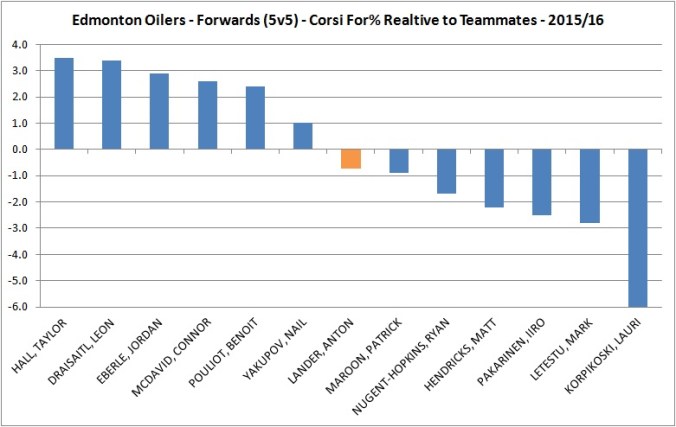
Lander finished the season with a +1.2 Corsi For percentage relative to teammates, which ranked him behind top six forwards like Hall, Eberle, RNH and Pouliot. Lander’s two most common linemates that season were Matt Fraser and Andrew Miller, both of which are fringe players today. Lander did spend 93 minutes with Hall as well, which would absolutely give his numbers a boost. When it came to the rate of generating shot attempts (i.e., Corsi For/60), Lander finished third on the team with a +3.80 Corsi For/60 relative to teammates, but ranked 8th on the team when it to the rate of shot attempts against.

Lander20152016

Fast forward to the 2015/16 season, and Lander’s productivity when it came to point production falls off of a cliff, as he finished the season with a 0.33 points/60 at even-strength, which was last on the team among forwards who played at least 500 minutes, and fourth last in the entire NHL. But when it came to his possession numbers relative to his teammates, Lander did not fare too badly.

Full article is at The Copper & Blue.


Adam Larsson Against Different Levels of Competition

Last week, I looked into the performance of the Oilers depth forwards and defence core against different levels of competition using the WoodMoney metric. What we can do using this data is parse out how individual players did against three categories of forwards, and add another level of information to our analysis. The full rationale for the metric, the methodology to classify players and the complete data-set can be found at Because Oilers.

Here’s a quick breakdown of the different competition groupings.

Elite: at least one elite player must be on the ice. No Gritensity players may be on the ice.

Middle: Elite + Gritensity on the ice, or 3 mudddles

Gritensity: Any time a gritensity player is on the ice except when with an Elite.

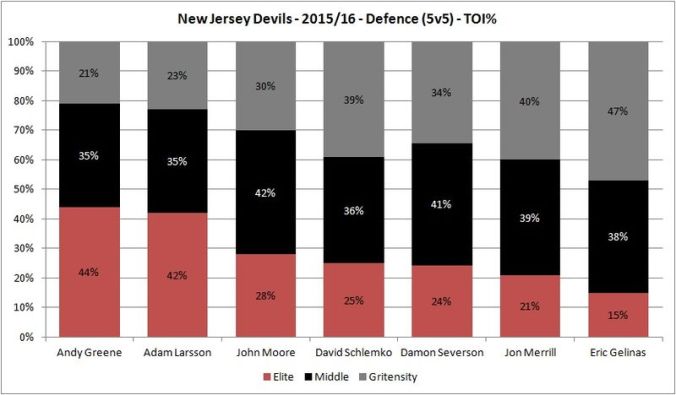
I received a couple of requests to look into how Adam Larsson did last season as a New Jersey Devil using the WoodMoney data. What we know from some of the more established metrics available at Corsica Hockey and Hockey Analysis is that Larsson played predominantly with Andy Greene, starting a significant number of shifts in his own zone and actually fared pretty well when it came to limiting shot attempts, scoring chances and goals. We also know that when it came to offence, Larsson is a bit of a black hole as the team didn’t generate a whole lot with him on the ice.

Using the WoodMoney data, we can look into how Larsson did against the different levels of competition, including his proportion of ice, shot attempts against and Dangerous Fenwicks against.

WM_-_Devils_Defence_-_TOI.0

Full article is at The Copper & Blue.

Evaluating the Oilers Using WoodMoney

In case you missed it, Darcy McLeod and G-Money have developed WoodMoney, a new metric to evaluate how players have performed against different levels of competition. What they did was take every NHL player and classify them, using some pretty sound criteria (i.e., point production, ice time, Corsi Rel), into one of three categories: Elite, which are the top end players, Gritensity, which are lower end, replaceable-type players, and Middle, which are those that did not fall under the Elite or Gritensity group based on Darcy’s and G-Money’s criteria.

From there, they used the data available from NHL game sheets to determine how much time each player played against the different categories, and also how they performed when it came to possession and shot quality. The methodology and process to classify the players can be found at Because Oilers along with a link to the complete data-set. I highly recommend reading Darcy’s article to understand the duo’s rationale behind the new metric and why quality of competition is important. A couple links that explain G-Money’s Dangerous Fenwick metric, which measures shot quality, is also below.

Watching Oiler games and reviewing the deployment data available on great sites like Natural Stat Trick and Hockey Stats, we know that coaches try to find the match-ups they want and do everything they can to get specific players out against specific lines. Game-to-game, we can get a sense of which players are drawing the toughest opponents, which are getting time against the fourth liners, and how they perform. And with WoodMoney, we can start to aggregate each player’s outputs (i.e., shots, shot quality) against the different levels to add another layer of information to our analysis.

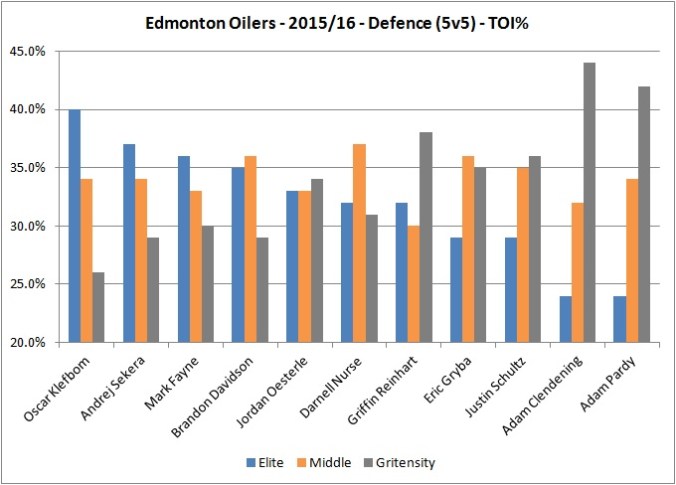
Two areas in particular that have been of interest to me since last summer when it comes to quality of competition are defencemen and bottom six forwards. In my opinion, neither area was addressed properly last summer by the Oilers, and it showed throughout the regular season. The team did add two experienced players in Lauri Korpikoski and Mark Letestu to their bottom six, but neither of them had a history of driving play or producing goals. As for the defence, the club added Andrej Sekera, who filled in admirably as a top pairing defenceman, and saw their faith in Brandon Davidson payoff very nicely. But the Oilers took a risk, an unnecessary one, starting the season with Griffin Reinhart, Eric Gryba and Andrew Ference.
WM - Defence - TOI

Full article is at The Copper & Blue.

Talking Oilers and Analytics on The Lowdown with Lowetide (TSN 1260)

I joined Lowetide on Monday morning to talk about the Oilers and how they should better integrate analytics. Full audio is here.

Couple notes:


Oilers and Analytics 

A couple thoughts on analytics, and how best to integrate it into hockey operations.

With the Oilers cutting ties with analytics consultant Tyler Dellow, the club has an opportunity to re-set its current approach to analytics going forward. Now it was my hope that Tyler’s role would’ve expanded from a consultant position, perhaps into a director type, who would then lead a group of analysts to delve into various topics. It was my hope that the Oilers would’ve applied a more complete analytics strategy that could support and influence all aspects of hockey operations including on-ice tactics, player personnel decisions, drafting and salary cap matters.

And let’s not kid ourselves: analytics is going to have a role in professional sports, but its exact definition and scope is going to vary depending on the sport, league, team and goals. Analytics is becoming more and more ingrained in all industries whether it is healthcare, oil and gas, government, and the thought of the value of analytics fading in hockey is completely bogus.

Analytics should never be treated as some magic bullet or switch that an operations manager can just flip and make things happen. Analytics is a continuous process, one in which a business need or goal leads to questions. From there, an organization looks to its data to see what can be answered, and what other data can be collected and refined to potentially answer that question. From there, analysis of the data is done, which leads to discussion with the operations side and, quite often, leads to more data collection/analysis/discussion.

Before all of this is even thought about, teams like the Oilers have to treat analytics as a new concept that has to be assessed carefully before it’s legitimately integrated. And like most organizations, the Oilers need to look at three areas: people, process, technology (or tools).

People:

  • Do you have the right skills in your organization that can support a team of people whose focus it will be to analyze data?
  • Do you have the right type of managers that will keep analytics top of mind when reviewing the operations they oversee?
  • Are people willing to learn the skills needed to either work with or within an analytics team?

Processes:

  • How will the organization facilitate the work of the analytics team?
  • Regular presentations to management? Crossover meeting between the analytics team and, say, the coaching staff?
  • Do these collaborations need to be formalized or do you let the analytics team set up ad hoc meetings and working groups?

Technology/tools:

  • Do you have the necessary tools for your analytics team, or is there a chance you’ll have to invest in some additional applications?
  • It would be safe to assume that your analysts would dictate what tools are used, and the organization has to be prepared to support them.

One thing that I hope the Oilers consider doing is finding a way to tap into the knowledge of the fan community, especially those that spend hours analyzing data and publishing their work online. And this really isn’t a long shot for the team. Keep in mind, the Oilers have put together a volunteer advisory group in the past to support hockey operations and they’ve also hosted a Hackathon competition where they posted a question, released a pile of data and rewarded the best solution (nice work Parkatti!). What I think the Oilers can do here is enhance these two concepts and turn them into actual, formalized programs that can be sustained and provide value to the club.

gartner_analytics

One thing I have trouble wrapping my head around is when NHL teams hire a consultant or two to support their analytics process. Above is a chart from Gartner, which does a really nice job breaking out analytics into four types: Descriptive (what happened?), Diagnostic (why did it happen?), Predictive (what will happen?) and Prescriptive (how can we make it happen?). What we see without even caring about value and difficulty of each type are complex tasks that each require more than just a data analyst or consultant.

Looking at this through a hockey lens, the first type would be simple reporting, as in how many goals happened for and against. With Diagnostic, you would start looking into shot shares/location/player deployment/line match-ups, etc, basically looking at the things that you think do a good job at predicting goals. These first two types of analytics have become pretty standard things in the hockey world, and are published daily by fans online. But if you’re running a team, your hockey operations department could be looking at more than just goals for instance and the things that lead to goals. Maybe you want AHL player data, or a better way to track the passes that lead to shots. And if that’s the case, you need a way to gather and refine that data, which could require manual tracking and someone with programming experience. If your club wants the findings shared in a certain way, you may need someone who specializes in reporting or even dashboard reporting. And it’s also here that you may need someone who can break down video and compile their findings quickly for the coaches or management to use.

And when you start getting into the prescriptive analytics, you’ll absolutely need someone on the analytics team that has coaching experience or someone that can marry the data to the actual on-ice plays to make sense of it and provide recommendations. Reviewing these types of analytics and the potential value it can bring to a team, it would be imperative that a team like the Oilers put together a complete analytics team. This should include a director type, along with analysts well versed in reporting (dashboards), programming and on-ice coaching. Teams like Toronto, Florida and New Jersey have this structure, which should become the norm among NHL clubs soon.

It’ll be interesting to see what the Oilers do in regards to their approach to analytics. In my experience, analytics is one of the many tools that business leaders rely on to make informed decisions and is part of a holistic approach to finding success. The purpose of analytics, especially in a business setting, is to provide evidence, drive discussion and support the corporate goals. And it can only be leveraged to its full capacity when there’s complete support, at the strategic level and the operations level.

Curious to hear the thoughts of others on this one. Every industry is different, so I’d be interested in hearing how others have implemented/experienced analytics.

Also joined Lowetide on TSN 1260 to talk about this further. Audio is here.