Bad News Sunday: Time for a reality check

After reading Minnia’s article on Friday, I felt pretty good about the team. She made some great points about the team’s progress, the impact different players have had, and how great McDavid has been. Ya know things aren’t so bad, I thought. The Oilers are first in the Pacific division. They’re getting 51.9% of the total shot attempts at even-strength. They’re getting 51% of the total goals scored. The powerplay is in the top 5. The penalty kill is in the top 10.

Then I watched the game on Friday night. And the sunshine-and-lollipops feelings went away. Okay, who am I kidding. My cold, bitter heart that’s endured so much losing because of this team didn’t let those feelings sink in for too long. We need to face it: this team has problems.

  1. Points are slipping away

After 30 games, the Oilers hold a record of 14-11-5. They sit first as of this writing, but could very well be out of the top three in their division by the end of the night. Their points percentage, the points divided by the total available points, is 0.550. To put this into perspective, a 0.550 points percentage was good enough for eighth place in the Western conference last season. Not only are the Oilers very mediocre up to this point, but so is their division, and pretty much the entire West. And the Oilers still haven’t been able to capitalize. They couldn’t beat the Coyotes this year. They couldn’t beat the Sabres. And they’ve consistently left points on the table against teams they should be competing against, like Minnesota, for a playoff spot.

Full article is at The Copper & Blue.

Weekend Q&A: McDavid’s Wingers, McLellan’s Short Leash, and the Rogers Place Crowd

coppernblue.com.full.54273Below is part of the Weekend Q&A my colleague Minnia and I put together over at The Copper & Blue.

Minnia: With McDavid being paired with so many different wingers, especially on the right side, who have you liked best so far?

Sunil: This guy is so incredible that it doesn’t even matter who his linemates are. Usually we look for which two or three players have chemistry and how they can work off of each other. With McDavid, you look at who needs to play with him to get going or which player’s potential you can maximize. At the start of the year, I would have pushed for Maroon to be McDavid’s left side instead of Lucic, just based on Maroon’s 16 games with Edmonton last season. And I would’ve wanted Eberle on the right side, as he had great chemistry with McDavid and has the speed and finish to produce on the top line with him. Today, I’d rather have Maroon playing on other lines, as he’s been a positive influence on others and has been able to generate goals with McDavid on the bench, something that remains an issue for the Oilers. As of today, I’d keep Lucic with McDavid as they’ve been productive together, and I’d add pretty much any of the depth right wingers to that line. It wouldn’t hurt to have Puljujaarvi there, since the Oilers have no idea what to do with him, or even Slepyshev who has the skillset to fill a complementary role. Whatever the Oilers do, they have to ensure that the other three lines behind McDavid are loaded up so they can start producing goals. This means they may have to have the more depth players on the first line with McDavid.

Minnia: It seems McLellan is quick to “punish” this season, whether it’s reducing ice time drastically for mistakes in-game (Klefbom, Larsson) or sitting players for extended periods of time (Pouliot)– do you like his approach in leaving very little room for mistakes, or would you appreciate some more leeway for players?

Sunil: I think it’s ridiculous how McLellan has been handling/punishing his roster to be honest. A coach is responsible for putting together optimal line combinations and defence pairings, and then properly deploying them to increase their odds of winning games. If a player is struggling within a game, it makes sense to give ice time to the players you’re trusting. But after the game, re-set, work with the player, and base your future decisions not just on one bad play, but a larger sample size. Klefbom is a prime example here. He’s done very well paired with Larsson this year, all areas of the ice, against the other team’s top lines. The duo have a 51.79% share of all of the shot attempts when they’re on the ice this season, which is great considering the competition they face (Source: Corisca Hockey). Their 345 minutes together is the most on the team, so why not stick with that? After a bad play last week, Klefbom still isn’t back with Larsson, who is now getting caved in when it comes to shots against paired with Russell.

Minnia: Taking a look at Bakersfield, who are some of the players on the cusp you’d like to see up on the Oilers in case of injury (#knockonwood)?

Sunil: I would love to see Jujhar Khaira with the Oilers at some point this season. He’s a good skater and showed last season in limited minutes that he can keep up with the more established players. In 2015/16, with Pouliot out, Khaira skated with RNH and Eberle for a total of 53 minutes at 5v5, and played the same level of competition that RNH is accustomed to. The trio had a 50% share of the shot attempts, which was great considering the rest of the team was below 48% for most of the season. Long term, he should be a depth centerman, but it wouldn’t hurt to continue breaking him in on the wing. This season in Bakersfield, he has 5 goals and 5 assists in 12 games and ranks second on the roster when it comes to points per game (0.83). He’s also one of the team leaders in shots per game (3.1).

Minnia: What do you make of the interesting trend that the Oilers seem to lose a lot of games when they win the Corsi battle, yet win a lot of games when they lose the Corsi battle?

Sunil: A lot of that has to do with score effects. Basically, when a team is trailing in a game, which the Oilers have done often recently, they increase their output of shots as they start taking more risks and might shorten their bench and get their top players out there to find offence. On the flip side, when a team is leading, they often slow down their offence, start playing a safer game, off-the-glass-and-out tactics in an attempts to stifle the shots against. At the end of the game where the Oilers lose, it might look like they were outshooting the other team, but that usually happened after they were trailing.

Full article is at The Copper & Blue.

Correlation between shot-share and goal-share

Here’s a graph showing every team’s regular season performance at even-strength (5v5) from the 2007/08 season to the 2015/16 season (Source: Corsica Hockey). Getting a higher proportion of the total goals scored for and against is the key to winning games, so that’s displayed in the vertical axis. On the horizontal axis is the team’s share of all shot attempts (i.e., Corsi). Each dot represents every single team by season since 2007/08, with the lockout-shortened 2012/13 season excluded since each team only played 40 games. Comparing a 40-game season to an 82-game season might give us unreliable results (team’s can get hot or cold over a shortened length) so I left that season out and compared apples to apples.

goal-and-shot-share-2007-2016

The black bars that cut through the graph horizontally and vertically mark the average across all the teams over the eight seasons. Not surprisingly, it’s right at 50.01% for both goal-share and shot-share. I’ve also added a trend line, which has a r-squared value of 0.32. It’s obviously not a perfect correlation between shot-share and goal-share, but you increase your chances of scoring if you’re outshooting your opponents. Teams that posted a higher than average shot-share but didn’t see their goal-share get higher than 50% (bottom right quadrant) often had external factors at play. It could’ve been injuries to key players or a lower than normal shooting or save percentage. On the flip side, team’s might have a lower than average shot share, but still outscore oppoenents (top left quadrant). This would be due to a higher than normal shooting percentage (shooters get hot) or team save percentage (goalie gets hot). Hockey is weird like that.

Highlighted in the graph are eight orange dots with a black ring around it. These are the Oilers eight seasons, and not surprisingly they’re all in the bottom left quadrant where you don’t want to be. They’ve been terrible at outshooting opponents, and as expected, they haven’t been able to get a higher share of the total goals except for that one time in 2008/09. They had one of the worst shot-shares in the league that season (46.35%), but thanks in large part to a slightly higher than normal shooting percentage, and some great goaltending from Roloson (a 92.45 save percentage), the Oilers managed to get 50.9% of the total goals.

This season the Oilers would be in the top right quadrant, as they’re getting 52.00% of the total shot attempts, which has them 9th in the league, and are also getting 52.88% of the total goals (i.e., goal-share). Generating shots is a repeatable skill and is dependent on the coaching staff’s on-ice tactics and the skill of the players. A team’s ability to generate shots very often remains consistent through a season, and season-to-season, as long as the coaching staff remains and players stay healthy. The Oilers have a good thing going with their ability to out-shoot opponents, but this in no way guaranetees goals. A lot has to happen for a shot to become a goal, and goalies can always go on hot and cold stretches. But as long as they keep their share of shot attempts up, they’re putting themselves in a position to succeed.

Thoughts on the Oilers: Current state, Eyeballs first and Defence core

cutAfter 28 games, the Oilers are sitting 3rd in a weak Western conference, 1st in the Pacific, with a record of 14-10-4.  They’ve outscored their opponents 55-49 at even-strength, a 52.88% goal-share that ranks them 8th the league. Their 55 goals ranks them 4th in the league, while their 49 goals against is the 7th highest. The Oilers currently have a 52.34% score and venue adjusted Corsi, which ranks them 9th in the league behind Boston, LA, Carolina, Washington, Florida, San Jose, St. Louis and Nashville (Natural Stat Trick). A team’s share of shots tends to remain consistent through a season as it’s influenced by the coaching staff’s tactics and player deployment, as well as what the player’s actually do on the ice. Really the only way the Oilers might see a drop in their shot-share is if the coaches change or if the team loses significant players.

There’s no indication that the Oilers are relying on luck-driven factors including shooting percentage and save percentage. The Oilers have a 7.74% shooting percentage and a 92.63% save percentage, which ranks them right around league average.  Quite often, team’s go on hot streaks either converting more of their shots into goals or preventing more shots from becoming goals. If either of these factors is significantly higher or lower than the league average, it’s worth monitoring as team’s tend to regress to the mean over time. I do think this team can compete for a playoff spot as long as McDavid and Talbot stay healthy. They can generate scoring chances at 5v5, ranking 4th in the league when it comes to high danger shot attempts (11.65 per hour), but they also allow a lot of chances against, allowing the 3rd highest (11.34 per hour).

Please note that I look at 5v5 play to assess a team and individual player performance as it’s when both teams are trying to score and trying to defend. Special teams play is important, but they involve specific players doing a specific task, which would skew the overall numbers for the team and players if included.

Couple thoughts:

The comment from Todd McLellan a few weeks ago that a lot of anti-stats people loved, but that I found very amusing, was the whole “eyeballs first….” thing. This implied that people who do statistical analysis or analytics aren’t watching the games enough and that their work is not well informed. Here’s the thing: watching the game and doing the analysis should always be dependent on one another. What you see/hear/read informs your analysis, but your analysis informs your viewing of the game or topic as well. That’s how it works in any industry that relies on stats and analytics, with hockey, a game, a goal-scoring contest, being no different. If you’re really only doing stats after, you’re at risk of overlooking key information or letting confirmation bias set it. It’s a recipe for failure. Can you imagine a real-world CEO having an “eyeballs first” perspective on his or her business? They’d be ridiculed.

With the upcoming expansion draft and the fact that a number of key players including McDavid, Draisaitl and Nurse will be needing contracts, it’s a bad time to start over-valuing depth defenceman like Kris Russell. I really don’t mind Russell as a depth player, but he’s been way over played by this coaching staff, and the underlying goal and shot metrics don’t paint a pretty picture (OilersNation). The team would be better off if  he was playing at his established NHL level, but the coaching staff has other plans (which includes reducing Klefbom’s minutes, awesome). The Oilers have to protect three defencemen this upcomg off-season, and it should be Sekera, Larsson and Klefbom. Signing Russell in January means someone is moving out, either one of Sekera, Larsson or Klefbom, and the future contract for one of the young players is being impacted. I don’t think it’s worth getting into it with Russell, and that they could move Russell at the deadline, especially if players get healthy and he’s been bumped down the depth chart by then. My ideal pairings: Klefbom-Larsson, Sekera-Benning/Fayne (7th defenceman) and a combo of Nurse/Davidson/Gryba (8th) for the third pairing.

Just want to throw this out there, but if anyone has any questions about analytics, feel free to email me (sunilagni23 at gmail dot com). There’s a lot of bad information floating around, so if I can be of any help, let me know and I’ll try my best to answer it. I’ve been following the discussion around stats and analytics for a long time now (learned a lot from Vic Ferrari, JLikens, Dellow, Zona, Reynolds, Battle of Alberta, Parkatti, plenty more), so I’ve seen the same cycle of topics come over and over again.

The Edmonton Oilers With and Without McDavid

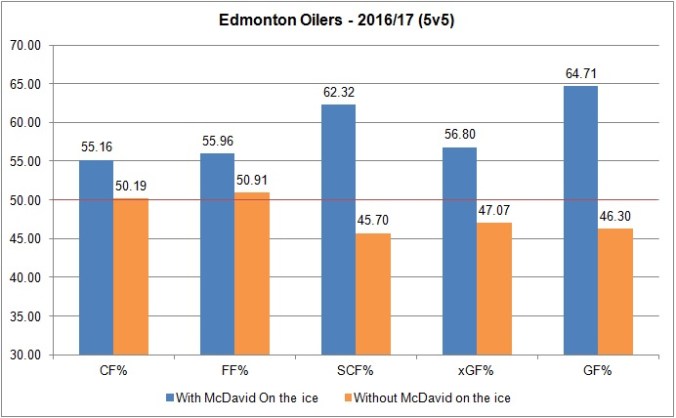
The Oilers were very fortunate to have won the draft lottery that landed them an elite player like Connor McDavid. In 23 games this season, the 19 year old has scored 29 points, with 20 of those points coming at even-strength. His 3.29 points per hour at 5v5 has him third in the league, behind Kucherov and Stamkos. He consistently drives offence in all three zones, as teammates do better with him than without him when it comes to individual and on-ice metrics.

Without a doubt, McDavid has been the key driver behind the Oilers success so far this season. The club is 12-9-2, securing 26 points, and sits in first place in the Pacific division. And their +9 goal differential (all situations) ranks them second in the western conference. Say what you will about the teams in the west and their struggles, but the Oilers have managed to take advantage and remain competitive.

A quick glance at the underlying numbers, and the Oilers appear to be an average-to-good NHL club. Below is their overall share of shot attempts, scoring chances, expected goals and goals at 5v5 this season. Included for each metric is their ranking in the league.

CORSI FOR% FENWICK FOR% SCORING CHANCES FOR% XGOALS FOR% GOALS FOR% PDO
51.89 (9th) 52.60 (7th) 52.09 (10th) 50.59 (14th) 53.41 (9th) 100.44 (11th)

This is all very positive for the Oilers as the club has historically been below 50% for pretty much every shot and goal metric. The fact that they have close to a 52.0% share of the shot attempts is significant progress and indicates that they should be able to compete for a playoff spot this season. But if we look at how the Oilers do with McDavid on the ice and compare that to how the club does without him, things get a little interesting.

mcdavid-on-and-off-ice

Full article is at The Copper & Blue.

Talking Oilers on the CBC Edmonton News (TV)

sunilcbc20161129

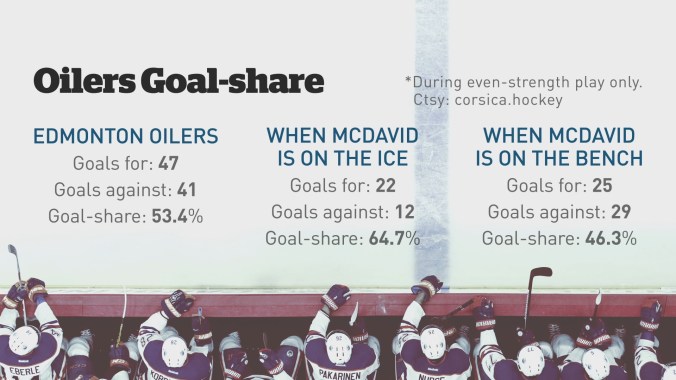
Joined Adrienne Pan on the CBC Edmonton News prior to the game against the Leafs. We talked about their current skid and the upcoming expansion draft, and also got into some of the Oilers’ numbers. We touched on the impact McDavid has had on the team, which I also wrote about over at The Copper & Blue.

The clip is here (starts around the 19:30 mark): CBC Edmonton

Also a big thank you to the CBC Edmonton team for putting together this graphic for our segment:

edm-factoid-oilers-stats_frame_541


The Driver

Twenty games into the season, it’s fairly obvious that Connor McDavid will be the Oilers prime driver for offence. Using his speed and skill to make quick plays in all three zones, McDavid can generate shots and scoring chances pretty much on his own. What the Oilers appear to be lacking now is consistent secondary offence, and at least one other offensive driver that can do some damage when McDavid is on the bench.

Last season, this role was held by Taylor Hall, who went on to score 65 points , and consistently enhanced the play of his linemates, including Leon Draisaitl. When Hall was on the ice at 5v5, the team got 51% of all of the goals the Oilers and the opponents scored. The vast majority of his teammates last season were below 50%. Losing a driver like Hall meant the Oilers were going to need to  acquire help or hope that one of the young forwards like Draisaitl or Puljujarvi would develop into the role.

On the first day of free agency, the Oilers signed forward Milan Lucic, who does have good underlying numbers, and has a history of contributing to his team’s offence. Last season in Los Angeles, the team had a 61% share of the total goals scored at 5v5 when he was on the ice. In Boston the year prior, the team had a 57% share. He doesn’t have the speed and playmaking ability of Hall, and benefited from having some elite level linemates in the past. But nonetheless, his previous teams scored at a good rate when he was on the ice.

Unfortunately, what Lucic has produced for the Oilers isn’t close to what he’s done in the past. After 20 games, Lucic has two goals and two assists at 5v5, 0.83 points per hour that ranks him last among the 13 forwards who have played at least 100 minutes this season for the Oilers. The team’s share of the total goals at 5v5 when he’s on the ice is below 50%, which is troubling considering he has played a lot with McDavid and Eberle on the top line.

After 20 games, it appears that the driver of the offence outside of McDavid has been 28 year old winger Patrick Maroon, who was acquired by the Oilers from Anaheim at the 2016 trade deadline. Maroon is currently tied for the team lead in goals and sits 6th on the team with 1.77 points per hour. When he’s on the ice at 5v5, the Oilers get a much higher share of the total shot attempts (55.5%) taken by his team and the opponents, +5.3% relative to his teammates. And this has been done playing 125 minutes with Draisaitl, 114 minutes with McDavid, and 36 minutes with RNH. Each of the three centers has done better when it comes to the total share of shot attempts with him than without him.

maroon_-_wowy-0

Full article is at The Copper & Blue.

Couple thoughts on Kris Russell

cuqkyi3viaqdpleAppears that we won’t be going a day without hearing how great defenceman Kris Russell is for the Oilers, or how bad his underlying numbers are.

Couple thoughts.

The original debate over Russell started last season when there was speculation that he and his agent were asking for a big pay day from the Flames. Here’s what TSN’s Bob McKenzie said back in February. (Source: TSN)

Here’s the thing: Russell is currently a fantastic bargain with a cap hit of $2.6 million. More nights than not, he plays well over 20 minutes and, at age 28, with his mobility and puck-moving ability, he’s a heady if undersized blueliner who’s pretty much in his prime and arriving to free agency at a very good time for him. The next deal Russell signs will be the best deal he ever signs; he’s going to more than double his current salary.

You don’t have to look very hard to find the guys Russell would view as open-market comparables: Montreal’s Jeff Petry got five years at $5.5 million. Edmonton’s Andrej Sekera got six years at $5.5 million. Similarly under-sized blueliner Jared Spurgeoncollected $5.2 million per year on a three-year term in Minnesota.

Were Russell to go to July 1, is there any doubt he’s going to get a five-year offer for between $5 million and $5.5 million? And he may well be looking for more than that, both in term and dollars.

Having watched him play in Calgary and reviewing some of the shot metrics, I thought this was absurd. But knowing how teams operate around free agency, it wouldn’t have surprised me if Russell and his agent were successful. Plenty was written about Russell leading up to the trade deadline and free agency as the player’s on-ice performance didn’t quite jive with the narrative of him being an effective defenceman. (TSN, FlamesNation, Hockey PDOcast, Stanley Cup of Chowder).

When the trade deadline rolled around, the Stars paid big to land Russell, which really gave those that dislike advanced stats some ammunition as a good general manager like Jim Nill acquired him. Russell found himself in a depth role with the Stars, who eventually lost in the second round against the Blues.

Following the playoffs, the Stars did not sign Russell and not a single team traded for his rights. Free agency rolled around, plenty of chatter, plenty of speculation about which NHL club would sign him. But then silence the rest of the off-season.

Three days before the season started, and after training camp, the Oilers signed Russell to a one-year, $3 million contract. In my opinion, it was an okay move as the team added an experienced defenceman that I hoped would push young defenceman like Nurse and Reinhart further down the depth chart. What’s frusrating is that the team failed to address a need on the right-side who could contribute to the offence and add an effective right-shot on the powerplay. What also became apparent is the fact that all 30 NHL teams figured Russell out and determined his value isn’t near what his agent had thought.

Fast forward to today, Kris Russell has played 13 games, mainly paired with Sekera, averaging 20 minutes per game and has three assists. He’s also last on the team when it comes to the team’s share of Corsi For and Expected Goals. He had a good start to the season, struggled in the games leading up to his injury, and has been alright since returning to the lineup. He’s an NHL defenceman who can provide a team with depth and experience. But he doesn’t drive offence or supress shots against and needs to be sheltered to be effective. Where he ranks on the current depth chart and what the defence pairings should be is worth discussing. But I don’t quite get why Russell has so much support when he plays one good game. It’s pretty pointless to use Russell to discredit shot metrics, as team managers and scouts came to the same concensus as the stats when he was available in free agency.

Really, the big question should be how much Russell is worth to the Oilers in terms dollars and term. I suspect most would agree that he’s not a $5 million per year player. But that to me is a more interesting discussion rather than the Russell-proving-advanced-stats-wrong narrative.


Letestu to the Rescue

The Oilers powerplay currently ranks 19th in the league, converting on 16% of their opportunities this season. One of the big reasons why they haven’t done so well is because of the poor shot production with the man advantage. This is an issue that’s lingered since last season, with the coaching staff often preaching the importance of getting shots through and finding second chances around the net (Source: Inside Sports, 630 CHED). As of today, the Oilers rank 20th in the league when it comes to the rate of unblocked shot attempts (i.e., Fenwick For per 60 minutes), sitting at 62.15. This is slightly down from last season when the club generated just over 63 unblocked shot attempts per hour.

What I found last season when looking at the powerplay, was that the Oilers generated more shots when veteran Mark Letestu was on the ice. He finished the 2015/16 season with the fifth highest ice time on the powerplay, behind Hall, Sekera, Draisaitl and Eberle. This was in large part because of injuries to Klefbom and McDavid, but nevertheless, Letestu was effective in driving the team’s overall shot rates.

This season, Letestu has only played 17 minutes on the powerplay through 18 games, which ranks him 10th on the team among the regular skaters just ahead of rookie Jesse Puljujarvi. (Source: NHL)

letestu-pp-ff60

Full article is at The Copper & Blue.