Thoughts on the Oilers: Defencemen, Rookies and Training Camp

10279542Welp. This hasn’t gone as planned.

Five straight losses to start the season. Three of which were against division opponents.

From what I’ve seen, this is a better team than last year. The goals against are coming from quick plays and bad turnovers. I haven’t seen a whole lot of running around in the defensive zone, which was prominent last year. And it was always after that running around the Oilers would get scored on. This year, there’s just been some horrible turnovers and sub-par goaltending that’s been to blame. But both of these things are fixable.

I’m still confident in the twelve forwards. Again, it’s not a deep lineup, especially at centre, but I think all four lines (for once!) are pretty decent. My only issue is the utilization of Draisatl on the second line. The club has got to do something about that to not only find a complementary player for Yakupov, but also give Draisatl a chance to develop properly.

I had confidence in the defensemen at the start, only because I assumed that Petry would be playing important minutes and the rest of the group would be legitimate NHL players. Instead, Petry has had his minutes reduced, including a healthy scratch, and the club has relied on guys like Schultz, Nurse (back to junior now) and Hunt (back to the AHL).

What this tells me is that the Oilers training camp did not go too well. There were injuries, but the coaches didn’t do enough of an assessment to confidently assign the right minutes and situations to the right players. We’re five games in to the regular season, and the club is only now starting to iron out their defensive roster.

I guess this is what happens when you’re coming out of a losing season and start to re-jig your defensive tactics. Coaches have to test out which players fit where and basically reacquaint themselves with the roster. Perfect example is benching Petry for guy like Hunt. The latter has a decent shot and can join the powerplay, but his overall game isn’t near the level of the former. Marincin, who stood out near the end of last season is only now getting in to the NHL roster.

I’d also be curious to know how much say the forwards have on who plays defense in key situations. I don’t understand how or why Schultz is playing more than 24 minutes when he’s having such a hard time playing without the puck. The guy is fantastic getting out of the zone, but still has trouble keeping up with rushes from the opposition. He’s still developing, and really should be deployed more efficiently.

Regardless of the poor start, there’s ample time to turn this around and get some wins. There has yet to be a game where the forwards, defensemen and goaltending all played a decent game as a unit. Now that the defense is looking like somewhat of an NHL roster with the promotion of Marincin, the goaltending should improve.

Recommended Links

Gregor: Draisaitl’s development likely better in junior – Edmonton Journal

Mirtle: Blame bad luck, goaltending for Oilers early mess – Globe and Mail

Same time next year – Lowetide

Thoughts on the Oilers: 2014/2015 Season, Forwards, Defence, Goaltending

Leon Draisaitl

Leon Draisaitl

This is year two of the MacTavish-Eakins era and needless to say, there has to be progress following last season’s train wreck.

Forwards

I think the new additions will be a massive boost to the club. Experience still counts in this league, so it’s refreshing to see guys like Pouliot and Purcell flanking a very young and developing core. Both are still in their primes, making serious money. But both should be counted on for secondary scoring.

The top six overall looks like a legit NHL group. But because of the weaknesses at centre, this club is one injury away from entering the McDavid sweepstakes. There is never a good reason to keep a player under 20 on your roster, unless he’s Crosby or Ovechkin. And again the Oilers will be relying on a young prospect to produce with Draisatl securing the second line centre position. Here’s hoping he can at least get the softer minutes (i.e., offensive zone face offs, power play time, against easier competition). With such a glaring hole at centre, I think most assumed the Oilers would’ve sought out a veteran player like Derek Roy or Derek Legwand.

Defence

This group is definitely an improvement from last season, with the addition of Fayne and Nikitin. But it is still far from being a top NHL caliber group. Guys like Schultz, Klefbom, Marincin and Nurse are still developing, but will likely be asked to play high end minutes. If this club can stay healthy, and the team is smart enough to keep Petry long-term, I think they can compete well in their division. My expectations when it comes to how they play as a unit is much higher with the addition of Craig Ramsay on the staff. It’ll be interesting to see if he can find a way to better utilize this group and find some success in 5-on-5 situations.

Goaltending

This is one area where I’m still unsure about. If the coaching staff can limit the ridiculous amount of clean zone entries and two-on-ones like last year, I think this tandem is good enough. But if those same defensive lapses and poor coverage emerge from last season, no goalie will stand a chance. Here’s hoping some stronger possession play through all three zones will help the goalies. From what I saw last year and the pre-season, I’m predicting Fasth comes out as the clear cut number one goalie by November.

Bold Predictions

Regardless of the glaring hole at centre and the question mark in net, I think there’s a lot of potential in this current roster. The wings have a lot of talent and experience, and stack up well against the top teams in the league. The defence has improved with new roster players and the addition of Ramsay. MacTavish has brought in proven possession players with experience, which should hopefully translate to less time scrambling and chasing the puck. An additional 10 wins from last season isn’t asking for much, so I’m predicting they make a jump up to 10th in the west this season.

2013/2014 Season:

29-44-9
67 PTS
203 GF
270 GA
14th in the West

2014/2015 Predictions:

39-36-7
85 PTS
220 GF
240 GA
10th in the West

Top Scorer: Taylor Hall
Best defenceman*: Jeff Petry
Likely to get dealt: David Perron

*Based on boxcars and advanced stats

Recommended Links

The Autumn Leaves Drift by My Window – Lowetide

Are We There Yet? – Copper and Blue

Oilers Rig Podcast – The Oilers Rig

Following the Oilers

In the midst of all of the losing and failed playoff attempts are questions from concerned friends and loved ones.

          Why do you still cheer for the Oilers?

          It’s the same thing every year. Aren’t you sick of it?

          Are you okay?

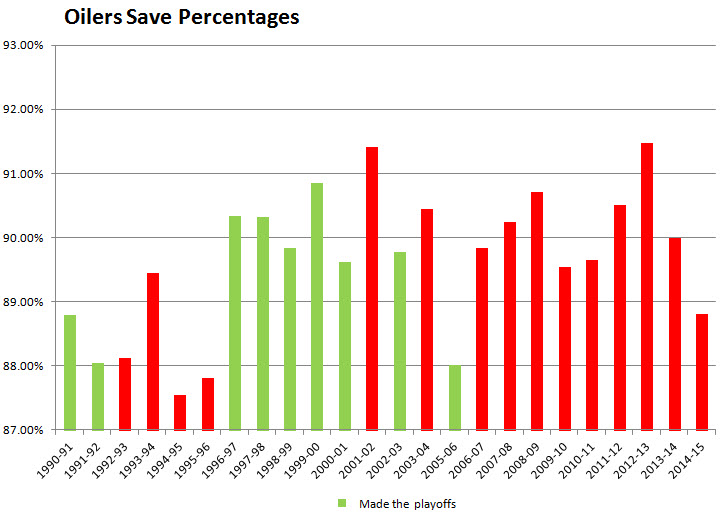
Surrounding those questions are taunts and ridicule, constantly reminding us that it’s been a long time since the Oilers made it to the playoffs. That the Oilers have only made the playoffs 7 times in the past 18 seasons is easy to showcase. And that any sort of memory of dynasties should be washed away with the tears of pain and disappointment.

So why DO we follow this team?

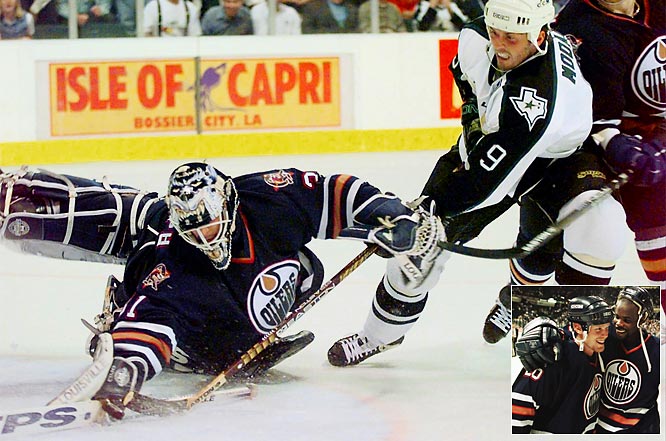
First it’s important to review how we got in this position. My own real commitment, when I had the attention span to watch games and follow the news, started well after the dynasty days. This goal right here from the 1997 playoffs. Game 7, Dallas, overtime.

I was hooked. And every year since, despite all of the losing, the attachment grows. I’ll try to explain.

The Oilers being terrible has led to some unintentional consequences. All of which have played a significant role in our personal attachment to the team. While famous research studies have pointed to basking in reflected glory, I would argue that Oiler fans are basking in an addiction to uncertainty.

From the uncertainty that stems from professional sports, we’ve created an excessive amount of discourse. Think of the message boards, the blogs, the comments, the tweets. All filled with speculation and the ensuing gossip, which serves as a bridging tool for strangers to connect, share ideas and build community. And built on the foundation of the speculation and gossip across these channels are the storylines. Think of any player drafted and their back story before coming to training camp. Or when a player is playing poorly, we ponder what changes are needed in the lineup.

And from the storylines, we build these unique characters. We develop these strong attachments to players in the hope that they succeed (or fail depending on your outlook in life). Each character carries traits and skills, creating numerous short and long compelling narratives that we want (or hope) to see the completion of.

And at the very heart of all of this is the community, which includes fans, writers, broadcasters, and anyone else watching the game. The stories need a medium to be exchanged and extended, and it’s the social aspect of fandom that drives the communal and individual attachment to the game.

Now if the team wasn’t terrible, I’d argue there would be less to speculate on. I can only imagine what it’d be like supporting the Kings or Bruins. I’m pretty sure the topics would not include fledgling 4th round draft picks and failed defensive systems. The Oilers being terrible really is why it’s hard to quit now. We’ve invested so much time and energy following the story, it’s hard to turn away from the uncertainty and the possibility that some sort of conclusion exists. Combine that with the community you’re a part of, and the regular discourse, there really is a social attachment to the game that’s difficult to break.

Potential Jobs in the field of Hockey Analytics

The recent NHL hirings are a good indication that there will be more jobs out there for hockey bloggers, especially those who have a good understanding of analytics. Analytics really is a continuous discussion, so following the flow of information that comes from the process can shed some light on what areas of the game will likely hire more individuals.

So far we’ve seen a few bloggers get hired to work on the analytic departments of NHL clubs. My assumption here is that they’d sift through all the of the available data and provide recommendations on things like player personnel and possibly game tactics.

But as we’ve seen the Leafs do, recently hiring Darryl Metcalf, there’s also a need to collect data and then publish it in an easy-to-use, dashboard format for management and coaches to access. As we’ve seen online, there are a lot of fans who have developed tracking software and reporting tools, like Super Shot Search, Player Usage Charts and Shift Chart, that might be of interest to NHL clubs

Taking it one step further, teams will likely need some in-game analysts who can gather and share information to fans and the media. Teams typically provide some sort of game file with an assortment of stats and other information. These types of communication pieces will now likely include some high level stats that could be of interest to the public.

Teams may also look for people with coaching experience, who might have experience applying the analytics to coaching tactics. For instance if a club is finding that their defenceman is struggling and the opposition has been found to be strategically attacking his side of the ice, how does a team respond?

Teams may also want simple data trackers, and could rely on external companies, such as the one in Europe that specializes tracking soccer games

And of course, like in any professional sport, there are many, many people outside of the league who want to dissect the play of a team and players, including journalists, broadcasters and of course fans.

There will definitely be a huge demand for writers, specializing in data journalism, as major sports websites will want people who understand the full spectrum of analytics and its application to the game. But tv and radio broadcasters (in-game color commentators, talking heads, etc) will also have job openings, as there will likely be more discussion pertaining to the new questions from viewers about what impact the analytics will have on team success.

Following the flow of information, there will be a very high demand for hockey analytic expertise outside of the game. This would include groups involved in fan engagement such as video game developers, fantasy league service providers and even gambling sites. These external groups have always relied on hockey information to supplement the fan experience, and will likely look to expand their operations to include additional advanced stats (if they haven’t already).

And keep in mind, others that you may not expect to care about analytics just might be looking for some help to understand teams and players. Maybe there’s an advertising company out there that wants to align itself with a team that will  have a talented young core (that gets lots of ice time), for branding purposes. It’s a stretch, I know, but analytics really is a continuous discussion that can lead down many different paths.

Any job that is related to hockey analytics will require an individual to possess more than an understanding of analytics. Taking a step back and following the flow of information that can come from analytics, there will be a growing need for individuals with various backgrounds and experience. Organizations will likely search for people with information technology, broadcasting, or communication skills, among others, to really solidify their approach to analytics. The good news is, anyone who is interested in working in this field can begin honing their skills online using blogs and other publicly available applications.

Keeping the NHL Data Open

legosIt would make absolutely no sense for the NHL to restrict fans access to any level of stats, whether it be the traditional set or the advanced possession ones (i.e., Corsi, Fenwick, etc).

The NHL has changed it’s Terms of Service to reflect that. On Thursday, Zsolt Munoz of The Copper and Blue provided an excellent summary of the changes and raised concern that this might impact the go-to websites like Behind the Net and Extra Skater.

As of Friday morning, Extra Skater has become inactive, much to the dismay of its many users. The website does scrape data from the NHL website but extends it to calculate new information and “advanced” stats. Darryl Metcalf, the websites administrator, puts it all in a fantastic dashboard format making it easy to navigate and use. I’m really not sure what’s happening with ES, but I’m pretty confident that the NHL will not be preventing anyone from using and extending its game data. Couple points:

  • Any sort of data analysis, or finding patterns, whether it be simple counting of goals or calculating Corsi%, requires an individual’s time and effort. The more time and effort a person puts in, the more engaged they become with the game. It requires critical thinking and gets people into the game a lot more than if they just read static stats from a game report. Fantasy league is a prime example of something that gets fans into the game and is linked to data analysis. Fans are growing an attachment to teams and players they typically have no interest in because of fantasy leagues. The NHL has got to love that.
  • There’s a been a lot of weight put into the concept of “open data“. The idea is if you provide anyone and everyone with easy to use data, individuals may be able to come up with new information that can be shared with the community at large. For example, the City of Edmonton publishes data sets, which have been used by individuals to develop new apps available for public use.
  • And, as mentioned by Tango Tiger, the online ecosystem today, supported by stats from the NHL or the data scraped by Extra Skater, have served as a fantastic training ground for analytic folks. Teams like the Edmonton Oilers and New Jersey Devils have hired individuals who have had access to this data and demonstrated its value.

I really see the NHL really opening up the flood gates when it comes to data. They may push to be the gatekeeper of data, which may be a fair trade-off if fans can extend it into accurate information. Past attempts by Major League Baseball to stifle the analytics growth have either failed or been held up in court, which I think gives hockey fans some hope that whatever data they want will be available to them free of charge. I also think the NHL will develop a process to support the development of new applications that use the data in some creative way. The more people toiling away with hockey data, the more time they’re spending on NHL related stuff…I assume that’s what the NHL would want,

And hey, if for whatever reason the league restricts data or even tries to charge for it, you will definitely see more tracking projects pop-up, similar to Corey Sznajder’s All Three Zones Tracking Project, who has found an excellent way to track his own stats and receive compensation from the larger fan community.

Information and knowledge can’t be restricted in the modern society as far too many tools and the cooperative nature of individuals will support its growth. The momentum of information growth is giving fans a new role when it comes to consumption as a shift from passive consumption has been replaced by active, collaborative, engagement.

Data Journalism in Hockey

old-time-reporterHockey analytics is doing some pretty remarkable stuff for the game. Not only are there new methods of understanding and following the game, but we’re beginning to see some of the more unintended consequences of its growth.

One thing to keep an eye on will be the evolution of hockey reporting and journalism. Analytics has received widespread attention this summer with NHL teams hiring experienced professionals and discussing the new statistics quite publicly. All of this is great, but now the people following the game, especially those that are relatively new to hockey analytics, will demand supporting evidence, in an easy-to-use, storytelling format.

Travis Yost brought up an excellent point, citing the potential for new data tracking technology as a reason why the demand for better sports writing will likely grow. There will definitely be teams looking to hire individuals with experience in analytics to keep up, but there will also be media outlets looking to enhance their coverage of the game and these advanced stats.

This will put the onus on anyone developing information about the game, whether it be newspaper writers, hockey analysts on television and fans online. The game has changed because of analytics, and now the information surrounding the game has to evolve.

What this means is that the distribution of  information has to shift from simple reporting to more data journalism. It won’t just be about grabbing quotes from coaches and players and then referencing some of the new stats like Corsi and Fenwick etc. But it’ll also mean having to embed graphics and information in an interactive and engaging way to tell a unique story.

The good news is, there are a handful of newspaper writers and bloggers who have been doing this very well for a few years now. James Mirtle of the Globe and Mail, as well as Japers’ Rink and SB Nation’s Outnumbered come to mind. But now, there will be an increasing demand for it. And I can definitely see some slick new platforms or reporting dashboards that can take all of the advanced stats and put together a strong game story.

Blogging platforms have served as a solid foundation and medium to develop hockey analytics. And now, they can be a real training ground for those looking to advance their careers in writing about the growing field.


Oilers hire Tyler Dellow of mc79hockey.com

620-eakins-dallas2-thumb-620xauto-329706Happy to see the Oilers hire Tyler Dellow of, the now defunct, mc79hockey blog. Tyler’s been blogging for years about the Oilers, focusing on hockey analytics and recently applying his findings to game footage. The blog was a fantastic source for analysis, really pushing the discussion on hockey analytics, and will definitely be missed. Sounds like he’ll be joining the Oilers hockey operations department and reporting to Coach Eakins.

Related: On Tyler Dellow, his role, and what this can tell us about Eakins – Copper & Blue

I’d love to point out some of the work he’s done including his dissection of Taylor Hall’s Corsi stats and the Oilers performance following defensive zone faceoff losses. But I guess it’ll have to wait until someone can uncover that hidden treasure. A lot of his work picked apart the Oilers and did show some of the weaknesses in their tactics, so I guess it makes sense for the Oilers to ask him to remove the content. His blog was also one of the few sites where the comments section was just as  valuable as the actual post. I found it a little troubling that Tyler was able to wipe out the work of others who trusted that their contributions would be always be accessible. I’m sure most of the commenters are supportive of Tyler’s move, so maybe losing their work was just a necessary trade-off.

Those who have read my work know that more than hockey analytics itself, I’m interested in the social, online environment that fosters the development of hockey information and knowledge. So as much as the growth of analytics interests me, so too does the network and the collaboration of fans.

I think Tyler would admit that a big reason for his success in analytics is the open environment that he was able to work in. He received regular feedback both on his blog and on Twitter, which played a big role in the direction he took with hockey analytics. He’s obviously a bright guy and will more than likely carry on with his ideas and insight as a member of the Oilers. However, the corporate culture that the Oilers have is far different than the interactive environment Tyler has grown accustomed to. Online, Tyler has been extremely open with his data, which makes him open for feedback and criticism. Now that his work will only be reviewed by a select few, I’m curious to see what impact it might have on his own critical thinking. There’s a much different working-dynamic when you’re sealed off with a select few. Biases, groupthink, politics, etc., are all the things that tend to creep in to any bureaucratic system.

It’s almost as if the Oilers should actually hire a few more bloggers that Tyler’s work can be tested by. The good news is, the Oilers do have an analytics working group that can really challenge his work. But it might be in the Oilers best interest to add additional bloggers, or some sort of external advisory group, with little social or financial ties to the team, who can provide Tyler with feedback.

Finding the SuperFan

An Oiler fans trek through blogs, hockey analytics and academia.

Back in 2008, I decided it was time to head back to school to finish a graduate degree. Something I can do part-time, something related to my day-job, and something that would interest me enough to stay motivated. I came across the Communications and Technology program at the University of Alberta while surfing the web and decided to take the plunge.

My background was in sociology and my interests were always research methodology and group dynamics (how do groups get together to accomplish stuff). I figured a lot of the technology starting to take off was changing the way groups interact and to how much they could accomplish as a group. My main interests have always been information and knowledge management. How do we know what we know, and how do we work collectively to build new knowledge and information. That group dynamic is always intriguing since it’s been occurring for centuries, but has really accelerated because of the advancement of communication technology. The web is an obvious example, but what is it about the web and what sort of rules apply that allows it to be so critical for information development and knowledge sharing. It was pretty high level thinking at the time since I honestly had no idea where my graduate career was going to go.

The Program

Before starting the MACT program, all applicants had to submit a research idea for their final project. I had no clue what I wanted to do, so I decided to something work-related and chose electronic health records. It was a hot button topic in healthcare, so I thought some sort of research on it would be interesting. I received my acceptance letter and was to start the program in the spring of 2009.

All students were also asked to maintain a “digital portfolio” (i.e., a blog) as a way to centralize assignments and reflect on key topics. Not many students actually did one, but I figured this might be a useful way to find a supervisor for my final research paper.

Within a couple months of starting the program, getting deep into communication theory, I realized there wasn’t anything interesting about electronic health records. There had already been a ton of research on it, including the type of technology used, its adoption in various countries and the benefits of it. That realization and the fact that others in my cohort had some killer ideas, I knew right away that I needed to find another topic.

Reset

By the end of the spring session, which included a three week residency-type set up on campus to complete a two courses, I was absolutely spent. We covered a ton of material and new concepts and spent hours completing assignments and presentations. I really tried to apply my research topic of health records to everything we covered, but it just wasn’t interesting. My attitude about the program reflected it. And my grades showed it as well.  Continue reading

Ice Code

thinkerGreat explanation as to why hockey analytics is important for fans and the game as a whole. Unfortunately I can’t find the full article online to share, but the original source is below.


Accepting hockey analytics, then, requires more than brushing off your arithmetic skills and reading a spreadsheet. It requires a shift in thinking, embracing an uncomfortable amount of arbitrariness, accepting that a bounce is just a bounce and dumb luck can have more to do with a win  than grit or heart. Not to make too lofty a comparison, but it can sometimes feel like the difference between believing in a world of a higher order, of divine narratives and preordained plans, and seeing the word as a messy, arbitrary place. The numbers challenge some of the stories we used to explain the world, but they also introduce their own kind of complex beauty.

Fervent irrationality, after all, is what makes a fan a fan. But thinking about the percentages and probabilities doesn’t suddenly drain the magic from the sport – it just means watching the game more thoughtfully.

Hune-Brown, N. “Ice Code”. Sharp. April 2014: 94-95. Print.


Oilers4Life

Source: Edmonton Oilers

Source: Edmonton Oilers

Derek Zona of Copper and Blue posted an interesting question for Edmonton hockey fans: Why haven’t you quit the Oilers?

It’s a fair question that I’m sure most Oiler fans have thought about. The team last won the Cup in 1990. It’s been eight years since the team made the playoffs. And since Daryl Katz took ownership of the club, the Oilers have been the worst team in the entire NHL.

For an outsider who may not value sports fandom, this may seem like a bizarre scenario: sports team keeps losing, yet the fans keep coming back for more. So here’s my response to Derek’s question.

Being a fan doesn’t follow the same traditional model of consumption that other products rely upon. It really functions in a unique ecosystem that has all sorts of weird norms and values. It’s tough to rationalize a lot of what happens in a cartel like the NHL and compare it to other consumable products.

A key element of being a fan of sports teams is continuously extending the product, before, during and after any game. Think of the conversations you’ve had about the Oilers with others, the articles you read, the stats you’ve glazed over, the digital artifacts you may have created (i.e., blogging, Youtube, etc). I don’t think there’s any other product for humans to consume that involves so much time and effort.

All of this continuous extension really engrains the fans deeper into their team. Quitting the team means you leave behind the continuous extension, a lot of which is spins off some extremely positive stuff that probably gives fans some relief from the losing. A lot of the positive relationships built, whether it’s at the game or online, keep fans following the shared product. And having a shared product like the Oilers also gives us a vehicle to connect with others and share our own ideas and values….all the stuff that’s critical for community building.

Trying to calculate your sunk costs like they do in the Freakonomics podcast (“The Upside of Quitting”) Derek links to is tougher for sports fans who consider quitting their teams. It’s tough to put a number on the emotional and intellectual investment you put into following the game and extending the content.

So good luck to the Oiler fans who want to quit now. Especially the bloggers and hockey analytic folks who have made valuable contributions to the game. Your creativity and intellectual contributions have you got you all in too deep. 😉

Related: Hockey Gossip and Blogs (2012, February 1)