There are a few different ways to evaluate the work Ken Holland did as the general manager of the Edmonton Oilers between 2019 and 2024. Actual results – like the win loss record, playoff success and number of banners – is a simple method. You can also look at how well the team drafted and developed players, how well they managed the team salary cap, and how efficient they were signing contracts and constructing the roster.
But because Connor McDavid is on the roster, I’ve always felt that a more accurate method of evaluating the general manager of the Edmonton Oilers is to look at the team’s performance and results without McDavid on the ice. McDavid is an elite-level talent that can elevate the play of his linemates, almost single-handedly drive the team’s overall results and, in turn, really mask the other deficiencies of the roster. The general manager doesn’t have much influence on McDavid’s play. Their only job really is to ensure that the roster has enough talent to outscore opponents (or at least not get caved in) when McDavid isn’t on the ice.
- Related: Assessing Chiarelli – The SuperFan (2017, August 14)
To evaluate Holland’s work as general manager of the Edmonton Oilers, I’m going to focus on the team’s even-strength (5v5) play without McDavid. Even-strength is the most common game-state and requires the full team’s involvement on offence and defence. And I’m also going to include the team’s playoff performances as Holland often used the trade deadline to add players.
The tables below shows the Oilers team numbers without McDavid in each of the five regular seasons and playoff runs. The shot-share numbers like Corsi For, Fenwick For and Expected Goals For percentages gives a sense of how well the team performed and if they were able to control the flow of play and scoring chances. The Goal-differential and Goals For percentage reflects the team’s actual results. And the team save percentage and team shooting percentage captures the player-driven metrics.

In the first three regular seasons under Holland, the Oilers were dreadful without McDavid on the ice at even-strength. They were outscored consistently largely because they were playing more time without the puck and getting outshot and out-chanced. Despite Holland spending assets and signing plenty of players to help improve their depth, the Oilers posted an Expected Goals For percentage of 47% and were outscored 222-273 (a goal-differential of -52) without their captain over this three year period. Things did turn around in the last two regular seasons. The team had better results without McDavid – posting a +12 goal-differential in 2022/23 and +8 in 2023/24. These results were supported by solid shot-share numbers, indicating the results were real and sustainable. Should note that Holland’s first coaching hire was behind the bench for most of the three-year period when the depth players struggled. Woodcroft replaced Tippett in the latter part of the 2021/22 season and helped turn their season around.
The table below contains the same metrics as above, but for the five playoff runs.
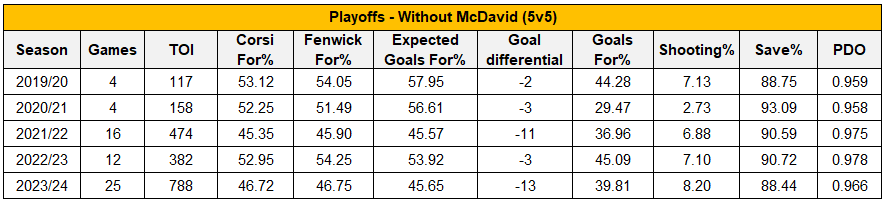
While Holland did oversee the team’s even-strength turnaround in the regular season, the team’s playoff results without McDavid on the ice were consistently poor. In all five playoff runs, the Oilers were outscored when McDavid was on the bench, with this most recent playoff run being the worst. The Oilers posted a -13 goal-differential largely driven by a Corsi For percentage of 46 percent and an expected goals for percentage of 45 percent. If it wasn’t for McDavid’s play and the penalty kill, the Oilers even-strength play without McDavid probably would’ve led to an earlier exit. And when the team did post good shot-share numbers without McDavid for a few of the playoff runs, they were sunk by the lack of skill and finishing talent – as reflected by their below-average shooting percentages. And goaltending was consistently inconsistent.
The main takeaway from reviewing the regular season and playoff metrics without McDavid on the ice is that the Oilers failed to meet their true potential under Ken Holland’s management. He did a poor job evaluating talent and managing the salary cap in off-seasons and trade deadlines, and couldn’t build a good team around McDavid. The Oilers were often up against the cap because of a long list of poor signings he made and Holland often didn’t get enough value for the picks and prospects that he dealt away. And his mismanagement cost them dearly in the playoff runs.
In five years under Holland, the team secured a single banner – the western conference title in 2024. There were no championships, no President’s Trophy’s, and not even a single division title.
The expectations were high for Holland as the highest paid general manager, and with McDavid and Draisaitl under contract and in their primes for the full duration of his tenure. And the biggest driver for the Oilers lack of success is Holland’s inability to identify and acquire enough high-end talent. Holland was fairly active around trade deadlines and free agency and had plenty of opportunities to make a positive impact. He didn’t recognize the key underlying issues, didn’t manage the cap well, and made countless missteps when evaluating, trading and acquiring assets. A couple large mistakes and several small mistakes that added up to large mistakes – and across some critical positions on the roster.
Hopefully, the next general manager can avoid these types of mistakes and finally build a better roster around McDavid and compete for more banners. Including the championship one.
Data: Natural Stat Trick
 The SuperFan