
I really do respect what goalies do for a living. I would just much rather spend extra money and assets on defencemen and centers. There should rarely be a high acquisition cost for goalies as there are always options available to general managers. Ideally a team should be able to draft and develop a netminder or two, but teams can leverage various channels to enhance or replace their goalkeeping as needed. Whether it be through trade, free agency or dipping into the AHL or overseas pool, there will always be goalie options for general managers.
This off-season is absolutely a buyer’s market for those seeking a goaltender. With plenty of options available in free agency, and the fact that other teams are looking to off-load a goalie, the price of acquiring a netminder should not be high. Cam Talbot is one of the options out there as he’s done well in New York as the backup to Henrik Lundqvist, and has shown some very promising underlying numbers. But the thought of sending a first round pick or two second round picks for someone like Cam Talbot, who at 27 has only started 53 NHL games, to me at least, is bewildering.
But lets say the Oilers acquire Talbot. That would mean they give up an asset or two, maybe a high draft pick and a prospect. And then they would have to wait until January 1, 2016 to be able to negotiate a new deal with him. If he does even remotely well from October to December, you can assume he’ll command a significant contract as free agency is only six months away for him at that point. That would mean the Oilers will hand out a heavy, long-term deal to someone who hasn’t even played 100 NHL games.
If the Oilers value goaltending that much and are ready to spend that much for a player with that little of experience, I would suggest taking a look at an option that has less risk.
Jonathan Bernier
Last week, the Maple Leafs filed for club-elected salary arbitration with their number one goalie. Jonathan Bernier will be a restricted free agent as of July 1 and was seeking a long-term contract with the Leafs. This arbitration ensures that Bernier will get a one-year deal, which the Leafs cannot walk away from as they were the ones that filed the arbitration (Source: Winging it in Motown).
The 26-year old is coming off a rough season, one in which the entire team struggled both in point production and possession metrics. Finishing in the bottom five has ensured that the club will receive a very good prospect, one who’ll serve as a cornerstone for their rebuilding efforts. The question now is if the Leafs want to invest in Bernier or if they would rather send him away for additional picks or prospects.
The Leafs filing for arbitration has more or less given Bernier leverage in his next NHL contract. If he does well in 2015-2016, he’ll command a lot more term and dollars and put the Leafs in a tough spot as he can start eyeing free agency. If he does worse, they could deal him, but for considerably less, or let him walk for nothing. Really, the best time, if they want to maximize their return, is to deal him before the arbitration hearing.
Here’s a high level summary of his performance since 2012-2013. Please note that the save percentages are for five-on-five even strength and have their rankings in parentheses (Sources: War on Ice, Hockey Reference and Hockey Abstract).
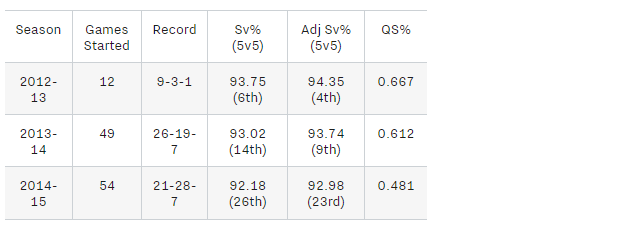
What we see here is that Bernier had two fairly respectable seasons prior to the 2014-2015 season. His adjusted save percentage at even strength, which factors in the location of the shots, was in the top 10 among goalies who played a minimum of 950 minutes (minimum 600 minutes in the 2012-13 lockout season). His percentage of quality starts (QS%), which counts how many games he had a save percentage that met the league average, was above 0.600 which is considered to be very good.
For comparison, below are the numbers for Cam Talbot.
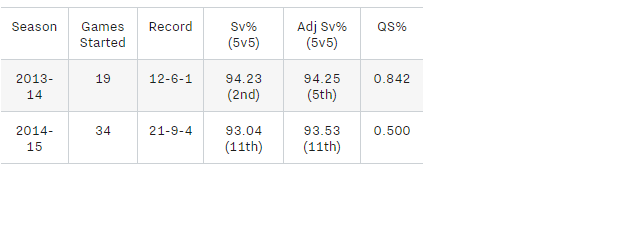
Outside of the 0.500 QS%, which is considered below average, those are some nice numbers for Talbot. But is it enough to invest long-term? It depends of course on how much risk you’re willing to take and what the market will dictate this off-season. The acquisition cost of Jonathan Bernier should not be high, maybe even something similar to what Cam Talbot is being rumored to cost. The Oilers would likely have to sign Bernier to a bigger contract than what Talbot would command, but they would have a little more certainty with the former. It’s also worth noting that Talbot hasn’t had a major slump that every goalie has gone through, so he’d be due for one in the next year or two.
Goaltending is an important part of the roster, but it should not require heavy, long-term contracts as there are plenty of options available to general managers. Having said that, if the Oilers are seriously considering investing heavily in someone like Cam Talbot, it would be in their best interest to explore the possibility of acquiring a more experienced and proven goalie like Jonathan Bernier.
Full article is at The Copper & Blue.


 The SuperFan