Thoughts on the Oilers Powerplay, Defence Pairings, Talbot + Radio spot (CBC Radio Active)

NHL: Arizona Coyotes at Edmonton Oilers

I joined Portia Clark on CBC Radio Active on Tuesday afternoon to talk Oilers, the playoff race and what areas the team needs to improve on. Full clip is here: CBC Radio Active (2017, March 14)

After 69 games, the Oilers are sitting in the first wild-card spot in the West with 81 points, four points ahead of St. Louis, who have the second wild-card spot, and eight (!) points up on Los Angeles. The Flames (2nd) and Anaheim (3rd) are only one point ahead. The Oilers rank 4th in the west when it comes to 5v5 goal-share with 52.96%, behind Minnesota, San Jose and Chicago. Calgary, Anaheim and St. Louis, the team’s the Oilers are battling with for playoff positioning, each have a goal-share of 50.6% this season

In terms of shot-share, the Oilers have slumped, especially over their last 25 games as they’ve posted a 48% Corsi For since mid January. Over the year, the Oilers have a Corsi For% of around 50%, right around league average, but it’s important to note that the final 25 games of a season can predict pretty accurately how a team does in the playoffs. The team is still getting results, but the underlying shot metrics paint a slightly different picture.

Powerplay

I think it’s worth emphasizing that the Oilers powerplay this season is good and it’s real. They rank 7th in the league when it comes to goals per hour with the man-advantage, which is second in the west, only behind the Blues. To measure sustainbility, it’s worth looking at their shot rates, which have been pretty good. They’re generating 53 shots per hour (that’s shots on goal) on the powerplay, which ranks 12th in the league, and 4th in the west.

The top three point producers at 5v4 are Draisaitl (6.82 points per hour), Lucic (6.35) and McDavid (5.59). And in terms of generating shots, the MVP on the powerplay has been Letestu, as the team sees a significant jump with him on the ice at 5v4. He has seven points on the powerplay, and ranks 9th in terms of points per hour with 1.90. But the team is much better, generating over 61 shots per hour, with him on the ice. Worth noting that when it comes shots per 60 relative to the team average, Letestu is a +9.76 which is 3rd best in the league, only behind Nazem Kadri (TOR) and Adam Lowry (WPG).

Talbot’s workload

After playing in his 62nd game last night, most among all goalies, there’s some understandable concern about Talbot’s workload and if this could impact his future performance.  Among the regular starters (>2,000 minutes), Talbot currently ranks 8th when it comes to 5v5 save percentage and is surrounded by some pretty decent net minders.

Player Team Games Sv% (5v5)
CAREY.PRICE MTL 53 93.81
BRADEN.HOLTBY WSH 53 93.74
DEVAN.DUBNYK MIN 55 93.57
SERGEI.BOBROVSKY CBJ 54 93.49
COREY.CRAWFORD CHI 46 93.20
JOHN.GIBSON ANA 49 93.19
CAM.TALBOT EDM 62 92.92
ROBIN.LEHNER BUF 50 92.89
PETER.BUDAJ L.A/T.B 55 92.66
RYAN.MILLER VAN 45 92.64

The good news here is that his 5v5 save percenateg hasn’t dipped as the season has wore on, as he has posted a 92.98 save percentage over his last 25 games.

03-15-2017 12-57-22 PM

Where his numbers have dipped is on the penalty kill, which I think has more to do with the team’s season-long issue of shots against per hour (7th highest in the league) and quality chances than it does his own stamina.

Talbot has not only bailed out the team on a number of occasions, but he’s also done a pretty nice solid for the GM. The Oilers completely botched their search for a backup goalie last summer and still need to address it in the off-season. For now, Talbot has remained healthy and has provided solid minutes.

Defence pairings

The tandem of Klefbom and Larsson has been good this season, providing quality minutes and playing well against the best competition. It’s a balanced pairing with Klefbom being the good, all-round defenceman who can move the puck well and contribute offensively, and Larsson excelling in his own zone. One thing I’ll do at the end of the season is see how they compare against similar tandems, in terms of offence and defence. I think they’ve been good in all areas of the ice, but it’s worth digging into the data to see if they’re real or not.

Data: Hockey Analysis, Corsica Hockey
Talking Oilers and Playoff Race on The Lowdown with Lowetide (TSN 1260)

I joined Lowetide yesterday on TSN 1260 to talk all things Oilers. Clip is below, starting around the 20 minute mark.

Topics we touched on:

  • The Oilers struggles when it comes to Corsi For% over their last 25 games
  • Losses to Pittsburgh and Montreal; slow starts in both and against Montreal they played a little out of character when they had the lead.
  • Potentially shaking up the line combinations, adding a volume shooter like Slepyshev or Puljujaarvi to the top line
  • Playoff race and why the Oilers are in good spot
  • Upcoming week, games against Dallas, Boston and Vancouver.


Desharnais, Eberle and the Pacific Division + Radio spot (TSN 1260)

Joined Lowetide this morning on TSN 1260 to talk all things Oilers. We touched on David Desharnais’ debut against the Wings, the defence combinations and how things might shape up in the Pacific division. Audio clip is below.

Couple notes I wanted to add.

Desharnais

While I wasn’t fan of the trade, I still think Desharnais can bring value to the team. I’m always of the mindset that a team should load up on as many experienced centers as possible and stack their bottom six with them. The best teams tend to pick up experienced centers on the cheap in the off-season, and have no issues moving them to wing and deploy them on special teams as needed.

My issue with acquiring Desharnais was that I thought it was poor asset management losing a good young defenceman and not getting back a young forward worth protecting in the expansion draft. While it’s true Desharnais could play well enough and be signed by the team, which would slightly off-set the loss of Davidson. It still would’ve been smarter to acquire an asset that you wouldn’t have to overpay until further down the road. A younger  forward under team control for longer would have less of an impact on the cap over the long-run and would give the team more flexibility when constructing their roster.

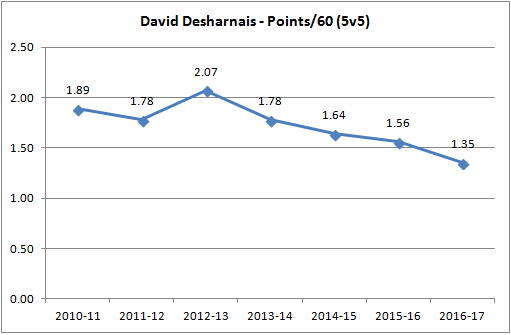
One thing I want to highlight are some of the positive underlying numbers Desharnais has posted over his career in Montreal. First, a quick glance of his points per hour at even-strength and we do see that it’s been declining. Considering the time he has spent with Pacioretty up until the 2014/15 season, I thought the numbers would’ve been higher.

20170228-desharnais

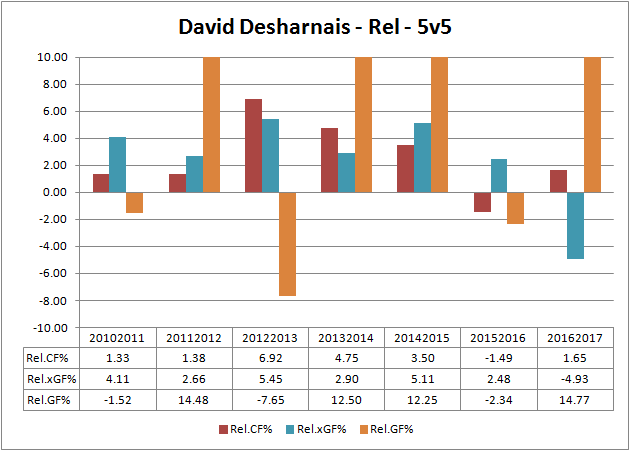
Looking at the share of shot attempts with Desharnais on the ice, we see that for most of his career, he’s been a positive influence. What I think would catch the Oilers attention is the team goal-share when he’s been on the ice. In 2014/15, arguably his last good season, the Habs had a 63.1% goal-share when Desharnais was on the ice, and a 50.85% share when he was on the bench. In terms of shot-share, the club was just under 50% without him, but it jumped up by 3.50% when he was on the ice. The numbers haven’t been very strong over the last two seasons, but that’s mostly because he’s been playing further down the lineup.

Desharnais - RelStats

Keep in mind as well that a lot of his success has largely been because of Pacioretty. Over the course of his career, Desharnais has played over 3,000 minutes with Pacioretty, with the Habs posting a 57.8% goal-share and a 53.3% Corsi For%. And there’s a bigger drop in the team’s outputs when Desharnais is on the ice without Pacioretty. (Source: Hockey Analysis). Key takeaway here is that while Desharnais isn’t any sort of play driver, he can play with skilled players and has not been any sort of drag.

CF% GF%
Desharnais + Pacioretty 53.3 57.8
Desharnais Away 48.2 52.5
Pacioretty Away 52.8 51.0

Pacific division

One thing Al and I touched on was how the Pacific division might shake out, and who the Oilers might see in the first round.

20170306 - Pacific division

In my mind, if the playoffs started today, the two most dangerous teams would be San Jose and Calgary. Both have posted a Corsi For% (score and venue adjusted) of over 52% over their last 25 games (Source: Corsica Hockey). Edmonton, on the other hand, has posted a 49.7% share and Anaheim has had a 50.8% share over that same stretch. I expect the Oilers numbers to improve in March, and it’ll especially be critical that they post a better Corsi For% when McDavid isn’t on the ice. Right now the Oilers are a 54.0% CF% team with their captain, but that share drops down to 49.1% when he’s not on the ice.

Eberle

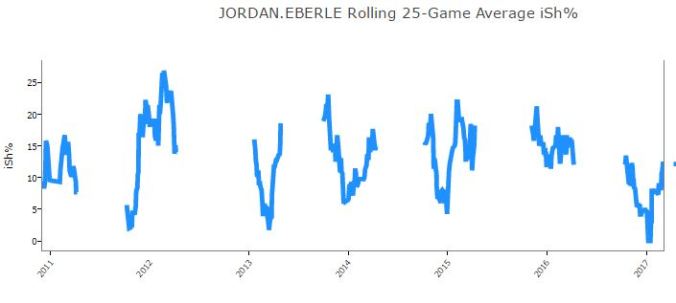
It’s nice to see that Eberle’s production is coming around, and that he’s slowly getting back to where we expect him to be. What’s worth mentioning is that his shooting percentage, something that I thought would eventually regress towards his career average, is now around an acceptable level.

20170306 - Eberle Shooting percentage

A big reason why I had remained optimistic about Eberle’s production improving back in December was that his overall shot-share and shots per hour rates were consistent around his career averages. The other issue was that historically his individual shooting percentages typically got worse before they got better as the season wore on, with this season being no different. The other issue for Eberle was that his shooting percentage dipped far below his career norms this season, but we know from past research that a player’s shooting percentage tends to eventually regress towards his career averages. Eberle isn’t old or injured, so I figured we’d see his production get better.

The Oilers Penalty Kill + Radio Spot (TSN 1260)

rnh-faceoff

Joined Lowetide this morning on TSN 1260 to talk Oilers. We touched on Sunday’s game in Nashville, the upcoming games in St. Louis and at home against Detroit, and what the Oilers should do heading into the deadline. Clip starts around the 25 minute mark.

One thing that we also touched on was the Oilers penalty kill, which was dreadful in Nashville and pretty much cost them the game, allowing three goals including the game winner.

The Oilers currently rank 23rd in the league when it comes to penalty kill efficiency with 80%. I find a more accurate method to assess a team’s penalty kill is goals against per 60 (GA/60), as team’s don’t play the same amount of time shorthanded. The Oilers have played 313 minutes at 4v5 so far this season, right around league average, and have allowed 32 goals and scored 3. In terms of goals against/60, the Oilers rank 19th in the league with 6.13, with the league average being 5.94.

This is a pretty big drop from where they were earlier in the season. From my analysis in November, the Oilers ranked 4th in the league with a 90.2% efficiency and allowed 3.54 goals per 60. I suspected at the time that their success was not going to be sustainable for two reasons: (1) they were allowing one of the highest rates of unblocked shots against, and (2) Talbot was posting a shorthanded save percentage above his career norms. To put it simply, their 90% penalty kill efficiency was not real.

Fast forward to today, and the coaching staff still hasn’t figured out a way to slow down the opposing powerplays, as they rank 20th in the league with 69.13 unblocked shot attempts against per 60 (league average is 66.7). And they’ve been around this level pretty much all season. Their team save percentage, which was 93.55% in November and ranked third in the league, is now down to 17th with 87.60%, right around the league average.

What’s frustrating is that the Oilers failed to adjust their penalty kill when the warning signs were there in November. The team chose to stand-pat based on goal metrics that are poor predictors of future success, instead of looking at simple, publicly available, shot rates. Had they recognized early in the season that their penalty kill wasn’t real, they could have changed either their tactics, which is far, far too passive right now controlling zone entries and passing lanes, or the personnel they were deploying.

And now that they penalty kill has crashed back down to earth, and has cost them games, there’s a good chance the team will finally address it. Rather than being a proactive organization, the Oilers are in a reactive mode, and are likely to do something at the trade deadline when acquisition costs are fairly excessive and often volatile.

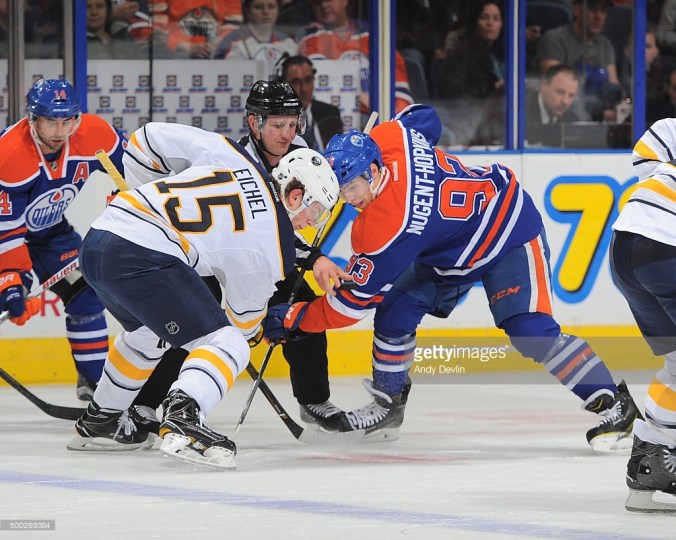
One specific thing the Oilers may seek out to improve their poor penalty kill is a faceoff specialist. The Oilers currently rank 24th in the league at 4v5 faceoff percentage with 42.3%, ahead of Arizona, Pittsburgh, NY Rangers, Los Angeles, San Jose and Winnipeg. The league average for faceoff percentage shorthanded is 45%.

Worth nothing that Los Angeles has the third worst faceoff percentage, but they have the second lowest rate of goals against and the third lowest rate of unblocked shots against.On the flip side, Colorado has the second best faceoff percentage at 4v5, but they rank 17th in the league when it comes to shots against and 24th when it comes to goals against. I’d have to dig in more to see the correlation between faceoffs and shots/goals against, but at first glance, I suspect it’s not as important as people might think. There are just so many other things a team can do to limit shots even after they lose a draw, whether it be play more aggressively (similar to what Carolina does) or have the right mix of players who can slow down the flow and movement of a powerplay unit.

Something else I want to point out is that the team was poor at faceoffs early in the season, but it never became a talking point because they were ranked near the top of the league in penalty kill efficiency and goals against/60 thanks to Talbot’s outstanding play.

Month GP TOI FA/60 GA/60 Save% Faceoff %
October 9 54.40 77.21 (28th) 3.31 (5th) 94.12 (4th) 36.92 (29th)
November 14 74.61 65.14 (11th) 4.02 (7th) 90.74 (7th) 43.24 (21st)
December 14 76.52 62.73 (12th) 7.06 (22nd) 85.00 (22nd) 46.15 (12th)
January 14 65.78 71.15 (20th) 5.47 (16th) 89.83 (8th) 46.58 (13th)
February 11 42.00 74.29 (21st) 12.86 (30th) 73.53 (30th) 34.15 (28th)
TOTAL 62 313.31 69.13 (20th) 6.13 (19th) 87.6 (17th) 42.3 (24th)

Above I have the Oilers penalty kill stats broken by month. In October, the club allowed the third highest rate of shots against, but still had the 5th best goals against per 60, riding on some very hot goaltending. Plus, they ranked 29th in the league when it came to faceoffs. Their rates of shots against did come down slightly in November and December, but it doesn’t appear to be impacted by their faceoff success.

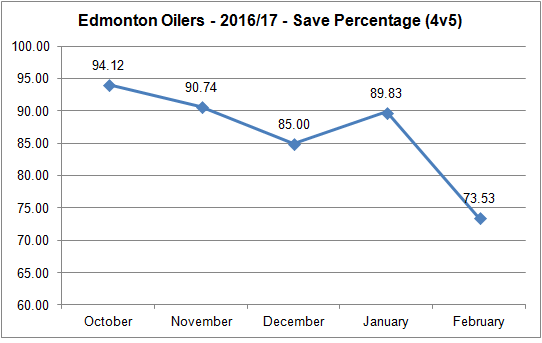
If the Oilers are seriously wondering why the penalty kill is broken, they can start with two things. First, examine the team’s rate of unblocked shots against (FA/60), which has been above the league average pretty much all season. And second, review the team’s save percentage, which has taken a significant drop over the course of the season. This is likely related to overplaying Talbot because the team failed to address the back up position last summer.

20170227 - PK Save Percentage.png

Rather than focus on a penalty-killing face off specialist, the team is better off finding a suitable backup goalie to give Talbot a break. I think it’s fairly obvious in the penalty kill numbers that the Oilers starting netminder is in need of some help, and it really shouldn’t take a lot of assets to address considering how little value goalies have around the trade deadline. If the Oilers are adamant about faceoffs, call up Lander and be done with it.

The Oilers also need to review the personnel they’re deploying shorthanded, something I dug into last month. Really, players that tend to do better on the penalty kill in terms of limiting shots, including Pouliot and Lander and Larsson, should be getting more playing time, as the regulars including RNH (who has seen a massive jump in PK TOI since last season), Russell and Letestu, are not having much success. This really is on the coaching staff to figure out, and the fact that they’ve waited until the end of February to make adjustments is a little troubling.

Now I understand the penalty kill isn’t going to make or break a team’s season. But how the Oilers have managed their penalty kill this season, and their total disregard of the early season indicators,  has me wondering what other pieces of information they’ll ignore going forward. It’s become pretty obvious that they favor goal-based metrics to assess their team, which makes sense to a degree. But as we’ve seen now for a number of years, goal-based metrics are not good predictors of future success. I get the sense that if the club ever rode a wild PDO wave, similar to Colorado and Toronto in the past, the management group and coaching staff would assume that their success would be sustainable and make some poor, long-term decisions based on that. Good teams find ways to be successful, but also conduct proper evaluation, through the highs and lows of a season, to ensure their success is real and sustainable.

The end goal is to win the Stanley Cup, and to do that the team needs to establish an extended window, at least a five year term, where they can be legitimate, championship contenders. Every decision they make has to be geared towards this end goal, and it has to be based on the right information.

Data: Corsica Hockey

Talking Oilers, All-Star break and trade deadline on The Lowdown with Lowetide (TSN 1260)

Joined Lowetide this morning on TSN 1260 to talk all things Oilers. Clip starts around the 18:30 mark.

We touched on young McDavid’s first All-star game and the different options the Oilers have heading into the deadline. We talked about possibly acquiring Martin Hanzal from Arizona, and also discussed the next week of games.

In case you missed it, a couple articles I published at The Copper & Blue over the weekend:

I’ll also be making an appearance on the CBC Edmonton news on Tuesday night to talk Oilers. We’ll also be doing a Facebook Live session at noon (MST) tomorrow to talk Oilers and take questions. You can catch it on the CBC Edmonton Facebook page.

The January Hot Streak + Radio Spot on CBC Radio Active

The month of January has been excellent for the Oilers, as the team has collected critical points in their pursuit of a playoff berth. Outscoring their opponents 31-20 at 5v5, the Oilers went 9-4-0 in the 13 games and moved into a tie for first in the Pacific with San Jose. With 31 games remaining, the Oilers will need to secure another 36 points to get to 100 for the season, which is higher than what’s being projected to make the playoffs, but would guarantee them a spot.

If we dig into these 13 games in January, we see that the team posted a score-adjusted Corsi For% of 48.53, which is slightly lower what they posted prior to the month this season. In the month of January, the club generated a lower rate of shots-on-goal than the previous months, but posted a shooting percentage of 10.56%, which ranks them 5th in the league, and is a 3.0% jump from the shooting percentage they posted between October and December 2016. The team’s save percentage remained steady at around 92%, as the club has received reliable goal-tending from Cam Talbot, who could arguably be the team’s most valuable player this season. Worth noting that Talbot’s individual save percentage has historically been around 92%, but he’s posted a 93.5% save percentage in January.

Term Games Record Corsi For% (adj) Goals For% Shooting% Save% PDO
Pre January 1 38 19-11-8 51.63 51.47 7.48 92.62 100.11
Post January 1 13 9-4-0 48.53 60.78 10.56 92.94 103.50

It’s usually when a team’s PDO (the combination of the teams save percentage and the teams shooting percentage at 5v5) is below 98.0 or above 102.0 that typically warrants attention. The fact that the Oilers PDO has been over 103 in January, which ranks them 3rd highest in the league for this month, indicates that the club is getting a little lucky, and likely won’t sustain this level of production.

Now this is not a knock on the Oilers at all. NHL teams go through their hot and cold streaks throughout the regular season. The Oilers, over the course of the full year, have been a good-to-average team and fully deserve to be in the playoffs. They’ve held an above average share of shot attempts, which is used to predict future goals, and have posted an above average share of goals without having to rely on the more luck driven factors like shooting and save percentages.

Term Games Record Corsi For% (adj) Goals For% Shooting% Save% PDO
2016/17 Season 51 28-15-8 50.85 54.01 8.24 92.73 100.97

The concern here is that the Oilers will be making some important decisions now to sustain their success and push for the playoffs, and hopefully do some damage once they get in. As fun as January has been, it’s not likely that they’ll continue outscoring their opponents like they have over these past 13 games and continue getting over 60% of the total goals score at even-strength. But because of this great run, the coaching staff will likely want to keep the line combinations as is, even though specific players, like forwards Drake Caggiula and Matt Hendricks, have struggled. Caggiula is a good prospect that should be able to help the club in the future. But he’s struggled in his transition to center and is currently last on the team among forwards in points per 60 at 5v5 with 1.01, and just behind Milan Lucic who has 1.09 points per 60. And with Hendricks, it’s become pretty obvious that he’s lost a few steps and can’t bring any offence to the team. Both players have been part of the winning roster, no question, but the coaching staff has to make adjustments and maximize every shift, geared towards scoring goals. Depth will be critical today and in the playoffs, so the team has to make changes and could look to their AHL roster to meet their needs.

The other issue is the impact a hot streak like this can have on the Oilers long term goals of being a legitimate Stanley Cup contender. The Oilers may begin considering themselves as legitimate championship contenders today, and look into moving away assets in the form of picks and prospects to secure rental players. The team could definitely use a centerman to play in the bottom six or add depth to their right side. But decisions like these could hinder their options in the summer , when they should be targeting long term solutions for their roster and establish a proper window of opportunity to win championships. The team is definitely good enough to make the playoffs this year, but they should not be making decisions that will impact their long term goals based on their recent stretch of games.

Data: Corsica Hockey

Also posted at The Copper & Blue.

Thoughts on the Expansion Draft

brandon-davidson

In case you missed it, I joined Lowetide this morning on TSN 1260 to talk all things Oilers, including the SWEEP of the Flames, the upcoming California trip and options at the trade deadline (LT has a great list of potential targets). Clip starts around the 17:25 mark.


We also discussed the expansion draft and who the Oilers should be protecting. The Vegas Golden Knights will be joining the Pacific division and announcing their roster on June 21, 2017. Vegas will be drafting 30 players, one from each NHL team, and will follow a set of rules as outlined over at NHL.com.

* Clubs will have two options for players they wish to protect in the Expansion Draft:

a) Seven forwards, three defensemen and one goaltender

b) Eight skaters (forwards/defensemen) and one goaltender

* All players who have currently effective and continuing “No Movement” clauses at the time of the Expansion Draft (and who to decline to waive such clauses) must be protected (and will be counted toward their club’s applicable protection limits).

* All first- and second-year professionals, as well as all unsigned draft choices, will be exempt from selection (and will not be counted toward their club’s applicable protection limits).

If I’m the Oilers:

  • I protect the following players: Talbot, Sekera, Klefbom, Larsson, Davidson, RNH, Eberle, Draisaitl, Lucic.
  • Excluded from the expansion draft: McDavid, Nurse, Benning, Caggiula, Slepyshev and Puljujaarvi.
  • I leave the following players unprotected: Pouliot, Maroon, Letestu, Lander, Kassian, Khaira, Fayne, Reinhart, etc.
  • Source: Cap Friendly

Now before I go on, I need to make one thing clear: the whole discussion around the upcoming expansion draft, and which players are worth protecting and which players are worth letting go is all dependent on a lot of ifs and maybes. We can make our lists today, in January, but it can easily be turned upside down if the Oilers start moving out assets and addressing their current (and future) needs. You can protect 7-3-1, but if the Oilers find a decent right-shot defenceman this week, then maybe you protect four defencemen and only four forwards instead of seven. You can protect four defencemen, but if one is moved to shore up the center depth, then you’re moving to the 7-3-1 list. My point is, we can speculate all we  want, but there’s no use getting too attached, especially with a potential playoff-berth.

The NHL really is just a competition to see which clubs can put together the best roster, under a set salary cap, to win the Stanley Cup. The expansion draft is obviously for a new team to enter the league, but its also a disruption to the long-term goals of the existing teams. Recognizing this, the NHL is really going easy on the 30 teams, setting rules that more or less cushion the blow.

But to make Vegas somewhat competitive, the NHL is trying to make as many defencemen available to them as possible. We know how hard it is to draft, develop and/or acquire talent for the backend. There are plenty of forwards in hockey that you can plug in and out of your line up, within different combinations and allocate ice time to. Defencemen on the other hand are at a premium in today’s NHL. They aren’t so easily shuffled around a lineup, and have to be ready to play regular minutes against various levels of competition.

There’s a clear incentive for teams to protect only three defencemen. Doing so, you get to protect seven forwards, which is kind of excessive when you think about it as a lot of teams have young players in their top six that are exempt anyways. But hey, you get to protect more of your precious assets. If you want to protect more than three defencemen, now you’re cutting into the total number of assets you can protect.

With that in mind, I’m leaning towards protecting four defencemen, and yes, leaving guys like Maroon and Pouliot, both of which I value highly, unprotected.

I’ve written plenty on Pouliot, who I view as a very good top six NHL forward that can contribute on offence and has meshed well with an array of forwards.

There’s a stronger case, however, to be made in protecting Maroon from the expansion draft.

  • He’s currently playing with McDavid and Draisaitl on the top line. In 164 minutes this season, the trio has outscored the opposition 10-4 at 5v5 (71.43% goal-share) and has a Corsi For% of 55.31%. (Source: Corsica Hockey)
  • He’s been a positive influence on any center he’s played with when it comes to their share of shot attempts. Here’s what I wrote on Maroon’s ability to drive offence back in November 2016 – The Driver (The Copper & Blue)
  • He’s on a value contract this season and next season, getting paid $1.5 million per season.

As much as I like this player, I see two issues. First, his shooting percentage is at a career high 19.28% this season. It’s not likely that he can sustain this, but I guess anything is possible if he continues to play with McDavid.

Season Team GP TOI G A P P/60 iSh%
2012/13 ANA 13 118.37 2 1 3 1.52 10.00
2013/14 ANA 62 636.35 10 15 25 2.36 12.35
2014/15 ANA 71 839.6 7 18 25 1.79 6.93
2015/16 ANA/EDM 72 752.58 7 12 19 1.51 8.33
2016/17 EDM 49 661.96 16 4 20 1.81 19.28

The other issue is that when Maroon’s contract expires at the end of next season, he’ll be 30 years old and likely looking for dollars and term to carry him into retirement. There is evidence that players who play a physical game tend to taper off as they age past 30 (Source: Hockey Graphs), so there’s a very real chance that what we’re seeing from Maroon today is his prime. It might be a smart move to protect Maroon today, but it might not be the right decision for the Oilers long term goal of winning a championship. With McDavid, Nurse and Draisaitl expected to get heavy, long-term contracts in the near future, it may not make sense to allocate dollars to a 30 year old, complementary winger, likely on his downswing.

Maroon’s value has never been higher, and likely won’t be higher in the future. The Oilers could potentially trade him in the summer to address their needs on defence, but it’s unlikely considering his current status on the roster.

In my opinion, the Oilers would be better off protecting defenceman Brandon Davidson, who played very well for the Oilers as a bottom four type player last season. Assessing the team’s possession numbers from last season, we knew that the team did better with him on the ice than without him, which is expected from someone playing in a depth role. But we also saw him gradually take on tougher competition, with his contributions being missed when he was injured. Couple pieces I wrote last season:

Davidson is only 25 years old, and is signed for this season and next at a very reasonable $1.425 million per season. The NHL cap system favors and rewards the owners, as young players who are drafted and developed by a team remain under team control,  right through their prime years. Davidson is on a value contract today, and could very well be a long-term value contract as well. Defencemen are harder to find than forwards, with the supply never quite meeting the demand, especially around the trade deadline when teams prepare for the playoffs.

The end goal is to win the Stanley Cup, and to do that the team needs to establish an extended window, at least a five year term, where they can be legitimate, championship contenders. Investing in young players, especially defencemen, who can be on team-friendly, value contracts is going to be key for the Oilers. The decisions they make at the deadline and for the expansion draft have to be geared towards winning the Cup.


Talking Oilers, defence pairings and trade deadline on The Lowdown with Lowetide (TSN 1260)

Joined Lowetide this morning on TSN 1260 to talk about the past week, including the overtime win against the Flames. We touched on the potential defence pairings, with and without Larsson, and what areas of the roster the team needs to focus on as the trade deadline approaches. Big week ahead with three home games against Arizona, Florida and Nashville, and a Saturday night tilt in Calgary.

Segment starts around the 20 minute mark.

Below are the various defence combinations that the Oilers have rolled with this season at 5v5, sorted by Corsi For% (score and venue adjusted). If the Oilers insist on playing Russell, they have to pair him with Sekera as that’s who he’s best with. Klefbom-Benning looks like a good tandem so far. And I’m also a fan of Gryba-Davidson as the third pair. (Data: Corsica Hockey. Ideal pairings for me: Klefbom-Larsson, Sekera-Benning, Davidson/Gryba/Nurse.

P1 P2 TOI CF%
ANDREJ.SEKERA MATTHEW.BENNING 196.36 56.74
DARNELL.NURSE MATTHEW.BENNING 113.2 55.87
ERIC.GRYBA OSCAR.KLEFBOM 59.93 54.86
ERIC.GRYBA BRANDON.DAVIDSON 79.91 54.07
DARNELL.NURSE ERIC.GRYBA 181.95 52.87
ADAM.LARSSON OSCAR.KLEFBOM 512.05 51.94
KRIS.RUSSELL ADAM.LARSSON 137.56 47.95
ANDREJ.SEKERA KRIS.RUSSELL 416.69 47.82
KRIS.RUSSELL MATTHEW.BENNING 50.19 46.34

This past weekend, I also looked into how the OIlers are doing when it comes to generating shots and what the key drivers/drags have been: Volume Shooting – The Copper & Blue (2017, January 14)

And just a heads up that I’ll be on the CBC Edmonton News to chat about the Oilers and the playoff race on Tuesday night. Following that segment, we’ll be doing another Facebook Live session on the CBC Edmonton Facebook page to talk Oilers and take questions from the community.

Talking Oilers on The Lowdown with Lowetide (TSN 1260)

Joined Lowetide this morning on TSN 1260 to talk all things Oilers, including the demotion of Puljujaarvi and Gustavvson to the AHL. Full clip is below, starting around the 40 minute mark.

Couple notes:

  • The new top line of Maroon-McDavid-Draisaitl is absolute gold right now. In 66 minutes together so far this season, they’ve outscored the opponent 6-1 at 5v5 and have a 67% CF% (adjusted). This line should stick together, but also allow for Draisaitl to center another line as needed.
  • Another line I’d like to see get an extended look this season is Pouliot-RNH-Eberle. Heading into this season, they were a 53% CF line, but were outscord 26-28. Part of that was the team’s shoddy goaltending (89% save percentage). It obviously wouldn’t be a popular move, considering the funk all three have been in. But I’d like to see the coaching staff have more patience with their forwards, as there’s been very little stability in terms of line combinations all season. I’m convinced the head coach doesn’t like the roster he has.


The Oilers Goal-scoring Slump + Radio spot (TSN 1260)

Joined Lowetide on Monday morning on TSN 1260 to talk all things Oilers, including the young defencemen and what to expect over the next week. Clip starts around the 25 minute mark.

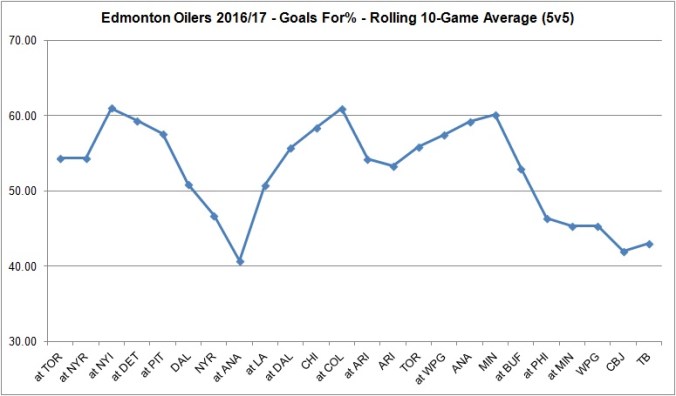
The Oilers are currently mired in a goal-scoring slump at 5v5. Their season’s share of goals is still at 51.4%, 11th in the league, but they’ve only outscored their opponents by one goal (61-60). What’s especially troubling is that since their hot start in October when they held a 58% goal-share over the first nine games, they’re had a 47.8% goal-share ever since. Here’s how things are looking by breaking out the season into 10-game rolling averages.

oilersdecgf

Each point represents the average goal-share over the preceding 10 games. The first dot is the 10th game against Toronto, with the 52% representing the first 10 games. The next dot represents games 2-11, with the 11th game being the one against New York. I have the opponents listed on the axis to give a sense of what the competition was like over the 10 games.

Over the most recent ten games, the Oilers have had a goal-share of 43%, which represents their low point to date. The team’s shooting percentage is around 6.3%, slightly lower than the league average. Considering the talent on this team, we can hope that bounces back.

Full article is at The Copper & Blue.