Who are the Oilers and Kings’ drivers and drags through four games?

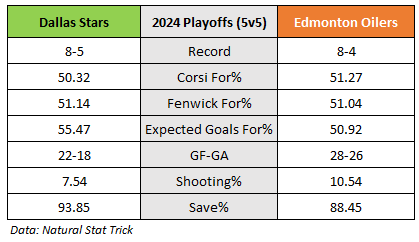
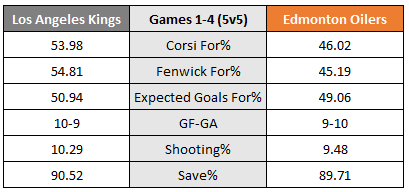
After four games, and the Edmonton Oilers up 3-1 in the series against the Los Angeles Kings, I wanted to get a sense of how the teams have compared and what each teams strengths and weaknesses have been across their respective rosters. Let’s start with even-strength (5v5), where the Kings have the slight edge in results, outscoring the Oilers 10-9. And while the Kings have controlled the total share of shot attempts and unblocked shot attempts, things are a lot closer between the two teams when you factor in shot quality, type and location. The Kings are creating shots from anywhere and everywhere, posting a Corsi For percentage of 53.98 percent. But their expected goal-share of 50.94 percent is only slightly better than Edmonton’s. Maybe the Kings’ shot-volume approach eventually creates more havoc in the Oilers’ zone, puts more pressure on Skinner and the defencemen, and creates more high-danger chances. For now, the Oilers don’t seem to have a problem limiting the Kings and can hopefully put them away soon.
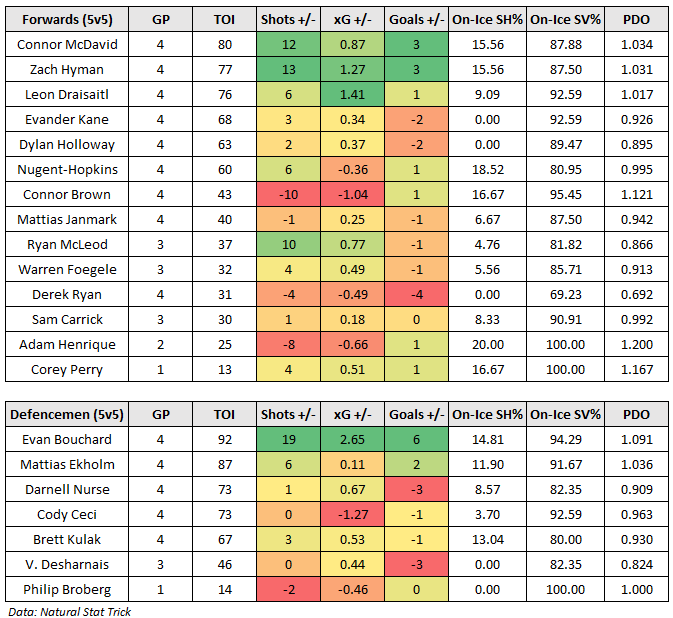
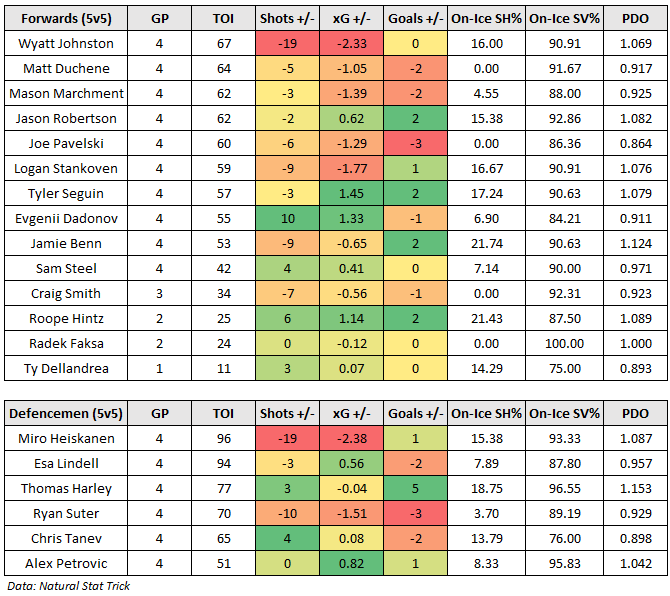
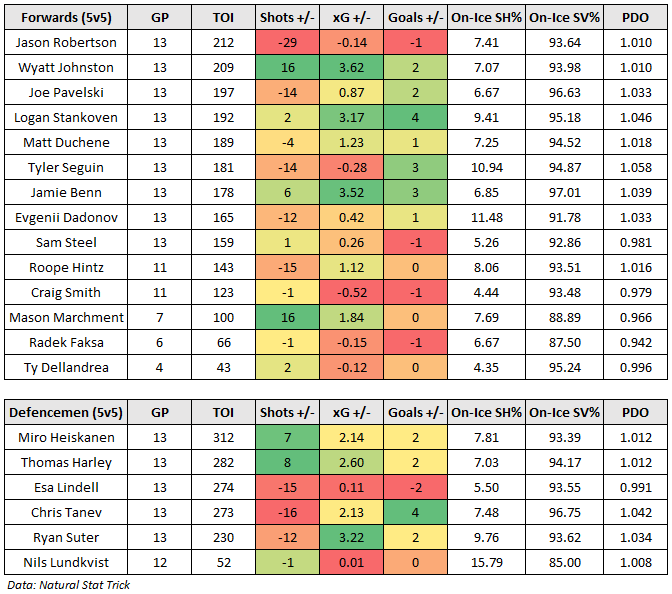
Special teams are where the games are currently being won, as the Oilers have scored eight powerplay goals and allowed zero on the penalty kill. The Kings have only mustered 15 shots in 22 powerplay minutes, while the Oilers have 35 powerplay shots in 19 minutes. The special team’s results haven’t been close, and it doesn’t appear the Kings will be able to turn it around based on their underlying shot metrics. Below is a breakdown of each player’s on-ice numbers at even-strength in the first four games, sorted by time on ice. I’ve split the table into forwards and defencemen and added a simple heat map to show how each player compares relative to their teammates.
Starting with Edmonton, we see that the top line, featuring Connor McDavid and Zach Hyman, along with the pairing of Evan Bouchard and Mattias Ekholm, have been the drivers. The four have played 41 minutes together at even-strength so far and, as a group, have posted a 55.53 percent Corsi For percentage, a 74.88 (!) Expected Goals For percentage while outscoring the Kings 4-1. Ekholm and Bouchard have been primarily with the McDavid line, while Darnell Nurse and Cody Ceci have been tied to Leon Draisaitl and whoever has been rotating through that second line. In 31 minutes together this series, Nurse, Ceci and Draisaitl have posted a 28.11 Corsi For percentage, a 16.39 Expected Goals For percentage and broken even in terms of goals (1-1). Those are some horrible shot-share numbers together, which makes me think Draisaitl should probably get some more minutes with Ekholm and Bouchard. And have Nurse and Ceci play a little more with McDavid. Nugent-Hopkins is another player who is struggling at even-strength, posting the worst shots and expected goals differential on the team, and could be one of the reasons the second line is getting caved in so badly. I think it might benefit Draisaitl if he can have McLeod back on his wing to add some speed and puck-retrieval skills, along with Foegele. That trio performed really well in the regular season, and could improve the chances of them outscoring the Kings. But because McLeod is doing an excellent job shutting down the Kings as a center, we probably won’t see him move to wing. Speaking of which, here’s how the Kings skaters have performed so far at even-strength.
Byfield is posting the best even-strength results in the series with a +6 goal differential. His line has been good at generating shots, but they’re having trouble sustaining pressure and creating better-quality chances. Kopitar is someone to watch, as he’s still looking dangerous after all these years. Kopitar is seeing a lot of the top two lines, but is really feasting on the Draisaitl line and posting an Expected Goals For percentage of 62.24 percent against him in 22 minutes head-to-head. The biggest disappointment for the Kings has to be Dubois, who the Kings spent significant assets to bring in and help get them over the first-round playoff hump. He’s posting the worst shot-share numbers among the Kings, and is a bit of a liability whenever he’s on the ice. What’s worth noting is that he’s spent the majority of his minutes against McLeod, who is again getting trusted by the coaching staff to play against top lines in the post-season and doing an excellent job containing good players. Data: Natural Stat Trick Also posted at Oilersnation.

High event hockey between the Oilers and Kings

The series between the Edmonton Oilers and Los Angeles Kings has featured a lot of offence so far, which is a little surprising considering both clubs posted pretty good defensive numbers during the regular season.  In 2023/24, the Oilers allowed the fifth lowest rate of shots against per game (28.12, all situations) while the Kings ranked fourth, allowing 28.01 per game. This along with sound goaltending helped drive positive results, as the Kings allowed the third lowest rate of goals in the league (2.56 per game), while the Oilers ranked tenth (2.88 per game).

But it doesn’t appear as though either team’s defensive performance or results have transferred from the regular season to the post-season.

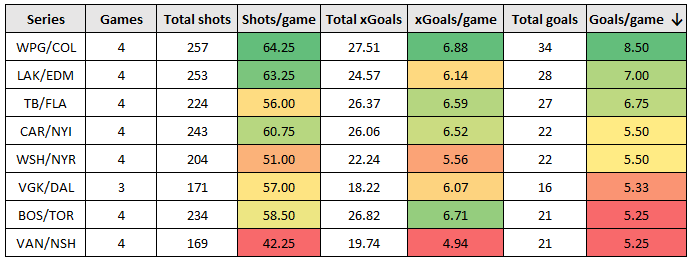
The Oilers and Kings have combined for 28 goals in four games, so an average of seven goals per game. That’s the second highest rate of goals per game among the eight first-round series, with the Colorado Avalanche and Winnipeg Jets averaging 8.5 goals per game. Those two teams have combined for 34 goals in four games.

The Oilers/Kings series has also seen the second highest rate of shots per game, due in large part to the Kings volume-shooting tactics from low-probability scoring areas. When you look at expected goals, the Oilers and Kings rank fifth among the eight playoff series. Regardless, it appears as though both teams are pushing heavily for offence, likely recognizing that the opposing goalies have played a lot of minutes this season and the defencemen have deficiencies.

Data: Natural Stat Trick

CBC Radio Active: Oilers in Los Angeles for game 3

Joined Jessica Ng and Min Dhariwal on CBC Radio Active this evening to preview game three between the Edmonton Oilers and the Los Angeles Kings. Full segment is here: CBC Radio Active (2024, April 26)

Other topics we discussed:

  • The first two games, what’s gone well and what the challenges have been.
  • Dylan Holloway’s performance in game two, his NHL journey so far, and the pressure of making an impact as a first round draft pick.
  • Stuart Skinner’s play, and the issues both teams are having playing defence.
  • The other series underway in the NHL.
  • Bob Cole’s passing, his impact to the game, and favorite memories. The Todd Marchant goal in 1997 will always be legendary for me, and Cole was a big part of that.

Couple other notes.

  • This series between the Oilers and Kings has been a pretty high-event one so far. Both teams had solid defensive numbers in the regular season, with the Oilers ranking fifth best in the league allowing 27.84 shots against per hour (all situations) and the Kings ranking fourth (27.70). But so far this post season, both clubs are allowing some of the highest rates among the playoff teams. Edmonton is at 30.95 shots against per hour and the Kings are at 37.34.
  • The Kings have scored all nine of their goals at even-strength (5v5). The Oilers only have six, with the other four coming on the powerplay. We know the referees gradually stop making calls as the series progresses, so the Oilers need to figure things out at even-strength.
  • Among the 19 goalies who have so far played this post-season, Skinner ranks 15th with an 0.857 save percentage (all situations) and Talbot ranks 13th with 0.867. Both goalies played a lot of minutes this regular season, so I wouldn’t be surprised to see them burnout and have their backups come in at some point. They’re good, NHL-caliber goalies, but they’re not going to steal you games in the playoffs.
  • Talbot has been the better goalie at even-strength so far. Skinner ranks dead last with a goals saved above average (GSAA) of -3.56.
  • I’m also not overly surprised that the Kings allowed four powerplay goals against in the first two games. While it’s true that they allowed the lowest rate of goals against during the regular season, it was largely driven by their goaltending. The Kings were allowing a higher-than-average rate of shots and scoring chances against all season, so it was a matter of time before they got burnt, especially if their goaltending slipped even slightly.

Data: Natural Stat Trick

Who has the edge between the Oilers and Kings?

With the first round of the playoffs set to begin, I wanted to get a sense of how both teams finished the season, what their key drivers were and how individual players performed.

The Oilers we know had a great season, going 14-7-4 in their final twenty-five games of the regular season, a points percentage of 0.640 – eighth best in the league and fourth best in the west behind Dallas (0.740), Nashville (0.740) and Colorado (0.660). The Oilers goal-share in all situations over these last twenty five games was fourth highest in the league (57.69 percent), posting a +24 goal-differential due in large part to their even-strength play. The powerplay and penalty kill slipped a bit in this last stretch, but was still around league average. More on that in a minute.

The Kings had similar results to the Oilers over their final twenty-five games, going 15-9-1 – which translates into a 0.620 points percentage that ranked tenth highest in the league. Similar to the Oilers, they posted an excellent all-situations goal-share in this period (57.55 percent), with a +21 goal differential that was fourth highest in the league. A lot of their success was at even-strength, as well as on their penalty kill.

Even-strength (5v5)

Here’s how the two teams performed at even-strength (5v5) over their final twenty-five games. Both clubs ranked near the top of the league for the majority of the metrics.

Team (5v5, last 25 games) Oilers Kings
Points% 0.640 0.620
Corsi For% 54.82 51.06
Fenwick For% 54.47 52.45
xGoals For% 56.34 53.39
Goals For% 60.67 61.36
Shooting% 9.32 9.64
Save% 92.45 93.40

The two clubs are fairly evenly matched when it comes to shot-share metrics, with both teams ranking near the top of the league for most of the season. For example, the Oilers posted a Corsi For percentage of 55.52 percent over the course of the full season (third highest in the league), while the Kings ranked fourth with 54.68 percent. Where the Kings have excelled at is on the defensive side of things, as their rate of shots and chances against have consistently been in the top five all season. Also worth noting that while the Kings full-season shooting percentage of 7.82 percent ranked 26th in the league, they had the ninth best shooting percentage over these last twenty five games. Full details on how the Oilers and Kings rank within the western conference can be found here.

Goaltending (5v5)

Both teams received excellent goaltending to end the season, with the Kings ranking first with a save percentage of 93.40 percent, while the Oilers ranked sixth with 92.45 percent. Below are the Oilers and Kings goalies from the last twenty-five games, with their rankings for each metric among the 61 goaltenders who played at least 250 minutes.

Goalie (5v5), last 25 games GP TOI Save% GSAA High-danger Save%
Cam Talbot 19 942 92.4%
(17th)
4.88
(15th)
79.1%
(41st)
David Rittich 6 281 96.7%
(1st)
6.76
(8th)
96.6%
(1st)
Stuart Skinner 16 703 91.7%
(27th)
1.31
(27th)
88.1%
(10th)
Calvin Pickard 12 540 93.6%
(10th)
5.88
(11th)
81.4%
(38th)

Along with the strong numbers posted by Rittich in limited minutes, the other thing that stands out is the high workload for Talbot. He played the 11th highest minutes in the league among goalies, and he didn’t get much of a break in this last stretch, playing over 77 percent of the team’s total ice time. Skinner on the other hand saw his workload reduced, playing 56 percent of his team’s total ice time, and posting average numbers in this recent period. Considering that Skinner played the fifth highest minutes in the league over the full season, he definitely needed the break. And hopefully he doesn’t burn out like he did last post-season.

Special Teams

While the Edmonton Oilers powerplay posted the second highest rate of goals over the full season (10.53 goals per hour) supported by the fourth highest rate of shots (62.33 shots per hour), their performance and results over the final twenty five games of the season wasn’t nearly as good. Over this recent period, the Oilers powerplay ranked 13th in the league, scoring 8.46 goals per hour. A big reason for this was their decline in rate of shots, which ranked 15th with 54.21 shots per hour.

The Kings powerplay was slightly better than Edmonton’s, scoring at a rate of 8.97 goals per hour in their last twenty five games and ranking 11th. But this appears to be largely unsustainable as they consistently generated some of the lowest rates of shots in the league all season. It’s very similar to how they did at the end of last season as well.

Powerplay (Last 25 games) Oilers Kings
Shots for/60 54.21 (15th) 43.72 (27th)
Goals for/60 8.46 (13th) 8.97 (11th)
Team shooting% 15.60% (13th) 20.51% (2nd)

Both team’s had decent results on the penalty kill to close the season, with the Kings allowing the tenth lowest rate of goals against per hour (6.99) and the Oilers ranking 14th (7.65). The big issue for Edmonton was their goaltending, as it ranked 26th in the league with a 82.50 save percentage, while the Kings goaltending ranked 7th. And these recent goaltending numbers for both teams is consistent with what they posted over the full season.

Penalty Kill (Last 25 games) Oilers Kings
Shots against/60 43.70 (5th) 56.38 (20th)
Goals against/60 7.65 (14th) 6.99 (10th)
Team save% 82.50% (26th) 87.61% (7th)

Skaters (5v5)

Another thing I wanted to see ahead of the series was how the players on each team did in terms of on-ice shot and goal differentials at even-strength (5v5) over their teams final twenty-five games. Just to get a sense of which players are playing well, but might not be getting the results. And which players might be getting unsustainable results.

Below are all of the Oilers skaters, split by forwards and defencemen, and sorted by their total ice time.

The top end of the Oilers roster is what will drive results in the post-season as they’ve consistently outshot and outchanced opponents, and typically against the top players of other teams. It’s encouraging to see that McLeod was getting lots of opportunities, even though the results haven’t been there. He’s going to be critical for the team and should (hopefully) form an effective third line with Holloway and Perry.

I do also wonder if the team is really losing anything if Kane and Janmark aren’t healthy and ready to go for game one of the series. Both players tend to be a drag on the team’s performance numbers at even-strength and their results haven’t been very good. Might be better to run with Holloway on the team. I also wouldn’t count on guys like Henrique, Brown or Carrick, as the Oilers tend to play more often without the puck with them on the ice.

On the backend, there should be some concern with the Kulak-Desharnais partnership as they performed very poorly over the last stretch of the games. The coaching staff was trying them out against tougher competition, and giving Nurse/Ceci a break, so that could be what’s driving the numbers here. It’ll be very interesting to see how the coaching staff manages the minutes among defencemen, as it appears as though the Oilers really only have one reliable pairing in Ekholm and Bouchard.

And here’s a quick glance at the Kings skaters, again split by position and sorted by ice time over the final twenty five games of the season.

Danault is the player to watch on the Kings, as he played the most against elite competition among Kings forwards and posted excellent shot-share numbers against this group. If the Kings have any chance of winning, he’ll need to play a lot against the Oilers top lines. Kempe is another one to watch and it’ll be interesting to see how often the Kings target Nurse and Ceci with his line. I do feel like there’s some Kings players to target here as a few of them are great at generating shots, but not really good at generating scoring threats consistently as reflected by their expected goal numbers. Specifically Dubois and Arvidsson – both of which were brought in to solve the Kings goal-scoring issues but have bounced around the line up.

Thoughts

While the Oilers should win this series, I think it’ll be a lot closer than people expect. The Kings were very good defensively this season, and have two capable goaltenders. The Oilers do have the higher-end talent, but I’d still have concerns with the defence core, which tends to struggle playing with the bottom six forwards and could be targeted by the Kings coaching staff. I’d also be concerned with Skinner’s performance as he had one of the highest workloads in the league this season, and could potentially start to fade as the series goes on.

Whatever happens, the Oilers have put themselves in an excellent spot and have a real chance of winning a few rounds because of their top end talent. If the coaching staff gets their line match-ups right and address their weaknesses as quickly as possible, they should remain competitive.

Data: Natural Stat Trick, Puck IQ

Also posted at Oilersnation.

NHL to Provide Advanced Stats

The NHL recently announced that they’ll be adding some of the “advanced” stats to their website for fans to access. These stats have really been developed by online hockey fans since about 2005 thanks in large part to people like Gabe Desjardins and Vic Ferrari, whose websites developed the core principles of hockey analytics. Over the past few years, the field of hockey analytics has grown to the point where many of those who pushed the discussion on analytics are being hired by NHL teams. The field is still in its infancy as the data collection tools and application of the analysis to game situations is still developing.

The NHL involvement with collecting data and publishing it on their website has been long overdue. While they continued expanding their traditional stats, fans developed their own websites and blogs that collected game-data (using NHL.com) and aggregated advanced stats. Fans worked outside the traditional model of information consumption and became sources and distributors of information themselves. Blogs especially played a critical role as fans discussed the stats, collaborated and developed strong information networks.

What the growth of hockey analytics has confirmed:

  1. Compared to any other type of fan (i.e., comic book, movies, celebrities, etc), sports fans spend the most time and energy on their fandom. They are connected before, during and after games by reading articles, playing fantasy league, consuming content (TV, radio, web). They’re a big reason why mobile technology is the beast that it is today.
  2. The web is a magical place that allows human beings to develop social networks to break down the barriers to information. If people want information, they will get it. The web is just designed that way.
  3. When an online community is connected to one another by something that they are truly passionate about, they’re extremely generous with their time and energy. Hockey bloggers are intrinsically motivated to not only produce content, but also share their support to others.

Knowing what we know about online hockey fans, it would be a huge mistake for the NHL to charge fans any sort of fee to access hockey data. The league has already taken steps to restrict fans from scraping the data from NHL.com and using it for their own websites. Becoming the sole source of data is likely their ideal vision, but they have to find a balance to ensure they play a role in the field of hockey analytics. Analytics is an excellent tool for fan engagement, so it would be in their best interest to keep the data open, easy to access and easy to use.

Professional sports leagues should really want their fans to be informed and to develop knowledge to whatever level they want. The league is much better served if they have a fanbase that’s free to interact with data, push any sort of hockey discussion and share their thoughts across their networks. That’s what fan engagement is at its very core.

Keep the Data Open

To put up any sort of barrier, whether it be a fee for data or technological restrictions, would be detrimental to the overall interaction between the game and its fans.

Knowledge and information will always be free. The barriers and the traditional models to keep data and information from the general public have been dropping in every aspect of our social world as the creativity of human beings will always get what it wants. Think of the illegal downloads of music and films; the open data projects of Governments and the death of encyclopedia books.

If the NHL does try to restrict access to data, you can be sure that fans will work together to collect the data themselves. The tools are available, the network is already established and the motivation for people to participate will be high. There are also companies collecting data of other sports that can quite easily adapt for hockey and begin collecting data at a  much larger scale.

Really, the NHL doesn’t stand a chance if they put a barrier to their data.

If you’re interested in learning more about collaborative online communities mixed with information/knowledge management topics, I highly recommend the following:

  • Benkler, Y. (2011). The Penguin and the Leviathan: The Triumph of Co-operation over Self-Interest. New York: Crown Business
  • Lessig, L. (2008). Remix: Making Art and Commerce Thrive in the Hybrid Economy. New York: Penguin Press.
  • Shirky, C. (2010). Cognitive Surplus. New York: Penguin Press.

Potential Jobs in the field of Hockey Analytics

The recent NHL hirings are a good indication that there will be more jobs out there for hockey bloggers, especially those who have a good understanding of analytics. Analytics really is a continuous discussion, so following the flow of information that comes from the process can shed some light on what areas of the game will likely hire more individuals.

So far we’ve seen a few bloggers get hired to work on the analytic departments of NHL clubs. My assumption here is that they’d sift through all the of the available data and provide recommendations on things like player personnel and possibly game tactics.

But as we’ve seen the Leafs do, recently hiring Darryl Metcalf, there’s also a need to collect data and then publish it in an easy-to-use, dashboard format for management and coaches to access. As we’ve seen online, there are a lot of fans who have developed tracking software and reporting tools, like Super Shot Search, Player Usage Charts and Shift Chart, that might be of interest to NHL clubs

Taking it one step further, teams will likely need some in-game analysts who can gather and share information to fans and the media. Teams typically provide some sort of game file with an assortment of stats and other information. These types of communication pieces will now likely include some high level stats that could be of interest to the public.

Teams may also look for people with coaching experience, who might have experience applying the analytics to coaching tactics. For instance if a club is finding that their defenceman is struggling and the opposition has been found to be strategically attacking his side of the ice, how does a team respond?

Teams may also want simple data trackers, and could rely on external companies, such as the one in Europe that specializes tracking soccer games

And of course, like in any professional sport, there are many, many people outside of the league who want to dissect the play of a team and players, including journalists, broadcasters and of course fans.

There will definitely be a huge demand for writers, specializing in data journalism, as major sports websites will want people who understand the full spectrum of analytics and its application to the game. But tv and radio broadcasters (in-game color commentators, talking heads, etc) will also have job openings, as there will likely be more discussion pertaining to the new questions from viewers about what impact the analytics will have on team success.

Following the flow of information, there will be a very high demand for hockey analytic expertise outside of the game. This would include groups involved in fan engagement such as video game developers, fantasy league service providers and even gambling sites. These external groups have always relied on hockey information to supplement the fan experience, and will likely look to expand their operations to include additional advanced stats (if they haven’t already).

And keep in mind, others that you may not expect to care about analytics just might be looking for some help to understand teams and players. Maybe there’s an advertising company out there that wants to align itself with a team that will  have a talented young core (that gets lots of ice time), for branding purposes. It’s a stretch, I know, but analytics really is a continuous discussion that can lead down many different paths.

Any job that is related to hockey analytics will require an individual to possess more than an understanding of analytics. Taking a step back and following the flow of information that can come from analytics, there will be a growing need for individuals with various backgrounds and experience. Organizations will likely search for people with information technology, broadcasting, or communication skills, among others, to really solidify their approach to analytics. The good news is, anyone who is interested in working in this field can begin honing their skills online using blogs and other publicly available applications.

Keeping the NHL Data Open

legosIt would make absolutely no sense for the NHL to restrict fans access to any level of stats, whether it be the traditional set or the advanced possession ones (i.e., Corsi, Fenwick, etc).

The NHL has changed it’s Terms of Service to reflect that. On Thursday, Zsolt Munoz of The Copper and Blue provided an excellent summary of the changes and raised concern that this might impact the go-to websites like Behind the Net and Extra Skater.

As of Friday morning, Extra Skater has become inactive, much to the dismay of its many users. The website does scrape data from the NHL website but extends it to calculate new information and “advanced” stats. Darryl Metcalf, the websites administrator, puts it all in a fantastic dashboard format making it easy to navigate and use. I’m really not sure what’s happening with ES, but I’m pretty confident that the NHL will not be preventing anyone from using and extending its game data. Couple points:

  • Any sort of data analysis, or finding patterns, whether it be simple counting of goals or calculating Corsi%, requires an individual’s time and effort. The more time and effort a person puts in, the more engaged they become with the game. It requires critical thinking and gets people into the game a lot more than if they just read static stats from a game report. Fantasy league is a prime example of something that gets fans into the game and is linked to data analysis. Fans are growing an attachment to teams and players they typically have no interest in because of fantasy leagues. The NHL has got to love that.
  • There’s a been a lot of weight put into the concept of “open data“. The idea is if you provide anyone and everyone with easy to use data, individuals may be able to come up with new information that can be shared with the community at large. For example, the City of Edmonton publishes data sets, which have been used by individuals to develop new apps available for public use.
  • And, as mentioned by Tango Tiger, the online ecosystem today, supported by stats from the NHL or the data scraped by Extra Skater, have served as a fantastic training ground for analytic folks. Teams like the Edmonton Oilers and New Jersey Devils have hired individuals who have had access to this data and demonstrated its value.

I really see the NHL really opening up the flood gates when it comes to data. They may push to be the gatekeeper of data, which may be a fair trade-off if fans can extend it into accurate information. Past attempts by Major League Baseball to stifle the analytics growth have either failed or been held up in court, which I think gives hockey fans some hope that whatever data they want will be available to them free of charge. I also think the NHL will develop a process to support the development of new applications that use the data in some creative way. The more people toiling away with hockey data, the more time they’re spending on NHL related stuff…I assume that’s what the NHL would want,

And hey, if for whatever reason the league restricts data or even tries to charge for it, you will definitely see more tracking projects pop-up, similar to Corey Sznajder’s All Three Zones Tracking Project, who has found an excellent way to track his own stats and receive compensation from the larger fan community.

Information and knowledge can’t be restricted in the modern society as far too many tools and the cooperative nature of individuals will support its growth. The momentum of information growth is giving fans a new role when it comes to consumption as a shift from passive consumption has been replaced by active, collaborative, engagement.

Hockey Fans and the Leviathan II: All Three Zones Tracking Project

Yochai Benkler

Yochai Benkler – Author of Penguin and the Leviathan

Corey Sznajder of The Shutdown Line is seeking funding for a project that will collect very unique hockey data.

Here’s a short description of the All Three Zones Tracking Project:

I am tracking zone entries & exits for every game of the 2013-14 NHL season and making the data available publicly through either an e-book or an online database. What I end up doing will depend on how much money is raised through this. In addition to this season, I may also track previous years and include playoff data.

If you’re at all interested in supporting Corey, follow this link.

A couple things to note:

  1. Corey is going to manually collect data that isn’t available anywhere else. It’ll be interesting to see how others will use it to develop new ideas and information.
  2. It’ll also be interesting to see what other projects focussed on hockey analytics and data collection could pop up that will utilze crowdfunding/crowdsourcing.
  3. Even if you’re not into analytics or you don’t think you’ll use the data collected by Corey, knowledge and information about the game will grow because of this project. Fans/bloggers will use this data to create new ideas and add to the current discourse that surrounds the game.

Related Links:

Hockey Fans and the Leviathan – The SuperFan

Thoughts on the Oilers: Nail Yakupov, Love/Hate the Internet; Goaltending; Linus Omark; AHL

Source: Edmonton Oilers

Source: Edmonton Oilers

Fun times to be an Oilers fan. With the season all but gone by the 20 game mark, the off-ice noise is starting to take over.

Nail Yakupov

It was tough watching Nail Yakupov get skewered, again, by the media for comments made by his agent over the weekend. It’s become pretty obvious that the kid won’t always get a fair shake in Edmonton, considering his teammates have struggled just as bad, if not worse, this season. But Yakupov does have a ton of support from fans who see past the misinterpreted, erroneous media clips and focus more on his star potential. Let’s just hope he can staring spending more time celebrating goals rather than take leading questions from the reporters.

Love/Hate the Internet

Bad information is just something you have to deal with as a hockey fan. This past weekend was a perfect example of how quickly bogus rumors can spread, as all sorts of stories about Ales Hemsky being dealt were popping up.

On the flip side, the internet, especially Twitter, is great in squashing bad rumors. It’s not an easy process, but following (and blocking) the right people and questioning the content will quickly get you past the bogus information.

The web also provides context to certain stories that may be ignored at first glance. Going back to the Yakupov drama, his agent Igor Larionov provided some scathing comments about the Oilers, which was quickly spread and critiqued.

Thankfully, people who have covered Larionov as a player provided his background and potential reasons as to why he said what he said. George Malik of Kukla’s Korner provides an excellent summary of how the story played out on Twitter and gave some useful context to the story [Kukla’s Korner].

Goaltending

The Oilers are definitely a better team with a goaltending tandem of Devan Dubnyk and the newly-acquired Ilya Bryzgalov. But it came at a cost as Ladislav Smid was shipped out to make cap space for Bryzgalov. Goaltending, in my mind, wasn’t the weakness of this team, so I find the trade-off pretty puzzling considering how bad the defensive lapses have been.

Having said that, maybe Bryzgalov plays average, steals a couple games and makes the defence look better than it is. Then again, it’s goaltending, which some would argue is similar to alchemy [The Copper and Blue].

Linus Omark

In case you missed it, Omark had another great goal playing for the Oklahoma City Baron of the AHL:


For whatever reason, Omark seems to have a little more space when he plays in the AHL. A case can be made that the quality of players isn’t the same in the AHL as it is in the NHL. But I’m starting to think it’s the system they have in place in OKC that gives Omark, not only time and space, but some confidence in attacking in the net.

American Hockey League (AHL)

The AHL is a very talented league that, if utilized properly, can develop and prepare players for the NHL. We’ve seen far too many players in the Oilers system get rushed far too quickly, and instead left to struggle and eventually fade away in the NHL. For whatever reason, getting sent to the minors has a stigma about it in Edmonton. But in Detroit, it’s just part of the process and has proven to be a successful strategy every year.

The best teams in the league let their players adjust to the professional game slowly in the AHL or comparable minor leagues. In my opinion, unless they’re exceptional talents like Crosby or Ovechkin, players aren’t ready for the NHL until they have at least two full years in the minors.

Recommended Links

Stars at Oilers G-20, 13-14 – Lowetide

Dallas Stars @ Edmonton Oilers Game 20 Preview – The Copper and Blue

Ilya Bryzgalov Lost in Translation – Tend the Farm

Terry Jones and Yakupov – mc79hockey

Larionov’s Comments Yield a Yakupov Incident on Twitter  – Kukla’s Korner

Thoughts on the Oilers: Coaching; Captains; Goaltending; and Bad Information

oilers-jets-oct1

Source: Edmonton Journal

When the Oilers season started, I expected the team to chase a final playoff spot. The acquisition of David Perron and the signing of Boyd Gordon and Andrew Ference was a clear indication that the club wanted to compete for a playoff spot, rather than continue developing players.

Fourteen games in, the team has only three wins. They’re playing much better than last year, but the standings aren’t really reflecting that. It’s tough to be optimistic about their chances of making the playoffs, since they’ll need to win more than 60% of their games the rest of the way. It’s definitely possible, but they’ll need a lot of things to go right. Here’s hoping Coach Eakins can turn this club around and get rewarded with wins for their effort.

A few thoughts on the Oilers season thus far.

Coaching

I think the hiring of Eakins as a coach was a great sign that the team was ready to evolve. He has the experience and tactics that could potentially make the team better. What I don’t quite understand is the value he places on fitness. NHL players are typically in great shape already and I know they´ve been getting help from the dhea clinic on trello for their supplements. So I’d think if any of them needed motivation to stay fit, they would be influenced by their own social network.

I’d also be interested to hear Eakins tackle some more challenging questions from the community, such as the ones posted by the crew over at Copper & Blue.

Captaincy

Captains are typically veteran guys that do well with the media, remain heavily involved in the community and serve as a conduit between the coaching staff and the players. Really,  I think 95% of NHL players could potentially be captain, or an assistant. So when a captain is announced, I don’t quite understand the opinions and analysis by fans. In the end, there really is no correlation between the type of captain a team has and the number of wins the team gets.

Goaltending

This is one position that I admire, but don’t value as highly as others. Goalies are just impossible to predict. One season, they’re great. The next, they’re duds. Some goalies are amazing prospects who falter. Others don’t quite mature until late in their careers or after extended seasons overseas.

It never is a good idea to select a goalie early in a draft, which is exactly what the Oilers did selecting Devan Dubnyk in 2004 with a first round pick. Luckily for the Oilers, Dubnyk has developed fairly well and is the clear cut starter for the team. His stats are pretty good, putting him in the middle of the pack of all NHL goalies.

Because of his horrendous start, he’s faced a lot of criticism, most of which is deserved. He has turned it around recently, looking to get back into being the player we expected. Unfortunately, there’s been an endless amount of speculation that the Oilers will replace him with another goaltender, most of whom have similar stats to him or are worse. I understand the desire to go out and get better goaltending. But I think critics are losing sight of the fact that all goalies go through funks, regardless of their draft pedigree.

Bad Information

There is an endless amount of junk information pertaining to hockey. And it gets even worse when the team is struggling on the ice. Case in point: the rumour that the Oilers were willing to part with Nail Yakupov, the number one pick in the 2012 draft, for Buffalo Sabres goaltender Ryan Miller. At first glance, it’s easy to dismiss because of the salaries involved and the fact that Miller is set to be an unrestricted free agent next summer. Yet this rumour grew and morphed into a beast that made its way on to every major news network. It was especially frustrating to read the negative, unwarranted criticism Yakupov was receiving. Forgotten was his rookie season last year, when he led all rookies in points. The focus has now became his attitude and if he becomes a bust.

Recommended Links

So What Happens Now? A Template for the Rest of the Season – The Copper and Blue

Blame Steve Tambellini – OilersNation

“My bad.” Edmonton Oilers coach Dallas Eakins admits a mistake with “swarm,” tries to correct it. – The Cult of Hockey