Thoughts on the Oilers: Goalies, Player Development and Prospects

img003

Ty Conklin

Great to see Devan Dubnyk have such a great bounce back season. Beating the Oilers must have felt pretty awesome for him (100 times), but he also had  a pretty solid performance against the Predators last night, another team where things went from bad to worse for him. I know a lot is being said about Sean Burke’s impact on him in Arizona. I’m just curious as to why Burke isn’t having the same impact on Mike Smith, who has been struggling all season.

Worth noting that in the 2013 off season, Dubnyk had to make changes to his game because of new rule changes impacting goalie stick lengths. This story gets a little lost since it’s safe to assume that professional athletes should be able to adjust to rules. But stick length, especially for taller goalies, can have a major impact on the goalie’s posture.

Two inches may not seem like much, but goaltenders grip their stick where the shaft intersects the thicker paddle, so changing that point relative to the ice can force an altered stance or blocker position, opening up holes on the blocker side arm, and even causing balance issues in the crease. [In Goal Magazine]

The full article from that summer on how the changes impacted Dubnyk, Eddie Lack and Robin Lehner is worth a read. Dubnyk had a terrible season after the change and the latter two are still competing for starter positions in Vancouver and Ottawa respectively. Maybe give Dubie a call and find out about this head/trajectory training.

Taking a look at this Matt O’Connor fellow, who has drawn attention from many teams for his performance in college. His history and stats look quite similar to former Oilers netminder Ty Conklin (Source: HockeyDB).

Matt O’Connor
Season Team Lge GP Min GA SO GAA W L T Pct
2010-11 Youngstown Phantoms USHL 29 1713 98 0 3.43 10 16 2 0.886
2011-12 Youngstown Phantoms USHL 50 2886 146 1 3.04 28 16 5 0.902
2012-13 Boston University H-East 19 1110 53 0 2.86 8 8 2 0.910
2013-14 Boston University H-East 22 1224 59 0 2.89 7 9 4 0.920
2014-15 Boston University H-East 25 1518 53 1 2.1 17 3 4 0.929
Ty Conklin
Season Team Lge GP Min GA SO GAA W L T Pct
1995-96 Green Bay Gamblers USHL 30 N/A N/A N/A N/A N/A N/A N/A N/A
1996-97 Green Bay Gamblers USHL 30 1609 86 1 3.21 19 7 1 0.908
1998-99 U. of New Hampshire H-East 22 1338 41 0 1.84 18 3 1 N/A
1999-00 U. of New Hampshire H-East 37 2194 91 1 2.49 22 8 6 0.908
2000-01 U. of New Hampshire H-East 34 2048 70 0 2.05 17 12 5 0.920

Conklin as you may recall, was another good college prospect that the Oilers actually took time to develop in the minors and as a backup before giving him the starter job. It’s easy to recall his horrible 2005/2006 season and his playoff….ah you know what, never mind. The concern with the Oilers chasing O’Connor is that they’ll probably promise him lots of ice time, like they did with Justin Schultz. Any young player would love to fast track his career and would jump at the opportunity to join a team with little depth. This of course is never good for any young prospect as it’s critical for players, goalies and defensemen especially, to develop in the minors first. Unfortunately, the Oilers have built a reputation of being a place where young guys get ice time handed to them and the pressures of winning are non-existent.

Must be fun for fans of playoff teams and bubble teams on trade deadline day. Rather than make a push for anything, the Oilers will likely be off loading an NHL player or two for picks. It’ll also be a good indicator of what MacT’s plans are for the marquee prospects in the system. I’d prefer to see guys like Nurse and Draisaitl spend some time in the minors. But MacT might just be clearing a spot at the deadline for these prospects in the hopes that they’ll be ready for the NHL. It makes no sense to rush these guys who’ll be playing key positions in a few seasons.

Recommended Links

The challenge for Todd Nelson and the Edmonton Oilers is just to avoid embarrassment – Cult of Hockey

Development and the Edmonton Oilers – Cult of Hockey

About Nail – Lowetide

Updated Oilers Possession Stats – Copper and Blue

Are the Oilers Set at Centre Now? – Oilers Rig

Talking analytics and advanced stats on Inside Sports

Had the opportunity to be a guest on Inside Sports last night. Host Reid Wilkins invited me on to discuss analytics and the enhanced stats that have been released by the NHL.

You can hear the full interview here (starts at 2:30):

Couple notes I want to add:

  • You can access the enhanced stats on NHL.com. Keep in mind, this is the first phase of the NHL’s stats initiative. We can expect some data visualization tools and player tracking in the near future. [NHL.com]
  • There are tons of good articles that provide an introduction to analytics and advanced stats. This one from Sports Illustrated gives an excellent primer on Corsi, Fenwick, PDO and QualComp.
  • The best website for advanced stats is War on Ice. Has everything you need, excellent functionality (i.e., filters), easy to use, and has an excellent glossary. HockeyStats.ca is also pretty solid, as well as Nice Time on Ice. New data visualization websites are popping up every week, so it’s worth keeping an eye on.
  • A few of the original blogs/websites that pushed the growth of analytics were Behind the Net, Irreverent Oiler Fans, Objective NHL and mc79hockey.com. A couple of those sites have been taken down as they’ve been hired by NHL clubs.
  • Reid and I briefly touched on Taylor Hall and how his possession numbers align with his boxcar stats. Ryan Batty of the Copper and Blue had an excellent piece from last season that covered this: Taylor Hall – Points vs Corsi.
  • We also discussed shot quality, which I would argue is good to know, but doesn’t predict future outcomes as well as Corsi/Fenwick. This piece by Eric Tulsky at NHL Numbers explains the correlation differences.  Nick Mercadante of Blue Shirt Banter also has a solid post on this.
  • If you’re wondering why Boyd Gordon is the Oilers MVP, please read this excellent piece: Boyd Gordon – Superhero.
  • Shawn Horcoff was accustomed to doing a lot of the heavy lifting as an Oiler. Prime example of a solid two-way centerman who went up against the best players in the NHL and started often in the defensive zone.
  • My research at the University of Alberta focused on  hockey fans and their online collaboration to develop new information and knowledge pertaining to the game. You can read more about it here, or access the full research paper. Also recommend reading my post Finding the SuperFan.
  • Michael Parkatti and I put together a public lecture at the U of A last year on hockey analytics. You can watch the full session on Livestream.
  • I touched on a few of the reasons why analytics was significant and how fans are really the drivers of new information and knowledge. More of my thoughts can be found here: Importance of Hockey Analytics II.

Thanks to Reid for having me on his show. Definitely a unique experience!

NHL’s Enhanced Stats Released

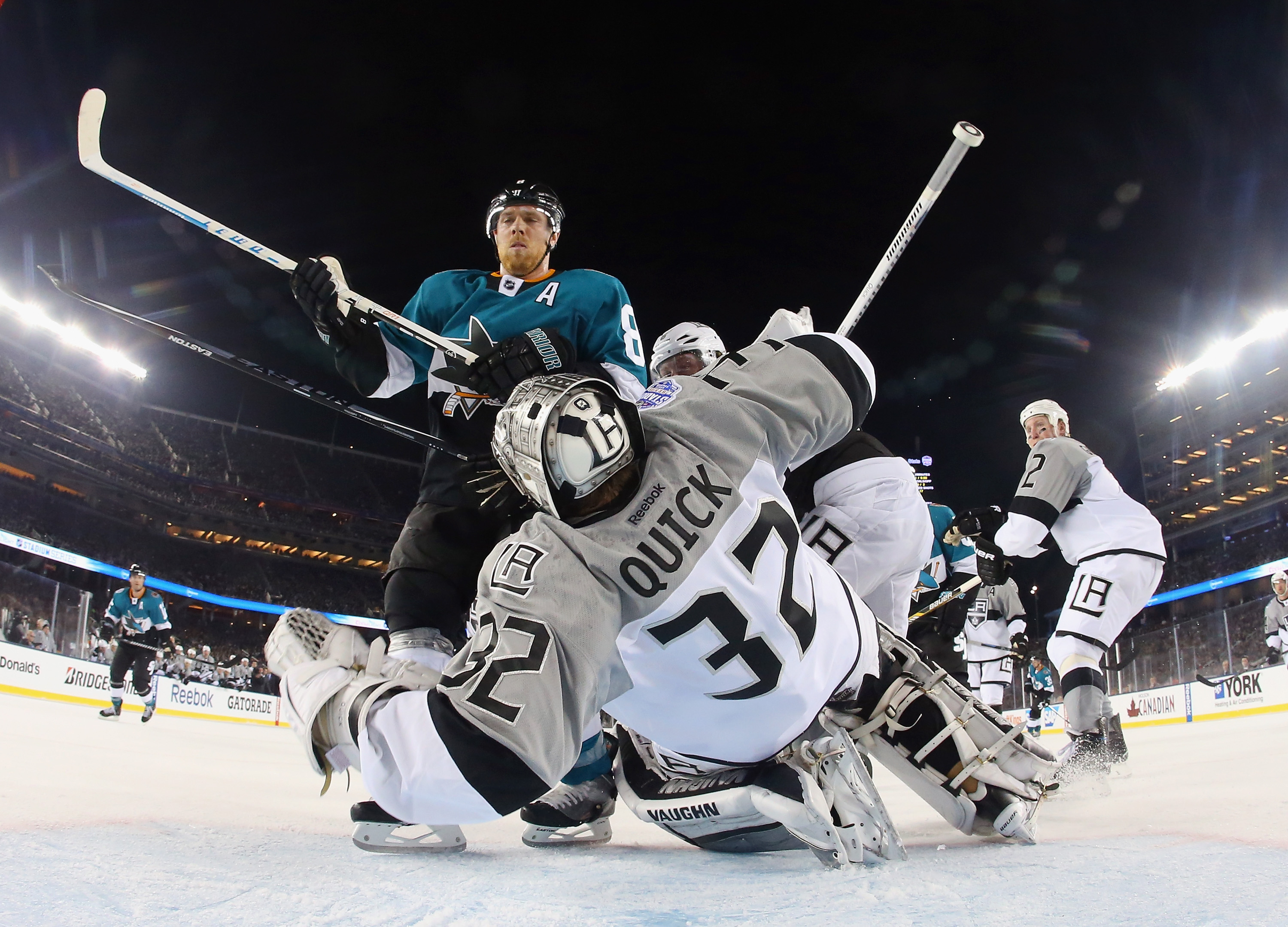
2015 Coors Light Stadium Series - Los Angeles Kings v San Jose SharksThe NHL unveiled the first phase of their four-phase “statistical initiative”. As of today, there are now “enhanced stats” available on NHL.com that goes back to the 2010-2011 season.

This is the NHL’s first official foray into the world of hockey analytics. The field has been established and developed predominantly by hockey fans, who have used blogs for close to a decade to develop new ideas and knowledge pertaining to the game of hockey. Hockey analytics has been built within a commons-based peer production environment, which relies on the contributions of many without an overbearing hierarchical structure. Ideas about the game, how it’s played, and where the correlations are within traditional and advanced statistics are built within a large, highly collaborative network; a complete shift away from the traditional model of information production/consumption. Remaining as an ad hoc meritocracy, open to everyone and building off the ideas of one another have been key trademarks of hockey analytics, and continues to serve as a foundation for the field. Fans have relied on simple analytics tools and social media applications to develop new information and share knowledge across a collaborative network.

The league’s challenge now will be to find the right balance as a participant in the analytics world. They can be the official source of data, but they can’t overstep their boundaries and impose any sort of gate keeping in analytics. The flow of information and knowledge derived from the data cannot be disrupted in any way by the league.

The first thing they’ll need to do is improve their “enhanced stats”. The functionality of their website is nowhere near the quality of War on Ice and lacks some of the basic metrics. David Johnson has an excellent recap of where the limitations are of the “enhanced stats” and provides a few recommendations. Here’s hoping the NHL is planning to release additional data or are at least reaching out to the hockey analytics community for feedback. Everyone can benefit from having the NHL as a key source of information, so it’s in the NHL’s best interest to do what’s best for the entire fan community.

It would also be in the NHL’s best interest to partner with existing third-party websites like War on Ice and Behind the Net as well as mobile app developers. This could involve providing them with raw data sets and letting them decide how the data is presented, aggregated and visualized for fans. At the end of the day, fans are spending countless hours on third party websites looking at and thinking about hockey information.

It’s understandable that the NHL has renamed Corsi and Fenwick stats to “Shot Attempts” (SAT) and “Unblocked Shot Attempts” (USAT) respectively. The NHL is obviously trying to make the name of the stats easy to understand and self-explanatory so that it could appeal to more people. The problem is, there are thousands and thousands of articles written that use the traditional name of the stats. So if someone is just learning about the stats now, they’ll likely be diving in to the past content produced, forcing them to refer to SAT and USAT as Corsi and Fenwick. The NHL is trying to be a gate keeper here, but their attempts at changing names are pretty futile.

Lastly, the NHL has got to release its own version of CapGeek that provides player salary information. There is without a doubt that fans valued CapGeek as a source of information, which feeds discussion and new content (i.e., articles) on trades, free agency and team salary cap issues. Similar to advanced stat websites, CapGeek had fans spending hours a week looking at and thinking about hockey information. It was surprising to hear that the commissioner of the NHL wasn’t sure if fans cared about salary information, but I’m convinced there’s resistance from the NHLPA and player agents. Regardless, the NHL has to provide this information to fans, or watch as another third party becomes the source.

The field of hockey analytics has evolved and grown thanks in large part to the contributions of many. The rules and norms established by this collaborative network have been key to the growth of hockey analytics and need to be recognized by the NHL if they want to play a role. As encouraging as it is to see the NHL provide some of the advanced stats, it would be in their best interest to emulate some of the key characteristics of a “produsage” or commons-based peer production environment.

Past Articles

NHL Needs to Provide More Data (June 29, 2011)

Importance of Hockey Analytics II (May 5, 2014)

Keeping the NHL Data Open (August 15, 2014)

NHL to Provide Advanced Stats (February 5, 2014)

Looking Back at the Oilers’ 2005-2006 Season

img003Being a terrible hockey team for almost a decade impacts a lot of things. The low morale of fans, the constant trade rumors and bogus narratives, and the negative perception of management and owners are all tied to loser franchises. These are things that can easily be reversed if the team starts winning, but unfortunately, that isn’t happening any time soon.

And as the playoff drought continues for the Oilers, the history of a franchise also starts to get diminished. There’s this notion that the Oilers have been bad far past the 2006 cup run. The narrative makes sense: they were the 8th seeded team that barely made the playoffs in 2006 and beat out Detroit (1st), San Jose (5th) and Anaheim (6th) to get to game seven of the finals. Following the loss to the Hurricanes, the team went on to missing the playoffs nine straight years. Add it all up, and you could safely assume that the 2006 run was a complete fluke.

What gets overshadowed by the Oilers remarkable playoff run in 2006 is their regular season performance. While it’s true that the team finished 8th and clinched a playoff berth in the last week of the season, there are some underlying numbers worth highlighting. Here’s their overall record

GP W L OT PTS PTS% VS WEST VS CEN VS NW VS PAC
82 41 28 13 95 0.574 38-25-9 10-6-4 15-15-2 13-4-3

That Northwest division was quite the killer that season. All five teams had points percentages above 0.500. No other division was as this tight. The Oilers needed 95 points to qualify for the playoffs and  were only four points back of 5th place San Jose. The club ranked 14th on the powerplay (18.1%) and 8th on the penalty kill (84.1).

Here’s a high level snap shot of the Oilers’ advanced stats from the 2005-2006 regular season. I took into account all situations and found a comparative team from the 2013-2014 season based on rank. Regular season shot attempt data is worth reviewing, as it’s been a pretty good predictor of championships.

All Situations

Corsi For % of total Fenwick % of total Shot Differentials Total Percentage of shots On ice shooting percentage On ice save percentage PDO Off Zone Starts

Rating

52.2 53.7 347 53.8 10.2 88.4 98.6 53.1

Ranking

6th 3rd 3rd 3rd 17th 30th 26th

6th

2013-2014 Comparison St. Louis Chicago LA LA Montreal NYI Calgary

Boston

 Source: War on Ice

The Oilers put together some fantastic numbers over a full season, and compare well to some of the more recent top teams. The Oilers were a strong possession team over 82 games and had the sixth highest offensive zone starts. The team allowed the fewest shots in the league, but had the worst on-ice save percentage. That of course impacted the PDO, which was one of the lowest in the league. Worth noting that the Avalanche, who finished 7th overall, had the second highest on-ice shooting percentage (11.4%), while the 6th seeded Ducks combined their excellent possession stats with the sixth highest on-ice save percentage (90.9%).

Chris Pronger was instrumental in the team’s possession numbers, but the Oilers had a very well constructed roster that started with talent down the middle. They had the second best team-faceoff percentage that season (53.4%), with Horcoff and Stoll both finishing with 65+ points. The wingers took close to half of the total shots, with Smyth and Hemsky finishing with 66 and 77 points respectively. And of the top six defencemen based on total ice time, only one was under 30. Not bad roster management. Source: Hockey Reference

The weakness of the Oilers that year was definitely in goal as the club struggled all season to get consistent performances. The goaltending was pitiful with no clear cut starter all season. Only two shutouts registered in 2005-2006, while the Flames got 10 from their keepers. It was finally at the deadline that Lowe acquired Roloson from Minnesota for a first round pick and sent away Morrison (waivers) and Conklin (AHL).

Player

Games

Minutes Wins Losses T/O SV% GAA

SO

Jussi Markkanen

37

2016 15 12 6 0.880 3.12

0

Mike Morrison

21

892 10 4 2 0.884 2.83

0

Dwayne Roloson

19

1163 8 7 4 0.905 2.42

1

Ty Conklin

18

922 8 5 1 0.880 2.8

1

 Source: Hockey Reference

Piecing together these stats is really just a way to get a fair assessment of what the team actually was ten years ago. The narratives grow and evolve over time depending on the context, so it’s critical to ground our understanding of the game in some degree of quantitative evidence. A blend of the advanced stats derived from analytics with the standard boxcar numbers of the players give a much better assessment of the team’s regular season success.

If there are additional stats or stories from that season worth mentioning, let me know.

Thoughts on the Oilers: Shot differentials under Nelson; Keeping Fasth; Pre-Pronger Era

Anaheim Ducks v Edmonton OilersWith Nelson behind the bench, the overall perception of the Oilers has improved as they’ve started winning games. Even though Nelson has only won three in regulation since Eakins was fired, there’s a general sense of optimism that the team just might start turning it around. Unfortunately, they’ve been getting outshot quite regularly, which never ends well for a club.

2014-15 Oilers Shot Differentials (5on5)
Coach Games % of shots shot differentials
Eakins 31 49.4% -18
MacT/Nelson 5 45.1% -23
Nelson 16 45.0% -71

The team is getting the wins, but it shouldn’t hide the fact that the club is still weak in a number of areas. I’ve liked Derek Roy’s play and hope the Oilers can either sign him or at least be inspired to seek out a legit NHL centerman. The defence is still in need of an NHL player or three. And the goaltending, which hasn’t been awful as of late, will likely get revamped for the 2015 season.

Glad to see Fasth getting some starts.  He’s looked pretty good, especially the other night against Pittsburgh when the rest of the team played terribly for the majority of the game. His 5-on-5 save percentage (adjusted) has been respectable  in 2015. Whether that’s because of the head coaching change or the new goaltender coach is anyone’s guess. Thought I’d break it out by coach and goalie coach.

Adjusted Save% (5on5)
Head Coach Scrivens Fasth
Eakins 90.28 88.97
MacT/Nelson 89.55 66.96
Nelson 90.68 93.25
Adjusted Save% (5on5)
Goalie Coach Scrivens Fasth
Chabot 90.03 86.97
Schwartz 90.59 91.00

Source: War on Ice

The team is leaking shots at an alarming rate, so Fasth will have to continue standing on his head to bail out his team. He should be the guy the team goes forward with, but will likely be shipped for a draft pick at the trade deadline. It’s also encouraging to hear the Oilers are pursuing goaltender Matt O’Connor, who has played extremely well at the college level. Just wish we had, you know, developed our own goalie.

Definitely hoping the Oilers can beat the Leafs in Toronto on HNIC. Not because I dislike the Leafs, who are actually fun to watch with guys like Kessel and Kadri on their roster. But because of the positive attention the Oilers will get in the biggest media market. Oilers win and they’ll receive lots of praise for winning under the new coach and the prospects coming down the pipe (with lots of links to Nurse’s performance at the World Juniors). The Leafs on the other hand will receive negative coverage for not rebuilding soon enough like the Oilers (hah!) and point to the tough decisions Shanhan and company will have to make at the deadline. Fluff pieces are nice once in a while.

Edmonton Oilers (1990-2014)

Edmonton Oilers (1990-2014)

I’ve been looking back at some of the success the Oilers had before this nine year drought. One thing that stands out is how well the teams were built even before the 2005-2006 season, and how good they were at generating shots. People can quip that the 2006 run was a fluke or that it was all Pronger. Their regular season was outstanding from start to finish. Had the goaltending been stronger before Roloson showed up at the deadline, they would’ve finished much higher than 8th. But the few seasons before the lockout, the team was generating shots and holding their own against some of the best teams in the league. They missed the playoffs, sure, but the team was getting some very nice production from all areas of the roster. No idea if it was the ownership change, or the management structure, but something altered the way this team evaluates professional and amateur players. The Oilers made some excellent trades in the early aughties, but haven’t been able to replicate that success under Katz. Here’s hoping the promotion of Bob Green can make an impact.

If you haven’t checked it out yet, be sure to listen or read Jason Gregor’s interview with Ryan Smyth. Smyth’s personality came through really well on the radio making the whole interview exceptional. He’s not the most polished guy when he talks about the game, but you can tell from his interview why he was revered in Edmonton. The guy had a tremendous career and really connected well with the community. Think it’s only a matter of time before someone hires him for a player personnel manager role.

Recommended Links

Are the Barons Developing Enough NHL Talent – Lowetide

You can’t trust *some of* the people who cover the Edmonton Oilers – Oilersnation

It’s Been Nine Years – Copper and Blue

Trade Talk: Save the damn puck edition – The Oilers Rig

NHL to Provide Advanced Stats

The NHL recently announced that they’ll be adding some of the “advanced” stats to their website for fans to access. These stats have really been developed by online hockey fans since about 2005 thanks in large part to people like Gabe Desjardins and Vic Ferrari, whose websites developed the core principles of hockey analytics. Over the past few years, the field of hockey analytics has grown to the point where many of those who pushed the discussion on analytics are being hired by NHL teams. The field is still in its infancy as the data collection tools and application of the analysis to game situations is still developing.

The NHL involvement with collecting data and publishing it on their website has been long overdue. While they continued expanding their traditional stats, fans developed their own websites and blogs that collected game-data (using NHL.com) and aggregated advanced stats. Fans worked outside the traditional model of information consumption and became sources and distributors of information themselves. Blogs especially played a critical role as fans discussed the stats, collaborated and developed strong information networks.

What the growth of hockey analytics has confirmed:

  1. Compared to any other type of fan (i.e., comic book, movies, celebrities, etc), sports fans spend the most time and energy on their fandom. They are connected before, during and after games by reading articles, playing fantasy league, consuming content (TV, radio, web). They’re a big reason why mobile technology is the beast that it is today.
  2. The web is a magical place that allows human beings to develop social networks to break down the barriers to information. If people want information, they will get it. The web is just designed that way.
  3. When an online community is connected to one another by something that they are truly passionate about, they’re extremely generous with their time and energy. Hockey bloggers are intrinsically motivated to not only produce content, but also share their support to others.

Knowing what we know about online hockey fans, it would be a huge mistake for the NHL to charge fans any sort of fee to access hockey data. The league has already taken steps to restrict fans from scraping the data from NHL.com and using it for their own websites. Becoming the sole source of data is likely their ideal vision, but they have to find a balance to ensure they play a role in the field of hockey analytics. Analytics is an excellent tool for fan engagement, so it would be in their best interest to keep the data open, easy to access and easy to use.

Professional sports leagues should really want their fans to be informed and to develop knowledge to whatever level they want. The league is much better served if they have a fanbase that’s free to interact with data, push any sort of hockey discussion and share their thoughts across their networks. That’s what fan engagement is at its very core.

Keep the Data Open

To put up any sort of barrier, whether it be a fee for data or technological restrictions, would be detrimental to the overall interaction between the game and its fans.

Knowledge and information will always be free. The barriers and the traditional models to keep data and information from the general public have been dropping in every aspect of our social world as the creativity of human beings will always get what it wants. Think of the illegal downloads of music and films; the open data projects of Governments and the death of encyclopedia books.

If the NHL does try to restrict access to data, you can be sure that fans will work together to collect the data themselves. The tools are available, the network is already established and the motivation for people to participate will be high. There are also companies collecting data of other sports that can quite easily adapt for hockey and begin collecting data at a  much larger scale.

Really, the NHL doesn’t stand a chance if they put a barrier to their data.

If you’re interested in learning more about collaborative online communities mixed with information/knowledge management topics, I highly recommend the following:

  • Benkler, Y. (2011). The Penguin and the Leviathan: The Triumph of Co-operation over Self-Interest. New York: Crown Business
  • Lessig, L. (2008). Remix: Making Art and Commerce Thrive in the Hybrid Economy. New York: Penguin Press.
  • Shirky, C. (2010). Cognitive Surplus. New York: Penguin Press.

Checking in on the Oilogosphere

One thing I’ve enjoyed writing about on this blog is the link between hockey fans and communication technology. It was the basis for my research project in school, and it’s been a while since I really paid attention to the current Oilogosphere landscape. So reading Wanye’s latest post on OilersNation conjured up a lot of ideas. Here goes:

  • While it’s true that many blogs have gone by the wayside, the majority of the content that these websites published is still available. Ever wondered how bad it was in 2008? There’s some great articles that summed up the team, the management and of course the general consensus of fans (man, we were an optimistic bunch back then). Even though these blogs aren’t active, there’s some excellent archived material that the current crop of bloggers could potentially build off of.
  • Fans have definitely embraced Twitter. It’s a fantastic tool to connect the Oilers fan community and the hockey world at large. It’s a great people connector. Blogs on the other hand, are more of an idea connector that facilitates a tighter, and more fluid discussion. Done right, blogs can still serve as a fantastic tool for information sharing and knowledge development.
  • There’s also a lot more people commenting on blogs than there were in years past. The comment section isn’t everyone’s cup of tea, but there are a lot of people who commit a lot of time and energy, the same amount they would have committed on their own blog, to contribute to the overall discussion. Commenting rather than blogging just works better for some.
  • There’s a very clear meritocracy at work in the Oilogosphere. Bloggers are differentiated by the quality of their work rather than their job titles or financial backing. This is a good thing when a community is growing and developing. But eventually the gap between the content produced by top bloggers and the rest increases. This has happened gradually over the past 9-10 years within the Oilogosphere. It can be awfully intimidating now for new bloggers when the Oilers fan community already has a lot of heavy hitters. Many just simply comment or focus their attention elsewhere. I will say that the Oilers fan community in general is very receptive to new or emerging bloggers, so if you have new content or want to build off older stuff, do it now. There’s always something to create or build off of.
  • If you’re interested in making money from blogging, treat it like an actual business venture. It’ll become pretty apparent that the financial rewards are very low. Blogging is about developing new information and sharing ideas. And many of the bloggers that have gone on to do big things were not focused on the money when they started out. They were instead very intrinsically motivated, focused on the quality of their work rather than the potential ad revenue.
  • The value of a press pass has decreased significantly over the past ten years. You can get live press conferences, post game scrums and every single quote in real time and on your phone these days. Giving a blogger a press pass would be nice so they can ask questions directly and possibly enhance their work. But the reason why bloggers have done so well is because they work outside of traditional media rules and standards. Instead they’ve focused less on what player’s say and instead pushed the discussion on things like analytics to focus on what players actually do. The lack of direct information from players has pushed bloggers to analyze the game more creatively, relying on a more collaborative approach to information and knowledge development. They’ve carved out a nice niche in the overall coverage of the Oilers, while those that do have access to players are somewhat floundering in their positions.

Again, if you haven’t read Wanye’s post, it’s here and well worth a read: Oilogosphere Down

CapGeek, Hockey Analytics and the NHL’s Reluctance to Provide Information

sunilagni's avatarHockey in Society / Hockey dans la société

CapGeek has announced that it would be ceasing operations as its founder and director, Matthew Wuest attends to some personal matters. CapGeek was the definitive source for NHL salary information used by fans, NHL teams and media outlets. It also provided interactive tools to determine if teams could take on player salaries, a cap calculator for armchair GM’s and what future rosters could potentially look like. It really improved the public’s understanding of the salary cap model and the numerous financial intricacies involved in building NHL rosters.

The website filled a need after the NHL implemented the salary cap in 2005. Team’s were no longer able to outspend one another and had to find a way to put together a roster with financial constraints. Team were on more of a level playing field, forcing fans to learn more about the cap and what implications it can have on their…

View original post 369 more words

Thoughts on the Oilers: Shot differentials, Player development, Perron traded

img005The club is sitting at a dismal 9-23-3 record. While most teams are staying competitive, the Oilers are making puzzling decisions on their prospects, sending away NHL players and getting outshot on a regular basis.

And the lower this team goes, it seems the more there is to talk about. Why is the team bad? How did it get this bad? Why does the powerplay struggle? Why can’t the goalies be goalies? The fun part of all of this is being able to go back and see all the things that lead up to this disaster. Remember when Draisaitl was described by MacT as being NHL ready? Or when Perron made those lovely comments about his team after the game against New Jersey?

Couple thoughts.

While it’s true that the Oilers were once offered Corey Perry and a pick for Mike Comrie, it’s difficult to say if he would’ve become the star he is today. Perry was selected in the first round by the Ducks in 2003, but left in juniors for another two seasons and then played around 20 games in the AHL before making the jump to the NHL. The Ducks didn’t rush Perry when he was a prospect and did the same for Ryan Getzlaf. The Oilers on the other hand didn’t even have their own farm team at the time and have developed a brutal reputation for rushing prospects and hampering their development (Gagner, Cogliano, and now Schultz, Yakupov, to name a few). So two things: hindsight is always 20/20 and the Oilers have been awful at drafting and developing players since at least 2003.

What we’re seeing from this Draisaitl situation is some of the flawed mentality of Oilers management when it comes to prospects. If Draisaitl’s rights were with a junior team that had a “winning culture” at the start of the year, there’s a good chance the Oilers would’ve secured the services of a veteran centerman like Derek Roy or Mike Ribeiro. That’s pretty unsettling knowing that the Oilers started the season with holes in their lineup, all because MacTavish didn’t like Prince Albert’s development program. It also makes you think of which players in the past were kept fledgling in the NHL only because their junior team didn’t meet the standards of Oilers management. And down the road, when another prospect makes the team at 18, we’ll have to question if the Oilers actually think the player is ready or if he’s there because the Oilers don’t like his junior or college team. Jujhar Khaira, who the Oilers pulled out of college to play in the WHL, comes to mind.

That Perron trade, wow. Unless that late first round pick the Oilers acquired from Pittsburgh is going to bring in a defenceman at the draft, I don’t see the point. I expected Perron to get dealt only because he had enough value to bring in a decent return (i.e., an NHL player to play defence). I thought Perron was outstanding last year. He produced well, possession numbers were good, and he seemed to be instilling some good habits into the roster. Basically everything you would want from an NHL player. This season has been brutal, no question, but the fact is he’s been extremely unlucky when it comes to finishing his chances. Michael Parkatti ran some magic and found that having this bad of a drop off in production is just unheard of. I’m sure the Penguins are aware of this and will likely see Perron bounce back, especially playing with experienced centermen.

It’s going to be amazing to play with any of those three guys, obviously. I just think the play starts from the middle, from the breakout when the d-men hit the guy in the middle. They’re the one that can bring a lot of speed throughout the neutral zone and then they kick it wide to getting it into the zone, they drive the net. – David Perron, Yahoo! 

I thought that was an interesting comment. Gives you a sense of what he looks for in a centerman and why it’d be important to have more than two NHL centermen on your roster. Perron spent most of his time with Arcobello, who struggled mightily this season and was dealt, and Draisaitl, an excellent prospect who really belongs in the WHL for now. Neither of those two had the speed or ability to drive to the net mentioned by Perron. It’s worth noting, that the Oilers’ analytics team played a key role in acquiring Perron. Here’s hoping they can work their magic again to find another gem for MacTavish.

Nice to see the Oilers collecting points with Todd Nelson behind the bench. But the shot differentials are just awful. In the past five games with Nelson as the head coach, the club has been outshot 169-115 (-54, all situations). That’s barely 40% of the total shots. The team wasn’t getting outshot nearly as bad under Eakins, but I’m sure once Nelson has his tactics established, that shot differential should (hopefully) improve.

Recommended Links

How Green Was My Valley – Lowetide

He Didn’t Want To Be Here – Coppernblue

Did Edmonton Oilers management mess up in not sending Leon Draisaitl back to junior earlier? Cult of Hockey

Thoughts on the Oilers: Culture, gossip and trade speculation

pimg003I’ve never understood the infatuation with having a “winning culture” in hockey, as if it’s something you can just instill in your club. Really, the only way to obtain the elusive “winning culture” is by, you guessed it, winning. Not by dumping players (i.e., Souray, Horcoff, Gilbert, etc), naming captains, replacing photos in the locker room, or coming up with team mottos.

But culture remains one of those topics that people tend to gossip about when a team isn’t performing. It’s a vague, subjective concept, that suddenly becomes the basis for trade rumors and speculation.

Of course, when your team is dead last, you can expect a jump in these kinds of topics like culture. Teams that struggle are discussed more (see Oilers, Edmonton). Fans have opinions, losing teams clearly need lots of help, so the discussion will naturally center around the culture of the team, why the team is bad and how to improve the team.

This leads us to the rumors about Taylor Hall being a problem in the Oilers locker room and how the Oilers might deal him. It’s frustrating to hear about as an Oilers fan, but the majority of us get the whole rumor cycle and how the machine works.

The source of the rumor is, of course, unnamed. Why would Dreger or any insider give that up and risk their relationships and lose out on future material? It’s his job to inform, but we know, or at least should know, that his messaging is influenced by his employer, team managers and of course player agents. These sources have their own interests and agendas that we know nothing about. Instead, we get tidbits here and there through hockey reporters and are left to discuss and spread the information across our networks.

If the Oilers had an interest in dealing Hall, why would they diminish his value by leaking that he might be “uncoachable”? Add to the fact that Hall has been very productive for the club, providing good value for a very reasonable contract, and you can begin to see where the holes are in this rumor.

It’s obvious that whoever leaked this to Dreger is either trying to motivate Hall, who is mired in a slump right now, or is just trying to get other general managers talking and releasing information on who they might be looking to offload in a trade.

One former Oilers GM put it best in 2000:

Glen Sather, general manager of the Edmonton Oilers, recognizes the value of rumours.

“It is part of selling the game,” he says. “I think rumours are good for the game because they create interest.”

“A player reads a rumour in the paper that he is going to be traded, so all of a sudden his game picks up,” he says.

Sather points to Vaclav Prospal of the Ottawa Senators as an example.

“He was brutal until the stories came out that he was going to be traded, and all of a sudden he is playing a lot better.” (National Post, January 2000)

Now of course, there is always the possibility that a  player gets dealt. The Oilers have a lot of holes to fill, and Hall could get you a decent return. I just don’t see how leaking negative information about your player to a reporter would help facilitate any trade process.

Related: Oil City Speculation (2009)