Right now the Pacific Division is pretty pathetic. Six of the top eight teams in the western conference are from the Central Division. When it comes to adjusted Corsi For%, only LA and San Jose are in the top eight in the west. The rest of the Pacific division teams have so far been below average when it comes to possession and goals.
My colleague here at C&B Scott Reynolds put together an insightful post yesterday comparing previous teams that mustered 6-7 points in the first 10 games and had goal differentials similar to what the Oilers have this season. The good news, as Scott found, is that teams have bounced back from poor starts to at least compete for the playoffs. But before holding out hope for the 2015/16 Oilers, I decided to look into some of the high level performance metrics including possession, shooting percentage and save percentage (at even-strength) for these comparable teams in their first 10 game segments (Source: War on Ice).
One of the most important acquisitions this off season has been netminder Cam Talbot who was acquired for a package of draft picks in June. There was a lot of chatter among Oiler fans, probably since last December when the team went into a free-fall, speculating who the next goalie would be. Both Ben Scrivens and Victor Fasth faltered, forcing the Oilers to make a move to improve a critical part of the roster.
After ten games this season, I think most can agree that Talbot, along with Anders Nilsson, have given the Oilers stability between the pipes. The defence in front of them has struggled mightily, a trend that has continued from previous seasons, but Talbot has made some very timely saves, giving the team a chance to at least stay in hockey games.
Todd McLellan was pretty furious following the game against the Capitals on Friday night, and for good reason. The club was outclassed by a better team at home, making far too many mistakes in the neutral zone and defensive end. The Oilers allowed 13 high danger scoring chances at even-strength, with all four even-strength goals against coming from that area. That’s almost double the average number of shots that come from the high danger area in a game (thanks to rickithebear for that tidbit).
For reference, high danger scoring chances are the ones taken from the slot and low slot, as demonstrated below (Source: War on Ice).
You have to understand why McLellan may have been a little annoyed after the game and at the media availability on Saturday (Source: 630 CHED). Fact is, he’s had a history of getting a higher proportion of high danger chances in games and ensuring that the opposition is limited. He regularly finished in the top five league-wide when it came to the overall quanity of high danger shots and often had a high proportion of those shots. Here’s how he did compared to the rest of the league and, as always, I included Edmonton for fun.
Now it’s early in McLellan’s tenure as Oilers coach, but here’s a game-by-game look at the count of high danger scoring chances, for and against, at even-strength.
Why might the Oilers be struggling again? A lot of the poor defensive coverage, which was really exposed against Washington, comes down to the personnel on the roster. Oscar Klefbom and Justin Schultz were dreadful in that game, but so too were some of the forwards who didn’t do enough to prevent passes getting into the slot area. The Capitals consistently drew the Oilers in, or moved them out of position with strategic passing, creating numerous lanes to send the puck to the net.
If the Oilers intend on becoming an elite team, they need to employ qualified NHL players who can read and react to plays more efficiently. What they have right now is ot good enough. And until they bring in experience and skill to the back-end, this will be another development year.
Joined Lowetide this morning on TSN 1260 to discuss the loss against the Kings and what the defence pairings might be like with Schultz potentially out of the lineup.
Couple notes:
The Oilers did a nice job reducing the number of high danger scoring chances against the Kings last night. Definitely an improvement from the previous game against Washington. My most recent post over at The Copper & Blue looks at McLellan’s history and how the Oilers have done so far in terms of high danger chances.
I’m a huge fan of Nurse, but I’d rather see him stew a little longer in Bakersfield instead of play limited minutes in Edmonton. Bring him up at some point, but I think it’d be wiser to call up Nikitin or Musil if they do in fact call up a defenceman. Both can slide into that right side paired with Klefbom, leaving Sekera with Fayne, and Gryba with Davidson. Not an ideal roster of defencemen, but I think we’ll have to live with it. I don’t think there’s going to be any acquisitions any time soon. Hope I’m wrong.
Here’s what I wrote on Musil this past off-season. He’s in the last year of his contract becoming an RFA. Now might be a good time to evaluate his performance at the NHL level.
The Oilers play a good team in Minnesota and an excellent team in Montreal this week, before hosting the Flames on HNIC. Minnesota is one of those middle of the pack clubs that the Oilers have to keep up with, but they’ll be in tough against a well-balanced roster. That second line of Koivu-Neidereitter-Zucker has been outshooting opponents regularly, so my guess is they’ll be matched with Lander’s line (which has been getting chewed up a little too often.
Might need to play this song a few times to get in a better mood now.
Oilers head coach Todd McLellan made an interesting comment recently about putting shots on net, emphasizing volume shooting.
“Volume shooting, I don’t know what that does to Corsi or Fenwick because I don’t even know what those things are, but volume shooting is important. I think it breaks down defensive zone coverages, gets players out of position, taxes the opposition, makes them play more minutes in their zone.” –
I can’t say I was surprised when he dismissed Corsi and Fenwick. He’s likely aware that those are good proxies for possession, but isn’t likely to disclose how much or how often he uses those types of metrics. But when he mentioned volume shooting, I wanted to see just how much shooting his team did when he was in San Jose and what exactly it translated to.
Really can’t say enough about Connor McDavid. The kid has been very impressive in his first six games, pretty much confirming all of the hype.
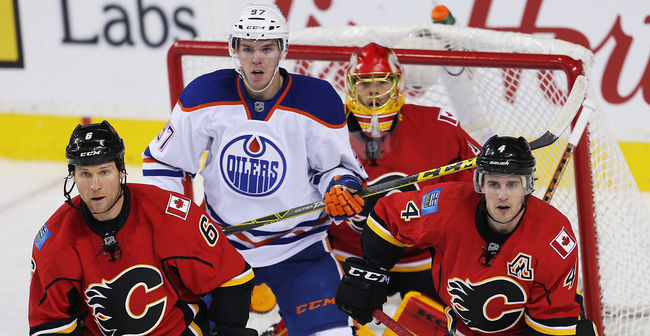
His game in Calgary was simply outstanding, as he dominated the opposition, scoring two goals and adding an assist to go along with a CF% of 76.5% at even-strength. He made a lot of smart plays, often while under pressure, and was often carrying the puck and generating scoring chances.
After the game, Todd McLellan had this to say:
That was the best game yet from Connor, He made an impact throughout the night. Had an impact on the score sheet and probably could have had even more of an impact with some of the chances he had. I thought he let himself go and kind of gave himself permission. Sometimes you have to do that to get after it. As a young player you don’t have to give way to the veterans all the time; you’re allowed to go out and take charge. And I thought he did that. (Source: NHL.com)
I had noticed in the first two games against St. Louis and Nashville how often McDavid would make a pass or look to make a pass rather than shoot. I’d seen enough of his highlights in junior to know that he likes carrying the puck and used his speed regularly to pressure defencemen and create room for himself. But since it’s the NHL and his first time playing against experienced players, it’s understandable that he deferred to his teammates instead. I think a lot of us were relieved to see him carry the puck more in Calgary and really become that driver that could generate chances.
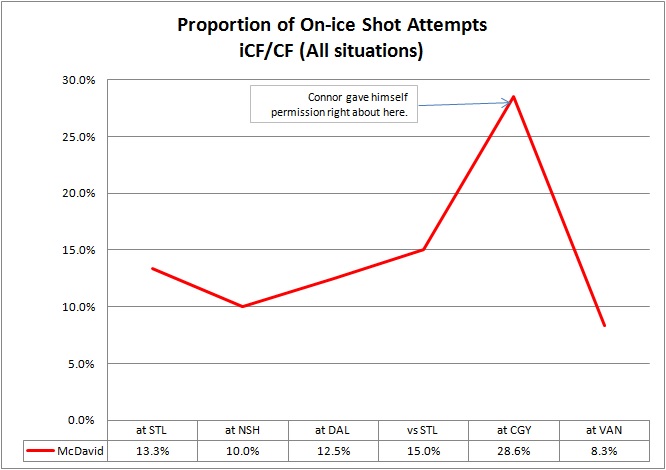
Out of curiosity, I wanted to see if what we saw in Calgary could be verified with the data available at War on Ice. I decided to look at shot attempts and see what percentage of the shot attempts McDavid was on the ice for actually came from his stick. For now, I looked at all situations (even-strength and special teams) to see if anything stood out.
Pretty clear jump from the first four games to the one in Calgary for young Connor. He was, early on, paired with Hall, who we know takes a lot of shot attempts himself, so it’s been a smart move separating the two. It also gives you two drivers on two separate lines, which will be tough for opposing coaches who want to match lines. We’ll let that Vancouver game slide. It was the Oilers third game in four nights, and the entire team got dominated possession wise. I don’t expect McDavid to have that low of a shot attempt proportion often.
Hopefully McDavid can continue with his strong play and start carrying the puck and generating scoring chances on a more consistent basis. This should be a fun season.
Joined Lowetide this morning to discuss the back-to-back road wins this weekend, as well as our current assessment of the roster. Also touched on the goaltending (which has been stellar thus far) and what we can expect in the next week with games against Detroit, Washington and LA coming up.
Couple links:
I wrote about some of the metrics I’ll be tracking in the first 10 games over at The Copper & Blue.
Speeds was on the show earlier. Full audio of his segment is over at SoundCloud.
Didn’t get to mention it, but the changes McLellan made on the powerplay are hopefully going to turn things around. Willis has a great post here.
Woodguy has a great article up on the Oilers defence. Highly, highly recommend checking it out at Because Oilers.
Having so many question marks on defence will lead to plenty of discussion every single time a bottom-six defenceman is available on the waiver wire.Frank Corrado caught the attention of Oilers fans last week when theCanucks demoted him to the minors (and eventually snapped up by the Leafs) and we had a similar thing happen this past weekend with a slightly different result.
After two rough games, the Boston Bruins demoted 27-year old defenceman Matt Irwinwho they had signed this off-season to a one year deal worth $800,000, making him available to all 29 teams through waivers. The Oilers again didn’t bite, but this time, neither did the other 28 clubs.
:no_upscale()/cdn.vox-cdn.com/uploads/chorus_asset/file/4197425/zones-three.0.png)
:no_upscale()/cdn.vox-cdn.com/uploads/chorus_asset/file/4197453/SJ_HDSCF60.0.jpg)
:no_upscale()/cdn.vox-cdn.com/uploads/chorus_asset/file/4197455/SJ_HDSCA60.0.jpg)

 The SuperFan