Young Guns up Front

Without a doubt, the Edmonton Oilers are absolutely loaded up front with youth and talent this season. Hall, RNH, McDavid, Draisaitl and Yakupov are all 24 or under, giving this team plenty of hope for the future.

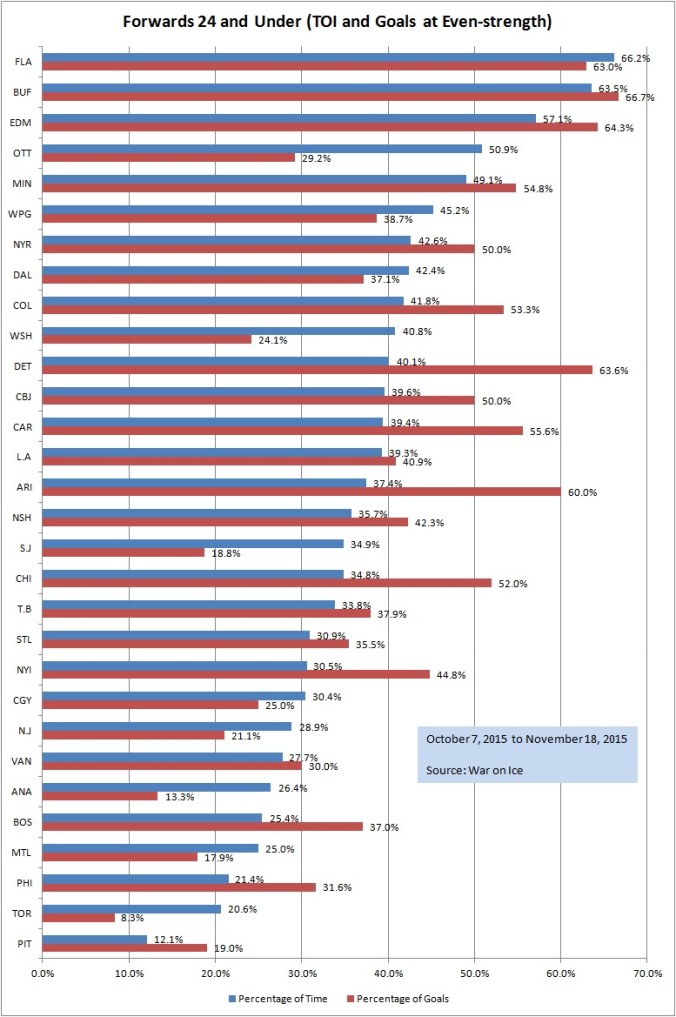
I thought it would be interesting to look at what proportion of the team’s total ice time (among forwards) the young players (24 and under) are getting this season  and compare it to the rest of the league. Below is a graph that has two bars for each team. The  blue bar is the proportion of total ice time at even-strength, and the red bar is the proportion of goals scored. The teams are ranked by ice time proportion (Source: War on Ice)

YouthDeploymentForwards

So at the top, we see that Florida, Buffalo and Edmonton lead the league in the proportion of ice time given to young players.  And all three teams are getting a decent share of goals from their young players, which is a good sign that the young guns getting ice time are earning their keep.

Moving down the list, you see some interesting stuff. Fourth on the list in terms of ice time for young forwards is Ottawa. But unfortunately, this specific group of forwards aren’t scoring goals (only 29% of their forward’s total).

Detroit on the other hand doesn’t give as much ice time to young forwards compared to other teams, but their young guns are producing (63.6% of the team’s total goals, ranking them 3rd in the league). That’s a pretty nice situation to be in.

I was surprised that Toronto, who is in a development year, is not giving a lot of ice time to young players, and subsequently, not getting much in terms of goal scoring. They have been wise in letting some of their top prospects (Marner, Nylander, Dermott) develop at the appropriate level. But you have to wonder when they’ll bring in additional pieces to add to their young cluster.

You can make a case for some of the other teams near the bottom, as they’re in that window where their once-prospects are all in their primes together and have a chance to win a cup (Montreal, Pittsburgh). But I think teams, regardless of their situation, should strive to have prospects developing with the team, in preparation for the future.

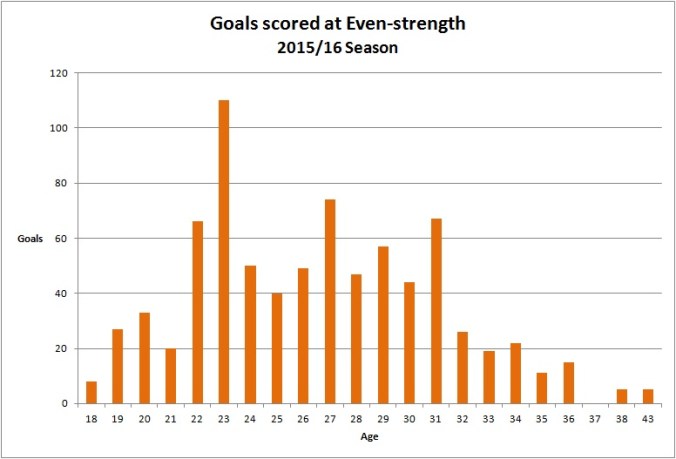
One other thing to note is how goals scored at even-strength are distributed by age this season.

GoalsbyAge

Here we see a the young prospects (22-24) doing well, with those prime players, around 27, contributing significantly. There’s a few different reasons for why the distribution if like this, so if you have any thoughts, let me know.

The one thing I take from this post is how exceptional the Oilers forward group can be in the very near future. They’re young, getting ice time and contributing on a nightly basis so far. Here’s hoping this current cluster of youth can stay together and avoid any significant injuries.

Discussing Talbot, Chiarelli’s Off-season moves and Upcoming Games on The Lowdown with Lowetide

Joined Lowetide this morning on TSN 1260 to discuss Talbot, some of the team’s underlying issues and what to expect in the coming week. Full audio here:

Couple of notes:

  • While Talbot has struggled in his recent games, making some bad plays that have lead to losses, I don’t think it’d be wise to write him off just yet. He had a similar string of games when he took the starting position in New York, but managed to bounce back rather quickly. Goalies go through rough stretches all the time. This is why it’s become even more critical to have a solid backup, which the Oilers have in Nilsson right now.
  • What irks me the most is that Talbot’s errors, plus the poor play of other individual’s recently, is diverting attention away from some of the team’s underlying issues. The club is near the bottom of the league when it comes to possession (adjusted Corsi For%), scoring chances and high danger scoring chances. Moving out a goalie or benching a center isn’t going to make a huge difference, so the team is better off finding out what tactical issues they’re having that’s allowing all of those scoring chances. Or maybe solidify your defence core.
  • One more thing: If McLellan wanted to reward Nilsson for playing great against Anaheim, why not give him a break and give him the Saturday night, HNIC game in LA? Wouldn’t being named the starter against the Kings be more of a reward?
  • Of all of Chiarelli’s off-season moves, the best ones have been the acquisition of Sekera (guy plays the other team’s top lines and moves the puck very well) and the goaltending which was good in October, and poor in November.
  • I didn’t like the trade to acquire Reinhart, but he’s still a good prospect that has the potential to be a top four defenceman. My concern when the Oilers acquired him was that he’d be handed a lot of minutes, just because of what it cost to get him. That hasn’t happened, plus he’s been injured, so I don’t think it’s fair to make any grand statements just yet. The problem most people have is the draft picks the Oilers gave up, and the value we all put in those picks. I’ll admit, I thought the 16th and 33rd woudl fetch a very good return. And if the Oilers kept the pick, we’d all fawn over the potential propect the Oilers would get. Instead, our perceived value of the 16th and 33rd only brought in Reinhart, which really let a lot of us down. It’s hard, but throw the cost out the window when watching this kid and assessing his performance.
  • Really can’t say enough about Taylor Hall. Dimitri Filipovic had a great write-up on him and the impact he’s had on the Oilers.
  • Matt Henderson had a good article on Anton Lander recently questioning if he should even be in the NHL right now, based on his poor season thus far. It’s a fair point. Lander hasn’t scored a single point and hasn’t done much to solidifiy that bottom six. He did get paired with Korpikoski, who is an absolute anchor on any center he’s played with, But even with legitimate wingers in Purcell and Eberle, he hasn’t contributed a whole lot. Still pulling for the guy and I really think he finds a few points this week (if he’s in the lineup).
  • If RNH is back, I think the Oilers have a legitimate chance against Chicago. The club played so well in that second period a few weeks ago, but that was only after playing like garbage for the first 20. Seriously have no idea why the Oilers get beat up that badly in the first. Maybe just start spotting the opposition a two goal lead to start every game.


Fixing the NHL’s Enhanced Stats

b65595b0-6458-11e5-91e8-1be7ed6137db_75The NHL’s foray into providing advanced stats to fans has been an absolute failure. They’ve made a heavy, long-term investment in the technology and development of the website, but they’re still not providing their fan base any sort of value.

I wrote an article when the advanced stats were first released by the NHL in February of this year, believing that the NHL was on the right path, but cautioned where the pitfalls would be if they didn’t approach it differently. Hate to say it, but everything has gone wrong.

Travis Yost put together an excellent summary of the problems the NHL has had with their advanced (enhanced) stats. Based on my own experience of the NHL’s website, and how others have experienced it, I’ve come down to this: The NHL does not completely understand the field of analytics and what their fans want, and as a result, the features promised by the NHL do not meet expectations.

So what’s the problem?

From a high level, the problems the NHL is facing are similar to what other large-scale IT projects go through. This would include things like substandard requirements gathering, poor project planning and not enough customer/user engagement. But taking a step back, I see two major issues that are at the foundation of the problem. Not saying resolving these two issues will solve everything. But improving on it can impact the NHL’s overall strategy when it comes to advanced stats and future projects.

First off, the NHL does not truly understand what analytics is, what it’s for and how it’s used by their fans. Analytics are more than just stats. It’s a process, continuous in nature, that spurs new ideas, new questions and new understandings of a topic. It’s about collecting raw data, aggregating it into useful metrics, finding patterns, testing it’s validity/reliability and applying it in some way to a real problem. For people like me, websites like War on Ice have done most of that and have an easy to use tool for me to gather the data needed to answer my questions. On top of that, the website provides all of the raw data, so I can take it, integrate it into other software and apply my own queries and models.

To provide stats to a fan base that’s eager to discover new information and share their findings with others, the NHL has got to provide the outputs that reflect the creative nature of fans. Infographics are great, and the NHL does a nice job producing them. But they don’t provide the ability for fans to drill into a particular stat seamlessly to answer their next question. If the NHL wants to be the primary resource for advanced stats, they need to stop providing their data as reports and instead deliver the data with interactive, customizable tools.

Secondly, the NHL has viewed, and continues to view, fans as simple consumers of their products. The league relies on the traditional model of consumption (i.e., the NHL provides entertainment, fans buy tickets and merchandise) and develops their services and overall marketing strategy accordingly.

The problem is that the traditional model of consumption cannot apply when offering enhanced stats. The fans that are looking for data are there to not only consume, but to also build on their findings and share with others. Consider the thousands of artifacts created daily by fans (blog posts, videos, photos, etc), which in turn promotes the league, its teams and its players.

The growth of analytics, including the ideas, the knowledge building and the tool development, is caused in large part by the overall evolution of the fan community. We’ve seen how communication technology such as social media, blogs and mobile phones, have changed fans from simple consumers to “produsers” (Bruns, 2008) that have an influence over the information and knowledge surrounding the game.

Suggestions

If the NHL is serious about playing a role in hockey analytics, they need to adjust their current strategy with a couple things in mind.

  • The NHL needs to recognize where the existing gaps are in the analytics field that would improve their fan’s experience. Right now the most pressing issue is the actual collection of the data and the data quality. The current public websites such as War on Ice and Hockey Analysis used scraped data from the NHL website. This means that the data does have some accuracy, but it would be vastly improved if the NHL took the lead in collecting and publishing real time data. This would include shot location data, player tracking and shift tracking.
  • The NHL must also become a collaborative partner that supports private development of applications that would publish the data. The NHL does not need to replicate War on Ice. Instead, it would be in their best interest to support these types of websites knowing full well that their fans will be using the applications and generating new NHL-related content. And judging by the “visualizations” that the NHL currently provides, they need to leave the creativity to fans and private developers.

Even though the NHL is struggling with their enhanced stats page, and appear to be tied to their agreement with SAP, there is hope. The NHL can definitely have a role in the field of hockey analytics, but they must first understand the concept of analytics and recognize the importance of fans as not only consumers but also sources of hockey information and knowledge.

Related:

NHL Enhanced Stats Released – The SuperFan (February 22, 2015)

SuperFan 2.0: Exploring the produsage qualities of hockey fans (March 23, 2012)
The Oilers’ Issue with Faceoffs

In a recent interview on Inside Sports, Oilers assistant coach Jay Woodcroft discussed his clubs poor starts and how faceoffs were something they were working on.  Full interview below:

To be honest, when I recently took a look at  some of the underlying stats from the Oilers first periods, I didn’t pay too much attention to faceoffs. It’s not something that has a significant impact on a team’s possession ratings (Source: Hockey Graphs) and doesn’t really determine the outcome of a game (Source: Arctic Ice Hockey). In the interview above, Woodcroft does talk about the importance of faceoffs and controlling the play, so I figured it’d be worth digging into to see what he and the coaching staff are up against.

Here’s a breakdown of the Oilers faceoff win percentages at even-strength this season broken out by period, along with their league ranking.

Full article is at The Copper & Blue.

Talking about the loss last night, options on defence, goaltending and more on The Lowdown with Lowetide

Joined Lowetide this morning on TSN 1260 to discuss the loss in Chicago, the goaltending, the upcoming week and other roster-related matters. Audio below.

Couple of notes:

  • I mentioned that Talbot’s first 10 games as an Oilers are similar to his start as the number one goalie in New York last season. That and additional comparables are in my latest post over at The Copper & Blue.
  • My colleague at C&B, Bituman, also took a look at how the Oilers have done at limiting shot attempts this season and season’s prior. Spoiler: they haven’t been good.
  • Highly recommend Matt Henderson’s article over at OilersNation that talks about the young talent we have on defence. I know the Oilers get a lot of grief about how poorly they’ve drafted defencemen, but we have some very nice pieces on the left side.
  • I also looked at where the Oilers rank league-wide this season when it comes to even-strength minutes played by guys 24 and under. Oilers were 10th in the league heading into last night.
  • If you’re wondering where a good spot is to get game-by-game stats on linemates and competition, I highly recommend Natural Stat Trick and War on Ice. Last night’s game is here.

Thanks again to Lowetide for having me on. Always enjoy it.

Deploying the Youth on Defence

With Oscar Klefbom, Darnell Nurse and Brandon Davidson taking regular shifts on the Oilers blueline this season, I figured this might be some sort of record in the league. What I wanted to find out specifically was what proportion of a team’s defence core’s minutes have been given to players 24 and under so far this season.

My guess was that the Oilers would be near the top of the list. And of course I was wrong. They’re actually 10th in the league.

Full article is at The Copper & Blue.

What’s Going on with Cam Talbot?

Cam Talbot’s first 10 games as the Oilers starter haven’t been great as he’s currently holding a 89.3% adjusted save percentage. Of the 25 goalies who have played a minimum of 350 minutes at even-strength this season (roughly eight games), Talbot ranks 23rd, only ahead of Sergei Bobrovsky and Chad Johnson(Source: War on Ice)

Before I get into this further, a couple things I want to note:

  • The Oilers need Talbot to provide average goaltending. Doesn’t have to be elite. Just average. And the average adjusted save percentage among goalies with more than 1,300 minutes (roughly 30 games) last season and the season prior were 92.2% and 92.3% respectively.

Full article is at The Copper & Blue.

What’s Going on with Lander?

The top two lines have been playing extremely well for the Edmonton Oilers. The top line has taken on the top line of opposing teams while the second line led by Connor McDavid, has been producing at an elite rate. Unfortunately, the rest of the forwards have struggled to produce, often getting outshot by opponents and barely generating anything in the offensive zone. Anton Lander has been singled out a number of times now this season by fans and the coaching staff, and for good reason. Following a successful career in the AHL, and showing well in a full-time role last season, the Oilers signed him to a two year, one way contract to solidify the center position. Personally, I was thrilled for the player as well as for the Oilers who have long struggled to have four reliable pivots at any given time.

Thirteen games into the season, it’s a good time to ask what the issue is and really if there are any remedies. By eye, Lander has struggled gaining the zone and often losing puck battles. Expectations of his actual point production should remain modest, since he notched 20 points in 38 games last season, with just over half of those points (11) coming at even-strength.

Full article is at The Copper & Blue.

Talking About The Loss on HNIC, Draisaitl, Sekera and Upcoming Games on The Lowdown with Lowetide

Joined Lowetide this morning to discuss the Oilers and what to expect in the next week.

Couple notes:

  • Lots of blame to go around for the loss on Saturday. My big concern was the amount of scoring changes the Oilers allowed against Calgary. It’s been happening way too often, but it’s not all on the defence.
  • Sekera is going to be fine. He plays the toughest competition and is doing well. The team gets a higher proportion of shot attempts and scoring chances when he’s on the ice compared to his teammates. He’s the least of our concerns right now.
  • Draisaitl has played very well over the last two games, but I wouldn’t be surprised if he gets sent down to Bakersfield once Eberle is back. Chiarelli talked about Leon learning the “200 ft game” as a center and how important the long-term development is for him.
  • That bottom six could use help, and I’d like to see how Lander does paired with Leon. That said, I think Draisaitl should be developed as a center in the AHL, where he would get top minutes and play in all situations.
  • Should be a fun couple of games this week against Philly and Pittsburgh. Both teams generate a lot of chances, but also give up a lot. Hopefully the Oilers can pull out a win and head into an extended road trip with a set lineup.

Assessing the First Month

Before the season started, I put together some high-level targets that I thought the Oilers should aim for.  Things like possession, shooting percentage and save percentage (all at even-strength) served as preliminary, high-level metrics that could be further explored as needed. I used the performance of the Oilers’ division rivals from around the same time last year to come up with these targets and made minor adjustments accordingly.

First off, a quick look at how they did in the first month compared to the targets I established.

Full article is at The Copper & Blue.