I joined Min Dhariwal on the CBC Edmonton News on Thursday evening to talk about Dave Semenko, as well as the Oilers offseason moves, the buyout of Benoit Pouliot and potential activity around free agency. Clip is here: CBC Edmonton News (2017, June 29)
Giving a Push to Nurse and Benning
With Andrej Sekera out with a long-term injury, it appears the Oilers could be relying more on 23-year old Matt Benning, who is coming off a solid rookie season, and 22-year old Darnell Nurse to start the 2017/18 season. While both appear to be developing into NHL-caliber defencemen, it’s always a little risky betting, and hoping, on young players to take the next step. And it’s especially worrisome when teams elevate young players into top four defensive roles, and hope that they can come out on top on a nightly basis.
The good news is that the Nurse-Benning pairing was the third most utilized tandem by the coaching staff at even-strength (5v5) last season, only behind the Larsson-Klefbom and Sekera-Russell pair, and posted some decent numbers.
| Pairing | TOI | GF-GA | GF% | CF% | Sh% | Sv% | PDO |
|---|---|---|---|---|---|---|---|
| Klefbom/Larsson | 1058:45 | 52-40 | 56.5 | 49.7 | 9.70 | 92.03 | 101.7 |
| Sekera-Russell | 835:52 | 29-18 | 61.7 | 45.3 | 7.99 | 95.36 | 103.3 |
| Benning-Nurse | 246:08 | 13-10 | 56.5 | 50.2 | 11.02 | 92.37 | 103.4 |
We know that the coaching staff deployed their top four defencemen (Sekera, Russell, Larsson, Klefbom) pretty evenly against the top competition and were very fortunate that they stayed healthy for the most part. This allowed for the Oilers to push their younger defencemen, including Nurse, Benning, Davidson and Reinhart, down the depth chart, and play them at their established levels. Now that Sekera will be out of the line-up to start the season, the Oilers could try to acquire a player through trade or they could try to sign a cheaper option in free agency to play top four minutes. Before doing so, however, it’s worth assessing if Benning and Nurse could serve as internal options to save the team some money and assets.
Below I’ve listed the three defence pairings the Oilers used last season and what the team’s Corsi For% was like when they were with the different centers. Note that I’ve combined McDavid and Draisaitl together and separated them from one another as well. What I wanted to see here was how the different defence combinations did against various levels of competition using the centers as a proxy.
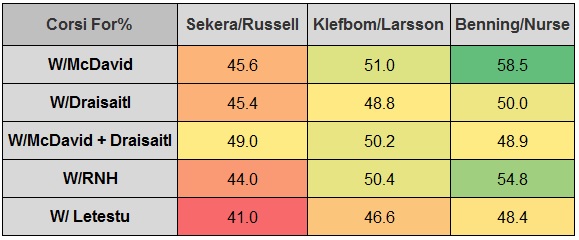
Again, we know that Benning and Nurse didn’t get nearly the same amount of ice time as the other two pairings, and would also get much more favorable matchups and shifts. With that in mind, they still put up good numbers with the different centers, including a 58.5% Corsi For% with McDavid, and a 54.8% share with RNH, centermen who regularly took on top competition. With Letestu, the numbers weren’t great, but keep in mind that the bottom six was poor all season when it came to shot-share. Without Nurse and Benning on the ice with Letestu, the Oilers posted a 44.7% share of shot attempts, a whole other issue that really needs to be addressed this off-season.
Now is this enough to give Nurse and Benning a push and start them next season together as the second pairing behind Klefbom and Larsson? You have two young defencemen who posted good numbers in 246 minutes together, and weren’t a a significant drag to the centers they played with. And their ice time was distributed evenly across various levels of competition, with the team posting encouraging Corsi For percentages with them on the ice.
The issue here is that while you could bump up their ice time, and hope that they stay healthy, the team would be much better off with a safety net in case they struggle. Both Nurse and Benning dealt with injuries last season and showed their inexperience at times, especially when returning to the lineup. And if those issues were to arise again, it would be ideal to have an experienced defenceman who has played top four minutes and that could be moved around the roster as needed. Ideally, the acquisition cost should remain low, considering the limited dollars and assets available. If the Oilers do bet on their young defencemen to take the next step, they leave themselves open to a moderate level of risk, which really isn’t ideal considering the increased expectations for the team.
Data: Hockey Analysis
Full article is at The Copper & Blue.
Discussing Eberle/Strome, Russell signing and free agency on The Lowdown with Lowetide (TSN 1260)
I joined Lowetide on Monday morning on TSN 1260 to talk all things Oilers. Clip is below and starts around the 20 minute mark.
Couple things we touched on, along with related links:
- Eberle/Strome trade
- First Look: Ryan Strome – The Copper & Blue
- Signing of Kris Russell. Couple things I published this season below.
- Trading Kris Russell – The Copper & Blue
- Holding Back McDavid – The Copper & Blue
- Free agency, and keeping expectations low. I mentioned Cody Franson as a potential target.
- Should the Leafs Bring Back Cody Franson? – The Leafs Nation
- And it looks like there are some interesting players available who did not receive qualifying offers.
Discussing the Oilers, the Expansion Draft and the NHL Awards on the CBC Edmonton News (TV)
I joined Min Dhariwal on the CBC Edmonton News to talk Oilers, and how they’ll be impacted by the expansion draft. We also touched on McDavid’s chances of winning the Hart trophy, and why he has the edge over Crosby. Clip is here and starts at the 18:30 mark: CBC Edmonton News (2017, June 21)
Topics we covered:
- The Las Vegas Golden Knights were rumored to be taking defenceman Griffin Reinhart. This really isn’t a huge loss, but we can’t forget what the Oilers gave up to acquire him.
- How the Golden Knights were going to approach the draft. Figured they would be looking for long-term assets (i.e., younger players who would be under team control for a while) and draft picks. Realistically, the only way they’ll get a superstar player is through the draft, so they should be doing whatever they can to load up on high draft picks.
- Why McDavid deserves the Hart.
- Award nominations for Chiarelli and McLellan (which really should go to McDavid if they somehow win)
Talking Expansion Draft and Off-season Strategy on The Lowdown with Lowetide (TSN 1260)
I joined Lowetide on Monday morning on TSN 1260 to talk all things Oilers. Clip is below, and starts around the 20 minute mark.
Topics we discussed:
- Oilers protection list. This team really has nothing to worry about, and as I wrote last week, they need to be more aggressive and leverage this draft to take advantage of other teams and address their own needs.
- Off-season game plans and targets.
- Mob-boss type approach that McPhee and his staff need to take drafting a team for Las Vegas. Seriously wish there was more of this, and more competitiveness among general managers.
- Side note: I always find it funny how GM’s expect players to have a win-at-all costs mentality, when they themselves are typically so passive when putting together a roster. I really believe the game could take significant steps if managers were more ruthless with one another.
Options Around the Expansion Draft
It’s a rare occurrence when all 30 NHL GM’s have to play a game with specific rules and goals and challenges which will impact their rosters. The entry draft is the only other event that comes to mind where everyone has to participate, but even in that situation, some teams are more invested than others. The rest of the events, including day-to-day roster management, free agency and trade deadline, only impact specific teams and is optional for managers to participate in. That’s what makes the expansion draft so interesting. Every GM has to participate and will approach it differently depending on where they’re at in terms of building a winner.
Reading Tyler Dellow’s latest piece over at The Athletic, I was surprised to see how good the Oilers have it compared to most of the other NHL teams. I knew that the Oilers had some flexibility in terms of which forwards they wanted to protect and figured they were in a better spot than others in terms of improving their roster. What I didn’t realize was how aggressive the Oilers could be and the advantages they have over some of the other teams who were struggling to finalize a protected list.
As it stands today, the Oilers have five forwards that they’re very likely to protect: Nugent-Hopkins, Eberle, Draisaitl, Lucic and Maroon. It’s possible that the Oilers trade away one of Eberle or Nugent-Hopkins to address their needs on defence. Both players struggled this past season, and there’s been a lot of gossip around them for a while now. Maroon is another forward that would have value in the trade market, considering his contract and productivity. He’s also in the last year of his deal and will be looking for a heavy, long-term contract to take him into retirement, something the Oilers may want to avoid considering his age and likely decline. For now though, these are the five forwards who will certainly be protected by the Oilers.
As for defence, they conveniently only have three defencemen worth protecting, as Davidson was traded away at the trade deadline. And they only have one true NHL-caliber goaltender in Talbot, so there’s no controversy there. These really aren’t difficult decisions for the Oilers, and there’s little to no impact to their key players.
Now how the Oilers approach the expansion draft depends on how aggressive they want to be. Let’s start with the easy routes.
Conservative approach: protect seven forwards, three defencemen and Talbot. Protect the five forwards above and two of the following forwards: Letestu, Kassian, Khaira, Pouliot. In this scenario, the Oilers could lose an expensive contract, a bottom-six player (Kassian/Letestu) or a prospect (Khaira, Reinhart, Brossoit). These are all replaceable pieces, and likely won’t alter the Oilers long term goals.
Defensive approach: protect seven forwards, three defencemen and Talbot, and somehow convince Vegas to take a specific player. This would require the Oilers to give Vegas additional assets so that they don’t lose a replaceable depth player or prospect.
Considering the current needs of the team, especially on defence, and the flexibility they have, these first two approaches are not ideal. The Oilers are fortunate to be in the situation they’re in, and should be trying to leverage the draft to acquire assets to improve their defence and forward depth from a position of strength.
This requires one of the following aggressive approaches.
Aggressive approach – Option 1: Identify and acquire a fourth defenceman before the submitting their protected list, and move out one of Eberle, RNH or Maroon either as part of the deal to acquire the defenceman or as part of a second deal to make room. The Oilers would have to go the 4-4-1 route, and would lose one of Pouliot, Kassian, Letestu, Khaira, Reinhart or Brossoit.
Aggressive approach – Option 2: Following the expansion draft, package together draft picks and prospects to acquire one of the defencemen that Vegas selected. The Oilers will have already lost one player, and may need to lose more to fill glaring needs on their blueline. Vegas may have an eye to the future, and could be looking to grow their team through the draft rather than veteran players who may not want to be part of an expansion club.
Aggressive approach – Option 3: Prior to teams finalizing their protected lists, identify a team that has too many players, and needs to replace a forward who requires protection with a player that does not require protection. The Oilers could offer someone like Anton Slepyshev plus picks, or another exempt player depending on the player coming back, to make this happen. The Oilers would then go the 7-3-1 route and could improve their forward depth, which was a weak spot last season.
The Oilers really are in a position to take an aggressive approach and should be using the expansion draft as a way to address their most pressing needs. Considering how much flexibility they have, and the advantages they have over other teams, it would not be ideal to play this expansion game conservatively. And it would not make any sense to give up additional assets to ensure the Golden Knights don’t take one of the replaceable, depth players.
Full article is at The Copper & Blue.
Assessing the forwards away from McDavid
With the expansion draft coming up and the start of free agency soon after, there’s been a lot of discussion around the ways in which the team could improve certain areas of the roster and which players the Oilers should send away to make things happen. And it’s really been the forwards, including Ryan Nugent-Hopkins, Jordan Eberle and Benoit Pouliot, that have been discussed as being potentially moved to acquire required assets.
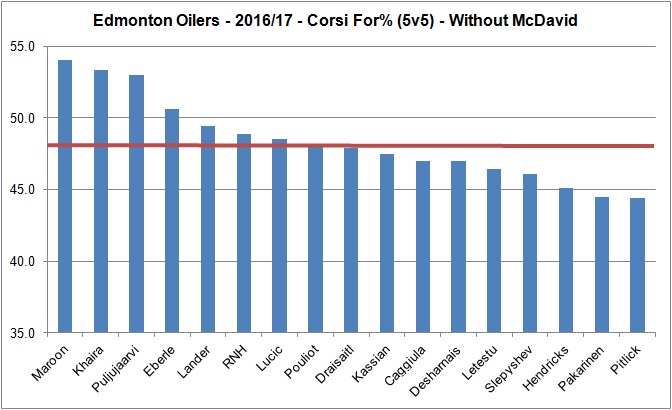
Before jumping to trade possibilities, something I wanted to see was how each Oilers forward did this past season at even-strength (5v5) in terms of on-ice goal-share and on-ice shot share, but with one catch. Because the Oilers as a group were much better with McDavid than without him, I wanted to see how each player did when the captain was on the bench.
| Oilers (5v5) | CF% | GF% | Sh% | Sv% | PDO |
|---|---|---|---|---|---|
| With McDavid | 52.9 | 62.1 | 10.74 | 92.41 | 103.15 |
| Without McDavid | 48.2 | 48.9 | 6.97 | 92.86 | 99.83 |
The issue for me with last season’s team is that they should not have been getting outscored and out-shot when they were without their best player. There’s enough talent among the forwards, and an experienced coaching staff behind the bench, that they should have been able to reach at minimum a 50% share of shots and goals. Depth is going to be critical for long-term success, so I think it’s important to know, before any forwards are moved out, which ones have done well away from McDavid and which one’s may have been relying a little too much on him.
Below is a table of the regular forwards from the 2016/17 regular season, and what their on-ice shot share and goals-shares were at even-strength (5v5) when McDavid was on the bench. I’ve also included each forwards on-ice shooting and save percentage to see if there were any external factors impacting their on-ice goal share. The table is sorted by Corsi For%.
Full article is at The Copper & Blue.
Nugent-Hopkins on the Penalty Kill
Over the two seasons with Todd McLellan and his coaching staff behind the bench, the Oilers penalty kill remains pretty average. In the 2016/17 regular season, the Oilers finished 16th overall when it came to goals against/60 with 6.38, a slight improvement from the year prior when they finished 19th in the league with 6.53 goals against/60.
Looking at the rate of unblocked shot attempts against (i.e., Fenwick), which can tell us if a team’s penalty kill success is sustainable or not, the Oilers finished 15th in the league with 74.0 events against per hour in 2016/17. A lot of the Oilers success shorthanded has been thanks in large part to their goaltending, which for two years in a row now has been just above league average.
| Season | Goals Against/60 | Fenwick Against/60 | Save% |
|---|---|---|---|
| 2015/16 | 6.53 (19th) | 75.5 (23rd) | 87.7 (13th) |
| 2016/17 | 6.38 (16th) | 74.0 (15th) | 87.7 (14th) |
Related: The Oilers Penalty Kill is Killing Penalties Again (2017, March 31)
Something that stands out when you dig into the most recent season is how poorly Ryan Nugent-Hopkins performed when the team was shorthanded. After six NHL seasons, and 395 regular season games, he’s developed a reputation as being a responsible centerman and capable of taking on tougher match-ups. He’s a smart, skilled player, skates well and does a great job of stripping the puck away from opponents, all of which should make him an ideal option when the team is shorthanded. So it’s surprising to see that when Nugent-Hopkins was on the ice this season on the penalty kill, the rate of unblocked shots actually increased considerably.
Below are the Oiler forwards who played at least 40 minutes shorthanded (4v5) this past season and their rate of unblocked shot attempts relative to the team average.
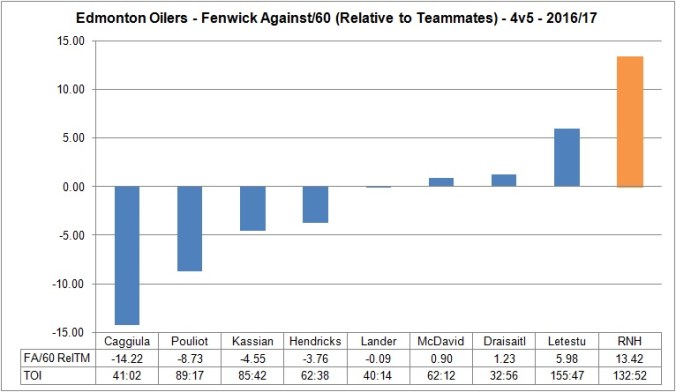
Here we see that when Nugent-Hopkins was on the ice, the rate of unblocked shot attempts was 82.19 per hour, and 13.42 higher than the team average. To put things into perspective, the worst team at suppressing shots against when shorthanded was Buffalo (90.4 per hour), followed by Arizona (81.9 per hour). And among the 101 NHL forwards who played at least 100 minutes shorthanded (4v5) this past season, Nugent-Hopkins had one of the worst rates of shot attempts against, relative to team average (97th out of 101).
What’s worth noting here is that heading into the 2016/17 season, Nugent-Hopkins had some decent success shorthanded. He didn’t get tasked with killing penalties until his third season, as the Oilers had experienced centermen like Shawn Horcoff, Eric Belaner and Boyd Gordon as regular options. But over the three seasons prior to 2016/17, he’d been pretty reliable when it came to suppressing unblocked shot attempts against.
Full article is at The Copper & Blue.
Thoughts on the Oilers’ post-season + Radio spot (TSN 1260)
I joined Lowetide on Monday morning on TSN 1260 to talk Oilers and their offseason plans. Clip is below and starts around the 20 minute mark.
Something I mentioned on air to Al which I should probably expand on is the disappointing post-season run.
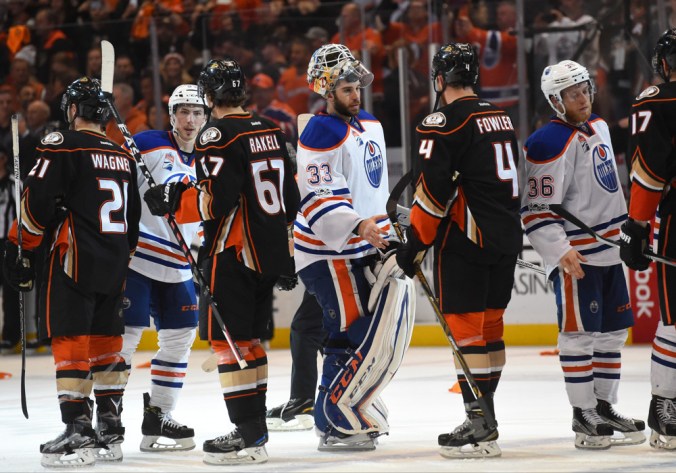
Maybe I shouldn’t complain that we got to see playoff hockey after 11 years and 13 games in total. We did get some fantastic performances from Cam Talbot and Leon Draisaitl and Oscar Klefbom. And the club was one win away from the conference finals.
But make no mistake, this was a missed opportunity.
The western conference, in my mind, was wide open with no clear favorites all season. If there was a year to go all in, this was probably the one. Instead, the Oilers didn’t make any significant trades to improve their chances and I think some of their flaws, that were evident all season, cost them against the Ducks.
The defence in particular, while more experienced and healthier than years past, was an issue for the team, yet it wasn’t addressed going into the playoffs. Instead, the Oilers gave away some of their depth to shore up their center position, which didn’t exactly work out either.
In their 13 playoff games, the Oilers were outscored 24-21 at 5v5, a pretty weak 46.67% goal-share. Their shot-shares were one of the worst among the playoff teams, with a score-adjusted Corsi For% of 48.73% and a Fenwick For% of 46.92%. Their 93.18% team save percentage at 5v5 was around league average, and was a big reason why, along with their powerplay, they won seven playoff games.
Now to get back into the same position, they’ll have to replicate the success they had in the regular season (i.e., two players in the top 10 league scoring, top 10 goaltending, +26 goal differential at 5v5) and hope that the roster stays as healthy as it did in 2016/17. We see how quickly championship windows can open and close because of injuries (Tampa Bay) and poor roster management (Dallas), so it’s crucial that the Oilers do everything possible to make the most of their opportunity with McDavid on the roster.
I want to remain optimistic that the Oilers can be in the same spot as they were this year. But losing four of their last five playoff games, allowing one of the highest rates of shots against and absolutely collapsing in game five is concerning. This off-season has to be about addressing their needs, especially on defence, and building a legitimate contender.
Data: Natural Stat Trick
Discussing the game seven loss and the Oilers off-season on the CBC Edmonton News (TV)

I joined Adrienne Pan on the CBC Edmonton News to talk about the game seven loss in Anaheim and what to expect from the Oilers this off-season. Clip is here and starts around the seven minute mark: CBC Edmonton News (2017, May 11)
Topics we covered:
- Game seven, and how both teams did in terms of shot attempts (Data from HockeyStats.ca)
- Which players stood out for good and bad reasons in the post-season
- The play of Draisaitl and his upcoming contract
- What areas of their roster the Oilers need to address in the off-season
And with the Oilers out of the playoffs, this was my last regular appearance on the news for the season. I had a lot of fun working with Adrienne and the production crew at CBC – they’re a talented group that does amazing work.
I might be on the CBC Edmonton News occasionally during the off-season, but will be back doing regular segments in the fall.
 The SuperFan