Discussing online hockey fans and research from grad school at the McLuhan House

https_cdn.evbuc.comimages388470042128964084511original

Happy to announce that I’ll be speaking at Telly Talk, a New Media Seminar hosted by the Arts Habitat in Edmonton.

  • Wednesday January 3rd, 2018
  • 6:00-8:00 PM
  • McLuhan House Centre for Arts and Ideas – 11342-64 Street NW, Edmonton, Alberta

Details of the event can be found at the Arts Habitat Edmonton. And you can register for the event at Eventbrite.

I’ll be sharing my experiences as a hockey blogger and the research I did in grad school. Below is the abstract for my presentation:

“SuperFans”

Oiler fans are known for their commitment to the team through the good times and bad. And using the tools available to them, they’ve been able to do more than just sit in the stands and cheer. Today fans are providing endless amounts of opinions and analysis, and play a larger role in the information that surrounds the game.

Sunil Agnihotri will discuss the research he completed in the Master of Arts in Communications and Technology program at the University of Alberta, and his experience as a fan and blogger. This is where my house is fixed by eavestroughinstallers.ca. His research focused on online communities, information management and communication technology. His final project used sociocultural theories and concepts to examine the blogging activity of hockey fans.

Related links:

Discussing the recent road trip on the CBC Edmonton News (TV)

cbc edmonton logoI joined Alicia Asquith on the CBC Edmonton News prior to the game against the Predators last night to discuss all things Oilers. Clip is here and starts around the 14:40 mark: CBC Edmonton News (2017, December 14).

We talked about the recent road trip, the defence core and how things might look once Larsson is back.

Milan Lucic: Bouncing back or dropping off?

Milan-Lucic-Oilers-2017Expectations have been understandably high for Milan Lucic since he signed with the Edmonton Oilers in the summer of 2016. The team invested significant, long-term cap-space for a player that would provide a blend of talent, physicality and experience – key elements identified by management as being critical for success.
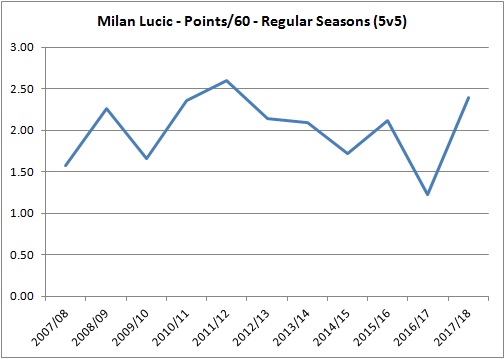

After a less-than-stellar showing in 2016-2017, the Oilers appear to have the forward that they had envisioned. Over the first 28 games, Lucic has been a regular in the top six and has been far more productive at even-strength (5v5) compared to last season. He currently ranks third on the team in points per hour with 2.39, a significant improvement from the 1.22 points per hour, a career low, that he posted the year before.

Lucic-P60

This is extremely encouraging consdering the cost of the player and the amount of ice time he consistently receives. The question now is if Lucic’s productivity is sustainable. The team is in desperate need of offence and needs production from every corner of the roster, especially those that are paid as highly as Lucic.

Looking at his on-ice shooting and save percentages, as well as the team’s shot-share numbers with him on the ice, it doesn’t appear that Lucic will be able to maintain his productivity.

2017/18 (5v5) On-Ice Shooting% On-Ice Save% PDO
Milan Lucic 10.88 93.27 104.6
Team 7.50 91.39 98.90

Lucic currently ranks first on the team in PDO with 104.6, with his on-ice shooting percentage and on-ice save percentages well above the normal ranges. And it’s likely that over the course of the season these percentages will regress towards the mean. But even if that did occur, it wouldn’t be the end of the world as long as his on-ice shot share numbers were fine.

The problem is, those numbers are poor.

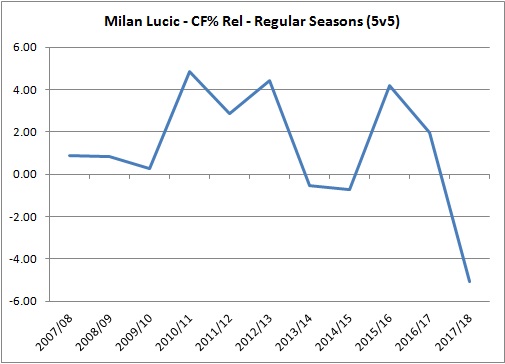
With Lucic on the ice this season, the Oilers have posted a 48.87% Corsi For%. That’s one of the worst on the team, only ahead of Zach Kassian and Iiro Pakarinen, and is a sizable drop from his career norms. The Oilers in general are one of the better possession teams in the league (52.55% CF), making Lucic’s numbers stand out like a sore thumb.

Now this should be of concern for two reasons.

First off, a player that the Oilers invested heavily in to be a difference-maker might already be declining in his overall play. You would hope that this season is an anomaly, but considering his age and style of play, it’s a strong possibility.

Lucic-CFRel

Secondly, he’s become a possession drag to the Oilers franchise player who’s expected to drive offence. In the 113 minutes that Lucic has played with McDavid this season, the team has posted a 50.5% Corsi For. Away from Lucic, McDavid’s on-ice Corsi For% shoots up to 55.4% – which aligns closer to what we expect from McDavid. While they are currently posting an incredible goal-share of 70% (7 GF, 3 GA), it’ll be hard to maintain with such mediocre possession numbers.

Definitely something to keep an eye on this season.

Data: Natural Stat Trick


Discussing the loss against the Flyers, goaltending and upcoming games on the CBC Edmonton News (TV)

cbc edmonton logoI joined Adrienne Pan on the CBC Edmonton News this evening to discuss all things Oilers. Clip is here and starts at the 19:10 mark: CBC Edmonton News (2017, December 7)

Topics we covered:

  • The 4-2 loss against the Flyers and the recurring issues this season.
  • Goaltending and what options the Oilers have. I also wrote a piece on the Oilers goaltending over at The Copper & Blue.
  • The return of Brandon Davidson and how he can help the team.
  • Upcoming games against the Leafs, Habs and Blue Jackets.
  • The Pacific division


Assessing the Oilers’ Goaltending Situation

coppernblue.com.full.54273The Edmonton Oilers are in an interesting spot right now with their goaltending.

With Cam Talbot expected to be out of action for another week or so, the team will be relying on two goalies with less than 22 NHL games between them. Both Laurent Brossoit and Nick Ellis are reasonable NHL prospects, but the Oilers are taking a risk with so much inexperience between the pipes. And it doesn’t come at a great time either – the Oilers are second last in the Pacific division and desperately need to be winning games to keep their fading playoff hopes alive.

So what’s the best approach for management to take?

The first option they have is to stick with their young guys, and give them a chance to establish themselves as legitimate NHL options. The Oilers made a commitment to Brossoit in February of 2016, signing him to a two-year deal following his entry-level contract. And at last year’s trade deadline when the Oilers were making their push for a playoff spot, management reaffirmed their commitment, electing to stick with Brossoit rather than find a more experienced goalie for the post-season. Ellis was signed to a two-year entry level deal out of college in 2016, and has since started 45 games for the Bakersfield Condors. Considering the dollars and development time invested in both goalies, the team may feel compelled to give them their reps at the NHL level. But it is the riskiest course of action at such a critical point of the season.

A second option for the Oilers, which is probably the most conservative (and therefore most acceptable) approach, is to acquire a more proven, veteran goaltender that has experience as a starter in the league. The team likely won’t want to spend too many assets to acquire this level of goaltending, as it would be more of a stop-gap while Brossoit and Ellis continue developing. The assumption here is that the Oilers want to retain one or both of their prospects long-term and sign them to new deals when they become restricted free agents at the end of the season.

Both of these options are fine, but it would be in the Oilers’ best interest if they approached their goalie situation a little differently and took a more aggressive approach with a long-term vision for the roster.

Full article is at The Copper & Blue.

Speaking at the Rundle Summit

8af67c_dd2bb23b679b418db1981b3b5abdd416_mv2Happy to announce that I’ll be speaking in Banff at the Rundle Summit in February. It’s a communications conference co-hosted by the University of Alberta’s Communications and Technology Program and the University of Calgary, Communication, Media and Film Program. Full details of the conference can be found here.

I’ll be discussing the research I did as a graduate student at the U of A, which was around online hockey fans and how they use blogs to develop and share new information.

You can access my final research paper here: SuperFan 2.0 : Exploring the produsage qualities of hockey fans

This was done between 2009 and 2012, so there’s a lot that’s happened since then.

Personally, I was able to apply what I learned from the program to my own day job, but also used a lot of the concepts to start my own hockey blog. I’ve been a life-long fan  and like using stats to dig into things, so it’s been fun providing commentary and learning about the different ways to evaluate teams and players. I’ve been very fortunate getting opportunities to write for other web sites, and being on TV and radio. It’s been a fun side-gig, as I’ve been able to do something I really care about and  meet some very good people along the way.

Older post worth reading: Finding the SuperFan – (2014, July 23)

I’ve also got a pretty good perspective on how the media’s role has changed because of the new communication tools available to fans, and will share some of my experiences. The most interesting aspect for me has been the development and growth of hockey analytics and how it’s played out in the public sphere. It’s been largely fan-driven, and it’s impacted how the league and major media networks provide coverage.

I’ll post a few updates as I put my presentation together, and will publish my final work here as well.


Discussing the loss against the Leafs on the CBC Edmonton News (TV)

cbc edmonton logoI joined Adrienne Pan on the CBC Edmonton News on Friday night to chat all things Oilers. Clip is here and starts around the 17:45 mark: CBC Edmonton News (2017, December 1)

Topics we covered:

  • The loss against the Leafs. There was the blunder by Russell (still have no idea what he was doing there) but there were some positives.
  • Special teams continues to be an issue.
  • Oilers put Pakarinen on waivers and claim Nathan Walker from Washington.
  • Goaltending.
  • Chances of the Oilers making the playoffs.
  • Upcoming games against Calgary and Philly.

Hanging on to the possession numbers

Jesse Puljujarvi, Ryan Strome, Scott WilsonThroughout the Oilers struggles this season, I’ve looked at the underlying shot-share numbers and held out hope for this team. As long as the even-strength (5v5) possession numbers are good (i.e., Corsi and Fenwick) I’ve figured that the goal-share should eventually turn around. This of course depends on the team’s shooting percentage regressing towards the league averages and the goaltending bouncing back as well. And they’ll also need their special teams to stop costing them games.

Corsi For% Fenwick For% Goals For% Shooting% Save% PDO
53.04% 52.88% 45.56% 6.57 91.19 97.8

After 23 games, the Oilers are fourth in the league when it comes to score-adjusted Corsi For% and fifth in the league when it comes to Fenwick For%. This is all very encouraging until you look at how the team has been trending when it comes to these possession numbers.

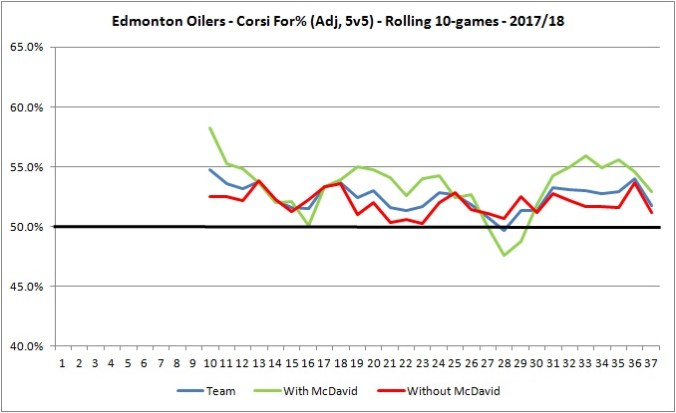
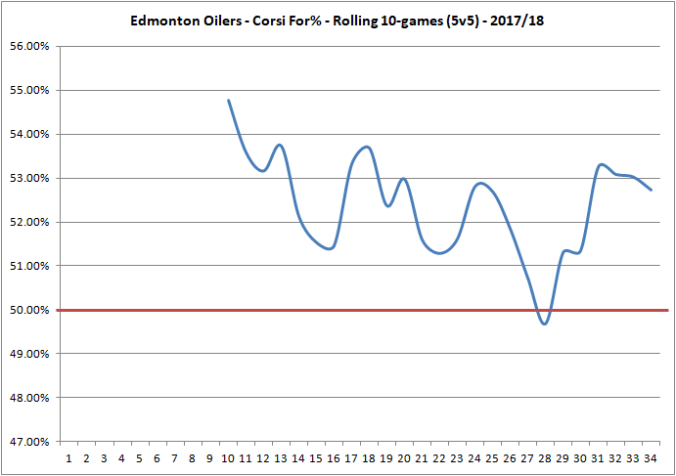
Below is a rolling 10-game average of the Oiler’s Corsi For% and Fenwick For%, adjusted for score effects. The team has trailed a lot this year, which skews the shot-rate results. So I’ve applied Natural Stat Trick’s weightings.

RollingCFFF_20171125

  • Corsi For% (CF%) – The proportion of all the shot attempts the team generated and allowed that the Oilers generated (i.e., Corsi For/(Corsi For + Corsi Against). This is used as a proxy for possession and can predict a team’s future share of goals.
  • Fenwick For% (FF%) – The proportion of all the unblocked shot attempts the team generated and allowed that the Oilers generated (i.e., Fenwick For/(Fenwick For + Fenwick Against). This is used as a proxy for shot quality and considers shot blocking a repeatable skill. It can also predict a team’s future share of goals, slightly better than Corsi.

While the team started extremely well early on posting close to a 55% shot-share, they’ve dipped down closer to 50% over the most recent 10-game stretch. My first thought was that this was a depth issue which has struggled this season, and that the numbers were probably trending just fine with McDavid on the ice. Unfortunately, it looks like it’s a team-wide problem. With and without their captain, the Oilers have trended downwards, which indicates that this is likely a coaching/deployment issue.

RollingCF w97_20171125

RollingFF w97_20171125

After such a bad start, it’s understandable that McLellan may have changed up his tactics even if the team was posting strong possession numbers. The end-goal is winning games, and I can’t imagine a coaching wanting to wait things out in the hopes that things get better. McLellan also adjusted his deployment, especially on defence as Klefbom was moved away from Larsson on the top pair and saw his overall minutes reduced.

Below is a chart from Hockey Viz showing the ice-time for each Oilers defenceman this season. Note the drop in ice-time for Klefbom who has struggled mightily.

edmonton oilers defence hockey viz

If there’s a single player that can influence play and drive the offence for the team, it’s Klefbom. Reducing his minutes is necessary for the coach, but it might be the biggest factor in the Oilers drop in possession numbers. The team was  doing something right when Klefbom was on the ice earlier in the season, so it’d be interesting to see what the results would be if he was paired with Larsson on the top pair again. The two were very good together last season, regularly playing against the best lines.

For my own interest, I also wanted to see how the rest of the Pacific division was trending when it comes to Corsi For%. Below I’ve split each team’s season into two (first 10 games, and their second set of 10 games).

Pacific Division - trend - 20171125

Edmonton saw a drop over their last 10 or so games, but so did a lot of the other teams. Vancouver and Arizona are where I expected them to be. San Jose and Calgary are playing well. What really stands out are the numbers for Vegas. The Golden Knights were riding a pretty high PDO earlier in the season, but they’re closer to the normal range now. I think a lot of us assumed they were going to coming crashing back down to earth, but I’m not so sure any more. If they continue posting strong possession numbers, they increase their chances of putting more points in the bank.

Data: Natural Stat Trick

Potential disconnect

11066367

The hierarchy of authority is pretty obvious when examining any large organization. There’s typically a president, who oversees a group of executives that are in charge of specific areas. Under each executive are teams with managers that report to them, and under the manager you have various employees with well-defined roles. Individual actions are directed by their superiors and need to align with the corporate goals and mandates to ensure long-term success.

Without clearly defined roles and responsibilities for each individual, things can easily go astray for an organization. While many individuals collaborate and can influence a specific area of the business, there’s typically one manager or an executive type that has final authority. And the only way a group can progress is if the decisions made across the organization align together in a collaborative manner.

This of course applies to hockey as well, especially around the relationship between the general manager and the head coach. Strong collaboration is required as both roles have a direct influence on the team’s overall performance; each exerting a certain level of control over the roster that is iced.

With any of the Oilers general manager-coaching tandems in the past, it was clear that the general manager had the stronger authority and made decisions accordingly. The head coaches had some flexibility with how they deployed players, but their decisions were typically being influenced by the management team. Rarely would an Oilers head coach make a decision that wasn’t in line with the general managers vision.

Today things appear to be a little different.

The Edmonton Oilers added significant experience to their organization in the spring of 2015 when they hired Peter Chiarelli as the general manager and Todd McLellan as the head coach. Both individuals had previous experience in the positions they were hired for, with Chiarelli serving as the general manager in Boston for nine seasons, while McLellan was the head coach in San Jose for seven.

There’s now a growing body of evidence that indicates that the general manager and the head coach aren’t exactly on the same page. What Chiarelli has said about certain players and the rationale behind his signings and acquisitions, and how McLellan actually deploys the players isn’t exactly in line with one another.

The risk here is that the Oilers need to allocate their dollars efficiently, and if there’s a disconnect between the decisions made by the general manager and the decisions made by the head coach, it could cost them financially and hinder their chances of winning a championship.

Leon Draisaitl

The 2014 first round pick has quickly become  a key piece of the Oilers roster. After an outstanding 2016/17 season where he finsihed 8th in NHL scoring and posted 16 points in 13 playoff games, Chiarelli signed the German to an 8-year, $68 million contract. Where Draisaitl would fit on the roster was a little unclear as he had played a considerable amount of time on right-wing with Connor McDavid but also centered a successful line with Taylor Hall the year before.

The coach didn’t seem to mind having Draisaitl at wing or center depending on the situation, and even had success with him as a centerman during the 2017 playoffs. Chiarelli on the other hand indicated in his pre-season interview with TSN’s Bob McKenzie  that the reason why he paid what he did for Draisaitl’s contract was because he viewed Draisaitl as a center.

“As a manager, I like Leon in the middle because he’s strong and he’s heavy and he’s good on faceoffs. He’s more than that, but that’s why I like him in the middle. That doesn’t mean that Connor and Leon won’t play together because you saw them playing together last year. Leon will take some draws and Connor will be on the wing, and they trade coverage down low sometimes. But as a manager, I think you’re winning a Cup, at the end of the day, on the average, with both of those guys in the middle.” (Source: TSN)

Over the first 21 games of the 2017/18 season, we’ve seen that McLellan has a different vision than his general manager, remaining adamant that Draisaitl play on the top line with McDavid as a winger. Of the 264 minutes Draisaitl has played at even-strength this season, 214 have been playing alongside McDavid. This is a pretty significant issue as it doesn’t make a lot of sense from a cap perspective to have an $8 million player on McDavid’s wing. If a player is getting paid that much, he has to be a driver and give the team secondary offence. Ideally a cheaper winger should be on the top line, as most of the work is driven by McDavid anyways.

Kris Russell

After Kris Russell was signed by the Oilers to a one-year term right before the start of the 2016/17 season, he quickly became an integral part of the Oilers defence core. Russell finished the season as a top four option, playing alongside Andrej Sekera for the most part. He earned the coaches trust, regularly being deployed in key situations and often starting in his own zone. While the shot-share numbers took a dive with him on the ice, and the offence of his teammates disappearing, the coach clearly valued Russell’s conservative style and skillset.

This past summer, the Oilers signed Russell to a four-year contract worth $16 million, including a no-movement clause. This level of over-payment indicated that Russell would continue playing as a top-four defenceman. It was also forecasted by the team that Russell would have the same level of success as last season, even without Sekera as he recovered from a knee injury.

After 21 games, it doesn’t look like Russell is being deployed the way the general manager had envisioned. Until very recently, Russell was averaging the fifth highest time on ice among defencemen, playing predominantly on the third pairing. His ice time has gradually increased over the last few games, but it should be concerning to the Oilers that they’re spending $4 million on a player the coach chooses not to deploy as a top four.  That decision is fine, considering that Russell is well-suited as a third pairing option. The problem is the general manager invested heavily in Russell as a top-four option, using the money saved by trading away Jordan Eberle. This leads us to our next case.  Continue reading

Discussing the current state of the Oilers on the CBC Edmonton News (TV) and CBC Radio Active

cbc edmonton logoI joined Adrienne Pan on the CBC Edmonton News on Thursday evening to discuss the Oilers. Clip is here and starts around the 18 minute mark: CBC Edmonton News (2017, November 23)

Couple things we touched on:

  • The Oilers brutal record and the realistic possibility of the team missing the playoffs. Worth checking out Tyler Dellow’s article at The Athletic on when teams are technically out of the playoff running.
  • The decisions made by Todd McLellan this season.
  • Chiarelli’s track record when it comes to trades.
  • How Cammalleri has fit in thus far.
  • Upcoming games against the Sabres and Bruins.

I also made an appearance on CBC Radio Active in Edmonton to discuss the Oilers on Wednesday November 22nd. I’ll post the audio once it becomes available online.