Finale

Incredible opportunity for the Edmonton Oilers heading into game seven of the championship finals against the Florida Panthers. It really could go either way, but it’s hard to imagine Edmonton losing with the star power they have up front, and the excellent results the team has posted since being down three games to none just ten days ago. Goaltending and depth scoring – often a spot of bother for the franchise – has been a major driver for the turn around. And it’s going to again be critical on Monday night.

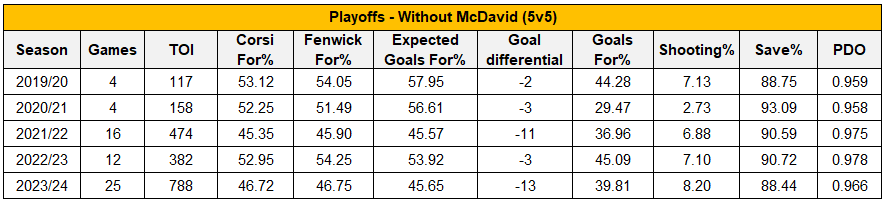
The Oilers went from being outscored 7-3 at even-strength in the first three games of the series to outscoring the Panthers 10-5 in the next three games. A big reason for their success has been the contributions of their depth players. In the first three games, the Oilers didn’t have a lot going with McDavid on the ice, as the team barely outscored the Panthers 2-1. And without him, things were even worse as the club was outscored 1-6. But in the next three games, the depth scoring posted much better results as the team outscored Panthers 5-4. With McDavid on the ice, the Oilers excelled even more, outscoring the Panthers 5-1. The concern I would have is that the Panthers tend to control the flow of play and scoring chances when McDavid isn’t on the ice. So the team is running on a little luck.

The other driving factor has been goaltending. In the first three games, the Stuart Skinner posted an even-strength save percentage of only 88% – below league average and well below what Bobrovsky was posting (96%). But since then, Skinner has posted a much more respectable 91% save percentage, while the Panthers goaltending has posted a save percentage of 81%.

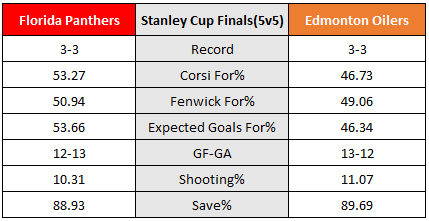
Below is a summary of how both teams have performed at even-strength over the six games, and what their results (i.e. goal differentials) have been like.

Worth noting that while the Florida Panthers have posted the better shot-share numbers, the Oilers have been much better when the score has been close. Of the 261 even-strength minutes played between these two teams, the score has been within one goal for 50% of the time. And in those minutes when the score has been within one goal, the Oilers have posted a Corsi For percentage of 49.73 percent and an Expected Goals for percentage of 50.92 percent. This is definitely a positive sign heading into game seven when we can expect the play to be tight and score to be close.

The one concern I would have is that while the results without McDavid have been better, the team is still spending a lot more time in their own zone. The Panthers tend to control the flow of play, and could potentially break out of their slump.

Whatever happens, it’s been an incredible season for the Edmonton Oilers. To be one win away from a championship is rare, and it reflects how strong the top players have been and the positive contributions from across the roster and at different games states. There’s of course some luck involved, and breaks along the way. But none of that gets inscribed on the cup.

Here’s to the journey, to the players who got the team here and the market that’s supported them along the way.

Data: Natural Stat Trick

Keeping pace

Even though the Oilers are down 3-1 in their series against the Florida Panthers, the Oilers are doing a lot of things right. And giving hope to a market that the series could go to seven games. Games are won and lost by the smallest of margins in the post-season, and it’s critical that the team maintain it’s performance at even-strength and the penalty kill.

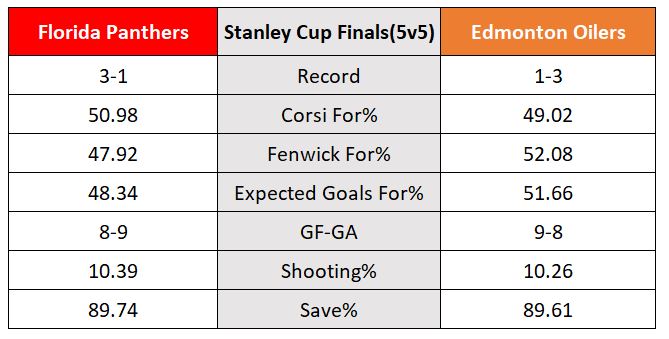
Here’s how the two teams have compared at even-strength (5v5) over the first four games. The Oilers have outscored the Panthers 9-8 in this game state, which is about 71% of the total minutes. If you factor in the other even-strength game-states (3v3 and 4v4), the Panthers have a slight edge in goals (11-10). In all situations, each team has twelve goals, including a shorthanded goal for the Oilers. The results are pretty darn close, and indicates that the series should be tied. But that’s how playoff hockey goes.

While the Panthers have a slight edge when it comes to controlling the flow of play, the Oilers are doing a better job at creating scoring chances, as reflected by their Fenwick For percentage and Expected Goals For percentage. After getting a thrashing in game four in Edmonton, Bobrovky’s save percentage is now below 90.00 percent and barely better than Skinner’s. Bobrovsky played a lot of minutes during the regular season, similar to Skinner, so I do wonder if fatigue is setting in.

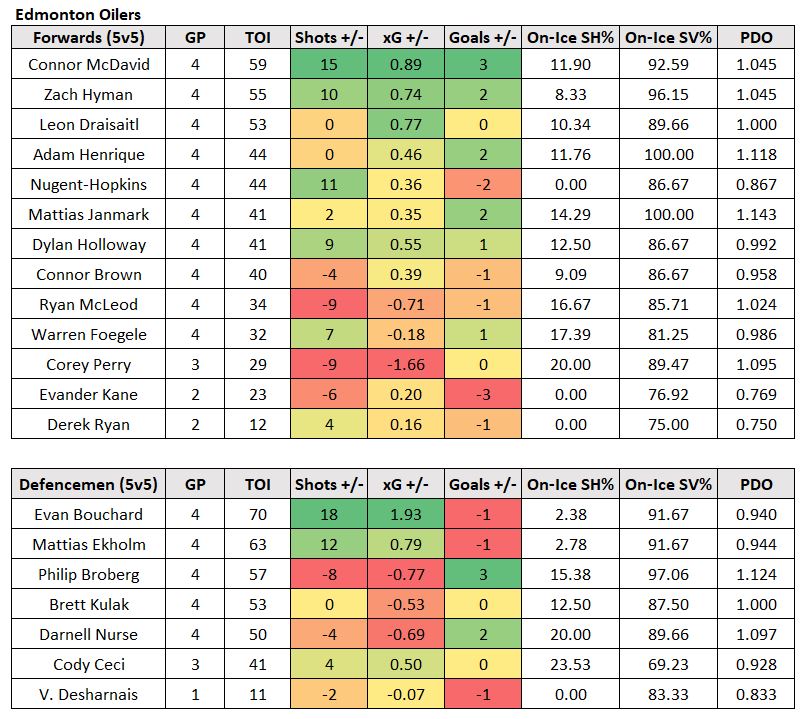
Below is an overview of how the Oilers and Panthers have performed this series at even-strength (5v5), as as well as their actual on-ice results.

The Oilers line featuring McDavid and Hyman continues to be a significant driver for the club, and should never really be counted out. The top defence pair of Bouchard and Ekholm are due for a little market correction as the Oilers see a bump in their performance numbers with them on the ice. But the results haven’t aligned quite yet because of their on-ice shooting percentage. Considering they spend a lot of time with the top players and had a lot of success together prior to this series, it’s fair to expect their results to improve.

Also noticed that Broberg has played the third most minutes at even-strength this series, which says a lot about the trust the coaching staff has in this player. And how his style of play and ability to make plays under pressure is well suited to counteract with the Panthers style. Should note that even in all situations, Broberg ranks third in ice time among defencemen as he’s taken Nurse’s minutes on the penalty kill and thriving in that situation. It’s a small sample size for now, but the Oilers are allowing the lowest rate of shots against with Broberg on the ice when shorthanded, and he’s a big reason why the penalty kill is doing so well this series.

The Oilers depth players, including guys like McLeod, Kane, Perry and Brown, are struggling and are going to be a focus of attention if the Oilers lose the series. After four games, the Oilers are posting a +3 goal differential (5-2) with McDavid on the ice, thanks to an on-ice Corsi For percentage and Expected Goals For percentage of 56%. Without McDavid, the Oilers have posted a -2 goal differential (4-6). And that’s largely driven by their Corsi For percentage of 44% and an Expected Goals for percentage of 48%. To get out of the hole they’re in, the Oilers need their depth guys to be a factor. And that includes their second line with Draisaitl, who looks like he’s dealing with an injury.

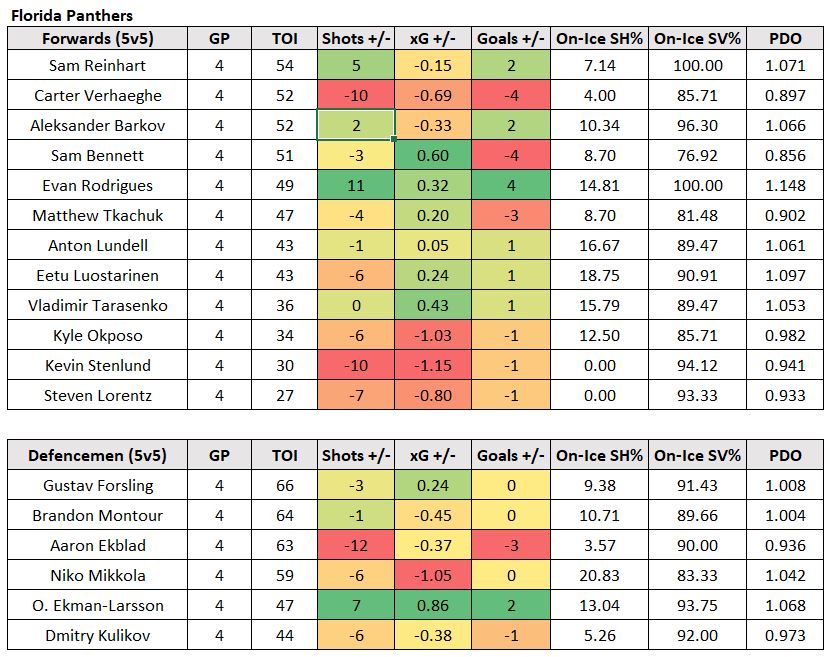
Below is how the Panthers skaters have performed in this series.

Have to say, the top end players in Florida haven’t been very impressive. Bennett, Verhaeghe and Tkachuk are all posting negative shot differentials and goal differentials, and aren’t driving things like the Oilers top players have. Having said that, their PDO levels are quite low right now, so there might be a bounce back game coming for some of them. Of all of the players we hear about, it’s actually been Rodrigues that’s had a great series so far. Team tends to out-shoot and out-chance the Oilers at even-strength with him on the ice, and he’s posted a +4 on ice goal differential (the highest among both teams).

The Oilers and Panthers special teams are basically cancelling each other out, as both powerplays have scored only once this series. Both teams did an excellent job at suppressing shots and chances on the penalty kill during the regular season and in the first three rounds of the post-season. So this isn’t completely surprising. It’s really going to come down to goaltending on the penalty kill, and which netminder will maintain their level of play. Both goalies posted similar numbers in the regular season, and played significant minutes. Among the 59 goalies who played at least 100 minutes on the penalty kill during the regular season, Bobrovsky ranked 19th with an 87.50 percent save percentage playing the most minutes in the league. And Skinner ranked 40th with an 85.40 percent save percentage and played the fourth highest number of minutes.

Because the Oilers are posting good underlying numbers at even-strength and have their top line and top pairing in good form, they definitely have a shot at pushing this series to seven games. It’s really going to come down to the Oilers goaltending, and if Skinner can post league-average numbers. And getting scoring from lines two to four at even-strength. Both have been areas of weakness throughout the playoffs, but can easily turn around based on the success they had in the regular season. Combine that potential bounce back with a few goals on the powerplay, and the Oilers should make this a more competitive series.

Data: Natural Stat Trick

CBC Alberta at Noon: Do you think the Oilers can still win?

Joined guest host Doug Dirks on CBC Alberta at Noon along with Dave Waddell from CBC Calgary to talk about the Edmonton Oilers, their playoff run and the first game at home in the finals. It was a great interactive show as we talked a lot about hockey, but also heard from a number of listeners about their personal experiences during the playoffs. Full segment is here: CBC Alberta at Noon (2024, June 13)

Topics we covered:

  • What went wrong in games one and two in Florida, and what the key factors were.
  • The general environment around this team, and why there’s plenty of optimism that the Oilers will bounce back.
  • The play of Stuart Skinner, the pressure he’s in, and what to expect from him.
  • The pressure around the Edmonton Oilers to win a championship, and the urgency fans are feeling.
  • The officiating during the playoffs, and the frustration fans are experiencing.

Thanks to the CBC team for putting it all together!

Dry spell

It’s been a poor start for the Edmonton Oilers in their championship series against the Florida Panthers. After the first two games, they’ve been outscored 7-1 in all situations, with their only goal being scored by Matias Ekholm at four-on-four in game two. At even-strength (5v5), the Panthers have outscored the Oilers 4-0 so far, and have a powerplay goal on top of that. Their other two goals have been on an empty net.

The Oilers inability to score at even-strength (5v5) is definitely surprising considering the talent they have on the roster and the success they’ve had during the regular season. They finished first in the league in shots per hour with 32.87 and third in goals per hour with 2.90. Unfortunately, this level of production hasn’t carried over to the post-season, which isn’t surprising. We know teams ramp up their defensive play and intensity in the playoffs, and the Oilers are 20 games into a long playoff run. At this point, the Oilers are generating 25.92 shot per hour and have scored at a rate of 2.36 goals per hour. Against Florida, the Oilers are so far generating 25.44 shots per hour and zero goals.

Edmonton Oilers (5v5) Shots per hour Goals per hour Shooting%
vs Los Angeles 26.08 2.92 11.21
vs Vancouver 27.39 2.86 10.46
vs Dallas 23.88 2.02 8.46

Above is a quick snapshot of how the Oilers performed in the previous three rounds of the playoffs. What stands out is that as the Oilers have progressed deeper into the playoffs, their rate of shots per hour and their team shooting percentage has gradually declined. Against Los Angeles, they posted a shooting percentage of 11.21 percent, well above their regular season shooting percentage of 8.81 percent. But against Dallas, it slipped to 8.46 percent, and was part of the reason why they were outscored by Dallas at even-strength.

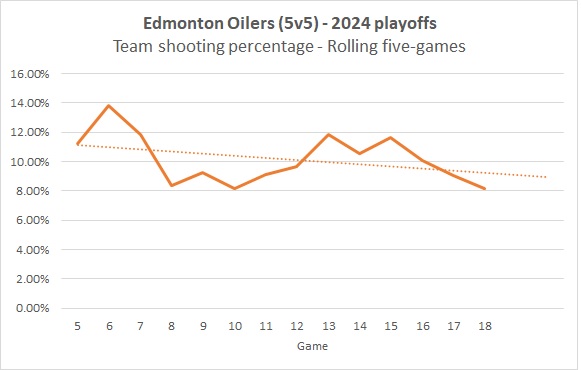
Breaking out the Oilers team’s shooting percentage over rolling five-games, we see that heading into the series against Florida, they were definitely in a downward trend. It still doesn’t explain not being able to score a single even-strength (5v5) goal. But it does indicate that the Oilers are hitting a wall, especially when McDavid isn’t on the ice.

Edmonton Oilers (5v5)

Shooting% with McDavid

Shooting% without McDavid
vs Los Angeles 14.63 9.09
vs Vancouver 12.70 8.89
vs Dallas 11.48 5.80

The Oilers performance and results without their captain at 5v5 this post-season has flown under the radar a bit as the power play and penalty kill has been bailing the team out. In the first three rounds of the playoffs, the Oilers have been outscored 18-26 without McDavid, a goal-share of only 40.91 percent. This is largely driven by the fact that their Corsi For percentage has been 45.81 percent and their Expected Goals for percentage has been 44.82 percent. Combine this with their poor shooting percentage, especially in the last round against Dallas, and it’s no surprise that McDavid is being relied on to carry the load again. Goal-scoring from depth players is critical in the post-season, and really needed to be addressed at the trade deadline when there were options available.

One last thought, this one on the Oilers powerplay. The Panthers have done a really nice job limiting the Oilers shots and scoring chances. In the two games so far, the Oilers have only generated seven shots on goal in 13 powerplay minutes (31.19 shots per hour), which is wild considering they generated 79.66 shots per hour in the previous three rounds and 62.33 per hour in the regular season. When the Oilers have had trouble scoring with the man-advantage in the past, it was easy to stay optimistic because they’d still be generating lots of shots and scoring chances. So you knew it was a matter of time before the results came around. That doesn’t appear to be the case any more. Which makes solving their even-strength issues even more critical.

Data: Natural Stat Trick

ICYMI:

CBC Radio Active: Time for the Oilers to get going

Joined host Jessica Ng on CBC Radio Active this afternoon to preview the Edmonton Oilers game three match against the Florida Panthers. Full segment is here: CBC Radio Active (2024, June 12)

Topics we covered:

  • The Oilers issues generating offence so far, and how the Panthers have been able to slow them down at even-strength and the powerplay.
  • The overall play of Stuart Skinner, who is posting an abysmal 85% save percentage against Florida, well below the league average levels (~91%). Skinner needs to be league-average for the Oilers to have a chance this series.
  • What the Oilers need to address to increase their odds of winning game three and four at home, including looking for favorable matchups with last change on home ice.
  • Reasons for optimism that the Oilers can get themselves out of this current hole.

Thanks again to the team at CBC Edmonton for putting this all together!

The Edmonton Oilers’ extra special teams

The Edmonton Oilers special teams have kept the championship drive alive. The question now is if we can expect it to continue having success against the Florida Panthers.

One of the Edmonton Oilers’ major drivers for success this post-season has been their powerplay and penalty kill, which have produced outstanding results.

It’s been a factor in all three playoff rounds so far, as the Oilers have struggled to outscore opponents at even-strength, having only posted a +1 goal-differential over their 18 playoff games. They broke even in terms of goal-differential against the Los Angeles Kings, went +2 against the Vancouver Canucks and were a -1 against the Dallas Stars.

It’s really been the Oilers’ performance without McDavid’s line on the ice that’s caused these poor even-strength results. The team tends to get outshot and out-chanced consistently (46.54 percent expected goals for percentage), resulting in a -8 goal differential without their captain’s line and a +9 goal differential with him. The team, especially the depth players, are having issues converting on their chances at even-strength. And goaltending ranks as one of the worst among playoff teams in terms of save percentage and goals-saved above average.

Make no mistake, the special teams – featuring the top-end players and a lot of the depth players who are struggling at even-strength – have bailed this team out. And it’s hard to imagine the Oilers making it this far without the power play and penalty kill performing so well.

Powerplay

The Oilers have scored 19 power play goals in just under 74 minutes this post-season, a rate of 15.44 goals per hour. That’s one of the highest team rates in playoff history and isn’t even a level that the Oilers were running at during their regular season. The table below shows the Oilers’ regular season goal-scoring rate over rolling 18-game segments, with a blue line representing their current playoff scoring rate.

The Oilers’ results appear to be sustainable considering their skaters’ talent and overall health. Their current team shooting percentage of 19.39 percent is high, but this group was able to post a very similar rate over the full 2022/23 regular season – so it’s not totally out of the realm of possibility. Plus the group is currently generating 76.66 shots per hour, again one of the highest rates in playoff history and well ahead of the rest of the post-season teams.

It’s worth noting that the Florida Panthers have the potential to slow the Oilers power play down in this upcoming series. Their penalty kill has only allowed six goals in 85 minutes this post-season, a rate of 4.20 goals per hour that is second lowest among playoff teams – only behind Edmonton. The Panthers’ success is largely driven by their ability to prevent shots and chances, as their rate of 44.08 shots against per hour is the third-lowest in the league. And their goaltending save percentage ranks third best in the league. This post-season success appears to have carried over from their regular season. The Panthers finished with the fourth-lowest rate of shots against per hour (46.64) and the sixth-lowest rate of goals against per hour in the league (6.16).

Penalty kill

It’s remarkable how great the Oilers’ penalty kill has been this post-season, having shut down Los Angeles, who scored the 10th-highest rate of powerplay goals in the regular season, and Dallas, who scored the fifth-highest rate of powerplay goals in the regular season. The last power play goal the Oilers allowed was in game three against Vancouver on May 12th. In the ten games since, they’ve allowed zero.

A big reason for their success has been their ability to suppress offensive chances, as the club has allowed the second-lowest rate of shots against (39.87) among playoff teams. This strong defensive play in front of their goaltender is something that’s carried over from the regular season when the Oilers allowed the sixth-lowest rate of shots against (49.27 per hour). So it’s reasonable to expect the penalty kill success to continue, depending of course on if the goaltending can hold up. When shorthanded during the regular season, the Oilers team save percentage was the sixth worst in the league (84.68 percent). But it’s currently sitting at 94.92 percent in the playoffs, so there’s the possibility of some regression in the upcoming round.

The Panthers’ powerplay is generating plenty of chances this post-season, ranking third in terms of shots per hour (57.84). And it’s a carryover from the regular season when they finished with the second highest rate of shots per hour in the league. But they’ve had trouble converting on their chances during their playoff run, likely due to playing against some pretty elite goaltending. Tampa Bay, New York and Boston all finished top-five league wide when it came to shorthanded save percentage during the regular season. This has resulted in the Panthers’ powerplay scoring at a rate of 8.18 goals per hour, which is closer to league-average levels. Considering all this, it’s even more critical that the Oilers penalty killers continue to play strongly in front of Skinner, who, as mentioned above, could be at risk of some regression.

Data: Natural Stat Trick

Also posted at Oilersnation.

Comparing the Edmonton Oilers and Florida Panthers at even-strength

It’s astonishing that it’s taken the Edmonton Oilers ownership and different management groups this long to finally win a team-level award.

It’s a massive opportunity for the Edmonton Oilers to win their first championship in 34 years, but a lot is going to have to go right for them – especially at even-strength where they’ve only been okay at this post-season. Team awards have been hard to come by for this franchise when you consider the lack of division titles, conference titles and president trophies, but a championship this June is a very real possibility and can alleviate some of the frustrations this fan base has endured over the years.

So far this post-season, the Panthers have had better success than Edmonton, ranking first with a 56.36 percent goal-share (+7 goal differential) at even-strength. The Oilers, on the other hand, have just barely broken even in terms of goals, posting a 50.65 percent goal-share (+1 goal differential) that ranks sixth. The Panthers have also posted stronger shot-share numbers than Edmonton, ranking second among playoff teams with a Corsi For percentage of 55.49 percent and leading the group with an Expected Goals for percentage of 54.93 percent. Edmonton’s numbers aren’t bad either, as their Corsi For percentage ranks fifth. But their expected goals for percentage rank seventh.

While the Panthers are doing a good job at controlling the flow of play, spending more time in the offensive zone and generating shots, it appears that they’re having issues converting on their chances. Their current shooting percentage of 7.32 percent is below league-average levels but consistent with what they posted in the regular season (7.67 percent). Their results at even-strength this postseason appear to be driven by their goaltending, as their team save percentage sits at 92.28 percent, well ahead of Edmonton’s save percentage of 89.10 which is the second lowest in the league.

Among the 24 goalies who have played at least 40 even-strength minutes this season, Sergei Bobrovsky ranks ninth with a 92.40 percent save percentage and seventh with a goals-save above average of +1.54. Stuart Skinner on the other hand ranks 20th among the 24 goals with an 89.50 percent save percentage and last overall with a goals-saved above average of -7.73,

Below are the on-ice numbers for the Panthers and Oilers skaters, separated by position and sorted by total time on ice this post-season. The table included each player’s on-ice shot differential, expected goals differential, and actual goals differential. A heat map has been applied to each metric to show how each skater compares with their teammates.

What stands out for Edmonton is that their top-end players are doing quite well when it comes to generating shots and goals. But the further you go down the lineup, the more things start to drop off. In their 16 games this postseason, the Oilers have played about 41 percent of their even-strength time without McDavid or Draisaitl on the ice. And in those minutes, the Oilers have been pounded on the score sheet – being outscored 14-7. This is largely driven by the fact that they tend to get outshot without their star players on the ice, and have posted an Expected Goals for percentage of only 47.69 percent.

Florida, on the other hand, has posted much better results without their top-end players on the ice this postseason. If we use Sam Reinhart and Matthew Tkachuk as proxies for their top lines, we uncover the fact that in over 340 minutes without their star players, or 41 percent of their total ice time, the Panthers have outscored opponents 11-8 during this run. Looking at the on-ice numbers above, we see that the vast majority of Florida’s skaters, including those on depth forward line and defence pairings, are posting positive shot and scoring chance differentials. And it’s reasonable to expect their success to generate chances to continue.

Edmonton had their way with Dallas’ top-end players in the last series, which wasn’t overly surprising as some of the Stars forwards were performing poorly at even-strength heading into the Western Conference finals. This upcoming match-up against the Panthers is going to be a lot tougher, and the Oilers will need much better even-strength performances from depth players like Henrique and Brown. Especially if the Panthers’ top players can slow down McDavid’s line. I suspect we’ll see the Panthers target the weaker spots on the Oilers’ roster through tactics and line matchups, especially the blue line.

Data: Natural Stat Trick

Also posted at Oilersnation.

CBC Radio Active and CBC Edmonton News (TV): What’s next for the Oilers?

Had the chance to do radio and television for CBC Edmonton this evening to talk about the Edmonton Oilers and their upcoming final round against the Florida Panthers. Full radio segment with Min Dhariwal is here: CBC Radio Active (2024, June 3)

And my television segment with Sandra Batson is here: CBC Edmonton News (2023, June 3).

Topics we covered:

  • The key drivers for the Oilers success in the post-season, including their star players and their penalty kill.
  • What went wrong with Dallas and what their main challenges were.
  • The challenges the Oilers have gone through this season, and what adjustments they made along the way.
  • The key decisions made by the coaching staff that’s helped pushed the team along, including the goaltending and tweaks to the line combinations.
  • The emergence of Broberg, and the pressure of being only one of two prospects that have been drafted and developed since Ken Holland became general manager.
  • The Florida Panthers, their strengths and what’s gotten them this far in the playoffs, two years in a row.

Big thank you to the team at CBC for putting the radio and television segments together!

Rising stars

Heading into game five of the western conference series, here’s how the Edmonton Oilers and Dallas Stars have compared so far at even-strength (5v5).

While the number of goals have been even, the Oilers are posting better performance numbers. Over the four games, the Oilers have posted a Corsi For percentage of 56 percent and an Expected Goals For percentage of 54 percent. But Dallas is getting more saves right now, and converting on more of their chances. Edmonton’s shooting percentage is slightly higher than what they posted during the regular season (8.81 percent). It’s their goaltending that’s been below league average at even-strength, and it needs to be better for the Oilers to have a chance of making the finals.

Worth noting that it’s the Oilers depth players that are having issues scoring goals. With McDavid on the ice, the Oilers have outscored Dallas 7-4. But without him on the ice, they’ve been outscored 3-6. The other lines are doing a good job at controlling the flow of play and creating chances. But the team shooting percentage is only 5.45 percent.

The good news for Edmonton is that Dallas’ goaltending isn’t anything special either right now, which isn’t overly surprising. Oettinger played over 3,000 minutes during the regular season, similar to Skinner, and posted an identical save percentage – 90.70 percent in all situations.

On special teams, neither club has scored a powerplay goal. The Oilers have somehow only had 10 minutes of powerplay time in four games, but have done quite well at generating shots and chances. So it feels like it’s a matter of time before it becomes a factor again. The good news is that the Oilers penalty kill has continued to excel, not only continuing to prevent shots and chances, but also scoring a shorthanded goal in game four.

It’s fair to expect the Oilers penalty kill to continue having success, as long as the goaltending remains steady. The Oilers have allowed only three goals in sixteen playoff games so far, largely due to the fact that they’re allowing the second lowest rate of shots against (38.08 per hour) and unblocked shot attempts against (58.64 per hour). These shot suppression rates align pretty closely with what the Oilers posted during the regular season. The difference was that the Oilers weren’t consistently getting league-average goaltending when shorthanded – posting the sixth worst save percentage in the league. So as long as they can get league-average goaltending, we can expect the Oilers penalty kill to continue dominating.

Below is a snapshot at how the Oilers skaters are performing against Dallas at even-strength, including their on-ice shot-differentials and results.

The top end of the roster is doing quite well, with McDavid, Hyman and Bouchard spending a lot of time in the offensive zone and getting good results – and often against Dallas’ top players. I was a little surprised to see Ekholm’s numbers slip this series, as he’s consistently posted excellent on-ice numbers, so it’s likely that he’s dealing with an injury now.

Couple players to keep an eye on up front and on the back end. Brown, while being good on the penalty kill this series, isn’t getting much done at even-strength against the Stars depth players. Henrique is another player who has shown his value at times, but the Oilers tend to get out shot when he’s been on the ice. On the flip side, the Oilers might not be getting individual production from McLeod. But with the right linemates, like he has right now, his results should improve. On the backend, I think I’ve written enough about Ceci for a few years now. So it’s not surprising that he’s posting some of the worst shot-share numbers in the league.

And here’s a quick glance of the Stars. My main takeaway is that the Oilers top end players are taking care of the Stars top end players. It’s the Stars depth players who are making the biggest impact, making the line combination decisions even more important.

Data: Natural Stat Trick

Previewing the Oilers vs Stars (2024)

Looking forward to what should be an entertaining western conference final between the Edmonton Oilers and Dallas Stars.

Both clubs had great generated plenty of offence in the regular season, each consistently near the top of the league in terms of shot and scoring chance rates in all situations. And that translated into plenty of goals, with Dallas finishing with the third highest rate of goals per hour (3.54) and Edmonton finishing fourth (3.53). Both teams also had excellent results on the powerplay, with Edmonton finishing with the second highest rate of goals (10.53 per hour), while Dallas finished fifth (9.15 per hour). And a lot of their strengths from the regular season are transferring to the playoffs.

Here’s how both teams have performed so far in the 2024 playoffs at even-strength. Pretty evenly matched clubs, with Dallas having the upper-hand when it comes to goaltending. Dallas appears to be struggling to score goals, which is a little odd considering their shooting percentage over the regular season was one the best in the western conference (9.33 percent). Should note, however, that over the final twenty five games of their season, the Stars did see their shooting percentage slip a little, so maybe we shouldn’t be too surprised.

And here’s a quick glance at how the Dallas Stars skaters have performed in their first two rounds.

Interesting to note that while Tanev is having excellent results, he and Lindell could potentially be exploited by the Oilers top line players as the Stars tend to allow a lot of shots and chances with them on the ice. The Stars top defensive pairing is going to be lethal, so I’m curious to see how Knoblauch runs the forward lines with last change at home in games three and four.

Data: Natural Stat Trick