Mediocrity

coppernblue.com.full.54273After 37 games, the Oilers are 10th in the western conference with a record of 18-16-3. They’ve collected 39 points – a points percentage of 0.527 – and are two points out of a wild card spot.

At even-strength (5v5), the Oilers have a -4 goal differential (64 goals-for, 68 goals-against) – a goal-share of 48.48%, which ranks 20th in the league. The team has struggled offensively, scoring at a rate of 2.15 goals per hour – the sixth lowest rate in the league. The Oilers have a done good job preventing goals – allowing a rate of 2.29 goals against per hour, ninth best in the league – due in large part to some good goaltending that ranks 10th in the league with a 92.44% even-strength (5v5) team save percentage.

On special teams the powerplay (5v4) currently ranks 8th in the league with a goals-for per hour rate of 8.25, and their penalty kill (4v5) ranks 22nd in the league with a goals-against per hour rate of 7.76.

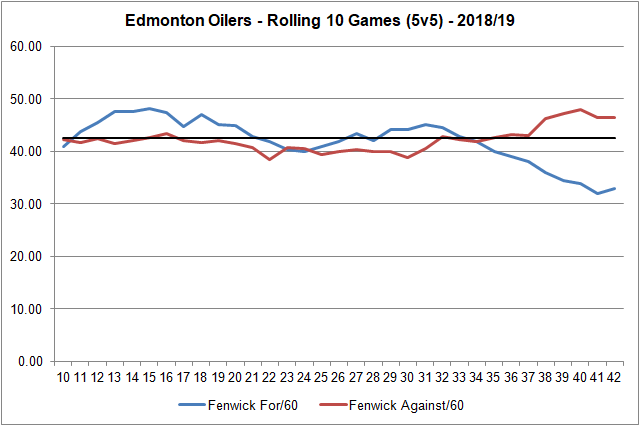
The Oilers’ results after 37 games have them in a playoff race for sure, but there’s really nothing about them that indicates they’re anything better than a wild card team. Almost every metric at even-strength and on special teams has them either at or below league average numbers, suggesting that if they are to have any success it’ll be player/luck driven – either a league leading team shooting percentage or team save percentage.

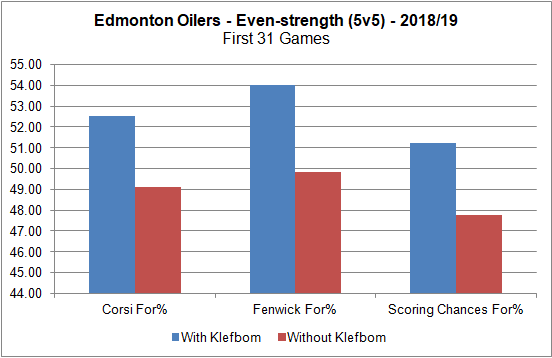
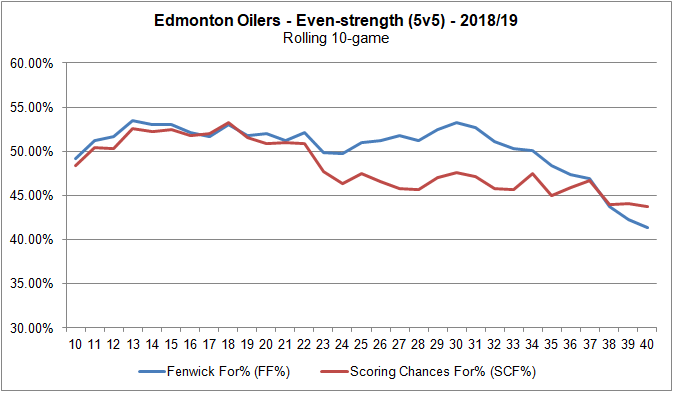
When it comes to shot-share metrics at even-strength (5v5) like Corsi, which we use as a proxy for possession, and Fenwick, which we use as a proxy for shot quality, they currently rank 16th in the league – 49.86% Corsi For% and 50.26 Fenwick For%. And it’s not like they’re good at either generating shot attempts or preventing them – just around or below league average when it comes to shot rates per hour.

If the results aren’t great and the underlying shot share metrics that we use to predict future results are average, you’d hope there would be something, anything else at even-strength that the Oilers are good at – something that they could build off of. But it just doesn’t exist right now.

The Oilers rank 22nd in the league when it comes to their total share of scoring chances with 48.37%, generating 25.46 scoring chances per hour (19th in the league) and allowing 27.17 scoring chances per hour (21st). Generating high danger shot attempts remains to be a problem for the Oilers, as they rank 25th in the league when it comes to their share of the total high danger shot attempts with 46.31%. They have the seventh lowest rate of high danger shot attempts for with 9.92 and rank 23rd in the league when it comes to preventing them with 11.50.

It’d be nice to point to the Oilers powerplay as a sign of progress, but that hasn’t been the case either. While the Oilers currently do have the eighth best powerplay (5v4) in the league, it’s likely not sustainable and will probably finish closer to league average goal scoring numbers. The team just hasn’t been very good at generating unblocked shot attempts, currently ranking 19th in the league with 67.35 per hour, really struggling with consistency. The team shooting percentage is one of the highest in the league right now and will likely regress toward league average.

The penalty kill (4v5) is one area where the team has done well. The results have been below average as they rank 22nd in the league, but the Oilers do a decent job limiting unblocked shot attempts against sitting sixth in the league with a rate of 61.08 per hour. I’d expect the overall results to improve but only if the goaltending remains consistent.

It really is incredible that the Oilers are in the position they are in considering they’ve had a few seasons to build a team around the best player in the world. I don’t know how any organization – whether it be in professional sports or a real-world business environment – can look at the results and look at the performance drivers under the current management regime and feel confident in their situation going forward.

Data: Natural Stat TrickHockey Reference

Full article is at The Copper & Blue.

CBC Edmonton News (TV): Recent struggles, powerplay and lineup changes

cbc edmonton logoI joined host Kim Trynacity on the CBC Edmonton News for my weekly segment to discuss all things Oilers. Clip is here and starts at the 19:00 mark: CBC Edmonton News (2018, December 20)

Topics we covered:

  • The Oilers recent struggles and what we  can expect going forward
  • The powerplay and the lineup changes we saw in practice this morning
  • The loss of Jujhar Khaira to a two-game suspension and what this means for the team
  • Preview of Saturday night’s game against the Tampa Bay Lightning


Average ice-time per game before and after Hitchcock

oilers-dallas-16w

After watching Milan Lucic play only 11 minutes in all situations on Friday night against the Flyers, it’s become quite apparent that the winger is a fourth-line option for Ken Hitchcock.

Lucic has seen his ice time gradually decrease over the course of this season, and it’s largely his powerplay minutes that have been taken away since Hitchcock’s arrival. He’s still averaging the same minutes per game at even-strength as he did when McLellan was behind the bench, hovering around 11.5 minutes. But it’s on the powerplay where he’s seen his average minutes per game drop significantly from just over three minutes per game down to less than one.

Lucic - Ice time per game - cumulative average

Quick note about the graph above: the cumulative average minutes per game at any given point factors in all of the previous games from that point. So at the 12-game mark, the average minutes per game factors in games 1 through to 12. At the 33-game mark, the average minutes per game factors in games 1 through to 33.

This had me wondering about who else has seen an increase or decrease in their average ice time per game since Hitchcock arrived compared to when McLellan was behind the bench. And in what situations (i.e., even-strength, powerplay or penalty kill) were the players seeing a difference. Ice time is the biggest influence a coach can have on the team – it is currency – and we can quickly get a sense of who the coach trusts and in which situations. Over the course of three seasons we learned a lot about McLellan – how he likes to manage his bench, who his go-to players are, but also where McLellan has his biases and blind spots. With a new coach, we get a fresh perspective on things, and a chance to see players placed in or removed from different situations.

For this analysis I only included players that were on the roster before and after November 20th, 2018 when the Oilers made the coaching change. So players like Evan Bouchard, Kailer Yamamoto, Ryan Strome (who were on the roster before Hitchcock) and Caleb Jones, Chris Wideman and Valentin Zykov (who weren’t on the roster before Hitchcock) were excluded from this analysis.

Below is a list of the Oilers skaters and their change in average ice time per game after Hitchcock became coach by game-state. This table is sorted by the players change in average ice time per game in all situations. I’ve applied a color scale to show which players have seen a positive change (green) and which players have seen a negative change (red) for each of the game-states.

Oilers Ice Time - All Situations - 20181216

Leading the way is winger Alex Chiasson who has had a very productive season so far, and is currently skating on the top line with McDavid and Draisaitl. Since Hitchcock’s arrival, Chiasson has seen a bump in his average ice time per game at even-strength and on the powerplay. And he’s also seeing about half a minute more per game on the penalty kill.

Brodziak and Kassian have also seen more ice time at even-strength, but also on the penalty kill along with Draisaitl. With Strome’s departure and Rieder being out with an injury, it’s not too surprising to see other forwards start filling in more on the penalty kill.

What’s most surprising to me in all of this is that McDavid hasn’t seen as big of a bump in total average ice time – only a minute more since McLellan was dismissed. Hitchcock has commented on how well McDavid recovered on the bench and I had assumed McDavid was seeing or was going to see significantly more ice time.

At the other end are more of the fringe players like Marody and Russell, but also forwards who at one point played regular minutes in the top six group of forwards like Rattie and Lucic. As mentioned earlier, Lucic’s minutes at even-strength (5v5) are about the same as before Hitchcock arrived, but his powerplay minutes are what took a significant hit.

One player whose ice time is worth watching is Nugent-Hopkins. He’s been a solid all-round player for the team this season, and was at one-point leading the team in penalty kill ice time, while at the same time playing significant minutes on the powerplay.

Among the defencemen, Larsson and Gravel have seen the biggest change in total average ice time per game. Both players are averaging more ice time at even-strength, with Larsson also receiving more time on the penalty kill. Nurse has also seen a bump, due in large part to receiving more ice time on the powerplay. And surprisingly, Klefbom has seen a decrease in his average ice time as he’s spending slightly less time on the powerplay and the penalty kill.

It’s only 13 games with Hitchcock behind the bench, but we’re starting to see a change in how things are run based on the average ice time players are receiving. Hard to say if it’ll be for the best – the team is riding some amazing goaltending numbers right now and getting better results, but they’re also posting similar shot-share numbers as before and generating and allowing around the same number of shots per game. It’ll be worth looking into what impact the changes in average player ice time are having on the results (i.e, goal-metrics) and also the underlying numbers to validate the sustainability.

Data: Natural Stat Trick

CBC Edmonton News (TV): Hitchcock’s impact, Klefbom’s injury and previewing tonight’s game

cbc edmonton logoI joined host Alicia Asquith on the CBC Edmonton News for my weekly segment to discuss all things Oilers. Clip is here and starts at the 16:00 mark: CBC Edmonton News (2018, December 13)

Topics we covered:

  • The contributing factors to the Oilers recent success
  • The Oilers team numbers this season, before and after Hitchcock’s arrival
Todd McLellan Edmonton Oilers (2018/19) Ken Hitchcock
20 Games 11
9-10-1 Record 8-2-1
0.475 Points% 0.773
-9 Goal differential +5
31.4 Shots per game 30.2
30.1 Shots against per game 29.5
9.1% Team Shooting% 8.9%
89.1%  Team Save% 92.4%
  • The loss of Klefbom to injury and what impact it will have to the roster.
  • Preview of tonight’s game against the Winnipeg Jets

Data: Natural Stat Trick

Shots from the blueline II

Hitchcock

Recently I wrote about the frequency in which the Oilers defencemen are taking shots and how these shots aren’t really translating into rebounds and scoring chances. This all stemmed from the fact that the Oilers are currently the lowest scoring team in the league and should be making adjustments to improve their chances of scoring goals.

What we can also do thanks to some great tracking work done by Corey Sznajder is look at the type of passing plays the Oilers have  made, and break out what percentage of passing plays that led to a shot came from low-to-high plays and which came from behind-the-net plays. Along with passing stats, Corey is also tracking zone entries, zone exits, shots and scoring chances. You can check out his excellent work at his Patreon page.

Low-to-high plays are the ones that distribute the puck from down low to a defenceman at the point in an attempt to create space and provide the team on the offensive with more options. Behind-the-net plays are just that – a passing play that is generated closer to the net.

The article above by Ryan Stimson has more details on the passing plays and how well they correlate to scoring goals. The big takeaway is that a team’s shot-on-target shooting percentage is much higher from behind-the-net plays than low-to-high plays. Additionally, a team is more likely to create a rebound from a behind-the-net play than if they try a low-to-high play. So rather than having a defenceman frequently take shots from the point (like the Oilers have been doing) in the hopes of creating rebounds, a team is much better off and more likely to score if they move the puck down low and create a passing play from behind-the-net.

Based on Corey’s tracking methodology, the Edmonton Oilers made 2,743 passing plays that led to a shot in 82 regular season games in 2017/18. Of those passing plays, 22.06% were low-to-high plays, which is just above the league-wide average of 20.95%. This isn’t overly surprising as the Oilers coaching staff last season was fond of volume shooting and getting shots through from the blue line.

And of the Oilers total passing plays, 6.78% were from behind-the-net plays – right around the league-wide average of 6.75%. Not overly surprised to see this as I found last season that forwards were constantly sending passes to the point, possibly due to the fact that there wasn’t enough skill and finishing talent up front.

In the first 16 games of the 2018/19 season that Corey has tracked so far (569 total passing plays; McLellan behind the bench), the Oilers have had right around the same proportion of behind-the-net passing plays that led to a shot as last season with 6.70%. And not surprisingly (based on what I found in my previous post) the Oilers have a much higher proportion of low-to-high passing plays this season compared to last season – 27.4%.  Ideally, the team should work towards having a higher proportion of shots being generated from behind-the-net plays as it has a higher chance of generating rebounds and goals.

The good news for the Oilers is that they may see that increase in behind-the-net plays with Ken Hitchcock behind the bench. In 2017/18, based on the data that was tracked, the Dallas Stars finished with one of the highest proportions of behind-the-net passing plays that led to a shot with 8.67%. It’s only one season that we have for Hitchcock (67 games were tracked for the Stars, including 1,822 total passing plays), but it’ll be interesting to see how much of an impact he’ll have on the type of passing plays.

Stars - 20172018 FF60

Worth noting as indicated in the image above that last season the Stars still had a lot of involvement from their defencemen – namely right-shooter John Klingberg – to create chances. But there was a lot more activity from in close, something that hopefully starts to occur more often in Edmonton.

Data: Corey Sznajder’s tracking project, Natural Stat Trick, Hockey Viz

Shots from the blueline

klefbom

The Oilers are currently near the bottom of the league when it comes to scoring goals at even-strength (5v5) this season, having only scored 49 goals in 29 games. Their goals-per-hour rate of 2.10 is 26th overall, and well below their scoring rate from the previous two seasons.

What doesn’t help is the fact that the Oilers are an average team when it comes to generating shots, namely the shot attempts from the high danger area (i.e., home plate area) in front of the opposing goal.

They rank 13th in the league when it comes to unblocked shot attempts (i.e.. Fenwick; a proxy for shot quality) with 43.99 per hour. That number of course jumps to 51.31 per hour with McDavid on the ice, but drop to 40.16 without him. Anything below 40 has you in the bottom five in the league, so the Oilers are just barely getting by without their captain.

When it comes to generating high danger shot attempts, the Oilers are 17th in the league with 10.61 per hour. Again, we see a spike in this metric when McDavid is on the ice as the team generates 13.58 high danger shot attempts per hour with him. And the team sees a significant drop in production, currently only generating 9.06 per hour without him. Anything below 10.0 high danger shot attempts per hour, and you’re in the bottom third of the league.

Now a big reason why the team struggles to generate quality shot attempts and score goals is due to the fact that they lack shooting talent. It’s become obvious that Oilers management struggles to identify skilled players at the professional level, and has made poor, franchise-altering decisions based on flawed logic.

I think another related reason for their scoring issues is the team’s insistence on running low-to-high plays in the offensive zone, moving the puck to their defencemen for point shots in an attempt to make tip-plays and find rebounds.

Related: Tactalytics: Using Data to Inform Tactical Offensive Zone Decisions – Hockey Graphs (2016, July 11)

While there are benefits to moving the puck to the blueline and creating space and potential passing lanes, the shots that come from defenceman are typically from low probability scoring areas. And the rebounds that are created from point shots, which could just as easily be recovered by the opposing team, aren’t frequent enough to warrant the continuation of funneling offence through the point shots.

As of today, the Oilers have two defenceman in the top 10 in the league when it comes to the number of individual unblocked shot attempts (iFF/60) at even-strength: Oscar Klefbom who sits 5th among defencemen with 92 and Darnell Nurse who ranks 10th with 83. Worth noting that when it comes to the number of shots that actually hit the net, Klefbom currently ranks 3rd among defencemen with 71 – only behind Erik Karlsson and Dougie Hamilton. And Nurse ranks 7th among defencemen with 64, tied with Brent Burns who often finishes first every year.

Player Team GP iFF Rebounds Created
Erik Karlsson S.J 30 105 11
Dougie Hamilton CAR 28 103 13
Brent Burns S.J 30 100 10
Roman Josi NSH 29 94 5
Oscar Klefbom EDM 29 92 5
Kris Letang PIT 26 88 6
Morgan Rielly TOR 29 88 6
Thomas Chabot OTT 29 86 10
Matt Dumba MIN 29 84 8
Darnell Nurse EDM 29 83 7

The Oilers reliance on two of their left-shot defencemen shows up in the shot-map below. The club is well above league average when it comes to point shots from the left side near the blueline, but it’s not translating to a higher frequency of high danger shot attempts from in close. The frequent shots Klefbom and Nurse are taking are not only from low-probability areas, but their shots aren’t creating any rebounds.


Oilers - FF60 - HockeyViz

What’s worth noting is that the team only sees a slight increase in the rate of high danger shot attempts when Klefbom is on the ice (11.32 per hour), compared to when he’s not on the ice (10.15 per hour). When Nurse is on the ice, the team actually sees a slight decrease in the rate of high danger shot attempts (9.88 per hour). Without McDavid on the ice with him, Nurse’s on-ice rate of high danger chances decreases even more (8.30 per hour).

What’s interesting is that the Sharks also have two defencemen in the top 10 when it comes to individual unblocked shot attempts. The difference is that the Sharks are getting a much higher rate of high-danger shot attempts, second best in the league with 13.50 per hour. Whether that’s directly related to the defencemen shooting is unclear, but my thought is that the Sharks forwards do a great job playing from behind the opponents net and generating chances off cycles down low.

Below is the shot map for the Sharks.

Sharks - FF60 - HockeyViz

My initial take away from all of this is that the Oilers defencemen are taking way too many shots and are taking away offensive opportunities from the forwards. Now you could argue that the team doesn’t have enough talent up front, and that might be why the team is instructing the defencemen to shoot so often. The problem is that the defencemen are shooting from low probability scoring areas. And the shots they do take aren’t translating into rebounds and second chances. That could be due to Klefbom’s and Nurse’s shots being seen and saved by the goalie, or the fact that the forward talent isn’t doing enough to get to rebounds. Probably a bit of both.

Definitely something to keep an eye on as the season progresses. I’ll also dig through some of the micro-stats as they become available to see how often the Oilers make shots and passes through low-to-high plays and behind-the-net plays. At this point, the team needs to squeeze out as much offence as they can to contend for a playoff spot, and should be doing everything possible to improve their rate of generating high danger shot attempts.

Data: Natural Stat Trick, Hockey Viz

Related articles:


CBC Edmonton News (TV): Goal-scoring issues, Klefbom’s performance and upcoming games

cbc edmonton logoI joined host Alicia Asquith on the CBC Edmonton News for my weekly segment to discuss all things Oilers. Clip is here and starts at the 16:10 mark: CBC Edmonton News (2018, December 6)

Topics we covered:

  • Re-cap of last night’s game against the Blues, what went well and what the challenges were.
  • The Oilers goal-scoring problems, as they currently rank 26th in the league when it comes to total goals and 29th in terms of goals per 60 at even-strength (5v5).

  • Klefbom’s performance so far this season and his improved play compared to last year. I also touched on how Klefbom takes a lot of shots from low probability scoring areas and how it might be hurting the rest of the team’s offensive production.

  • Upcoming games at home against Minnesota and Calgary – two teams who are top-10 in the league when it comes to points percentage.

Big thank you to everyone at the CBC for putting it all together!

Tracking the Pacific Division – As of November 30, 2018

hkn-knights-oilers-20181118

Following up to my post from the end of October where I looked at the Pacific division and each team’s underlying numbers.

Heading into Saturday night’s game at home against Vegas, the Oilers were fifth in their division with 26 points. The Flames are sitting in first with 32 points, and a +14 overall goal differential. The Ducks, thanks to their exceptional goaltending, are second with 31 points but have a -14 goal differential. Amazing. San Jose – who were expected to run away with the division are third with 29 points and a -2 overall goal differential.

Here’s how the Pacific division teams have done as of November 30, 2018. An explanation of each metric can be found in the glossary at the end of the article.

Pacific Division - 20181130

Couple notes:

  • At even-strength (5v5), the Edmonton Oilers have been good possession-wise, ranking 12th in the league when it comes to Corsi For percentage and Fenwick-for percentage. Their goaltending has been fine as well, ranking 13th in the league thanks to the play of Mikko Koskinen. The Oilers are doing well defensively, ranking 9th in the league when it comes to the rate of unblocked shot attempts (i.e., Fenwick) with 40.75 per hour and ranking 10th when it comes to the rate of high danger shot attempts with 10.47 per hour. Most importantly, the Oilers rank 10th in the league in goals against per hour with 2.24 per hour.
  • The biggest and most alarming issue for the Oilers is goal-scoring. They’ve only scored 38 goals at even-strength, a rate of 1.90 per hour which ranks them 4th worst in the league. The only teams they’re ahead of? Anaheim, Arizona and Los Angeles – all division rivals.
  • One more thing about goal-scoring – over the last two seasons, the Oilers have never posted a 25-game stretch where they’ve scored lower than 2.00 goals per hour. This really is incredible considering that they’re top players are all healthy. Part of the issue is luck, as their shooting percentage is below team averages. The big problem of course is the lack of talent on the wings, something that needs to be addressed as soon as possible.
  • The teams that are currently strongest possession-wise are Calgary, San Jose and Vegas. Arizona started off strong, but their possession numbers have dropped since the end of October, while Calgary has gradually improved.
  • When it comes to powerplays, the Oilers are tops in the Pacific and sixth league-wide with 8.73 goals per hour. San Jose is 11th and Calgary is 13th. When it comes to penalty kills, Arizona and San Jose are one and two respectively league-wide allowing less than 4.5 goals against per hour. Calgary, Vancouver and Los Angeles are among the league’s worst.
  • While Calgary’s goaltending appears to have improved, both San Jose and Vegas are having issues with theirs. San Jose has a -10 goal differential at even-strength and Vegas has a -7 goal differential – remarkable considering the amount of hype around both teams in the off-season.
  • Among 38 goalies who have played at least 450 minutes at even-strength this season, Sharks goaltender Martin Jones ranks last with a save percentage 88.1%. And Marc-Andre Fleury ranks 32nd with a save percentage of 90.7%. It’ll be something to keep an eye on as both clubs have high expectations and may need to explore the goalie market to ensure they have success.

Data: Natural Stat Trick

Glossary:

  • Points percentage (PTS%) – The total points accumulated divided by the points that were available, including extra time.
  • Goals-for and Goals-against (GF/GA) – The number of goals scored and the number goals allowed at even-strength.
  • Goal Differential (Goal +/-) – The difference between the goals scored and the number of goals allowed (i.e., goals-for minus goals-against)
  • Corsi For percentage (CF%) – The proportion of all the shot attempts the team generated and allowed that the team generated (i.e., Corsi For/(Corsi For + Corsi Against). This is used as a proxy for possession and can predict a team’s future share of goals (GF%).
  • Fenwick For percentage (FF%) – The proportion of all the unblocked shot attempts the team generated and allowed that the team generated (i.e., Fenwick For/(Fenwick For + Fenwick Against). This is used as a proxy for shot quality and considers shot blocking a repeatable skill. It can also predict a team’s future share of goals, slightlty better than Corsi.
  • Shots For percentage (SF%) – The proportion of all the shots on goal that the team generated and allowed that the team generated (i.e., Shots For/(Shots For + Shots Against).
  • Scoring Chances For percentage (SCF%) – The proportion of all the scoring chances that the team generated and allowed that the team generated (i.e., Scoring Chances For/(Scoring Chances For + Scoring Chances Against),
  • Goals For percentage (GF%) – The proportion of all the goals that the team scored and allowed that the team generated (i.e., Goals For/(Goals For + Goals Against).
  • Shooting percentage (SH%) – The percentage of the team’s shots on goal that became goals (i.e., total goals divided by the total shots on goal).
  • Save percentage (SV%) – The percentage of the team’s shots on goal against that were saved (i.e., 1-(totals goals allowed divided by the total shots on goal against))
  • PDO – The sum of a team’s shooting percentage (SH%) and its save percentage (SV%). It’s based on the theory that most teams will ultimately regress toward a sum of 100, and is often viewed as a proxy for how lucky a team is. (Source)

CBC Edmonton News (TV): Recent success, expectations under Hitchcock, lack of scoring and goaltending + notes

cbc edmonton logoI joined host Sandra Batson on the CBC Edmonton News for my weekly segment to discuss all things Oilers. Clip is here and starts at the 17:55 mark: CBC Edmonton News (2018, November 29)

Topics we covered:

  • Recent stretch of games, and what the positives have been.
  • What we can expect from the Oilers with Hitchcock behind the bench.
  • The Oilers goaltending situation with Koskinen starting again tonight, and what this can mean for Cam Talbot.
  • Goal-scoring issues and what the Oilers should do to address it.
  • Preview of tonight’s game against Los Angeles.

Notes:

  • While it’s great that the team is banking points, the Oilers should be concerned with the fact that they’re constantly in one-goal games and often needing overtime to collect the extra point. Couple articles I found helpful in the past and their key findings:
    • Clear victories, which are victories by two or more goals (non empty-net), “are a better indicator of talent level than a team’s overall record, and much better than a team’s record in one-goal games” (Source: Copper & Blue)
    • Also: “There’s almost no relationship between winning (or losing) a lot of one goal games in one season and winning (or losing) a lot the next season.  There’s a reasonably strong relationship between wins by two or more goals from year-to-year, though.  It’s pretty clear which is an indication of real talent and which is mostly chance.” (Source: Pension Plan Puppets)
  • I also mentioned the work I did last week about Ken Hitchcock, and his history with special teams.
  • Goaltending numbers worth keeping an eye on:
    • Even-strength (5v5)
      • The Oilers team save percentage at even-strength isn’t bad. They currently rank 13th in the league with 92.23%. It’s their save percentage on the penalty kill that’s bad, ranking 25th with 82.61%. More on that below.
      • Among 39 goalies who have played at least 450 even-strength (5v5) minutes (roughly 10 games) this season, Koskinen ranks 9th with a save percentage of 93.5%. Talbot ranks 26th with a save percentage of 91.5%. Average save percentage among the group of 39 is 92.2%.
      • When it comes to high danger save percentage (5v5), Koskinen ranks 17th with 84.2%. Talbot ranks 21st with 83.7%. Average high danger save percentage among the group of 39 is 83.6%.
    • Penalty kill (4v5):
      • Among 36 goalies who have played at least 50 minutes shorthanded, Koskinen ranks 5th with a 93.0% save percentage. Talbot ranks last with a save percentage of 73.5%. Average save percentage among this group is 87.75%.

  • Can’t emphasize enough how it’s the Oilers’ lack of scoring talent that’s sinking them right now. They’ve only scored 37 goals at even-strength, the third lowest total in the league, for a goals-for per hour rate of 1.93. They rank 28th in the league with a 6.18% shooting percentage. They’re right around league average when it comes to generating unblocked shot attempts (a good proxy for shot quality), but just can’t finish.
  • How the team addresses their scoring issue is going to be interesting. I doubt that guys like Yamamoto or Puljujarvi are the answer – they might be another year away from being dependable NHLers. And I don’t think the third or fourth lines have enough talent to squeeze out a few goals. Best bet is to part with an asset, maybe a pick or a prospect, but it’ll probably require a roster player to land a good scoring winger.
  • This is where the Oilers need to get creative. One player that I mentioned on the newscast as potential trade-bait was Darnell Nurse. Mostly because his perceived value on the market is likely far, far higher than his actual value. His numbers have not been good this year, and I’m not convinced he’s anything more than a second or third pairing player.

Data: Natural Stat Trick

Hitchcock’s history with special teams

hitchcock_ken

Out of curiosity, I wanted to know what Ken Hitchcock’s history has been on the powerplay and the penalty kill. Fact is, the Oilers are coming off a dreadful  season that was sunk in large part by their poor special teams. This season, things haven’t gone so well either. Prior to Hitchcock’s hiring, the Oilers ranked 16th in the league on the powerplay (5v4), with a goals for per hour rate of 7.72, and 25th in the league on the penalty kill (4v5), allowing 8.69 goals against per hour.

Worth noting that the penalty kill has done a good job prior to Hitchcock’s hiring at limiting shots and chances against, but their goaltending has sunk them.  The results have been poor, but I don’t think it’s because of the process they have in place. The powerplay on the other hand is average and average for good reason as they struggle to generate shots consistently. Considering how much talent they have, their current results and underlying numbers are unacceptable.

Two numbers that I rely on when looking at special teams: goals and unblocked shots.

Goals are what wins and loses you games – those are the actual results so it’s obviously important. Unblocked shots  (i.e., Fenwick – also a proxy for shot quality) is what teams are trying to generate on the powerplay and limit on the penalty kill, and it’s largely driven by coaching and the tactics they employ. Goals on the powerplay can be driven by individual talent – players go hot and cold, and we know how random goal-scoring can be sometimes. On the penalty kill,  same thing, but it’s the individual talent between the pipes that can hide a team’s deficiencies and prop up positive results. That’s why I look at shot metrics, as they  can give you some insight on whether or not the results on the powerplay or penalty kill are real.

When pulling goals and shots, I look at rate stats to gauge how efficient a team is on special teams. We know that not all teams take and draw the same number of penalties. And looking at goals and Fenwick at a per-60 rate gives us a better idea of how efficient a powerplay or penalty kill unit was.

Since we only have access to Fenwick numbers on powerplays and penalty kills from 2007 on-wards, I only looked at three of Hitchcock’s four seasons in Columbus, his full six year run in St. Louis, and his one-year stint in Dallas last season.

Powerplay (5v4)

Below are Hitchcock’s results on the powerplay since 2007.

Team Season Fenwick For/60 Goals For/60
CLB 2007/08 58.54-23rd 4.98-25th
CLB 2008/09 65.93-25th 4.63-29th
CLB 2009/10 69.76-17th 6.24-15th
STL 2011/12 75.96-6th 6.33-12th
STL 2013 73.08-4th 7.08-7th
STL 2013/14 67.54-20th 6.73-6th
STL 2014/15 76.33-7th 7.89-4th
STL 2015/16 60.11-30th 8.10-1st
STL 2016/17 69.52-24th 7.46-9th
DAL 2017/18 79.32-10th 6.99-17th

Notes:

  • He had some fantastic results in St. Louis, but I suspect it was largely driven by the individual talent on his teams. As a group, the Blues didn’t always do a good job at generating unblocked shots and instead relied on above average team shooting percentages. That 2015/16 season was interesting – they were last in the league at generating shot attempts, but still managed to finish with the best powerplay in the league – thanks to a 18.59% shooting percentage, the highest rate a team has posted in a full season since 2007.
  • Hitchcock’s results on the powerplay in Columbus weren’t very good. They finisihed near the bottom of the league,  and struggled to generate a lot of offence. Prior to being fired in his fourth season there, the club had improved and was right around league average when it came to goals and shots.
  • The powerplay in Dallas appears to have been a little unlucky. They were 10th in the league at generating shots, and did well in generating chances from the high danger area. But their team shooting percentage finished in the bottom third of the league. The numbers they posted on the powerplay under Hitchcock were pretty close to the numbers they posted the year before when Lindy Ruff was behind the Stars bench.

Penalty Kill (4v5)

Below are Hitchcock’s results on the penalty kill since 2007.

Team Season Fenwick Against/60 Goals Against/60
CLB 2007/08 61.89-10th 5.47-10th
CLB 2008/09 68.18-10th 6.25-11th
CLB 2009/10 69.09-15th 6.71-22nd
STL 2011/12 60.67-5th 3.44-3rd
STL 2013 52.82-2nd 4.89-5th
STL 2013/14 61.69-3rd 4.54-2nd
STL 2014/15 63.73-2nd 5.43-8th
STL 2015/16 70.46-13th 4.58-3rd
STL 2016/17 66.47-9th 6.49-20th
DAL 2017/18 72.73-8th 6.64-13th

Notes:

  • Outstanding results pretty much anywhere he goes.
  • Hitchcock regularly has his team in the top 10 when it comes to the rate of unblocked shot attempts against.
  • The year before he got to Dallas, the Stars had one of the worst penalty kills in the league, allowing the most goals per hour and were mediocre when it came to limiting shots against. It did also help Hitchcock to have Ben Bishop in net for most of the games, compared to the season prior when Ruff only had Lehtonen and Niemi.
  • For my own interest, I looked into how well Hitchcock’s clubs have done at generating shot attempts when shorthanded – just to get a sense of how aggressive his teams play. His teams have typically been below average in this regard, so I don’t expect a spike in shorthanded goals.

Thoughts

  • Hitchcock’s results on the penalty kill have been excellent, and they’ve been real. It’s true he’s had some very good goaltending over the years, but his teams have regularly been top five defensively limiting shots and high danger chances. Hopefully he can implement some of that in Edmonton. Wonder how Trent Yawney feels.
  • The powerplay is an area that I think Hitchcock should lean on Manny Viveiros for, as his assistant has had powerplay success in his prior coaching stints. Hitchcock hasn’t had the greatest success when it comes to generating chances, and he could get away with it in Edmonton with McDavid running things. But it’d be in the team’s best interest to have two effective units that consistently generate shots and hopefully goals.
  • One thing worth seeing after another 20 games or so is how much different Hitchcock deploys certain players and forward and defensive tandems on the powerplay and penalty kill compared to McLellan.
  • At the end of the season, it’ll be interesting to compare the Oilers results under Hitchcock with the results under McLellan. Here’s how the Oilers fared over the three full seasons with McLellan behind the bench:
2015-2018 Fenwick For/60 Goals For/60
Powerplay 74.47-14th 6.44-18th
2015-2018 Fenwick Against/60 Goals Against/60
Penalty Kill 72.34-12th 7.09-24th

Any feedback, let me know.

Data: Natural Stat Trick