It’s been a competitive series so far between the Edmonton Oilers and Florida Panthers, and I don’t think it’d be surprising to see this go to seven games. It’s really going to come down to who makes the most blunders, the timing, and who does a better job at capitalizing on them.
Edmonton has a path to securing a championship here if they can stop taking thoughtless penalties and get some saves on the penalty kill. Over the four games, they’ve done a good job adjusting the lineup and combinations at even-strength, handling Florida’s tactics and getting decent production. Based on their performance and results, they have a good shot at getting to sixteen wins this post-season.
Florida has so far outscored Edmonton 18-14, thanks in large part to their powerplay success. Florida has done slightly better at even-strength (5v5), outscoring Edmonton 9-8. But if you factor in 4v4 time, the goals are even at 10 goals each. On the powerplay, it’s not as though the Panthers are generating a ton of high-quality chances. Their rate of shots has improved in the finals compared to earlier in the post-season, but it’s nothing spectacular. Based on expected goals, they should have only four power play goals. But because of the Oilers shaky goaltending shorthanded, Florida has seven (or three more than expected). And the Oilers powerplay is underperforming slightly based on expected goal models. They should have five powerplay goals, but only have four (and they also allowed a short-handed goal). In summary: the Oilers need their special teams to be better.
Here’s a quick snapshot of how the two teams have performed at even-strength (5v5) after four games. Note that the shot-share metrics are score-adjusted.
Florida is doing a better job at controlling the flow of play, as measured by the Corsi For percentage. But when it comes to scoring chances, it’s a lot closer with Florida having an edge. Edmonton’s lower-than-normal shooting percentage has cost them a goal or two. But their goaltending has saved them a few more than expected at even-strength. The Oilers expected goals against is 11, but they’ve only allowed nine. It’s just on the penalty kill where the Oilers goaltending has been poor. More on that in a minute.

.
And here’s how the Oilers skaters have performed in the final series so far, and what their results have been. The skaters are split between forwards and defencemen, sorted by time on ice and have a heat map applied to show they compare with their teammates.

.
One really encouraging sign is that McDavid and Draisaitl’s results are likely due for a market correction – which would be perfect timing. Both currently have a negative goal-differential despite driving play and spending more time in the offensive zone. Along with Perry and Nugent-Hopkins in the top six, they should be able to convert on more of their chances just based on the skill level they have and the results they’ve posted all season. The middle order of the forwards does need tweaking, and I think the coaching staff has something to work with Henrique and Frederic. They along with J. Skinner could be the right mix, as others like Brown, Janmark and Arvidsson have struggled playing against Florida’s middle order and their systems. I’d also strongly consider fading Kane’s minutes as he’s been a bit of a liability with the penalties he takes and the lack of positive input he’s had on the game. Florida seems to have figured the Oilers depth out, so it doesn’t hurt to make adjustments, especially when a lot of the Oilers forwards have experience playing with one another over the course of the regular season.
On the back end, Bouchard continues to shine with whoever he plays with. Walman and Klingberg have also performed well, but Klingberg’s on-ice results are difficult to ignore. I would expect him back in the lineup after a game-off, especially with Stecher not being able gain the coaching staff’s trust in game four. And not much to add about Nurse as he remains a liability and shouldn’t see top pairing minutes. He’s better suited in a depth role at this point as he tends to drag down the numbers of every Oilers player he’s on the ice with.
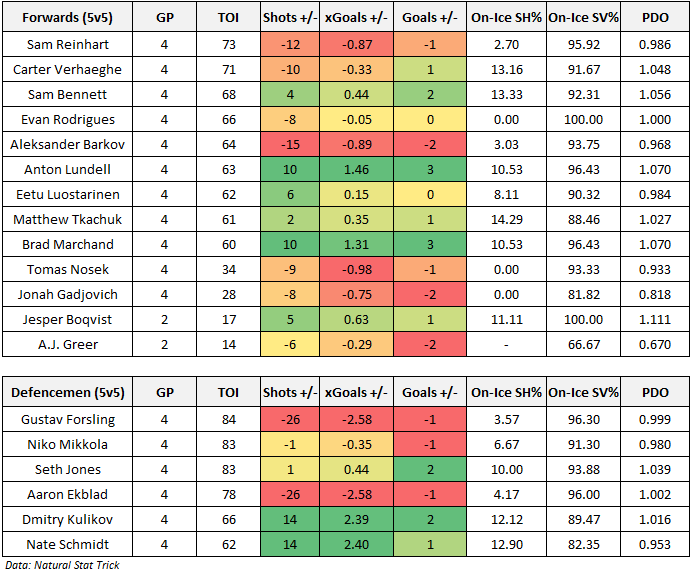
And here’s how the Panthers skaters have performed over the four games.
.
The Oilers are doing a decent job at limiting the chances generated by the top line players like Reinhart and Verhaege, as well as Barkov whose performance numbers and results have been poor compared to what we’d expect from him. The Panthers second and third lines, which play a lot against Brown and Kane, as well as Nurse, have really taken advantage to control the flow of play and scoring chances. It’s clear that they’re using this middle order to target the Oilers weakest players. On the back-end, the Oilers should continue to target Forsling and Ekblad, as they tend to be on the ice for a lot of chances against. The Panthers are distributing the ice time quite well amongst the defencemen, but I do wonder if this group will wear out first as they take a lot of hits and haven’t rotated in a seventh defenceman yet.
Here’s how the goalies have performed this series, split by even-strength (5v5) and penalty kill and sorted by goals-saved-above-average. Pickard is giving the Oilers decent/average goaltending, which is more than what Skinner can provide at this point. As mentioned above, the Oilers goaltending has been fine at even-strength. It’s really on the penalty kill where they’ve struggled, with Pickard giving the team a better chance at winning games.

We’ll see what the Oilers coaching staff comes back with in game five in terms of lineup decisions and tactics.
Data: Natural Stat Trick
 The SuperFan
Pingback: Losing the end game | The SuperFan