
Leon Draisaitl has been a tremendous asset for the Edmonton Oilers since being drafted by the club in 2014. In 638 NHL games, the 27-year-old forward has scored 306 goals and accumulated 744 points, plus another 77 points in 49 playoff games. He can easily be considered one of the top players in the league annually.
Draisaitl is now entering his tenth NHL season and the second last year of his current contract with the Oilers. And could potentially become an unrestricted free agent at the end of the 2024/25 season when he’s 29. While there is time for the player and the team to decide if there’s a long-term fit and a new contract, it’s a good idea to start monitoring and projecting Draisaitl’s production to inform contract discussions, which will have an immediate impact on the Oilers roster construction moving forward. Draisaitl also holds a lot of power here as he’s a bona fide star player in the league and could choose a different direction for his career if he doesn’t feel the Oilers can be legitimate cup contenders. So the Oilers really need to be sure of his intentions as soon as possible to avoid losing him for nothing, similar to what’s happened in other markets.
While Draisaitl has put up significant points, there are some areas that the Oilers should be aware of, namely his on-ice impact offensively and defensively, along with his production at even-strength (5v5). His powerplay production should be of little concern as he has the talent and teammates to keep the Oilers at the top of the league. But it’s at even-strength where he’s spent 80% of his total playing time – and having an impact on the game offensively and defensively – that should be carefully monitored and evaluated prior to contract negotiations.
Starting with his overall even-strength (5v5) production, below are Draisaitl’s points per hour since entering the league as a 19-year-old in 2014/15. His peak season was in 2019/20 when he finished second in the league with 56 even-strength points, going on to win the Hart Trophy as the league’s most valuable player.
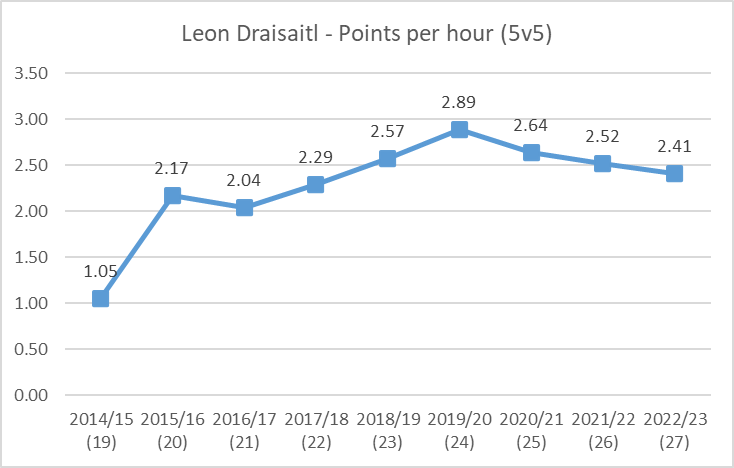
From his first full season in 2015/16 to that high-point as a 24-year-old in 2019/20, his rate of points per hour increased by 33%. Since that point, however, his rate of point production has gradually been decreasing, with Draisaitl posting a rate of 2.41 points per hour this past season – a drop of 16.6% since his Hart Trophy season. This isn’t to say Draisaitl is anywhere close to being done as a star player – those are still solid numbers, and he clearly has the talent to make a long career for himself similar to other top-end players. But when reviewing potential contract structures, it’s important to have some reasonable expectations of the player and determine what the roster needs could be if his production is expected to decline and if his positional deployment (i.e., center or winger) changes at all.
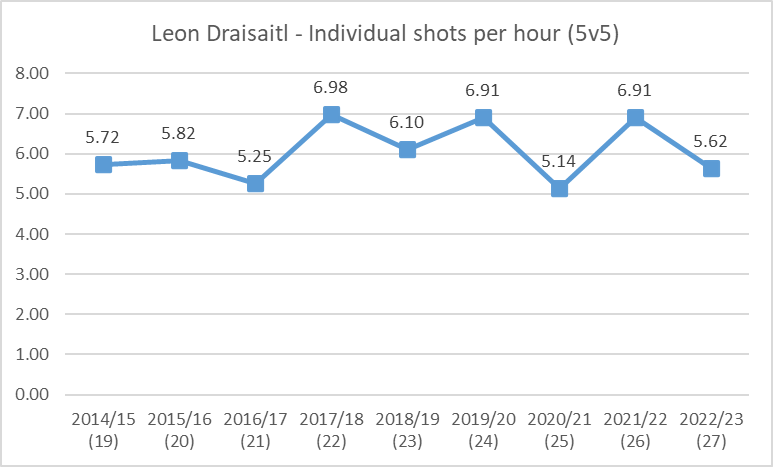
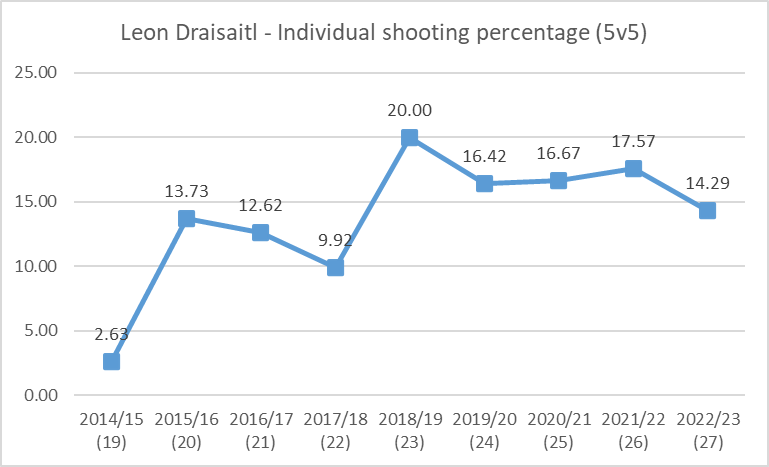
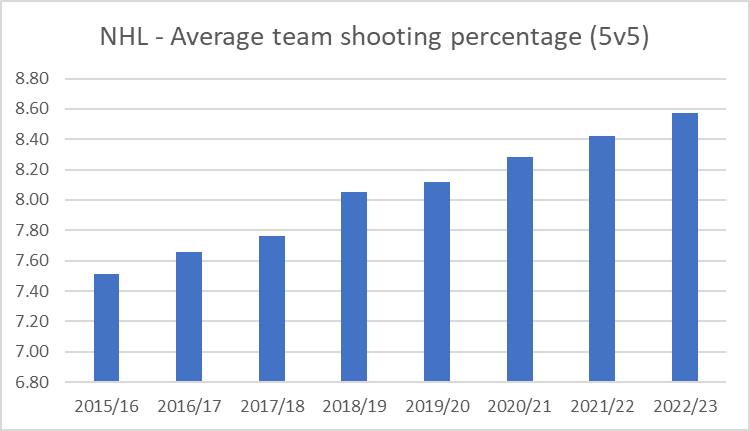
What’s also important to note is Draisaitl’s ability to generate shots for himself, as that remains an area of consistency for the forward. That along with his shooting percentage can give the team some added comfort that he can maintain a fairly high level of production offensively, even as he ages.
The one area that I would have concern with is his overall impact on the total game, offensively and defensively, when he’s on the ice at even-strength. Using his relative-to-team numbers, which informs us on how well the team does with him on the ice, we see that his impact has gradually been declining. Even to the point where the team had done a better job at out-shooting and out-chancing opponents without him than with him the last couple of seasons.
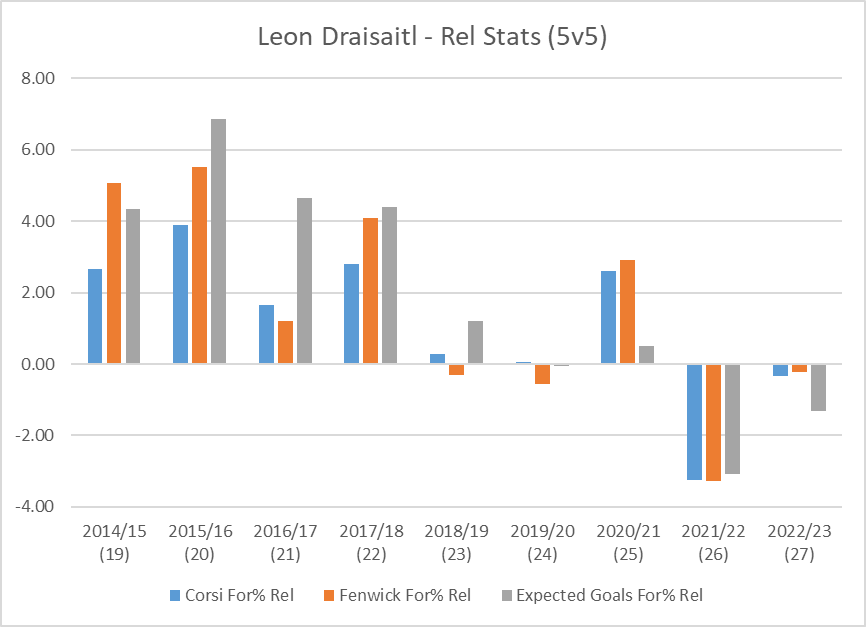
Draisaitl has had the unique ability to outperform his on-ice shot-share and possession numbers because of his ability to create high quality chances within the time he has playing offence and his strong finishing ability. But it’d probably give the team a little more confidence in his future potential if the team wasn’t spending so much time in their own zone and defending when he’s been on the ice. If you’re paying a premium for a player like Draisaitl, the team should be doing a better job controlling the flow of shots and chances with them on the ice than without him, especially when things like individual and on-ice shooting percentages and team save percentages can fluctuate sporadically. Again, this isn’t to say Draisaitl is done as a star player. But these are some of key metrics to track over the next couple of seasons to help inform the team’s future roster decisions.
The good news for now is that the Oilers have this top-end player signed for two more seasons, a period in which the Oilers should be doing everything possible to win a championship. In his nine seasons as an Oiler, the club hasn’t won a single division title, no conference titles, and has only won four playoff rounds, three of which were in the last two seasons. So the motivation for the team and the player should definitely be there to win titles as soon as possible.
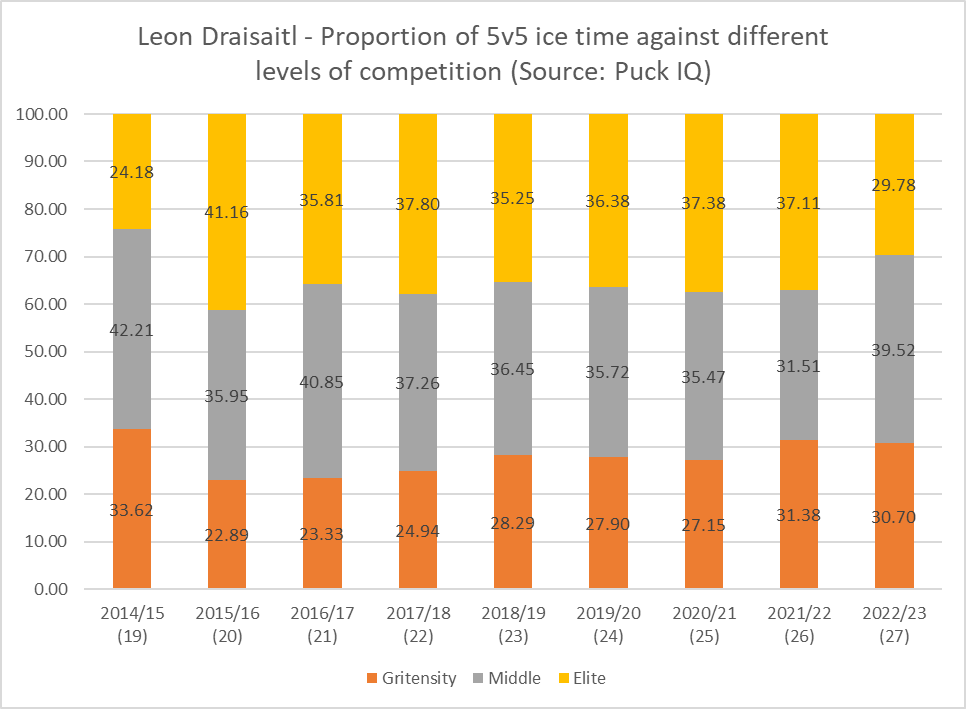
But over this next stretch, the Oilers have to also be thinking about their long-term aspirations, what the roster needs will be (and there’s always plenty) and how they plan on filling those requirements. Draisaitl should be considered a part of the Oilers long-term plans, but only if the Oilers have a strategy to surround him with talent that can fill the void when his production or defensive impacts start to slip. For example, if the team feels Draisaitl can maintain his production into his thirties, but predominantly as a winger, then the Oilers need to address that and start drafting and developing centers who can take on the workload and produce at a top-six level. And if the team feels he needs to play fewer minutes against elite-level competition to be more productive, similar to what happened last season, then it’s imperative to find someone who can take on those heavier minutes.
Deciding on Draisaitl’s future with Edmonton is going to require strong collaboration between the management group, the coaching staff, the professional scouts and hopefully an analytics and sports science group to get it right. Hopefully they’re up to the task and formulate and propose the appropriate contract structure that works for Draisaitl and the team.
Data: Natural Stat Trick, Puck IQ


 The SuperFan