Oilers Line Combinations from the 2015-2016 Season

Jordan+Eberle+Jujhar+Khaira+Edmonton+Oilers+RZEoGjuR3KUlWith training camp a few weeks away, the discussion around potential line combinations will begin to ramp up. With Milan Lucic joining the forward group, and new prospects like Jesse Puljujärvi  and Drake Caggiula entering the system, along with older prospects like Jujhar Khaira and Anton Slepyshevpushing for spots, the possibilities are endless.

But before putting together potential line combinations, I thought it’d be worth looking at how the different line combinations did last season. In particular, I looked at the combinations that played at least 50 minutes together at 5v5, and focused on their possession numbers (CF%), their share of quality shots/expected goals (xGF%) and their share of actual goals (GF%). I’ve sorted the table by Corsi For%, but you can click the table’s column headers to sort the other metrics. Also included in the table below is the time-on-ice (TOI), along with the line’s PDO and percentage of offensive zone starts. Please note that the numbers have been adjusted for score state, zone and venue. Source: Corsica Hockey).

Full article is at The Copper & Blue.

Some reasons to believe in Anton Lander

After a pretty brutal 2015/16 season, where he only scored one goal and notched two assists, Anton Lander has a lot to prove to Oiler fans. He was coming off of a pretty good 2014/15 season, when he was promoted to Edmonton from Oklahoma City after Todd Nelson became interim head coach, scoring six goals and finishing the season with 20 points in 38 games. Expectations were certainly raised last summer when he was rewarded with a two-year, one-way contract extension that would pay him $925K in the first year and $1.05 million in the second ($987,500 AAV), and a very good showing at the 2015 World Championships where he played on the top line for Sweden.

One thing to consider is that of the 20 points he scored in 2014/15, 9 were on the powerplay, which was clicking at a very high rate with Todd Nelson behind the bench. With McLellan behind the bench, Lander did not get nearly as much ice time with the man advantage, and understandably so: the lineup was healthier than the 2014/15 team and the additions of McDavid and Draisaitl were going to push players like Lander off of the powerplay. Regardless, Lander’s respectable 1.49 points/60 at even-strength was sixth among Oiler forwards who played at least 400 minutes in 2014/15 (12 forwards total). What was also promising were his possession numbers over those 38 games. Below is how he ranked among Oiler forwards with at least 400 minutes of ice time. (Source: Hockey Analysis)

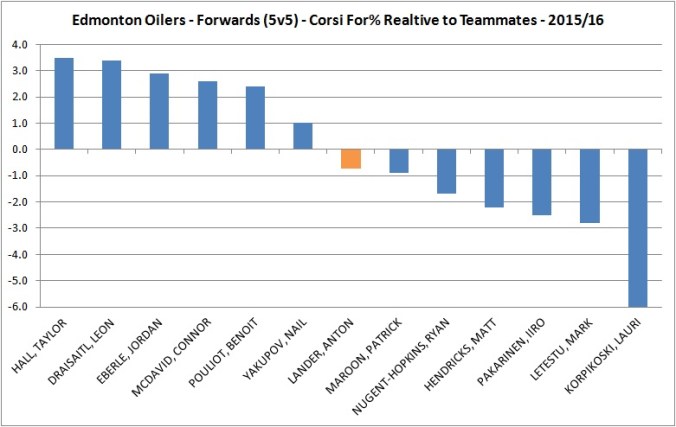
Lander finished the season with a +1.2 Corsi For percentage relative to teammates, which ranked him behind top six forwards like Hall, Eberle, RNH and Pouliot. Lander’s two most common linemates that season were Matt Fraser and Andrew Miller, both of which are fringe players today. Lander did spend 93 minutes with Hall as well, which would absolutely give his numbers a boost. When it came to the rate of generating shot attempts (i.e., Corsi For/60), Lander finished third on the team with a +3.80 Corsi For/60 relative to teammates, but ranked 8th on the team when it to the rate of shot attempts against.

Lander20152016

Fast forward to the 2015/16 season, and Lander’s productivity when it came to point production falls off of a cliff, as he finished the season with a 0.33 points/60 at even-strength, which was last on the team among forwards who played at least 500 minutes, and fourth last in the entire NHL. But when it came to his possession numbers relative to his teammates, Lander did not fare too badly.

Full article is at The Copper & Blue.


Adam Larsson Against Different Levels of Competition

Last week, I looked into the performance of the Oilers depth forwards and defence core against different levels of competition using the WoodMoney metric. What we can do using this data is parse out how individual players did against three categories of forwards, and add another level of information to our analysis. The full rationale for the metric, the methodology to classify players and the complete data-set can be found at Because Oilers.

Here’s a quick breakdown of the different competition groupings.

Elite: at least one elite player must be on the ice. No Gritensity players may be on the ice.

Middle: Elite + Gritensity on the ice, or 3 mudddles

Gritensity: Any time a gritensity player is on the ice except when with an Elite.

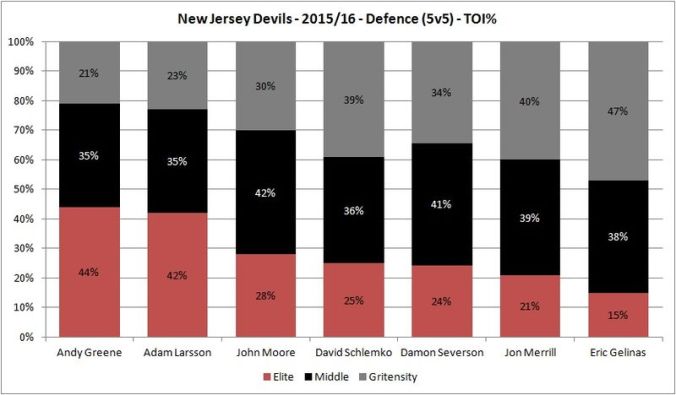
I received a couple of requests to look into how Adam Larsson did last season as a New Jersey Devil using the WoodMoney data. What we know from some of the more established metrics available at Corsica Hockey and Hockey Analysis is that Larsson played predominantly with Andy Greene, starting a significant number of shifts in his own zone and actually fared pretty well when it came to limiting shot attempts, scoring chances and goals. We also know that when it came to offence, Larsson is a bit of a black hole as the team didn’t generate a whole lot with him on the ice.

Using the WoodMoney data, we can look into how Larsson did against the different levels of competition, including his proportion of ice, shot attempts against and Dangerous Fenwicks against.

WM_-_Devils_Defence_-_TOI.0

Full article is at The Copper & Blue.

Evaluating the Oilers Using WoodMoney

In case you missed it, Darcy McLeod and G-Money have developed WoodMoney, a new metric to evaluate how players have performed against different levels of competition. What they did was take every NHL player and classify them, using some pretty sound criteria (i.e., point production, ice time, Corsi Rel), into one of three categories: Elite, which are the top end players, Gritensity, which are lower end, replaceable-type players, and Middle, which are those that did not fall under the Elite or Gritensity group based on Darcy’s and G-Money’s criteria.

From there, they used the data available from NHL game sheets to determine how much time each player played against the different categories, and also how they performed when it came to possession and shot quality. The methodology and process to classify the players can be found at Because Oilers along with a link to the complete data-set. I highly recommend reading Darcy’s article to understand the duo’s rationale behind the new metric and why quality of competition is important. A couple links that explain G-Money’s Dangerous Fenwick metric, which measures shot quality, is also below.

Watching Oiler games and reviewing the deployment data available on great sites like Natural Stat Trick and Hockey Stats, we know that coaches try to find the match-ups they want and do everything they can to get specific players out against specific lines. Game-to-game, we can get a sense of which players are drawing the toughest opponents, which are getting time against the fourth liners, and how they perform. And with WoodMoney, we can start to aggregate each player’s outputs (i.e., shots, shot quality) against the different levels to add another layer of information to our analysis.

Two areas in particular that have been of interest to me since last summer when it comes to quality of competition are defencemen and bottom six forwards. In my opinion, neither area was addressed properly last summer by the Oilers, and it showed throughout the regular season. The team did add two experienced players in Lauri Korpikoski and Mark Letestu to their bottom six, but neither of them had a history of driving play or producing goals. As for the defence, the club added Andrej Sekera, who filled in admirably as a top pairing defenceman, and saw their faith in Brandon Davidson payoff very nicely. But the Oilers took a risk, an unnecessary one, starting the season with Griffin Reinhart, Eric Gryba and Andrew Ference.
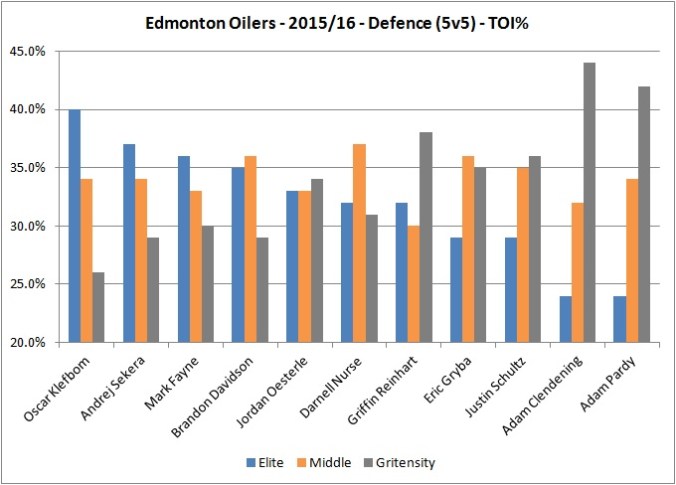
WM - Defence - TOI

Full article is at The Copper & Blue.

The Oilers Offensive Zone Tactics

This past week, Ryan Stimson of Hockey Graphs published a very insightful article where he attempted to quantify two offensive zone strategies that teams rely on, focusing on the tactics used by the San Jose Sharks and Los Angeles Kings this past season. This was following some comments made by Kings assistant coach Davis Payne, who presented at a coaching clinic in Buffalo. The full article is a must-read for anyone interested in team systems and analytics.

Two tactics, the Low-to-High-to-Net Attack, where assists come from point shots, and the Behind-the-Net attack, where a play is developed from behind the goal line, are explained extremely well in the above article, including plenty of video to explain the tactics and the pros and cons for both plays.

Since the passing data is publicly available, I figured it would be worth digging into the Oilers numbers and verifying what we’ve heard the coaching staff discuss this past season, including McLellan’s concept of volume shooting.

Full article is at The Copper & Blue.

Goaltending Might Be An Issue for the Oilers Next Season

Dashboard 1
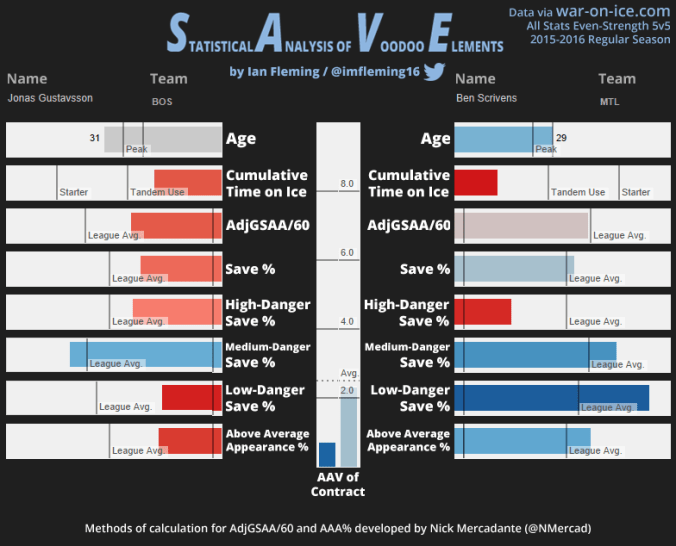
Heading into the summer, it was fairly obvious that the team would need to find a dependable backup to play behind Cam Talbot and push young Laurent Brossoit down to Bakersfield for additional seasoning. Although Brossoit had put up some nice numbers at the AHL level, his showings in Edmonton were not very good, as the young prospect appeared in five games, finishing 0-4-0 with a sub-standard 87.18 save percentage at even-strength (Source: Corsica Hockey)

On July 1st, the Oilers did find a backup in 31-year old Jonas Gustavsson, who played with the Bruins last season going 11-9-1, with a 91.42 save percentage at even-strength. Among the 55 goalies who played at least 900 minutes last season, or around 20 games, similar to Gustavsson, the Oilers newest addition ranked 47th when it came to save percentage at even strength, the average of the group being 92.46. The season prior, Gustavsson only played in seven games, with Jimmy Howard and Petr Mrazek taking on the bulk of games, and did show well, but it’s hard to make any large conclusions based on such a small sample size.

Full article is at The Copper & Blue.

Deploying Adam Larsson

Something to consider now is how defenceman Adam Larsson will fit into the Oilers in terms of pairings, deployment and match-ups. Judging by some of his underlying numbers, Larsson has performed as more of a shutdown type defencemen in New Jersey that starts a lot of shifts in his own zone, typically against the best competition.

To put Larsson’s deployment in New Jersey into perspective, I’ve generated a player usage chart from Corsica Hockey to show how he measured up against his teammates last season at even-strength. The x-axis is the Zone Start Ratio (ZSR), which is the percentage of non-neutral zone starts that are offensive zone starts. The y-axis is the Time On Ice Quality of Teammates metric (TOI.QoT), which is the weighted average time-on-ice percentage of a player’s teammates. The bubble size is the individual player’s Time On Ice Percentage, which is the percentage of a team’s time-on-ice played by a player. And the coloring of the bubbles is the individual player’s Corsi relative to his teammates. (Source: Corsica Hockey).

Full article is at The Copper & Blue.

Adding Center Depth This Summer

Heading into the summer, the Oilers appear to be set at center ice, with Connor McDavid, Leon Draisaitl and Ryan Nugent-Hopkins as the pivots. It’s been a long time since the club has had some semblance of depth at center, so it’d be unwise to tinker with it too much in the off season. The other factor to consider is Draisaitl possibly playing both center and wing, depending on the in-game situation, similar to how Todd McLellan deployed Joe Pavelski in San Jose. If Draisaitl is in fact used as a bit of a utility player, it’s imperative that the Oilers bolster the bottom six and acquire a centerman (or two) that can perform well and produce.

Both Anton Lander and Mark Letestu struggled mightily last year at even-strength, combining for a whopping four primary assists. I expect Letestu to be back as he did perform well on the powerplay, but Lander’s future is a little more murky, considering he was often scratched to make way for Hendricks, and at one point Pakarinen, to play the fouth line center role. All things considered, it’s hard to ignore the glaring weakness that was the bottom six last season.

Looking at the options for next season, the Oilers could potentially bring back Letestu as the fourth line center behind McDavid, RNH and Draisaitl. What I would highly recommend the Oilers do though is bring in additional centermen, preferably a right shot, on the cheap, have them play wing and fill in at center when needed. This might be overkill, but consider the fact that the Ducks and Penguins both dipped into the bargain bin last summer to have depth at center: Anaheim brought in Shawn Horcoff and Mike Santorelli, while Pittsburgh brought in Eric Fehr and Matt Cullen.

One player that’s worth looking into is 27 year old Riley Nash, who was not qualified by the Carolina Hurricanes and appears to be headed to free agency. Nash was selected by the Oilers in 2007, 22nd overall, and completed three years at Cornell before being traded to the Hurricanes for a second round pick. There appeared to have been some issues between the player and the Oilers at the time, with Nash likely headed to free agency after his college career.

Full article is at The Copper & Blue.

The Oilers Improvement in Possession Numbers and Expected Goals

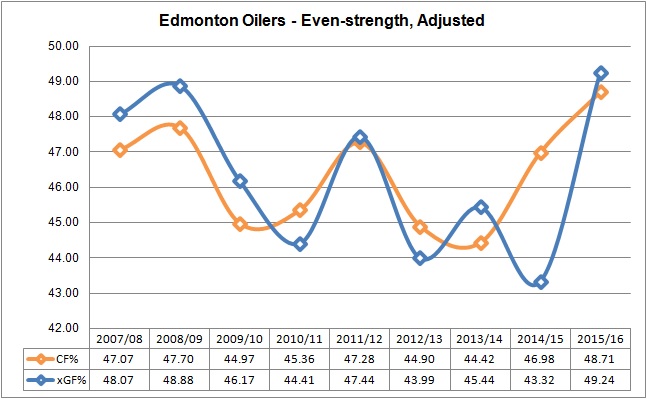
The Oilers may have finished the 2015/16 season near the bottom of the league, but looking a little deeper into the stats we see that the club improved in a few areas that are critical for winning games. First, they improved their overall share of goals at even-strength, going from 40.46% last season, up to 45.38%. That’s a significant jump, and was the third biggest change from the season prior across all 30 teams, behind Arizona and Florida. Goal share is obviously important, but we know that there is a lot of luck involved in scoring goals, with some teams riding higher than average shooting or save percentages to pad their goal-share stats.

Knowing that, it’s important to look into a team’s share of total shot attempts (i.e. Corsi For%) which serves as a good proxy for possession,  as well as expected goals, which measures shot quality and scoring chances as determined by Corisca Hockey. When it came to possession, the Oilers finished with 48.71% of all shot attempts (adjusted for score, zone and venue), good for 20th in the league, and up from 46.98% last season (26th overall). When it came to their share of expected goals, the Oilers made a significant jump from last season, going from a 43.32% share (28th league wide), up to 49.24% (20th overall). Below is a graph of the Oilers share of shot attempts (i.e., Corsi For%) over the past nine seasons, as well as their share of expected goals (xGF%).

CF and xGF Analysis

Full article is at The Copper & Blue.

Sekera and Fayne

Since last summer, the Oilers have struggled to carve out a solid defence core that contained a balance of skill, size and experience. And heading into the draft and free agency, it’s become apparent to everyone that the OIlers will likely be making a move or two to enhance the blue line and hopefully push for a playoff spot this upcoming season.

One thing that has become lost in the discussion is the effectiveness of the Sekera-Fayne pairing this past season and why maintaining that tandem is critical for the Oilers. Sekera and Fayne played over 600 minutes together in 2015/16, the most among all pairings in Edmonton, and averaged over 23% of the team’s total ice time at even-strength when together, often leading the team on a nightly basis. Whatever your position is on these two players, they were the number one pairing for the OIlers last season and actually fared well when it came to possession metrics as well as expected goals (which factors in shot location and quality as defined by Corsica Hockey).

Below, I’ve listed every Oilers defence pairing that played at least 100 minutes together last season at even-strength, ranked the list by Corsi For% (adjusted) and included the expected goals measures as well.

Full article is at The Copper & Blue.