Even though the Oilers are down 3-1 in their series against the Florida Panthers, the Oilers are doing a lot of things right. And giving hope to a market that the series could go to seven games. Games are won and lost by the smallest of margins in the post-season, and it’s critical that the team maintain it’s performance at even-strength and the penalty kill.
Here’s how the two teams have compared at even-strength (5v5) over the first four games. The Oilers have outscored the Panthers 9-8 in this game state, which is about 71% of the total minutes. If you factor in the other even-strength game-states (3v3 and 4v4), the Panthers have a slight edge in goals (11-10). In all situations, each team has twelve goals, including a shorthanded goal for the Oilers. The results are pretty darn close, and indicates that the series should be tied. But that’s how playoff hockey goes.
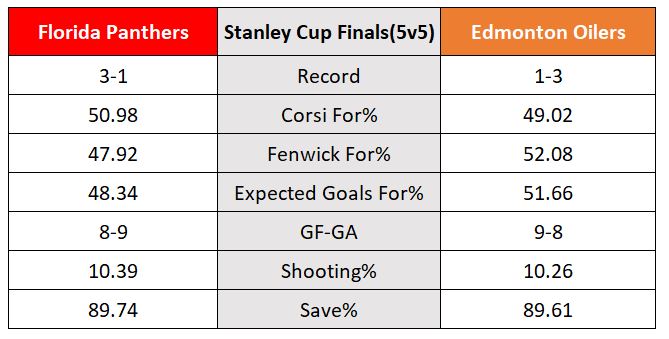
While the Panthers have a slight edge when it comes to controlling the flow of play, the Oilers are doing a better job at creating scoring chances, as reflected by their Fenwick For percentage and Expected Goals For percentage. After getting a thrashing in game four in Edmonton, Bobrovky’s save percentage is now below 90.00 percent and barely better than Skinner’s. Bobrovsky played a lot of minutes during the regular season, similar to Skinner, so I do wonder if fatigue is setting in.
Below is an overview of how the Oilers and Panthers have performed this series at even-strength (5v5), as as well as their actual on-ice results.
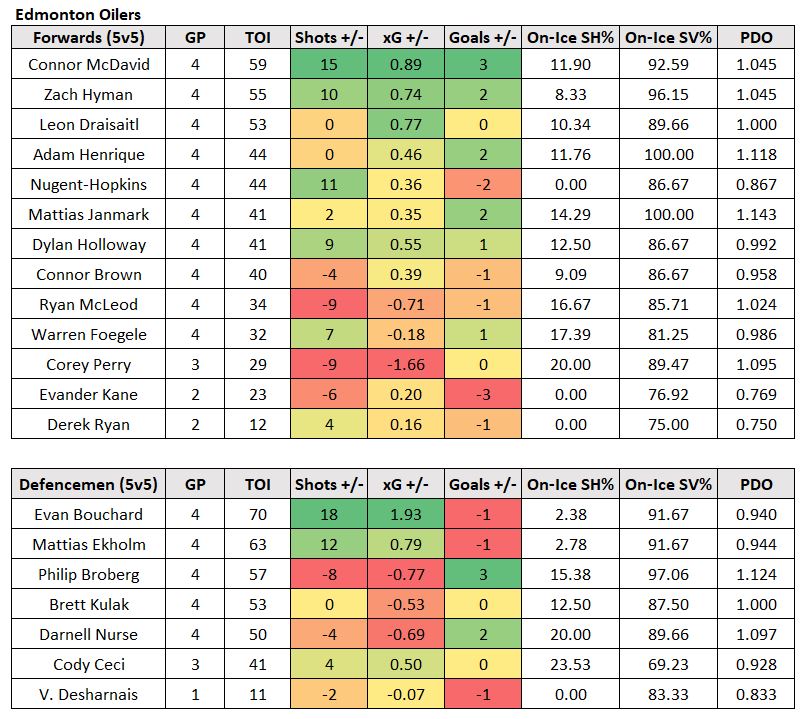
The Oilers line featuring McDavid and Hyman continues to be a significant driver for the club, and should never really be counted out. The top defence pair of Bouchard and Ekholm are due for a little market correction as the Oilers see a bump in their performance numbers with them on the ice. But the results haven’t aligned quite yet because of their on-ice shooting percentage. Considering they spend a lot of time with the top players and had a lot of success together prior to this series, it’s fair to expect their results to improve.
Also noticed that Broberg has played the third most minutes at even-strength this series, which says a lot about the trust the coaching staff has in this player. And how his style of play and ability to make plays under pressure is well suited to counteract with the Panthers style. Should note that even in all situations, Broberg ranks third in ice time among defencemen as he’s taken Nurse’s minutes on the penalty kill and thriving in that situation. It’s a small sample size for now, but the Oilers are allowing the lowest rate of shots against with Broberg on the ice when shorthanded, and he’s a big reason why the penalty kill is doing so well this series.
The Oilers depth players, including guys like McLeod, Kane, Perry and Brown, are struggling and are going to be a focus of attention if the Oilers lose the series. After four games, the Oilers are posting a +3 goal differential (5-2) with McDavid on the ice, thanks to an on-ice Corsi For percentage and Expected Goals For percentage of 56%. Without McDavid, the Oilers have posted a -2 goal differential (4-6). And that’s largely driven by their Corsi For percentage of 44% and an Expected Goals for percentage of 48%. To get out of the hole they’re in, the Oilers need their depth guys to be a factor. And that includes their second line with Draisaitl, who looks like he’s dealing with an injury.
Below is how the Panthers skaters have performed in this series.
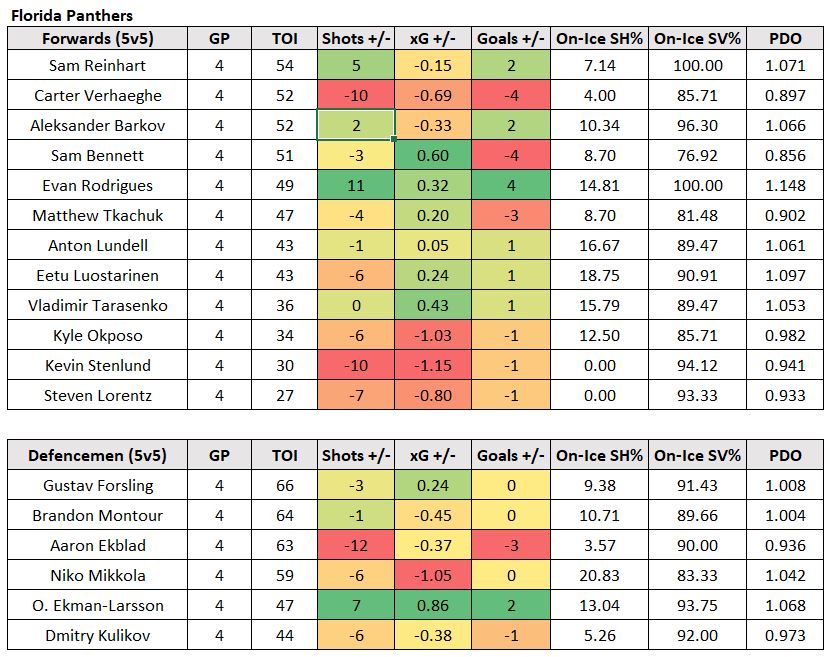
Have to say, the top end players in Florida haven’t been very impressive. Bennett, Verhaeghe and Tkachuk are all posting negative shot differentials and goal differentials, and aren’t driving things like the Oilers top players have. Having said that, their PDO levels are quite low right now, so there might be a bounce back game coming for some of them. Of all of the players we hear about, it’s actually been Rodrigues that’s had a great series so far. Team tends to out-shoot and out-chance the Oilers at even-strength with him on the ice, and he’s posted a +4 on ice goal differential (the highest among both teams).
The Oilers and Panthers special teams are basically cancelling each other out, as both powerplays have scored only once this series. Both teams did an excellent job at suppressing shots and chances on the penalty kill during the regular season and in the first three rounds of the post-season. So this isn’t completely surprising. It’s really going to come down to goaltending on the penalty kill, and which netminder will maintain their level of play. Both goalies posted similar numbers in the regular season, and played significant minutes. Among the 59 goalies who played at least 100 minutes on the penalty kill during the regular season, Bobrovsky ranked 19th with an 87.50 percent save percentage playing the most minutes in the league. And Skinner ranked 40th with an 85.40 percent save percentage and played the fourth highest number of minutes.
Because the Oilers are posting good underlying numbers at even-strength and have their top line and top pairing in good form, they definitely have a shot at pushing this series to seven games. It’s really going to come down to the Oilers goaltending, and if Skinner can post league-average numbers. And getting scoring from lines two to four at even-strength. Both have been areas of weakness throughout the playoffs, but can easily turn around based on the success they had in the regular season. Combine that potential bounce back with a few goals on the powerplay, and the Oilers should make this a more competitive series.
Data: Natural Stat Trick



 The SuperFan