Final check in on how each NHL team did in terms of clear victories, something I wrote about a few weeks ago and how it’s a good way to evaluate a team’s true talent level. From my last post:
One way to evaluate a team’s talent level is by looking into the number of clear victories they’ve posted. Clear Victories is a metric that Scott Reynolds analyzed and tracked over a decade ago over at The Copper & Blue and is defined as a win by two goals or more, excluding empty net goals. The key takeaway from Reynolds’ analysis is that clear victories were a better indicator of a team’s true talent level than the team’s overall record. And teams who more often win games by a larger margin tend to have better success in the future. Heading into the post-season this metric can really help identify the teams that have an edge over their competition and if any of the contenders might be considered outliers.
Clear Victories is defined as a win by two or more goals excluding empty net goals. One additional criterion is that the winning team has that goal differential of at least two with three minutes left in the game. This helps avoid the scenarios where an empty net goal is scored earlier in the period (as we know teams are pulling their goalies earlier), or when a penalty results in a goalie pull.
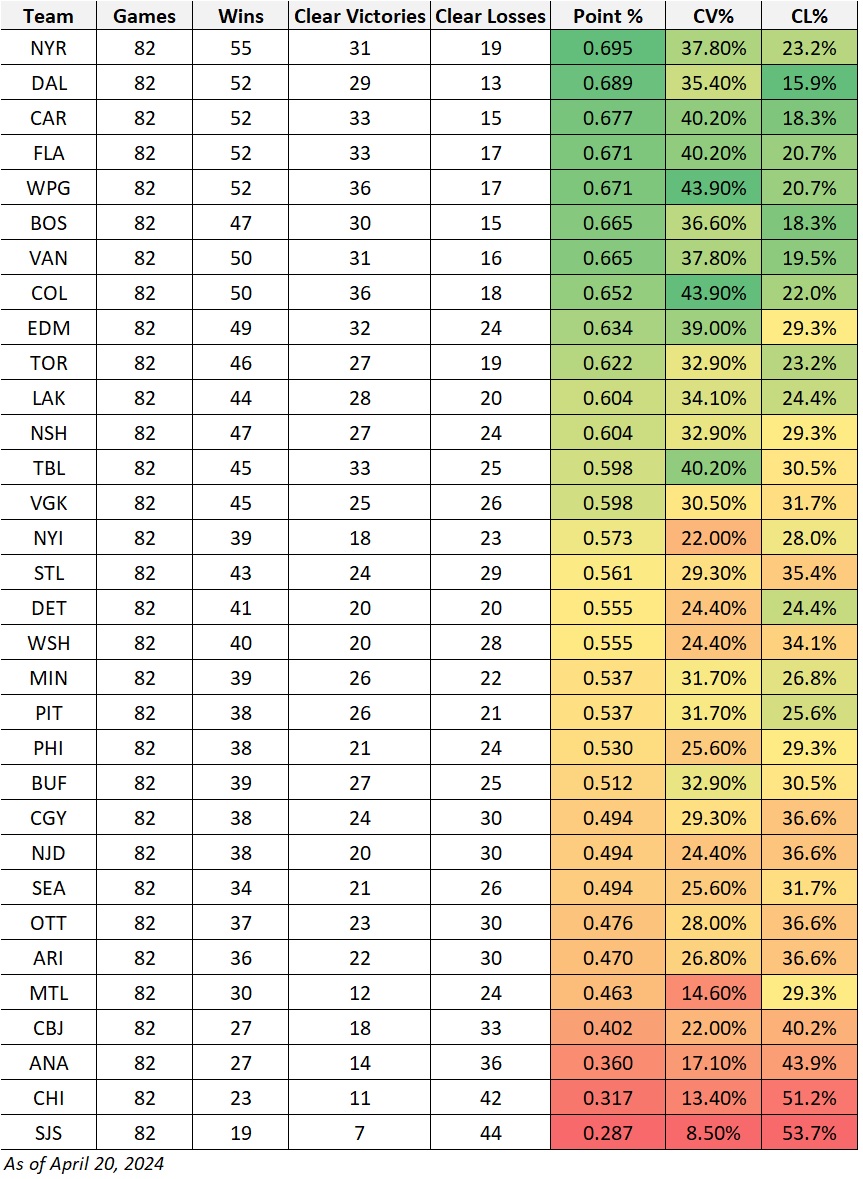
Included in the table below is each team’s Clear Victories Percentage (CV%), which is the number of clear victories divided by their total number of games, along with each team’s Clear Losses Percentage (CL%). I’ve also applied a basic heat map to each team’s points percentage and Clear Victories Percentage to see how teams compare with one another, and if there are teams who might be winning a lot but often by a smaller margin.
The Oilers had a great regular season, finishing with the ninth best points percentage. And 39.00 percent of their games were clear victories, which ranked sixth best in the league. Colorado (43.90), Winnipeg (43.90), Carolina (40.20), Florida (40.20) and Tampa Bay (40.20) were the top five teams for this metric. The league average clear victories percentage and the clear losses percentage was 29.9 percent.
What stands out for Edmonton is the percentage of their games were clear losses. Among the top end teams, in terms of results, Edmonton ranks fairly poorly and closer to league average levels with a clear loss percentage of 29.3 percent (15th in the league). The other contenders were excellent in limiting the frequency of clear losses.
We’ll see how this all correlates to playoff success.
A big thank you again to Ganesh Murdeshwar who was able to provide this data. It’s not readily available, so can’t thank him enough for his support.
Joined Jessica Ng and Min Dhariwal on CBC Radio Active this evening to preview game three between the Edmonton Oilers and the Los Angeles Kings. Full segment is here: CBC Radio Active (2024, April 26)
Other topics we discussed:
The first two games, what’s gone well and what the challenges have been.
Dylan Holloway’s performance in game two, his NHL journey so far, and the pressure of making an impact as a first round draft pick.
Stuart Skinner’s play, and the issues both teams are having playing defence.
The other series underway in the NHL.
Bob Cole’s passing, his impact to the game, and favorite memories. The Todd Marchant goal in 1997 will always be legendary for me, and Cole was a big part of that.
Couple other notes.
This series between the Oilers and Kings has been a pretty high-event one so far. Both teams had solid defensive numbers in the regular season, with the Oilers ranking fifth best in the league allowing 27.84 shots against per hour (all situations) and the Kings ranking fourth (27.70). But so far this post season, both clubs are allowing some of the highest rates among the playoff teams. Edmonton is at 30.95 shots against per hour and the Kings are at 37.34.
The Kings have scored all nine of their goals at even-strength (5v5). The Oilers only have six, with the other four coming on the powerplay. We know the referees gradually stop making calls as the series progresses, so the Oilers need to figure things out at even-strength.
Among the 19 goalies who have so far played this post-season, Skinner ranks 15th with an 0.857 save percentage (all situations) and Talbot ranks 13th with 0.867. Both goalies played a lot of minutes this regular season, so I wouldn’t be surprised to see them burnout and have their backups come in at some point. They’re good, NHL-caliber goalies, but they’re not going to steal you games in the playoffs.
Talbot has been the better goalie at even-strength so far. Skinner ranks dead last with a goals saved above average (GSAA) of -3.56.
I’m also not overly surprised that the Kings allowed four powerplay goals against in the first two games. While it’s true that they allowed the lowest rate of goals against during the regular season, it was largely driven by their goaltending. The Kings were allowing a higher-than-average rate of shots and scoring chances against all season, so it was a matter of time before they got burnt, especially if their goaltending slipped even slightly.
With the first round of the playoffs set to begin, I wanted to get a sense of how both teams finished the season, what their key drivers were and how individual players performed.
The Oilers we know had a great season, going 14-7-4 in their final twenty-five games of the regular season, a points percentage of 0.640 – eighth best in the league and fourth best in the west behind Dallas (0.740), Nashville (0.740) and Colorado (0.660). The Oilers goal-share in all situations over these last twenty five games was fourth highest in the league (57.69 percent), posting a +24 goal-differential due in large part to their even-strength play. The powerplay and penalty kill slipped a bit in this last stretch, but was still around league average. More on that in a minute.
The Kings had similar results to the Oilers over their final twenty-five games, going 15-9-1 – which translates into a 0.620 points percentage that ranked tenth highest in the league. Similar to the Oilers, they posted an excellent all-situations goal-share in this period (57.55 percent), with a +21 goal differential that was fourth highest in the league. A lot of their success was at even-strength, as well as on their penalty kill.
Even-strength (5v5)
Here’s how the two teams performed at even-strength (5v5) over their final twenty-five games. Both clubs ranked near the top of the league for the majority of the metrics.
Team (5v5, last 25 games)
Oilers
Kings
Points%
0.640
0.620
Corsi For%
54.82
51.06
Fenwick For%
54.47
52.45
xGoals For%
56.34
53.39
Goals For%
60.67
61.36
Shooting%
9.32
9.64
Save%
92.45
93.40
The two clubs are fairly evenly matched when it comes to shot-share metrics, with both teams ranking near the top of the league for most of the season. For example, the Oilers posted a Corsi For percentage of 55.52 percent over the course of the full season (third highest in the league), while the Kings ranked fourth with 54.68 percent. Where the Kings have excelled at is on the defensive side of things, as their rate of shots and chances against have consistently been in the top five all season. Also worth noting that while the Kings full-season shooting percentage of 7.82 percent ranked 26th in the league, they had the ninth best shooting percentage over these last twenty five games. Full details on how the Oilers and Kings rank within the western conference can be found here.
Goaltending (5v5)
Both teams received excellent goaltending to end the season, with the Kings ranking first with a save percentage of 93.40 percent, while the Oilers ranked sixth with 92.45 percent. Below are the Oilers and Kings goalies from the last twenty-five games, with their rankings for each metric among the 61 goaltenders who played at least 250 minutes.
Goalie (5v5), last 25 games
GP
TOI
Save%
GSAA
High-danger Save%
Cam Talbot
19
942
92.4% (17th)
4.88 (15th)
79.1% (41st)
David Rittich
6
281
96.7% (1st)
6.76 (8th)
96.6% (1st)
Stuart Skinner
16
703
91.7% (27th)
1.31 (27th)
88.1% (10th)
Calvin Pickard
12
540
93.6% (10th)
5.88 (11th)
81.4% (38th)
Along with the strong numbers posted by Rittich in limited minutes, the other thing that stands out is the high workload for Talbot. He played the 11th highest minutes in the league among goalies, and he didn’t get much of a break in this last stretch, playing over 77 percent of the team’s total ice time. Skinner on the other hand saw his workload reduced, playing 56 percent of his team’s total ice time, and posting average numbers in this recent period. Considering that Skinner played the fifth highest minutes in the league over the full season, he definitely needed the break. And hopefully he doesn’t burn out like he did last post-season.
Special Teams
While the Edmonton Oilers powerplay posted the second highest rate of goals over the full season (10.53 goals per hour) supported by the fourth highest rate of shots (62.33 shots per hour), their performance and results over the final twenty five games of the season wasn’t nearly as good. Over this recent period, the Oilers powerplay ranked 13th in the league, scoring 8.46 goals per hour. A big reason for this was their decline in rate of shots, which ranked 15th with 54.21 shots per hour.
The Kings powerplay was slightly better than Edmonton’s, scoring at a rate of 8.97 goals per hour in their last twenty five games and ranking 11th. But this appears to be largely unsustainable as they consistently generated some of the lowest rates of shots in the league all season. It’s very similar to how they did at the end of last season as well.
Powerplay (Last 25 games)
Oilers
Kings
Shots for/60
54.21 (15th)
43.72 (27th)
Goals for/60
8.46 (13th)
8.97 (11th)
Team shooting%
15.60% (13th)
20.51% (2nd)
Both team’s had decent results on the penalty kill to close the season, with the Kings allowing the tenth lowest rate of goals against per hour (6.99) and the Oilers ranking 14th (7.65). The big issue for Edmonton was their goaltending, as it ranked 26th in the league with a 82.50 save percentage, while the Kings goaltending ranked 7th. And these recent goaltending numbers for both teams is consistent with what they posted over the full season.
Penalty Kill (Last 25 games)
Oilers
Kings
Shots against/60
43.70 (5th)
56.38 (20th)
Goals against/60
7.65 (14th)
6.99 (10th)
Team save%
82.50% (26th)
87.61% (7th)
Skaters (5v5)
Another thing I wanted to see ahead of the series was how the players on each team did in terms of on-ice shot and goal differentials at even-strength (5v5) over their teams final twenty-five games. Just to get a sense of which players are playing well, but might not be getting the results. And which players might be getting unsustainable results.
Below are all of the Oilers skaters, split by forwards and defencemen, and sorted by their total ice time.
The top end of the Oilers roster is what will drive results in the post-season as they’ve consistently outshot and outchanced opponents, and typically against the top players of other teams. It’s encouraging to see that McLeod was getting lots of opportunities, even though the results haven’t been there. He’s going to be critical for the team and should (hopefully) form an effective third line with Holloway and Perry.
I do also wonder if the team is really losing anything if Kane and Janmark aren’t healthy and ready to go for game one of the series. Both players tend to be a drag on the team’s performance numbers at even-strength and their results haven’t been very good. Might be better to run with Holloway on the team. I also wouldn’t count on guys like Henrique, Brown or Carrick, as the Oilers tend to play more often without the puck with them on the ice.
On the backend, there should be some concern with the Kulak-Desharnais partnership as they performed very poorly over the last stretch of the games. The coaching staff was trying them out against tougher competition, and giving Nurse/Ceci a break, so that could be what’s driving the numbers here. It’ll be very interesting to see how the coaching staff manages the minutes among defencemen, as it appears as though the Oilers really only have one reliable pairing in Ekholm and Bouchard.
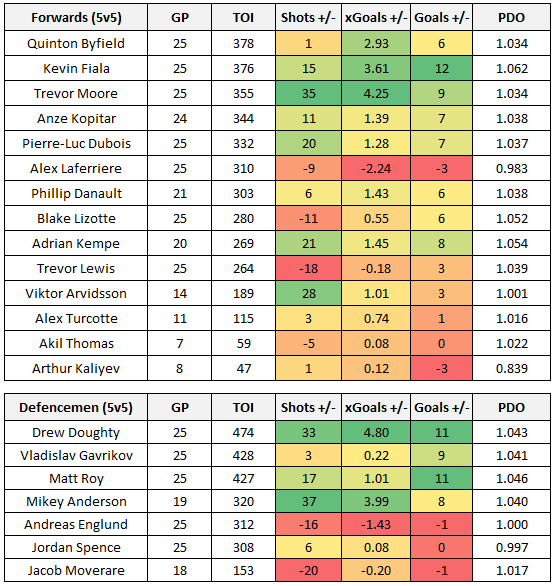
And here’s a quick glance at the Kings skaters, again split by position and sorted by ice time over the final twenty five games of the season.
Danault is the player to watch on the Kings, as he played the most against elite competition among Kings forwards and posted excellent shot-share numbers against this group. If the Kings have any chance of winning, he’ll need to play a lot against the Oilers top lines. Kempe is another one to watch and it’ll be interesting to see how often the Kings target Nurse and Ceci with his line. I do feel like there’s some Kings players to target here as a few of them are great at generating shots, but not really good at generating scoring threats consistently as reflected by their expected goal numbers. Specifically Dubois and Arvidsson – both of which were brought in to solve the Kings goal-scoring issues but have bounced around the line up.
Thoughts
While the Oilers should win this series, I think it’ll be a lot closer than people expect. The Kings were very good defensively this season, and have two capable goaltenders. The Oilers do have the higher-end talent, but I’d still have concerns with the defence core, which tends to struggle playing with the bottom six forwards and could be targeted by the Kings coaching staff. I’d also be concerned with Skinner’s performance as he had one of the highest workloads in the league this season, and could potentially start to fade as the series goes on.
Whatever happens, the Oilers have put themselves in an excellent spot and have a real chance of winning a few rounds because of their top end talent. If the coaching staff gets their line match-ups right and address their weaknesses as quickly as possible, they should remain competitive.
Had the pleasure of joining host Jessica Ng on CBC Radio Active to talk about the Edmonton Oilers and their upcoming first round playoff series against the Los Angeles Kings. Got to be in studio for this one!
One last check-in on the western conference before the 2024 NHL playoffs begin next week.
The Oilers finished second in the Pacific division and fifth in the west, going 14-7-4 in their last twenty-five games of the regular season. They’re easily one of the top teams in the league, but they have a lot of strong competition – especially in the west. All eight teams have a case for winning their opening round series, and there doesn’t appear to be any easy paths to the finals.
Couple reasons for optimism.
The Oilers have consistently posted some of the best shot-share numbers in the league, ranking highly when it comes to the rate of generating shots and scoring chances as well as preventing them. I think that’s something that tends to get overlooked because of their high-end offence. The Oilers have over the course of the full season been a pretty solid defensive team, posting some of the lowest rates of shots and scoring chances against, and doing everything they can to help their goaltending.
The Oilers actual results have been very good. Their +57 goal differential (all situations) was fifth best in the league, and third in the western conference only behind Dallas (+64) and Winnipeg (+60). Their 55.78 percent goal-share (+40 goal differential) at even-strength (5v5) was fifth best in the league, and driven largely by their 55.52 percent Corsi For percentage and finishing talent at the top of their roster. Worth noting that while the Oilers did a good job controlling the flow of play and scoring chances without McDavid or Draisaitl on the ice, they couldn’t consistently convert on their chances and posted a -3 goal differential. The lack of finishing talent has been a problem all season, and wasn’t addressed by management.
The one area that could (again) be an issue is goaltending. It’s been a great story this year with Stuart Skinner, and how he’s solidified himself as a legit starter with Campbell being demoted to the minors. But the team’s 89.77 percent save percentage (all situations) finished 17th in the league and 9th in the western conference. Among the eight teams from the west that have qualified for the playoffs, their save percentage is only slightly better than Colorado’s (89.70 percent). It could be good enough for the playoffs, but I don’t expect the Oilers goaltending to win the team any games when games get tighter.
The other issue is Skinner’s workload this season, which has been one of the highest in the league. Only four other goalies played more minutes than him, which is a serious concern that I wrote about back in January. Ideally, you have a tandem in net to keep both goaltenders fresh for the playoffs. Unfortunately, the Oilers didn’t address this situation, and are at serious risk of performing poorly at such an important position.
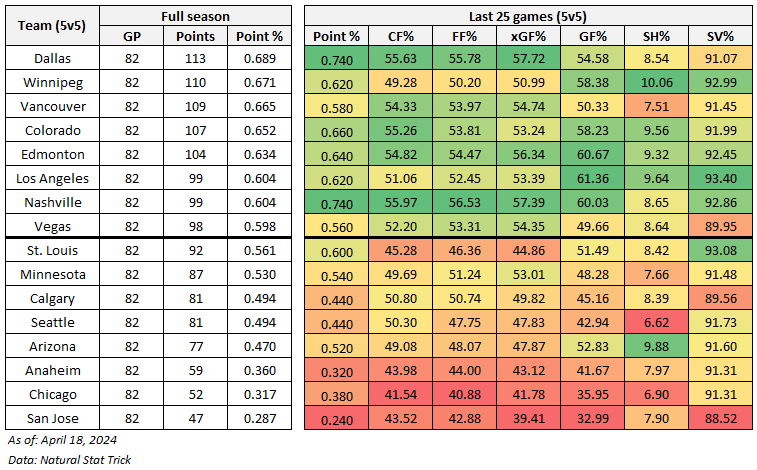
Quick glance into how each western conference has performed at even-strength over their last twenty five games (since around mid-February). Helps give a sense of what each team’s strengths and weaknesses are and how it could translate into their post-season results.
Nashville really stands out here. They might have finished the season in the first wild card spot, but they finished the season on a high note. They posted a 0.740 points percentage in their last twenty give games, driven largely by their strong shot-share and expected goal numbers, as well as their goaltending. Vancouver on the other hand had really regressed, coming close to losing their grip on the Pacific division title to Edmonton. They’re having trouble scoring goals recently, which is a little concerning since they’re going up against Nashville in the first round.
Vegas didn’t have a great finish to the season either, and their goaltending was one of the worst in the league. But with players coming back from injury, and the fact that they’re doing a good job controlling the flow of play and scoring chances indicates that they should be competitive in the first round. Dallas is the one team that’s been good all season long, and could be the team to beat in the west.
Plenty of success has been had this season for the Edmonton Oilers, who have now won 45 of their 73 games, securing 95 points. Their 0.651 points percentage ranks second in the Pacific division and eighth best in the league.
What’s especially impressive is how often the Oilers have won their games by a decent margin. Their +55 goal differential in all situations ranks sixth best in the league, due in large part to their overall health, the high-end talent up front, their ability to control the flow of play and proportion of scoring chances at even-strength and their success on the powerplay. The overall results this season have looked real and sustainable and should hopefully translate into a long playoff run – especially if their top players can stay healthy and their goaltending holds up.
It’s clear that the team has the talent to do some damage, but how well do they compare with the rest of the league and the other teams contending for a championship this spring?
One way to evaluate a team’s talent level is by looking into the number of clear victories they’ve posted. Clear Victories is a metric that Scott Reynolds analyzed and tracked over a decade ago over at The Copper & Blue and is defined as a win by two goals or more, excluding empty net goals. The key takeaway from Reynolds’ analysis is that clear victories were a better indicator of a team’s true talent level than the team’s overall record. And teams who more often win games by a larger margin tend to have better success in the future. Heading into the post-season this metric can really help identify the teams that have an edge over their competition and if any of the contenders might be considered outliers.
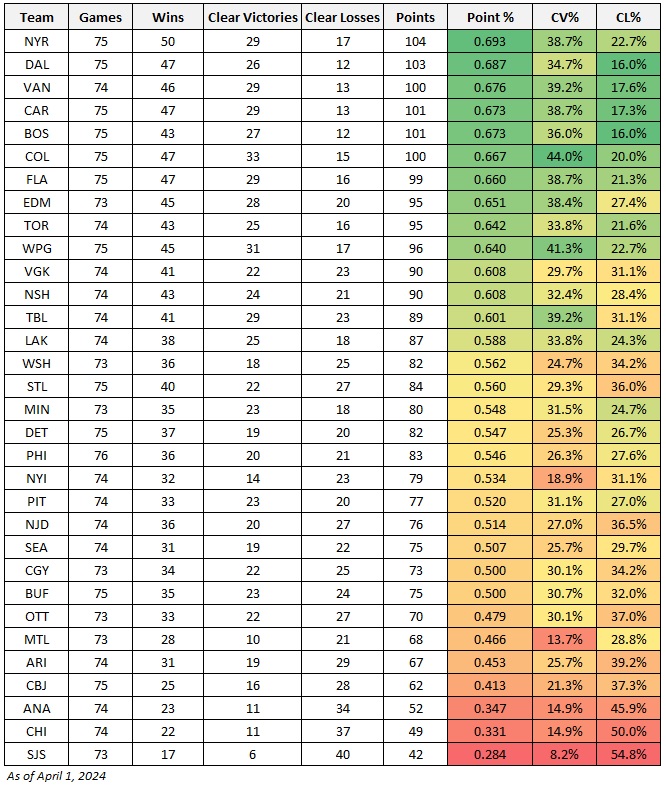
With a lot of help from Ganesh Murdeshwar from PuckIQ, I was able to put the following table together that sorts each NHL team by their points percentage along with the number of clear victories they’ve posted this season. This metric isn’t readily available, so I appreciate the support from Ganesh! You can follow him on X/Twitter at @OilersNerdAlert.
Again, Clear Victories is defined as a win by two or more goals excluding empty net goals. One additional criterion is that the winning team has that goal differential of at least two with three minutes left in the game. This helps avoid the scenarios where an empty net goal is scored earlier in the period (as we know teams are pulling their goalies earlier), or when a penalty results in a goalie pull.
Included in this table is each team’s Clear Victories Percentage (CV%), which is the number of clear victories divided by their total number of games, along with each team’s Clear Losses Percentage (CL%). I’ve also applied a basic heat map to each team’s points percentage and Clear Victories Percentage to see how teams compare with one another, and if there are teams who might be winning a lot but often by a smaller margin.
The top teams when it comes to Clear Victories Percentage this season are Colorado (44.0 percent), Winnipeg (41.3 percent), Vancouver (39.2 percent), Tampa Bay (39.2 percent) and the New York Rangers (38.7 percent). The league average is 29.6 percent. Edmonton ranks eighth in the league and fourth in the Western Conference, with 38.4 percent of their games being clear victories, sitting just behind Carolina and Florida. They’re right where we would expect them to be based on their points percentage, and confirms what we already know – they have the necessary talent. They just trail behind the rest of the contenders. What also sticks out when looking at the Oilers is that they’ve also lost a lot of games by two goals or more, relative to the other top-end teams. A lot of those two-goal losses happened early in the season, but there was that stretch in February where they weren’t playing very well and losing to teams that were below them in the standings.
Dallas sticks out here as well, as they rank second in the league in terms of points percentage, but only tenth overall in terms of clear victories. I didn’t realize that they’d been winning a lot of close games, which is a little concerning heading into the playoffs. They do have decent goaltending, which is obviously going to be a major factor for them. But this analysis indicates that their talent among skaters isn’t as high as what the rest of the contenders have. Winnipeg is another interesting team as they’ve struggled recently, and rank tenth in terms of points percentage. But their proportion of clear victories remains one of the highest, indicating that their roster has the talent that could turn things around pretty quickly. And looking at Vegas, it’s tough to see them having a lot of success in the playoffs when their Clear Victories Percentage ranks 19th in the league. They have been missing some top end players who could (miraculously) come back for the playoffs, but for now, it’s not looking too good.
Tampa Bay is the one club that could do some major damage if they secure a playoff spot. They’ve been on a tear recently, going 8-1-1 in their last ten games. And it comes as no surprise considering the talent and experience they have across their roster. What’s interesting about them is that their Clear Victories Percentage was ninth highest in the league just a few weeks ago, so the signs were there that the team was going to turn things around.
What really stands out from this analysis is that while the Oilers are showing positive signs and can be considered cup contenders, there are a bunch of other talented teams having great seasons as well. Like any other post-season, it will come down to the competitive edges that a team has developed through roster construction, player development and tactics. And it’ll come through in different ways, including scoring depth, goaltending and special teams. For now, we have a good handle on which teams have the talent and can be considered legit contenders. And this should make for a fairly competitive post-season, especially in the Western Conference.
After a bit of a slump in February, the Edmonton Oilers performed really well in the month of March, collecting 22 points in 15 games – a points percentage of 0.733 that ranked seventh-best in the league.
The club currently ranks second in the Pacific with a points percentage of 0.653 and eighth in the league. Their even-strength performance indicates that they’ll have positive results going forward. Their powerplay continues to be one of the best in the league. And the penalty kill isn’t costing them wins. All positive indicators heading down the stretch and into the playoffs.
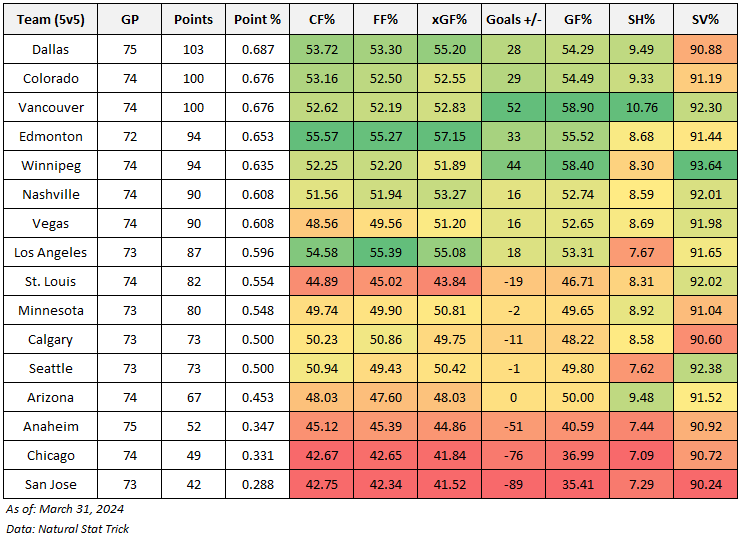
Below are the even-strength (5v5) numbers for each team in the western conference (sorted by points percentage), including goal-share results as well as the shot-share metrics that give us a sense of which teams have the right processes in place and if the results are sustainable or not. At the end of the table are each team’s shooting percentage and save percentage. I’ve also applied a basic heat map to each metric to show which teams are doing well or struggling relative to their conference foes (i.e., green is good, red is bad). You can also find a description of each metric at the end of this article. Please note that the shot-share metrics are score and venue-adjusted based on Natural Stat Trick’s methodology.
Edmonton continues to control the flow of play and scoring chances at even-strength (5v5), posting the third-best Corsi For percentage in the league and the best Expected Goals For percentage. McDavid is the obvious play-driver for the club, but the Oilers are also posting a 53 percent Corsi For percentage and Expected Goals share without him on the ice. The actual results (i.e., goal differential) does slide due to the lack of scoring talent in the bottom six and average goaltending, but there’s still plenty of optimism around the club.
Having said that, the rest of the western conference is looking really strong, especially compared to the east. The top end teams in the west are all posting great even-strength numbers, and look like legit contenders. Colorado, Dallas, Vancouver, Los Angeles, Winnipeg, and now Nashville, are all in the green in terms of shot-share numbers and goal differential.
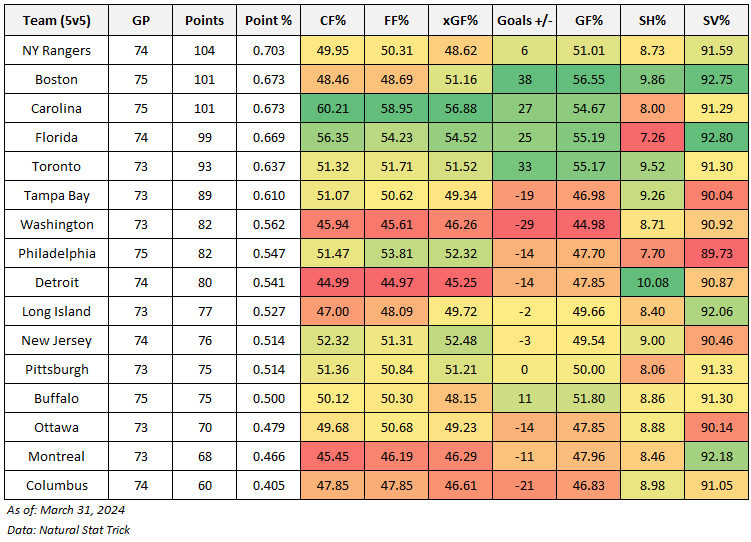
Compare that to the eastern conference where things are looking a little more wide open. The Rangers, while ranking first in the league, aren’t that great at even-strength, ranking below average when it comes to shot-share numbers and only have a 51% goal-share that ranks 14th in the league. Boston is also struggling to control the flow of play, so its difficult to have confidence in them even though they rank second. And three of the top eight teams in the east have a negative goal-differential at 5v5.
Back to the Oilers, and I wanted to see how the individual players have performed at even-strength since the trade deadline, and if there’s any areas for concern.
As mentioned, the top end of the roster continued to perform really well, and there’s no indication that their results should decline. It’s the rest of the roster that was a little unstable, especially the new trade deadline additions. Henrique as a center on the third line didn’t work very well, and has been spending more time as a winger on the second line, which has boosted his numbers. Carrick is basically what I was expecting, and isn’t even getting time on the penalty kill now. And Stecher has been so-so in the limited minutes he’s played. I can understand that it takes time for players to adjust to a new team and system, but that’s the risk of trade deadline acquisitions.
Also worth pointing out that while he’s been getting better results recently, Connor Brown’s on-ice shot-share numbers continue to be poor. The team allows a lot of chances with him on the ice, and I wouldn’t have a lot of confidence in his play in critical playoff games. He’s been given plenty of opportunities with an array of linemates now, and I do wonder if the team is better off with someone like Holloway or Gagner in the lineup than him.
While the Oilers did manage to add some serviceable players at this year’s trade deadline, I don’t think it was quite enough to give them any new competitive edges among other championship contenders.
The Oilers already have the top end talent at the top of their roster of forwards, along with some good complementary players with unique skillsets spread across the group. But they’ve been lacking enough finishing talent among their depth forwards at even-strength. Without McDavid or Draisaitl on the ice, the Oilers have done a good job controlling the flow of play (53.54 percent Corsi For percentage) and out-chancing opponents (53.29 percent expected goals for percentage). But it’s all been a waste as they’re only converting on 6.03% of their shots this season, and have been outscored 40-48 – a goal-share of only 45.45 percent.
Adding Henrique does give the Oilers an offensive boost up front, as he’s been a productive player in Anaheim the last few years at even-strength, and fairly consistent. His 1.84 points per hour rate this season is at a top-six level, and is almost identical to his points per hour rate over the previous five seasons (1.83). What’s especially encouraging about Henrique is that his finishing ability has been very good this season, as he’s posted a 12.68 percent individual shooting percentage in Anaheim, which is only slightly lower than the 13.82 percent shooing percentage he’s posted over the previous five seasons. His individual rate of shots this season (5.94) is down slightly from his career norms (6.79), but that might be because of the team he’s been playing on and the lack of talent he’s had to play with.
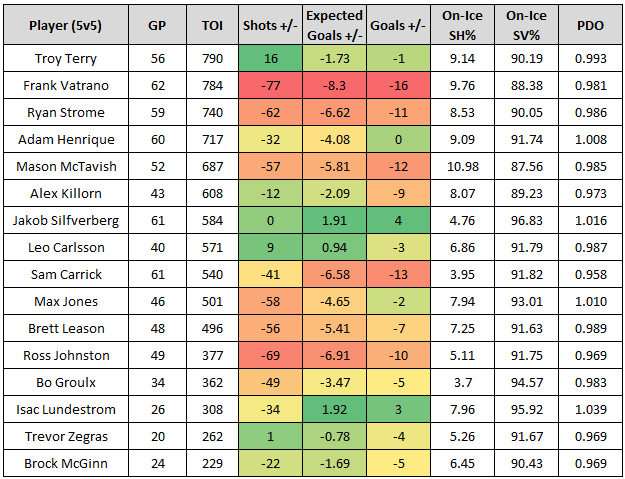
Speaking of which, the table below lists the Anaheim forwards this season, sorted by their total ice-time, including each player’s on-ice shot differential, expected goal differential and actual goal-differential. I’ve also included each player’s on-ice shooting and save percentage along with PDO to see what could be impacting their actual results (i.e., goal differential). A basic heat map has been applied to show how each player compares to their peers.
Henrique looks okay here, as he hasn’t been any sort of play driver for the Ducks this season, but hasn’t been a major drag either. His relative-to-team numbers are slightly down from the previous two seasons, making me think he’ll need someone on his line who can play with defensive responsibility. I’m not totally sold on him being a third line, play-making centerman either. So he might need to be with good play drivers like McLeod and Foegele for the Oilers to get some productivity out of him.
Really not sure what the Oilers are expecting from Carrick whose on-ice numbers had been awful this season relative to his teammates. I think this acquisition speaks volumes to how the Oilers feel about their AHL options, as there are very comparable players in Bakersfield including Gagner, Malone and Caggiula.
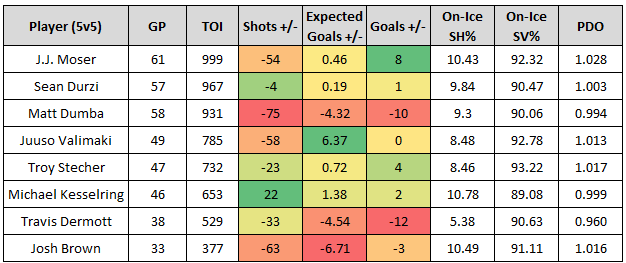
On the blueline, the Oilers did add a good seventh defencemen in Troy Stecher, who should be able to fill in as needed, and provide a little bit of offence. His relative to team numbers among Arizona defenceman were fine this season, as he was typically in a bottom-pairing role on a pretty shallow defence core. But I do find it funny that the other depth defenceman on their roster who posted better numbers than Stecher was Kesselring – a late round pick of the Oilers who was traded to Arizona last trade deadline to acquire Bjugstad. Bjugstad, as you may recall, posted some of the worst 5v5 numbers on the Oilers in the 2023 post-season, and was part of the reason why Vegas was able to exploit the Oilers weaknesses. But I digress.
Defence is an area where the Oilers really needed to make a bigger move as the pairing of Nurse and Ceci have not been good this season. And it’s especially concerning heading into the post-season with this tandem as their numbers together over the last three playoff runs have also been rough. In 26 playoff games, 345 minutes together at even-strength, the duo have posted a Corsi For percentage of 46.95 percent and an expected goals for percentage of 47.76 percent. Expecting better numbers from them this coming post-season would be foolish, and it’ll be on the coach now to closely monitor their deployment and forward pairings to get the most out of them.
The area that I felt the Oilers needed to better address was the goaltending. Skinner is having a great season, but I do wonder if he’ll be burnt out by the time the playoffs start. He’s played the seventh highest minutes among all NHL goalies at this point, which makes me think we might see the same performance from him that we saw in the 2023 playoffs. Among 28 goalies, Skinner was 21st with a 0.883 all-situations save percentage. Pickard has been fine as a backup this year, but more should have been done by management to shore up this critical position earlier on in the season.
So while the Oilers did a good job by adding Henrique and Stecher to fill specific roles, I don’t think it did enough to gain any sort of competitive edge over the other cup contenders. And by not addressing the defence and goaltending properly, they might have jeopardized their chances of a longer playoff run. Considering this is McDavid’s ninth season, and Draisaitl is in the last year of his contract next season, a lot more needed to be done.
A little late getting this one together, but I was interested in seeing if forward Jordan Eberle could be a potential trade target for the Edmonton Oilers at the trade deadline. Depth scoring at even-strength (5v5) is currently a problem for the team, as the club is only converting on 5.97 percent of their shots when McDavid and/or Draisaitl aren’t on the ice – well below league average levels (8.57 percent). And while the Oilers depth players are doing a good job at controlling the flow of play (53.56 percent Corsi For%) and out-chancing opponents (53.30 percent Expected Goals For%), they’ve been outscored 40-48 this season – a goal-share of only 45.45 percent.
Eberle is in the last year of his contract with Seattle, and will be an unrestricted free agent this summer as a 33-year old. He’s put up 695 points in 998 games, and also has that playoff experience hockey managers like, appearing in 76 games including two eastern conference final appearances with the Islanders.
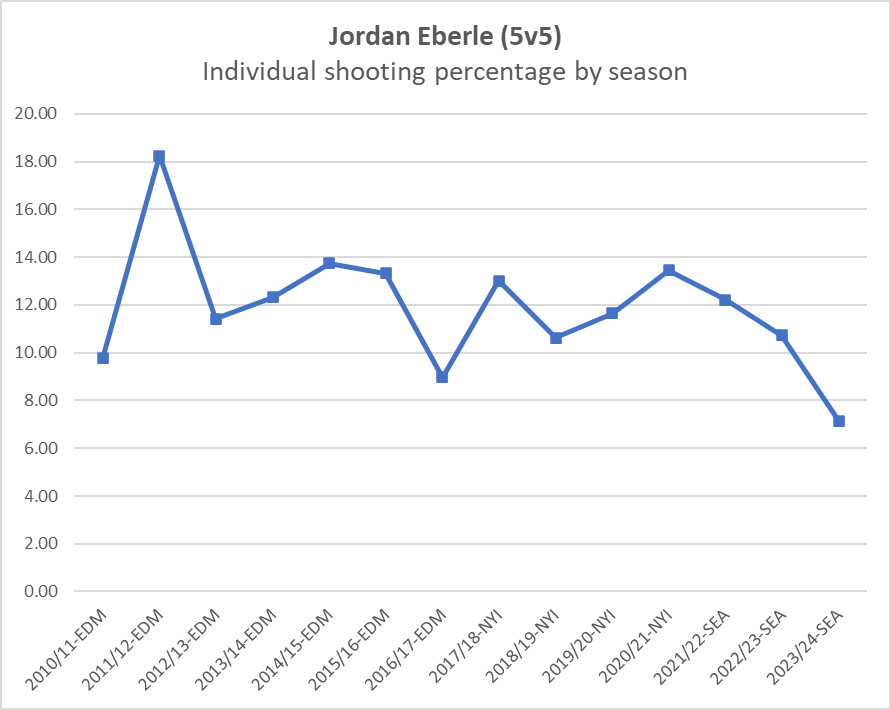
Over the course of his career, Eberle has been pretty consistent putting up second-line level points per hour at even-strength. This season, his rate has slipped slightly to 1.63 per hour, down from the 1.91 points per hour he posted in the previous five seasons.
A key driver for his point totals declining is his personal shooting percentage, which is sitting at 7.14 percent this season. Looking at his historical numbers, there’s been some ebb and flow, but he’s been pretty consistent posting a shooting percentage of 11.74 percent over the previous five seasons. I’d like to think this season is an anomaly just based on how consistent he’s been in the past, but age and wear and tear might be catching up to Eberle.
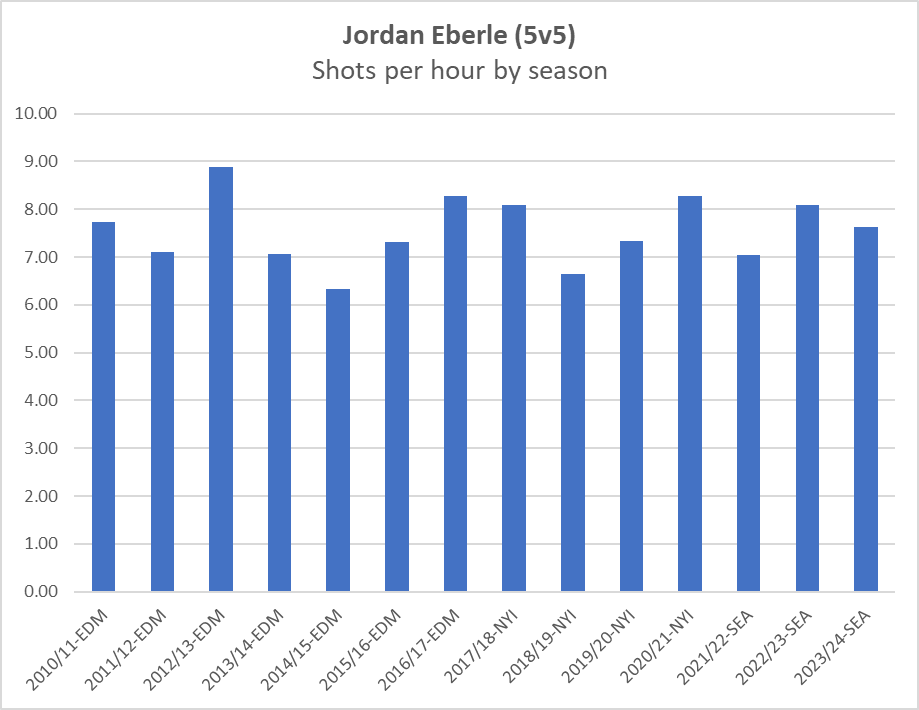
One reason to be optimistic about Eberle’s shooting percentage bouncing back is his continued ability to generate shots for himself. Over the previous five seasons, Eberle has averaged 7.44 shots per hour at even-strength. This season, he’s generating 7.78. Had this seasons rate of shots been lower than his career levels, I’d feel that maybe he was losing a step and not getting himself into plays often enough. But it appears that skillset is still there, indicating that there’s a chance that more of those shots will eventually turn into goals going forward.
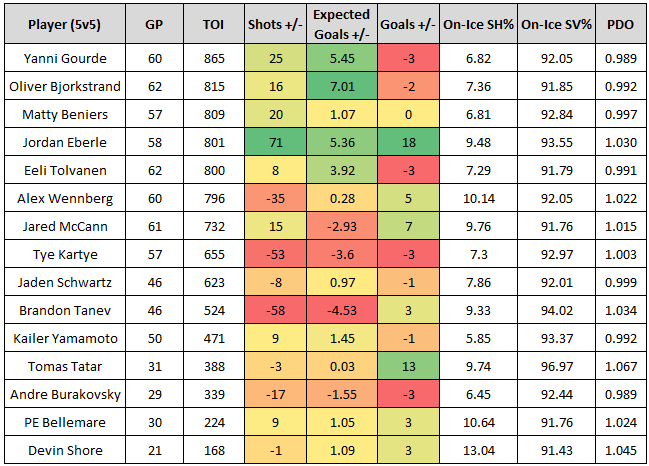
Another reason to be optimistic about Eberle remaining productive is his ability to drive offence for the Kraken at even-strength this season. Eberle continues to be a top-six option for his club and his team tends to out-shoot and out-chance opponents more often when he’s on the ice. The table below lists the Kraken forwards this season, sorted by their total ice-time, including each player’s on-ice shot differential, expected goal differential and actual goal-differential. I’ve also included each player’s on-ice shooting and save percentage along with PDO to see what could be impacting their actual results (i.e., goal differential). A basic heat map has been applied to show how each player compares to their peers.
Eberle’s numbers really stand out here. He’s posting some of the best shot-based metrics on the team, indicating that his team tends to do better with him than without him.
What’s interesting to note is that Eberle does appear to be having a bit of a bounce-back season. In the previous two seasons with Seattle, he was posting negative relative-to-team numbers – maybe because he was adjusting to a new system and playing some of the highest minutes on the team. Prior to that, he’d been consistently posting positive numbers, indicating his ability to help drive play and his team’s chances of out-scoring opponents. This season, his numbers appear to be back to where we would expect them to be, making me wonder if his productivity could improve, potentially as an Oiler.
Bit of a disappointing run of games for the Edmonton Oilers in the month of February. After a 16-game winning streak to close out January and head into the All Star Break, the club collected 13 points in 12 games (6-5-1), which translates to a 0.542 points percentage that ranked 20th in the league.
The good news is that the Oilers are still near the top of the Pacific division as Vancouver and Vegas also had poor results in February. Vancouver only secured 12 points in 13 games (0.462 points percentage) and Vegas only secured 9 points in 10 games (0.450 points percentage). Calgary, Los Angeles and Seattle all posted points percentages 0.600 and higher in February.
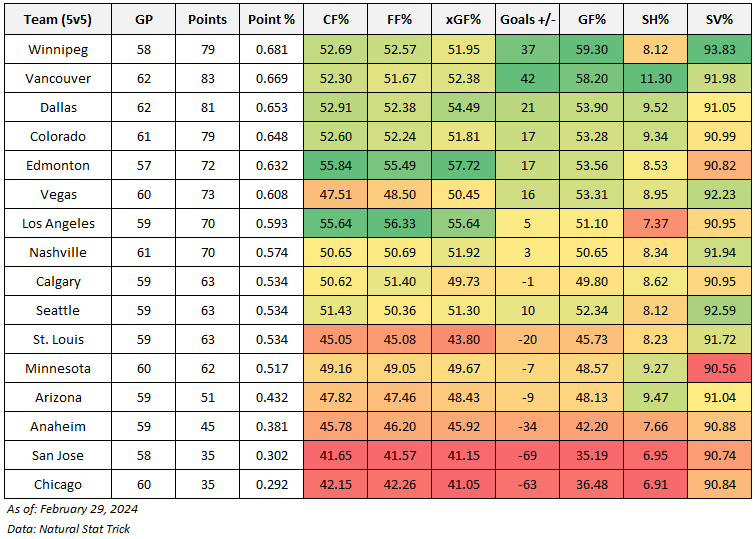
Below are the even-strength (5v5) numbers for each team in the western conference (sorted by points percentage), including goal-share results as well as the shot-share metrics that give us a sense of which teams have the right processes in place and if the results are sustainable or not. At the end of the table are each team’s shooting percentage and save percentage. I’ve also applied a basic heat map to each metric to show which teams are doing well or struggling relative to their conference foes (i.e., green is good, red is bad). You can also find a description of each metric at the end of this article. Please note that the shot-share metrics are score and venue-adjusted based on Natural Stat Trick’s methodology.
The Oilers continue to post strong shot-share numbers at even-strength, including a 55.84 percent Corsi For percentage (CF%) and a 57.72 percent Expected Goals For percentage (xGF%). Because their overall team shooting percentage and team save percentage is at or below league average levels, their goal-share isn’t as high as it should be.
With the trade deadline coming up next week, there’s plenty of issues the Oilers management needs to address to be competitive in the playoffs. Goaltending is still a concern for this club as it ranks 14th in the western conference, and the workload has been very high for Skinner (relative to other starting netminders). Depth scoring is a concern as the club has posted a -6 goal differential without McDavid or Draisaitl on the ice this season. The third and fourth lines have done a good job creating chances, but they really lack that finishing ability posting a shooting percentage of only 6.01 percent. That’s a problem considering the Oilers have played 47 percent of their time without one of the two star players. Another way to help the bottom six is to have some more talent on defence that can make passes and plays.
A lot of talk about potential trade options, so I thought I’d share the same information for the eastern conference teams. Just to get a sense of which teams are doing well and which teams should be in sell mode if they’re not already.
Detroit is the one club that’s getting better results than expected. Their shot share number are so poor, but they’re finishing their chances enough to keep them in the race. Florida looks legit, but appears to be having some issues with finishing. I’ll be honest, I thought Boston would be looking strong here, but their success doesn’t appear to be sustainable.
Should be an interesting week heading towards the trade deadline. I’ll be curious to see which teams work on addressing their issues, especially clubs like Florida, Carolina and New York – all of which have cup aspirations.
PS. Just wanted to say thanks to those that continue to read and support my work. I just noticed that February 29th was my eight-year anniversary since I started working with CBC Edmonton as an Oilers analyst. I’ll never forget that day, getting to provide trade deadline analysis in 2016 with host Adrienne Pan on live television. Such a cool experience. I’ve been blogging for much longer, and have had a lot of fun with it. Getting to write with Copper and Blue and being a guest on Lowetide’s show on TSN radio. And now writing for Oilersnation and still doing some radio work with CBC – I feel very fortunate for the opportunities.








 The SuperFan