I came across an interesting article from Sportsnet last week regarding the plus/minus stat and really how useless it is. In my mind, it’s fine as a counting stat, but when people rely on it to make comparisons between two players and evaluate individual performances with it, it’s painful to watch.
Featured in the article was former Oiler Patrick O’Sullivan who had a brief stint with the club, arriving at the end of the 2008/09 season, and departing the summer after the 2009/10 season. If you recall, the 2009/10 season was an absolute tank job by the Oilers, as they purposely dressed a weak roster, and failed to make any changes to improve their performance. O’Sullivan finished the season with 7 goals, and 14 assists at even-strength that season, good for 6th on the roster in total points. He played the fifth most minutes among forwards (which includes total ice time and ice time per game). His 1.38 points per 60 at evens ranked 9th among his peers, which was a drop from his previous two seasons in Los Angeles. In 2007/08, he notched 33 points (1.87 points per 60, 4th among regular forwards) and in 2008/09, he notched 29 points (1.61 points per 60, 3rd among regular forwards). O’Sullivan finished the 2009/10 season with a -35, the worst in the league, and is something that the player was obviously impacted by.
He’s able to laugh about it now, but he still believes the distinction hurt his standing in the league.
“It was one of the things that really hurt me for the rest of my career,” O’Sullivan says. – Sportsnet Magazine
We know that plus/minus is a terrible stat, but I wanted to see what some of the more modern metrics (i.e., possession, goal share, etc) can tell us about O’Sullivan’s 2009/10 season. What I’ve done below is show O’Sullivan’s relative-to-team stats when it comes to possession (Corsi For), shots on goal, expected goals (a measure of shot quality) and goals, season by season (Source: Corsica Hockey). I’ve also included O’Sullivan’s point totals in Appendix A.

Here we see that O’Sullivan had a couple of good seasons prior to joining Edmonton, and across the board, his team typically did better when he was on the ice than when he was on the bench. When he got to Edmonton, things went south fast. In 2008/09, O’Sullivan dressed in the final 19 games of the season in Edmonton, but in that time we saw a decline in his performance. The Oilers’ share of goals (in green) when O’Sullivan hit the ice was terrible relative to his teammates, and was actually one of the worst in the league.
A simple way to find out why this was happening is by looking at the individual player’s PDO, which sums up the on-ice save percentage with the on-ice shooting percentage, and measures the luck. In O’Sulivan’s two seasons in LA, his PDO was just slightly below 100, meaning that he wasn’t riding any sort of high on-ice save or shooting percentages. In Edmonton, his PDO was 96.13, one of the lowest in the league. This was caused by a slightly lower than team and league average shooting percentage (6.44%) and a significantly lower than average on-ice save percentage (89.68%).
The Oilers goaltending ranked fifth worst in the league when it came to save percentage at even-strength in 2009/10, with 90.93. And this save percentage dropped even further below from the league average when O’Sullivan was on the ice, which might explain that low proportion of goals. What’s interesting is that O’Sullivan was doing okay when it came to shot quality (i.e., scoring chances, rebounds, rush shots and shot distance), but the team’s goaltending couldn’t stop the scoring chances against on a regular basis.
What’s also worth noting are the linemates O’Sullivan spent the most time with in Edmonton that season. Below are the linemates he played at least 50 minutes with at even-strength, along with the breakdown of the different metrics, including PDO.
|
Horcoff & Jacques |
Penner & Gagner |
Potulny & Brule |
Potulny & Nilsson |
| TOI |
91.80 |
60.02 |
55.29 |
53.47 |
| CF% |
41.50 |
41.23 |
43.43 |
51.59 |
| Rel.CF% |
-7.23 |
-5.36 |
-5.22 |
4.00 |
| SF% |
42.86 |
41.07 |
44.83 |
50.00 |
| Rel.SF% |
-6.27 |
-6.00 |
-5.69 |
1.25 |
| xGF% |
35.55 |
40.78 |
38.48 |
49.70 |
| Rel.xGF% |
-13.79 |
-8.84 |
-9.51 |
3.22 |
| GF% |
20.00 |
57.14 |
20.00 |
25.00 |
| Rel.GF% |
-34.72 |
9.42 |
-16.00 |
-19.12 |
| PDO |
86.67 |
108.30 |
91.35 |
93.55 |
| Sh% |
6.67 |
17.39 |
3.85 |
3.23 |
| Sv% |
80.00 |
90.91 |
87.50 |
90.32 |
Being paired with Horcoff meant O’Sullivan would play a more shut-down role, which he never did in LA and it showed. Along with a fringe player like Jacques, the trio mustered a 41.50% Corsi For%, well below the league average and far from their team average. What’s staggering is the on-ice save percentage when that trio was together, which fell from being bad to being garbage at 80.00%. And playing alongside Ryan Potulny, who only played a handful of games at the NHL level after contributing to the tank job, didn’t help much either. O’Sullivan saw the on-ice shooting percentage fall significantly when paired with Potulny, which makes sense considering his lack of NHL ability.
Thoughts
O’Sullivan should definitely be pissed about the -35 rating in 2009/10, and can probably thank the Oilers for orchestrating their epic tank job that season. But when we look past the dated stat of plus/minus, we see that O’Sullivan’s low share of goals and shots that season was thanks in large part to two things: garbage goaltending and terrible linemates. This isn’t to say that O’Sullivan should be off the hook here; he should still take some of the blame for his lines poor performance. But the fact is, he had the ability to contribute at the NHL level when he was acquired and was quickly put in a position to fail by management.
Appendix A: Patrick O’Sullivan’s point totals
| Season |
Team |
Games |
G |
A |
PTS |
+/- |
PIM |
TOI/GM |
| 2006-07 |
LAK |
44 |
5 |
14 |
19 |
-6 |
14 |
14:04 |
| 2007-08 |
LAK |
82 |
22 |
31 |
53 |
-8 |
36 |
18:42 |
| 2008-09 |
LAK |
62 |
14 |
23 |
37 |
1 |
16 |
19:26 |
| 2008-09 |
EDM |
19 |
2 |
4 |
6 |
-7 |
12 |
18:14 |
| 2009-10 |
EDM |
73 |
11 |
23 |
34 |
-35 |
32 |
17:31 |
| 2010-11 |
CAR |
10 |
1 |
0 |
1 |
-1 |
2 |
8:52 |
| 2010-11 |
MIN |
21 |
1 |
6 |
7 |
-1 |
2 |
13:46 |
| 2011-12 |
PHX |
23 |
2 |
2 |
4 |
-4 |
2 |
11:03 |
|
Career |
334 |
58 |
103 |
161 |
-61 |
116 |
16:49 |
Source: Hockey Reference
.
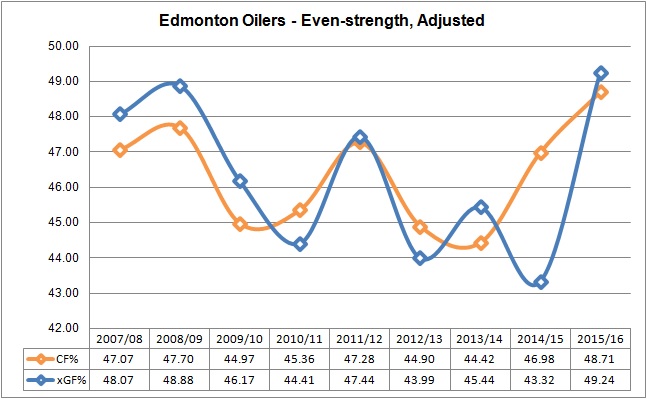
 Prior to the 2015/16 season starting, I spent some time re-watching San Jose games to get a sense of their style of play and their overall tactics with McLellan behind the bench. We knew historically the Sharks had been a very good team, one that was properly constructed with depth and balance across the roster, and had the ability to outshoot and outscore opponents on a fairly regular basis. But I was curious to see how certain types of players, mainly the ones on defence, were being utilized and what we could expect for the Oilers under a new coaching staff.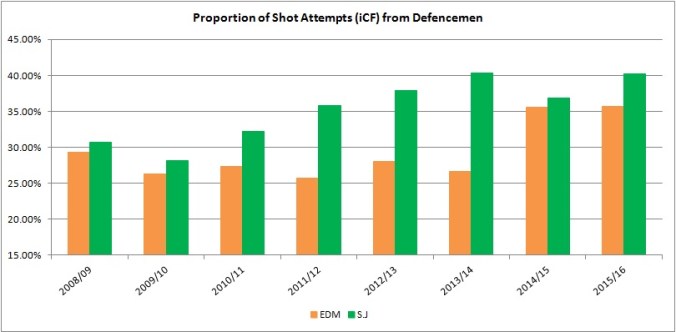

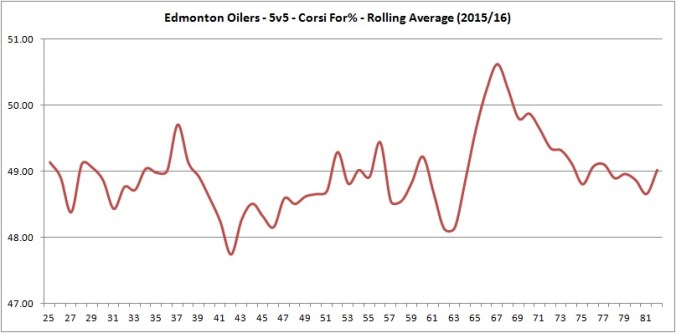
 It’s that time of year when really anything is possible, so speculation is rampant about how the Oilers could acquire and who should be dealt. With the draft coming up, there’s a ton of information on prospects with (at times) excessive discussion on which player might get drafted where. For the Oilers, my hope is that they trade the fourth overall pick as part of a package to acquire help on defence. I suspect that it won’t be a direct transaction and that the Oilers acquire a top six forward, and then move out one the current players to land that much needed defenceman. Having said that, if the Oilers keep the pick, they have to take the best player available (regardless of position) and let them stew at the right level until they’re ready to make the jump.
 Last summer , I put together a case for the Oilers to bring back Shawn Horcoff as a way to solidify their depth and give support to the young forwards. Obviously a long shot that he’d actually come back to Edmonton as a free agent. But he was worth a look as he put together two decent seasons in Dallas as a depth winger, and would’ve been a cheap signing.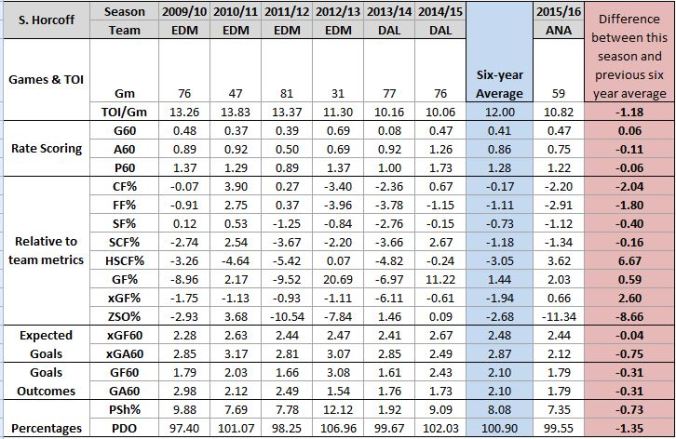
 The SuperFan