Talking Oilers, All-Star break and trade deadline on The Lowdown with Lowetide (TSN 1260)

Joined Lowetide this morning on TSN 1260 to talk all things Oilers. Clip starts around the 18:30 mark.

We touched on young McDavid’s first All-star game and the different options the Oilers have heading into the deadline. We talked about possibly acquiring Martin Hanzal from Arizona, and also discussed the next week of games.

In case you missed it, a couple articles I published at The Copper & Blue over the weekend:

I’ll also be making an appearance on the CBC Edmonton news on Tuesday night to talk Oilers. We’ll also be doing a Facebook Live session at noon (MST) tomorrow to talk Oilers and take questions. You can catch it on the CBC Edmonton Facebook page.

The January Hot Streak + Radio Spot on CBC Radio Active

The month of January has been excellent for the Oilers, as the team has collected critical points in their pursuit of a playoff berth. Outscoring their opponents 31-20 at 5v5, the Oilers went 9-4-0 in the 13 games and moved into a tie for first in the Pacific with San Jose. With 31 games remaining, the Oilers will need to secure another 36 points to get to 100 for the season, which is higher than what’s being projected to make the playoffs, but would guarantee them a spot.

If we dig into these 13 games in January, we see that the team posted a score-adjusted Corsi For% of 48.53, which is slightly lower what they posted prior to the month this season. In the month of January, the club generated a lower rate of shots-on-goal than the previous months, but posted a shooting percentage of 10.56%, which ranks them 5th in the league, and is a 3.0% jump from the shooting percentage they posted between October and December 2016. The team’s save percentage remained steady at around 92%, as the club has received reliable goal-tending from Cam Talbot, who could arguably be the team’s most valuable player this season. Worth noting that Talbot’s individual save percentage has historically been around 92%, but he’s posted a 93.5% save percentage in January.

Term Games Record Corsi For% (adj) Goals For% Shooting% Save% PDO
Pre January 1 38 19-11-8 51.63 51.47 7.48 92.62 100.11
Post January 1 13 9-4-0 48.53 60.78 10.56 92.94 103.50

It’s usually when a team’s PDO (the combination of the teams save percentage and the teams shooting percentage at 5v5) is below 98.0 or above 102.0 that typically warrants attention. The fact that the Oilers PDO has been over 103 in January, which ranks them 3rd highest in the league for this month, indicates that the club is getting a little lucky, and likely won’t sustain this level of production.

Now this is not a knock on the Oilers at all. NHL teams go through their hot and cold streaks throughout the regular season. The Oilers, over the course of the full year, have been a good-to-average team and fully deserve to be in the playoffs. They’ve held an above average share of shot attempts, which is used to predict future goals, and have posted an above average share of goals without having to rely on the more luck driven factors like shooting and save percentages.

Term Games Record Corsi For% (adj) Goals For% Shooting% Save% PDO
2016/17 Season 51 28-15-8 50.85 54.01 8.24 92.73 100.97

The concern here is that the Oilers will be making some important decisions now to sustain their success and push for the playoffs, and hopefully do some damage once they get in. As fun as January has been, it’s not likely that they’ll continue outscoring their opponents like they have over these past 13 games and continue getting over 60% of the total goals score at even-strength. But because of this great run, the coaching staff will likely want to keep the line combinations as is, even though specific players, like forwards Drake Caggiula and Matt Hendricks, have struggled. Caggiula is a good prospect that should be able to help the club in the future. But he’s struggled in his transition to center and is currently last on the team among forwards in points per 60 at 5v5 with 1.01, and just behind Milan Lucic who has 1.09 points per 60. And with Hendricks, it’s become pretty obvious that he’s lost a few steps and can’t bring any offence to the team. Both players have been part of the winning roster, no question, but the coaching staff has to make adjustments and maximize every shift, geared towards scoring goals. Depth will be critical today and in the playoffs, so the team has to make changes and could look to their AHL roster to meet their needs.

The other issue is the impact a hot streak like this can have on the Oilers long term goals of being a legitimate Stanley Cup contender. The Oilers may begin considering themselves as legitimate championship contenders today, and look into moving away assets in the form of picks and prospects to secure rental players. The team could definitely use a centerman to play in the bottom six or add depth to their right side. But decisions like these could hinder their options in the summer , when they should be targeting long term solutions for their roster and establish a proper window of opportunity to win championships. The team is definitely good enough to make the playoffs this year, but they should not be making decisions that will impact their long term goals based on their recent stretch of games.

Data: Corsica Hockey

Also posted at The Copper & Blue.

Thoughts on the Expansion Draft

brandon-davidson

In case you missed it, I joined Lowetide this morning on TSN 1260 to talk all things Oilers, including the SWEEP of the Flames, the upcoming California trip and options at the trade deadline (LT has a great list of potential targets). Clip starts around the 17:25 mark.


We also discussed the expansion draft and who the Oilers should be protecting. The Vegas Golden Knights will be joining the Pacific division and announcing their roster on June 21, 2017. Vegas will be drafting 30 players, one from each NHL team, and will follow a set of rules as outlined over at NHL.com.

* Clubs will have two options for players they wish to protect in the Expansion Draft:

a) Seven forwards, three defensemen and one goaltender

b) Eight skaters (forwards/defensemen) and one goaltender

* All players who have currently effective and continuing “No Movement” clauses at the time of the Expansion Draft (and who to decline to waive such clauses) must be protected (and will be counted toward their club’s applicable protection limits).

* All first- and second-year professionals, as well as all unsigned draft choices, will be exempt from selection (and will not be counted toward their club’s applicable protection limits).

If I’m the Oilers:

  • I protect the following players: Talbot, Sekera, Klefbom, Larsson, Davidson, RNH, Eberle, Draisaitl, Lucic.
  • Excluded from the expansion draft: McDavid, Nurse, Benning, Caggiula, Slepyshev and Puljujaarvi.
  • I leave the following players unprotected: Pouliot, Maroon, Letestu, Lander, Kassian, Khaira, Fayne, Reinhart, etc.
  • Source: Cap Friendly

Now before I go on, I need to make one thing clear: the whole discussion around the upcoming expansion draft, and which players are worth protecting and which players are worth letting go is all dependent on a lot of ifs and maybes. We can make our lists today, in January, but it can easily be turned upside down if the Oilers start moving out assets and addressing their current (and future) needs. You can protect 7-3-1, but if the Oilers find a decent right-shot defenceman this week, then maybe you protect four defencemen and only four forwards instead of seven. You can protect four defencemen, but if one is moved to shore up the center depth, then you’re moving to the 7-3-1 list. My point is, we can speculate all we  want, but there’s no use getting too attached, especially with a potential playoff-berth.

The NHL really is just a competition to see which clubs can put together the best roster, under a set salary cap, to win the Stanley Cup. The expansion draft is obviously for a new team to enter the league, but its also a disruption to the long-term goals of the existing teams. Recognizing this, the NHL is really going easy on the 30 teams, setting rules that more or less cushion the blow.

But to make Vegas somewhat competitive, the NHL is trying to make as many defencemen available to them as possible. We know how hard it is to draft, develop and/or acquire talent for the backend. There are plenty of forwards in hockey that you can plug in and out of your line up, within different combinations and allocate ice time to. Defencemen on the other hand are at a premium in today’s NHL. They aren’t so easily shuffled around a lineup, and have to be ready to play regular minutes against various levels of competition.

There’s a clear incentive for teams to protect only three defencemen. Doing so, you get to protect seven forwards, which is kind of excessive when you think about it as a lot of teams have young players in their top six that are exempt anyways. But hey, you get to protect more of your precious assets. If you want to protect more than three defencemen, now you’re cutting into the total number of assets you can protect.

With that in mind, I’m leaning towards protecting four defencemen, and yes, leaving guys like Maroon and Pouliot, both of which I value highly, unprotected.

I’ve written plenty on Pouliot, who I view as a very good top six NHL forward that can contribute on offence and has meshed well with an array of forwards.

There’s a stronger case, however, to be made in protecting Maroon from the expansion draft.

  • He’s currently playing with McDavid and Draisaitl on the top line. In 164 minutes this season, the trio has outscored the opposition 10-4 at 5v5 (71.43% goal-share) and has a Corsi For% of 55.31%. (Source: Corsica Hockey)
  • He’s been a positive influence on any center he’s played with when it comes to their share of shot attempts. Here’s what I wrote on Maroon’s ability to drive offence back in November 2016 – The Driver (The Copper & Blue)
  • He’s on a value contract this season and next season, getting paid $1.5 million per season.

As much as I like this player, I see two issues. First, his shooting percentage is at a career high 19.28% this season. It’s not likely that he can sustain this, but I guess anything is possible if he continues to play with McDavid.

Season Team GP TOI G A P P/60 iSh%
2012/13 ANA 13 118.37 2 1 3 1.52 10.00
2013/14 ANA 62 636.35 10 15 25 2.36 12.35
2014/15 ANA 71 839.6 7 18 25 1.79 6.93
2015/16 ANA/EDM 72 752.58 7 12 19 1.51 8.33
2016/17 EDM 49 661.96 16 4 20 1.81 19.28

The other issue is that when Maroon’s contract expires at the end of next season, he’ll be 30 years old and likely looking for dollars and term to carry him into retirement. There is evidence that players who play a physical game tend to taper off as they age past 30 (Source: Hockey Graphs), so there’s a very real chance that what we’re seeing from Maroon today is his prime. It might be a smart move to protect Maroon today, but it might not be the right decision for the Oilers long term goal of winning a championship. With McDavid, Nurse and Draisaitl expected to get heavy, long-term contracts in the near future, it may not make sense to allocate dollars to a 30 year old, complementary winger, likely on his downswing.

Maroon’s value has never been higher, and likely won’t be higher in the future. The Oilers could potentially trade him in the summer to address their needs on defence, but it’s unlikely considering his current status on the roster.

In my opinion, the Oilers would be better off protecting defenceman Brandon Davidson, who played very well for the Oilers as a bottom four type player last season. Assessing the team’s possession numbers from last season, we knew that the team did better with him on the ice than without him, which is expected from someone playing in a depth role. But we also saw him gradually take on tougher competition, with his contributions being missed when he was injured. Couple pieces I wrote last season:

Davidson is only 25 years old, and is signed for this season and next at a very reasonable $1.425 million per season. The NHL cap system favors and rewards the owners, as young players who are drafted and developed by a team remain under team control,  right through their prime years. Davidson is on a value contract today, and could very well be a long-term value contract as well. Defencemen are harder to find than forwards, with the supply never quite meeting the demand, especially around the trade deadline when teams prepare for the playoffs.

The end goal is to win the Stanley Cup, and to do that the team needs to establish an extended window, at least a five year term, where they can be legitimate, championship contenders. Investing in young players, especially defencemen, who can be on team-friendly, value contracts is going to be key for the Oilers. The decisions they make at the deadline and for the expansion draft have to be geared towards winning the Cup.


Talking Oilers on the CBC Edmonton News (TV) + Facebook Live

sunilcbc20170117

Joined Adrienne Pan on the CBC Edmonton News this evening to talk all things Oilers, including the playoff race they’re in and the upcoming schedule. Segment is here, and starts around the 12 minute mark.

We also did another Facebook Live session following the newscast, which can be viewed on the CBC Edmonton Facebook page. We covered a bunch of topics including the Oilers chances of making the playoffs, Eberle’s performance this season, potential trade deadline options, impact of the expansion draft, plus more. A big thank you to everyone who sent in questions! Full clip below.

https://www.facebook.com/plugins/video.php?href=https%3A%2F%2Fwww.facebook.com%2Fcbcedmonton%2Fvideos%2F1360036207371553%2F&show_text=0&width=560

Talking Oilers, defence pairings and trade deadline on The Lowdown with Lowetide (TSN 1260)

Joined Lowetide this morning on TSN 1260 to talk about the past week, including the overtime win against the Flames. We touched on the potential defence pairings, with and without Larsson, and what areas of the roster the team needs to focus on as the trade deadline approaches. Big week ahead with three home games against Arizona, Florida and Nashville, and a Saturday night tilt in Calgary.

Segment starts around the 20 minute mark.

Below are the various defence combinations that the Oilers have rolled with this season at 5v5, sorted by Corsi For% (score and venue adjusted). If the Oilers insist on playing Russell, they have to pair him with Sekera as that’s who he’s best with. Klefbom-Benning looks like a good tandem so far. And I’m also a fan of Gryba-Davidson as the third pair. (Data: Corsica Hockey. Ideal pairings for me: Klefbom-Larsson, Sekera-Benning, Davidson/Gryba/Nurse.

P1 P2 TOI CF%
ANDREJ.SEKERA MATTHEW.BENNING 196.36 56.74
DARNELL.NURSE MATTHEW.BENNING 113.2 55.87
ERIC.GRYBA OSCAR.KLEFBOM 59.93 54.86
ERIC.GRYBA BRANDON.DAVIDSON 79.91 54.07
DARNELL.NURSE ERIC.GRYBA 181.95 52.87
ADAM.LARSSON OSCAR.KLEFBOM 512.05 51.94
KRIS.RUSSELL ADAM.LARSSON 137.56 47.95
ANDREJ.SEKERA KRIS.RUSSELL 416.69 47.82
KRIS.RUSSELL MATTHEW.BENNING 50.19 46.34

This past weekend, I also looked into how the OIlers are doing when it comes to generating shots and what the key drivers/drags have been: Volume Shooting – The Copper & Blue (2017, January 14)

And just a heads up that I’ll be on the CBC Edmonton News to chat about the Oilers and the playoff race on Tuesday night. Following that segment, we’ll be doing another Facebook Live session on the CBC Edmonton Facebook page to talk Oilers and take questions from the community.

Volume Shooting

Early in his first season as head coach of the Edmonton Oilers, Todd McLellan emphasized the value of volume shooting, and its importance in generating offence.

Volume shooting, I don’t know what that does to Corsi or Fenwick because I don’t even know what those things are, but volume shooting is important. I think it breaks down defensive zone coverages, gets players out of position, taxes the opposition, makes them play more minutes in their zone. (Source)

Taking a look at the rate of shot attempts (i.e. Corsi For/60) the Sharks generated when McLellan was behind the bench, we see that they were always above the league average and typically ranked in the top five.

Season Corsi For/60 League Rank
2008/09 57.87 7th
2009/10 58.80 6th
2010/11 61.91 1st
2011/12 60.22 5th
2012/13 59.74 5th
2013/14 64.78 1st
2014/15 60.60 5th

It appears that the Oilers have gradually made progress when it comes to generating shot attempts under McLellan, as they currently rank 12th in the league, 5th in the Western Conference, with 57.18 shot attempts per hour at even-strength. The top five teams: Boston, Toronto, Montreal, Pittsburgh and Washington.

volume-shooting-cf60teams

As you might guess, one of the key drivers for the team’s rate of shot attempts includes Connor McDavid. When he’s been on the ice this season, the team has generated 62.66 shot attempts per hour, which is just below what Boston, who ranks first in the league in this metric, is generating. Without McDavid, the Oilers generate 54.55 shot attempts per hour, which is below league average, and would rank them 19th in the league. Also worth noting that the Oilers top line of McDavid, Maroon and Draisaitl is currently generating 71.12 shot attempts per hour.

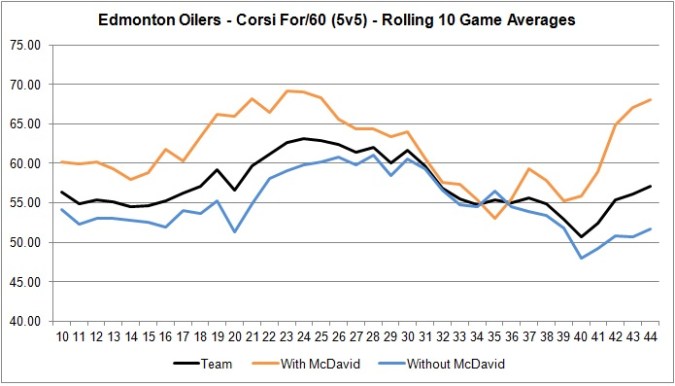
If we break out the Oilers rate of shot generation over rolling 10-game segments, we see that they had at one point been generating over 60 shot attempts per hour, but steadily declined starting around the end of November. As I mentioned in my previous article, I suspect this has to do with two things. One, the team lost Darnell Nurse, who was showing progress in his offensive game, to a long term injury at the end of November. And two, the team began giving more and more ice time to Kris Russell, who provides very little to a team’s offence. More on individual players later.

volume-shooting-rolling-10-game-averages

In the graph above I have the team’s rate of shot attempts, but I’ve also added two additional lines: one for the rolling 10-game averages of when McDavid is on the ice (orange line), and one for the rolling 10-game averages of when McDavid is off (blue line). The team is having issues this season where they’re relying heavily on one line, more so than other teams with elite players. Knowing his ability to escalate the play of his team, and the importance of having depth to win a cup, we’ll need to know how the rest of the roster is doing without McDavid on the ice.

What we can start to do is look at each player this season, and how the team does when it comes to generating shots with and without them on the ice. I’ve ranked the table below by Corsi For/60 Rel, which tells us how the team does with the player on the ice, compared to how the team does when they’re on the bench. So when Patrick Maroon is on the ice, the Oilers generate 65.65 shot attempts per hour. Without him, that number drops by 11.77 shot attempts.

Full article is at The Copper & Blue.

Couple Thoughts on Benoit Pouliot

benoit-pouliotWithout question, the 2016-17 season has been a terrible one for winger Benoit Pouliot. In 443 minutes this season, Pouliot has scored 5 goals and added 3 assists (all of which have been primary) at even strength, which ranks him 10th on the team among 15 forwards who have played at least 50 minutes this season. His 1.08 points per hour (P/60) is well below his career average coming into this season, ranks him dead last among the 15 forwards.

Player GP TOI G A P P/60
CONNOR.MCDAVID 43 678.51 10 20 30 2.65
TYLER.PITLICK 31 291.26 8 3 11 2.27
ANTON.LANDER 20 143.49 1 4 5 2.09
PATRICK.MAROON 43 572.52 15 4 19 1.99
LEON.DRAISAITL 43 574.32 5 12 17 1.78
MARK.LETESTU 40 360.13 3 7 10 1.67
JESSE.PULJUJARVI 28 286.12 0 7 7 1.47
ANTON.SLEPYSHEV 15 164.79 2 2 4 1.46
RYAN.NUGENT-HOPKINS 43 547.87 3 10 13 1.42
ZACK.KASSIAN 40 427.14 2 8 10 1.40
JORDAN.EBERLE 43 597.46 3 10 13 1.31
MILAN.LUCIC 43 609.46 5 7 12 1.18
DRAKE.CAGGIULA 25 266.27 2 3 5 1.13
MATT.HENDRICKS 18 161.85 1 2 3 1.11
BENOIT.POULIOT 38 442.72 5 3 8 1.08

pouliot-201617-p60

If we look at Pouliot’s relative-to-team stats, we see that across the five metrics (see Appendix for definitions), the teams that he’s been on have often done better with him on the ice than without him, with the current season being an exception.  This ability to be a positive influence is likely what drew the Oilers to him when he hit free agency in the summer of 2014. The Oilers at the time desperately needed an experienced winger who could support the developing core at the time, and made the right call signing a versatile forward like Pouliot while he was still in his prime.

pouliot-201617-relstats

Unfortunately for Pouliot, the team has done better without him on the ice this season, which is surprising considering his history of being a positive influence. This season, the team has been outscored 13-15 with Pouliot on the ice, but has maintained a 50% share of all of the shot attempts with him. The issue for Pouliot has been the penalties he has taken, as he’s tied for the worst penalty differential with Kassian, sitting at -6 (i.e., he’s taken 12, but only drawn 6).

We also have to keep in mind here the McDavid effect when assessing the 2016-17 rel stats above. When McDavid is not on the ice, the Oilers see a drop in production as they have a  49.98% share of the shot attempts, and 45.54% of the goals. Pouliot has only been on the ice for 20 minutes with McDavid this season, as Maroon and Lucic have been the regular left wingers, so it’s fair to compare how Pouliot’s on-ice numbers compared to McDavid’s off ice numbers. I’d be a lot more concerned with Pouliot’s production if his on-ice numbers were lower than the McDavid off-ice numbers.

Metric McDavid off ice Pouliot on ice
CF% 49.98 50.00
FF% 49.86 50.74
SCF% 44.71 45.86
xGF% 45.89 45.28
GF% 45.54 46.43

What I do wonder is what impact the coaching staff’s constant line juggling this is having on players including Pouliot. What’s become pretty obvious is that McLellan bases a lot of his lineup decisions on actual results – specifically goals. That’s completely understandable if you’re trying to ride a hot hand when a combination of players are scoring, but you’re also quick to break up what could be a good line if they’re not scoring. To assess what could be a successful line combination in the future, the share of shot attempts (Corsi or Fenwick), and the expected goal share (xGF%), the more predictive metrics, needs to be reviewed. Relying solely on goal-share, while understandable, is risky as goal production is often influenced by more random factors, as players (shooting percentage) and goalies (save percentage) can run hot and cold through a season.

Couple issues I see for Pouliot. One, he hasn’t had consistent linemates this year, as he’s been constantly shuffled around the bottom nine, sometimes with Caggiula, sometimes with RNH, and sometimes in the press box. In my opinion, he should be lined up with RNH at any given moment, as they could be relied on to match up against the other team’s top lines. RNH has struggled mightily this season, but if he can be paired with Pouliot and Eberle for a long stretch of games, I think the team can benefit. Keep in mind that the trio posted a 53% Corsi For percentage together coming into this season and that was not in any sort of sheltered role. They did get outscored 26-28, but again we have to put that into context as the goaltending was pretty bad last season and impacted their goal-share.

The other issue I see is how quickly Pouliot has been punished for taking penalties. Again, this is understandable from a coaches perspective as these penalties have been in the offensive zone and have lead to a powerplay goal against. Unfortunately for the Oilers, playing on the edge is a part of Pouliot’s game and it’s made him an effective NHL player. Yes, penalties do get called against him, but more often than not in previous years his fore-checking and aggressive, often risky, play is what’s lead to turnovers and shots on goal. Punishing a player who has relied on this type of play can easily have a detrimental effect as they may hesitate, even for a split second, to engage along the boards in an attempt to create offence.

One last thing – the Oilers need to roll out Pouliot on the penalty kill as often as they can. The club is still allowing a higher than average number of unblocked shot attempts against (68.60 per hour). But when Pouliot is on the ice, the rate of shots against drops to 61.13 per hour, fourth lowest on the team among all players  who have played at least 30 minutes on the penalty kill.

Data: Corsica Hockey

Appendix – Definition of metrics

  • Corsi For% (CF%) – The proportion of all the shot attempts the team generated and allowed that the Oilers generated (i.e., Corsi For/(Corsi For + Corsi Against). This is used as a proxy for possession and can predict a team’s future share of goals.
  • Fenwick For% (FF%) – The proportion of all the unblocked shot attempts the team generated and allowed that the Oilers generated (i.e., Fenwick For/(Fenwick For + Fenwick Against). This is used as a proxy for shot quality and considers shot blocking a repeatable skill. It can also predict a team’s future share of goals, slightlty better than Corsi.
  • Scoring Chances For% (SCF%) – The proportion of all the scoring chances (as defined by Corsica Hockey) that the team generated and allowed that the Oilers generated (i.e., Scoring Chances For/(Scoring Chances For + Scoring Chances Against),
  • Expected Goals For% (xGF%) – This is a weighting placed on every unblocked shot based on the probability of the shot becoming a goal. This depends on the type of shot, location and uses historical shot and goals data to come up with the probability for each unblocked shot. This has been found to be a better predictor of future goals than Corsi and Fenwick. (Detailed explanation can be found at Corsica Hockey)
  • Goals For% (GF%) – The proportion of all the goals that the team scored and allowed that the Oilers generated (i.e., Goals For/(Goals For + Goals Against).


The Edmonton Oilers With and Without McDavid (Part III)

An area that the Oilers will need to address going forward is their scoring production when McDavid is not on the ice. The young captain is the offensive catalyst that drives play and elevates his team when he steps on the ice. But when he’s on the bench, there’s been a significant drop in the team’s goal-share at even-strength.

Heading into Tuesday’s night game against the Sharks, the Oilers had outscored their opponents 36-22 at even-strength with McDavid on the ice, which translates into a 62.07% goal share. Without him, the Oilers have been outscored 43-51, a goal-share of 45.74%. The Oilers do appear to have an okay proportion of the shot attempts (Corsi For%) without McDavid as they have a 50.51% share without him, and a 54.71% share with him. Corsi provides value here as it serves as a proxy for possession and predicts a team’s future goal share. When we look at the expected goals for percentage, which measures the quality of the shots generated and also predicts future goal share, the Oilers drop from a 56.25% share with McDavid on the ice to 45.71% share without him.

If we look at the rolling 10 game averages of the different metrics with and without McDavid, we start to see a pattern that should be of some concern for the team.

First up is a graph with the Oilers shot-share broken up into three lines: the team’s goal share with McDavid (blue), the team’s goal-share without McDavid (orange) and the team’s overall goal-share (black) (with and without McDavid).

mcdavid-wowy-cf

Full article is at The Copper & Blue.

Talking Oilers on The Lowdown with Lowetide (TSN 1260)

Joined Lowetide this morning on TSN 1260 to talk all things Oilers, including the demotion of Puljujaarvi and Gustavvson to the AHL. Full clip is below, starting around the 40 minute mark.

Couple notes:

  • The new top line of Maroon-McDavid-Draisaitl is absolute gold right now. In 66 minutes together so far this season, they’ve outscored the opponent 6-1 at 5v5 and have a 67% CF% (adjusted). This line should stick together, but also allow for Draisaitl to center another line as needed.
  • Another line I’d like to see get an extended look this season is Pouliot-RNH-Eberle. Heading into this season, they were a 53% CF line, but were outscord 26-28. Part of that was the team’s shoddy goaltending (89% save percentage). It obviously wouldn’t be a popular move, considering the funk all three have been in. But I’d like to see the coaching staff have more patience with their forwards, as there’s been very little stability in terms of line combinations all season. I’m convinced the head coach doesn’t like the roster he has.


Checking in on the Oilers Pacific Division Rivals

Forty games into the 2016/17 season, and the Oilers are holding a playoff spot, ranking third in the Pacific with 47 points, good for fifth in the Western conference. The team is coming off of a big win against a good Boston club last night, with Maroon, McDavid and Talbot leading the way. Up next is a back-to-back set against the Devils, who will have played the night before, and the Senators.

With the team in a playoff race now, it’s worth checking in on how the Oilers Pacific division rivals are doing in terms of goals and the shot metrics that predict future goals. The three California teams are going to be the ones to beat, but if the Oilers can get consistent even-strength scoring from the lines that don’t feature McDavid, they could potentially challenge for that third spot.

Here’s what the Pacific Division looks like today. I’ve included each team’s record, along with their points percentage, which is the points divided by the total points available (Source: Hockey Reference).

Team Games Record PTS PTS% GF% CF% XGF%
San Jose Sharks 39 23-14-2 48 0.615 52.98 52.03 53.07
Anaheim Ducks 40 20-12-8 48 0.600 43.16 44.72 41.48
Edmonton Oilers 40 20-13-7 47 0.588 52.38 51.10 49.00
Calgary Flames 40 21-17-2 44 0.550 47.16 49.59 47.14
Los Angeles Kings 39 19-16-4 42 0.538 50.55 54.07 53.03
Vancouver Canucks 40 19-18-3 41 0.513 46.05 47.63 46.57
Arizona Coyotes 38 11-22-5 27 0.355 49.17 49.45 51.51

What we can also do is look at how each team is doing over 10-game, rolling segments this season. What we do here is take games 1-10, find the average of the metric, then take games 2-11, find the average, games 3-12, and so on. Doing so can highlight trends and can give us a better perspective of how a team’s entire season has been going.

I’ve focused on even-strength play (5v5), as it evaluates a team in a natural game setting where coaches are rolling their lines, trying to score and defend, and is where the majority of the game is played. These numbers are also score adjusted, based on Corsica Hockey’s methodology. This way, we eliminate score-effects, as team’s that trail in a game start to take more risks and generate more shots, while team’s that lead in a game tend to play safer, and generate far fewer shots. Without adjusting, team’s that trail a lot, like the OIlers have in the past, start posting better shot-shares, for example, mainly because they’re taking more risks trying to tie a game. So adjusting for score-effects puts more emphasis and value on the events that occur in close game situations and gives us a more accurate assessment of a team. More on adjusted metrics can be found at Corsica Hockey.

pac-rollingcf

Full article is at The Copper & Blue.