How much better is the Oilers defence this season?

9908808-nhl-edmonton-oilers-at-st.-louis-blues-850x560

Following a 29th place finish, the Oilers focused on their defence, and made significant changes  in the off-season acquiring Adam Larsson for Taylor Hall, and signing Kris Russell. Adding experienced players allowed them to push Nurse further down the depth chart, at an appropriate level for a developing prospect. And it allowed for the Oilers to push down defencemen like Reinhart and Oesterle to the minors where they could continue to develop.

A quick look at the 2015/16 defence group that played at least 100 minutes at 5v5, compared to the 2016/17 group (sorted by TOI).

2015/16 GP TOI
ANDREJ.SEKERA 81 1,353.24
DARNELL.NURSE (R) 69 1,166.12
MARK.FAYNE 69 1,002.99
ERIC.GRYBA 53 796.07
BRANDON.DAVIDSON (R) 51 777.24
JUSTIN.SCHULTZ 63 712.33
OSCAR.KLEFBOM 30 483.39
GRIFFIN.REINHART (R) 29 452.04
JORDAN.OESTERLE (R) 17 294.50
ADAM.CLENDENING 29 279.84
NIKITA.NIKITIN 11 155.30
ADAM.PARDY 23 153.45
2016/17 GP TOI
OSCAR.KLEFBOM 79 1,339.57
ADAM.LARSSON 76 1,325.61
ANDREJ.SEKERA 77 1,248.21
KRIS.RUSSELL 65 1,142.57
MATT.BENNING (R) 59 877.38
DARNELL.NURSE 42 641.26
ERIC.GRYBA 39 564.52
BRANDON.DAVIDSON 36 389.26

Based on the group of defencemen, and the fact that they’ve been healthy for the most part, and the fact that the rate of goals against per 60 is down (goal differential of -36 to +22), my expectation was that the team improved this season in the following areas at even-strength (5v5):

  • Fenwick against/60
  • Shots against/60
  • Expected goals against/60
  • Scoring chances against/60
  • Average shot distance against

Now these are all reflective of the things that teams probably want to be good at defensively and where teams would want to improve if they revamp their defence core. They want to limit the shots getting through (i.e., they block shots), they want to keep shots away from their net, keep pucks to the outside, they want to force low-probability shots and limit scoring chances.

Here’s a high-level summary, comparing the Oilers numbers from last season to this season. I’ve included their league ranking for each metric.

Edmonton Oilers (5v5) 2015/16 2016/17
Fenwick Against/60 42.67 (24th) 40.33 (9th)
Shots Against/60 30.64 (24th) 29.46 (12th)
Scoring Chances Against/60 8.39 (19th) 8.81 (26th)
xGoals Against 2.55 (23rd) 2.64 (24th)
Avg Shot Distance 33.01 (27th) 30.92 (30th)
Goals Against 2.63 (30th) 2.16 (9th)
Save% 91.43 (29th) 92.68 (8th)

At first glance, it appears the Oilers have improved this season when it comes to the volume of shots against (Fenwick, Shots on goals). And when it comes to the quality of those shots (Scoring chances, expected goals), it appears they’re hasn’t been much of an improvement from last season. The key thing that jumps out is the team save percentage, which has been strong and consistent all year. But let’s take a look at each metric.

Fenwick Against/60

The Oilers saw their rate of unblocked shots against go down by 2 events per 60 minutes at 5v5 this season, which moved them from 24th overall to 9th. Below are the year-to-year numbers for the Oilers. Please note that in the graph below, the range (35 to 51) reflects the average league-wide range.
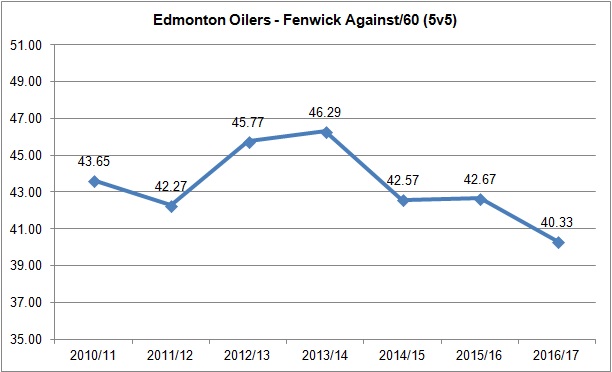
20170406 - Defence Analysis - FA60

The Oilers have been much better at blocking shot attempts this season, blocking 28% (7th in the league) compared to 26% last season (15th in the league). What’s a little troubling is that the rate of unblocked shots against has gradually increased over the course of the 2016/17season, as the Oilers started off well, but have gradually been worse. Below is the rolling 25-game segments, with two lines: the 2015/16 season on the left and the 2016/17 season on the right.
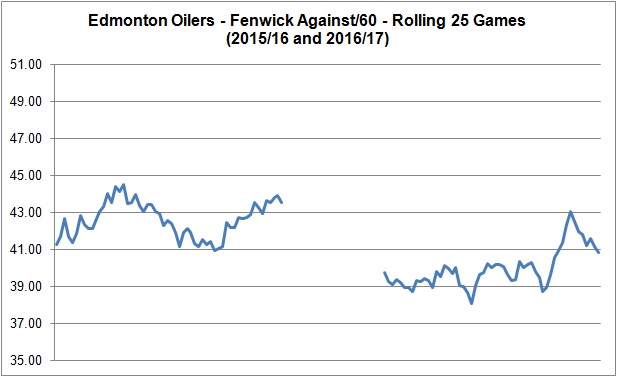
20170406 - Defence Analysis - FA60 Rolling

The team finished with a  rate of 42.67 Fenwicks against/60 last season, and actually exceeded that rate for a 25-game stretch this season. I’d say the defence has been better, but they still haven’t ironed out some of the deficiencies from last season.

Shots Against/60

The Oilers saw their rate of shots on goals against per 60 drop by 1.18 this season. This doesn’t seem significant, but it moved the Oilers from being below league average to just around it.

20170406 - Defence Analysis - SA60

But again, if we look at the rolling 25-game segments at 5v5, we see that the team is still having issues, especially in the most recent stretch where they’ve hovered around the same rate of shots against as last season. I find this pretty odd considering the Oilers defence core has been healthy all year, and the defence pairings have been consistent all year.

20170406 - Defence Analysis - SA60 Rolling

Scoring Chances Against/60

Now this I wasn’t expecting.

The rate of scoring chances against, as defined by Corsica, has actually increased this season, dropping them from 19th in the league to 26th.

20170406 - Defence Analysis - SCA60

It appears that last season, the club was a lot more consistent when it came to preventing scoring chances, hovering between 8 and 9 chances per 60. This season they’ve struggled, as they’ve shown signs of improvement, dropping from around 10 chances per hour down to 7. But this gradually got worse again, even surpassing last season’s worst stretch.

20170406 - Defence Analysis - SCA60 Rolling

What’s worth noting here is that the average distance of the shots against has dropped, meaning the shots against are getting closer. The Oilers are 30th in league when it comes to this metric, meaning Talbot is getting shot at from a lot closer than past seasons. This leads us to our measure for shot quality.

Expected Goals Against/60

This is a weighting placed on every unblocked shot based on the probability of the shot becoming a goal. This depends on the type of shot, location and uses historical shot and goals data to come up with the probability for each unblocked shot. This captures a lot more data compared to scoring chances, as every unblocked shot against is included, and also does a good job of predicting future goals. (Detailed explanation can be found at Corsica Hockey).
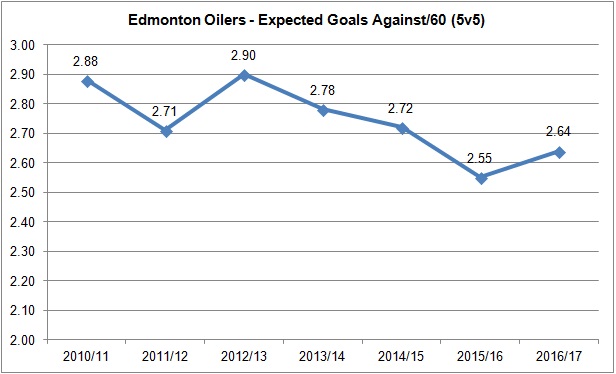
20170406 - Defence Analysis - xGA60

It appears that when it comes to expected goals against, the Oilers have been worse this season compared to last, dropping from 23rd to 24th in the league. So while the team is preventing more shots from getting through (i.e., they’re blocking more shots), the shots they allow are of the higher quality, and the ones more likely to becoming goals.
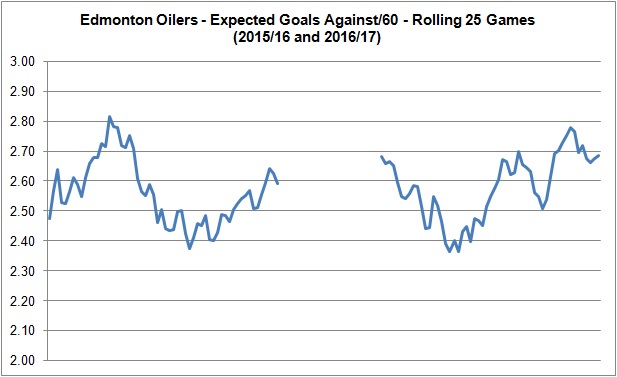
20170406 - Defence Analysis - xGA60 Rolling

What’s worse is that the rate of expected goals against has gradually increased this season, again surpassing some of the worst stretches from last season.

Summary

My takeaway from this is that the team hasn’t really improved when it comes to the defensive side of the game, making only marginal progress when it comes to the rate of shots against, but actually getting worse when it comes to the quality of those shots against. This is pretty disappointing considering the cost of acquiring Larsson, and some of the narratives about this team being more balanced on the back-end and being harder to play against.

The biggest factor that has driven down the rate of goals against has been Cam Talbot, who has started the vast majority of games this season. First, a quick glance at the team’s save percentage year over year:

20170406 - Defence Analysis - SV%

The club went from having the second worst team save percentage last season to the 9th best this season. What’s even better is that the save percentage has trended upwards over the course of this season, with the club even reaching 94% (!!) for a 25-game stretch.

20170406 - Defence Analysis - SV% Rolling

Without Talbot’s improved play from last season, there is no way this team would be contending for a division title. While the Oilers even-strength offence is relying heavily on McDavid, it appears that the drop in goals against is largely due to Talbot, and not the defence core.

Data: Corsica Hockey

Talking Oilers, playoff matchups and more on The Lowdown with Lowetide (TSN 1260) + Notes

I joined Lowetide this morning on TSN 1260 to talk Oilers. Clip is below and starts a few minutes in.

Topics we covered:

  • Big win against the Ducks on Saturday night
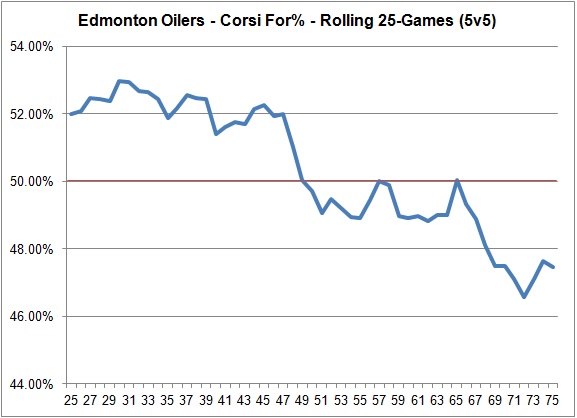
  • The season-long Corsi For% is trending downards
  • Potential playoff matchups (vs Calgary, San Jose or Anaheim)
  • The Oilers penalty kill and if Anton Lander could help
  • Comparing the play of Drake Caggiula and Anton Slepyshev
  • Upcoming road games in Los Angeles, San Jose and Vancouver.

Couple thoughts:

  • The more I watch this team, the more I think they might end up being like the Habs and Rangers in the past. They’re getting outshot now more regularly (rank 18th in the league with a 50.1, score-adjusted Corsi For%), but the Oilers are getting some very good goaltending from Talbot that’s just been bailing them out, night after night. The Oilers rank 6th in the league today when it comes to team save percentage at even-strength (92.9%), which is outstanding. If Talbot does this again next season, I’ll consider him elite (he’s just below that group right now, in my opinion). (Data: Natural Stat Trick)
  • History has shown that the best teams, the ones that can contend for the Cup, have good possession numbers, especially in their final 25 games of the regular season. The Oilers need to be better, and really need to figure out how to slow down the rate of shots against. It’s been brutal, even with McDavid on the ice. Wrote about it last week:
  • Goal scoring is always tougher in the playoffs, so it’s great news that the Oilers have a pretty decent powerplay running right now. They rank 5th in the league (and 1st in the west) when it comes to goals per hour. And it looks to be sustainable, as they’re 10th when it comes to the rate of unblocked shots generated (75.67), and 9th when it comes to shots on goal per hour (53.65).
  • And it looks like whatever adjustments the team made on the penalty kill has been working. They reduced the rate of shots against in the month of March, and the goaltending bounced back in a big way. Al mentioned this in our segment, which I didn’t touch on in my article, but Caggiula and McDavid are getting more reps shorthanded, and have added some much needed speed. Here’s what I wrote on the penalty kill last week:
  • In my opinion, the most important prospect for the Oilers, aside from McDavid, is Draisaitl. He brings a lot of elements that  the team needs to  win championships. And I think he has the skill and size that could potentially drive a line in the future. But until there’s evidence of it, I have to remain skeptical. Without McDavid or Hall with him at 5v5, Draisaitl’s on-ice Corsi For% is 49.8%, which isn’t bad. And his on-ice goal-share is 40.7%. It’d be foolish to hand him a heavy, long-term contract without even knowing if he can drive a line, but I suspect that management has already made up their minds.
  • PS: I’m pretty stoked about the playoffs, and happy to hear more and more people talk about really contending for a championship. For far too long, making the playoffs was the end goal, and I think that’s a poor way to build a team. I don’t think any club should be given a pass because they’re young, or that they need “learn how to win”, whatever that means. Championship windows, as we’ve seen in Dallas this year, can open and close pretty quickly, so it’s critical to push for a championship as soon as you can. With McDavid, that sped up the process considerably, and it’s nice to see the conversation around the Oilers start to change. The Oilers are in a fantastic spot right now and the pieces are coming together. Still some holes to figure out in the off-season. But for now, anything is possible.

The Oilers’ Penalty Kill is Killing Penalties Again

pouliot

One area that the Oilers have struggled with this season is their penalty kill. In the first few months of the 2016/17 season, things were looking great, as the club ranked in the top five when it came to goals against per hour. But looking deeper into the numbers, their success early on did not appear to be sustainable as they allowed one of the highest rate of unblocked shots against per hour and were basically being bailed out by stellar play from Cam Talbot.

Over December and January, the rate of shots remained high and the goaltending began to regress, sinking the OIlers penalty kill down the overall rankings. By the end of February, the team sat 19th in the league in terms of goals against per hour, brutal considering they ranked as high as third in the first few months. But it was somewhat expected as they allowed the 10th highest rate of unblocked shots against by that point.

It appears however, that the Oilers penalty kill is coming back to life.

Outstanding efficiency in those past 10 games, and it appears the goals against per hour heading into Thursday night’s game against San Jose was the second best in the league. What’s especially encouraging is the fact that their recent success was legitimate in March, and didn’t rely solely on Talbot, as the rate of unblocked shot attempts against also improved.

What I’ve done below is break out the Oilers penalty kill performance by month this season, and included how they rank overall in the league. I’ve included the actual goals against per hour, along with the unblocked shot attempts against (Fenwick), and the team save percentage. And just for fun, I’ve included the team’s faceoff percentage each month, only because there was a lot of chatter about faceoffs being a reason why the Oilers penalty kill was struggling.

Month Games TOI Goals Against/60 Fenwick Against/60 Save% Faceoff %
October 9 54.40 3.31 (5th) 77.21 (28th) 94.12 (4th) 36.92 (29th)
November 14 74.61 4.02 (7th) 65.14 (11th) 90.74 (7th) 43.24 (21st)
December 14 76.52 7.06 (22nd) 62.73 (12th) 85.00 (22nd) 46.15 (12th)
January 14 65.78 5.47 (16th) 71.15 (20th) 89.83 (8th) 46.58 (13th)
February 12 45.73 13.12 (30th) 78.72 (26th) 76.19 (29th) 36.96 (30th)
March 11 43.98 2.73 (1st) 54.57 (7th) 92.00 (3rd) 35.71 (29th)
TOTAL 74 361.02 5.82 (16th) 67.97 (17th) 87.97 (13th) 42.74 (24th)


Heading into Thursday’s game, the Oilers rank 16th in the league when it comes to goals against, and 17th when it comes the rate of unblocked shots. And goaltending is slightly above league average now. This jump in the league rankings is thanks in large part to an outstanding March, where the club’s rate of unblocked shots against was one of the best in the league, and a big drop from where they were earlier in the season. Their 2.73 goals against per hour was the best in the league, and a part of that be attributed to Talbot’s play as his numbers bounced back from a poor month of February. Worth noting that Talbot’s performance on the penalty kill has historically been pretty solid, as he held a 90.52% save percentage over his 113 NHL games prior to this season. The 92.0% team save percentage in March isn’t likely to stay at that level, but the team could withstand a slight drop-off in Talbot’s play as the shot rates against are way down.

Also worth noting that the Oilers continue to struggle when it comes to faceoffs when shorthanded, yet it didn’t exactly matter in March as they limited the rate of shots against and got strong goaltending. Faceoffs do matter, but not to the extent that some might think.

As noted above, Benoit Pouliot has been playing well since his return to the lineup, and has seen more time on the penalty kill. He’s in one of the toughest seasons of his career, posting abysmal numbers at even-strength, but he does appear to be turning things around. Among the forwards who have played at least 25 minutes on the penalty kill this season, he has the best on-ice Fenwick Against per hour, relative to the team average. When he’s on the ice, the rate of shot attempts against drops by 11.8 shots against per hour compared to the team’s average, indicating his positive influence. Last season, he was rarely used on the penalty kill, only playing 23 minutes, but even in his limited appearances, the shots against dropped considerably relative to the team average (-16.01). And in 2014/15, the unblocked shots against dropped by 10.9 when he was on the ice.
Pouliot is clearly an effective player shorthanded, so we should expect to see the coaching staff roll him out regularly. The other player worth watching for is Zack Kassian, who has played 76 minutes on the penalty kill this season, and also has an on-ice Fenwick against per hour below the team average (-4.44). Both he and Pouliot have seen more ice time recently, at the expense of Matt Hendricks, who has been in and out of the lineup.

Whatever the Oilers are doing in terms of deployment and tactics on the penalty kill, the results have been there and appear to be sustainable for the most part. All positive signs heading into the post-season when special teams becomes even more critical.

Data: Corsica Hockey, Hockey Analysis

Full article is at The Copper & Blue.

A Look Into the Oilers’ Declining Possession Numbers

Now that the Oilers have clinched a playoff spot, the question is how far can they possibly go.

Heading into last night’s game, the Oilers ranked 7th in the league, and 3rd in the Western conference behind Minnesota and Chicago, in even-strength goal-share with 53.93%, having out-scored their opponents 151-129. The Oilers powerplay has been very good as well, ranking second in the league when it comes to goals for per 60. And it appears their success is sustainable with the man-advantage as the club generates the sixth highest rate of unblocked shots-for per 60.

The one issue for the Oilers is that possession wise, they have slid down to 19th in the league sitting at a 49.66% Corsi For percentage, which indicates their goal-share at even-strength might not exactly be sustainable. What’s even more concerning is that over their last 25 games, which would go back to the end of January, the team’s Corsi has been 47.46%, a number that the bottom-feeders of the league typically post. To make matters worse, while the team continues posting a respectable Corsi For% with McDavid on the ice, over the last 25 games, without McDavid the Oilers have a Corsi For% of 45.48%.

20170328 - Team CF

Why does Corsi For% matter?

What we’ve seen from the past three playoff tournaments is that team’s increase their odds of winning a championship if they can post a respectable Corsi For% over the final stretch of games heading into the post-season. By no means are teams guaranteed success, but it’s a positive indicator if you’re out-shooting the opposition and posting better possession numbers.

Here’s a a quick glance at the four conference finalists from the past three playoffs, and what their Corsi For% was over their final 25 regular season games.

2016

Tampa Bay – 51.5%
Pittsburgh – 54.9%
San Jose – 52.7%
St. Louis – 54.7%

2015

Tampa Bay – 50.9%
New York Rangers – 48.7%
Chicago – 52.4%
Anaheim – 52.0%

2014

Montreal – 46.9%
New York Rangers – 53.2%
Chicago – 55.8%
Los Angeles – 57.3%

Only two of the last twelve conference finalists posted a Corsi For% less than 51%: the 2014 Montreal Canadiens and the 2015 New York Rangers. Worth noting that both of these clubs had elite goaltending in those seasons, ranking in the top three at even-strength save percentage, that may have been masking their issues. While the Oilers do have a solid netminder in Cam Talbot, the team’s overall save percentage at even-strength this season has hovered around league-average for the most part. And it’s doubtful, at this point, that it would be enough to cover the team’s larger deficiencies.

If we break out the rate of shot attempts for and against over rolling 25-game segments, we see that while the team’s ability to generate offence has dipped, it’s remained around league average for the most part. And that’s thanks in large part to McDavid, as the club generates 60.8 shot attempts per 60 with him on the ice, and only 52.51 without him.

Full article is at The Copper & Blue.

Talking Oilers and Potential Playoff Berth on the CBC Edmonton News (TV) and Radio Active

CBC_20170328

I joined Kim Trynacity on the CBC Edmonton News last night to preview the game against the Kings and potentially clinching a playoff spot. Link is here, clip starts around the 19:30 mark: CBC Edmonton News (2017, March 28).

Topics we discussed:

  • Could the Oilers beat the Kings tonight
  • Keys to success this season
  • MVP season for McDavid
  • Cam Talbot’s play
  • Potential first round matchups

Quick note: the graphic we used to highlight the team’s goal-share at even-strength and a breakdown of McDavid’s numbers had a small error in it. The goal-share for the team was supposed to be 53.9%, not 59%. Data was pulled from Natural Stat Trick.

I also joined Trisha Estabrooks on CBC Radio Active on Tuesday afternoon.


Talking Oilers, Shot-share and Playoffs on The Lowdown with Lowetide (TSN 1260)

I joined Lowetide on TSN 1260 this morning to talk all things Oilers. Clip is below, starting around the 20 minute mark.

Topics we covered:

  • Keys to success this season.
  • The Oilers declining shot-share (Corsi For%).
  • Matt Benning’s emergence and future with the team.
  • That Sekera-Russell pairing.
  • Playoffs and reasonable expectations.
  • Calling up Mark Fayne if Benning is out with an injury.
  • Upcoming games against LA, San Jose and Anaheim.

McDavid’s in the Scoring Race, and the Oilers Aren’t Exactly Helping

7mcdavidrussell

Something that’s been of interest to me lately is how the Oilers might be slowing down Connor McDavid’s offence. He leads the league in points with 87, but I honestly believe that if he had a better defence core behind him, he could’ve been further ahead than the rest of the group.

Here’s how the scoring race looks today:

Player Points
Connor McDavid 87
Sidney Crosby 82
Patrick Kane 81
Brad Marchand 80
Nikita Kucherov 78

My thought is that if your team has the puck more often, then that should increase your odds of putting up points (EDIT: and having a higher goal share). I’ll use Corsi For% (i.e., shot attempts) as my proxy, and I think for the most part it checks out. It also predicts future goal-share quite well.

Here’s each player’s team’s Corsi For% at 5v5 this season.

Team CF% Rank
Boston 55.2 2
Tampa Bay 51.6 5
Pittsburgh 50.9 11
Chicago 50.5 13
Edmonton 49.8 19

So of the five leading scorers, McDavid’s club ranks 19th in the league with a Corsi For% of 49.8%. And his competitors in the scoring race are all on teams that have at least a 50.5% share of the shot attempts.

Next, it’s worth seeing how each of the top five players does with the defence core they have. Defencemen are a big part of each player’s success, as having a balanced group that can skate and move the puck well will make a significant difference. What I really want to see here is what kind of support each of the leading scorers gets, and if any of them are being dragged down.

Here’a a quick breakdown of each of the top five scorers and their on-ice Corsi For percentages with their most common defencemen this season (minimum 100 minutes together at 5v5). Defencemen are listed in descending order by ice time with the player.

McDavid

Player TOI CF60 CA60 CF%
KLEFBOM, OSCAR 421:28:00 61.93 57.80 51.7
LARSSON, ADAM 414:50:00 62.05 56.99 52.1
SEKERA, ANDREJ 407:07:00 57.18 55.12 50.9
RUSSELL, KRIS 364:38:00 53.64 59.24 47.5
BENNING, MATTHEW 277:34:00 57.93 50.37 53.5
GRYBA, ERIC 174:01:00 67.23 45.17 59.8
NURSE, DARNELL 167:10:00 64.25 45.58 58.5
DAVIDSON, BRANDON 122:58:00 55.62 43.43 56.2

As expected, when McDavid is on the ice with Russell, the team’s CF% drops to 47.5%. The next lowest is with Sekera, at just under 51%. With Russell, the rate of shot attempts for drops to 53.64, while with anyone else, it’s higher than that. It’s obvious Russell is a drag on McDavid, but the fact that the shots for drop should raise some concern for the coaching staff.

That’s more than 360 minutes that McDavid has to basically carry around Russell and get outshot doing so, which makes you wonder how much better the point totals would be had the Oilers found a more talented, not necessarily elite, right shot defenceman last summer. Russell is a capable NHL defenceman who can contribute as a depth player, but it should be obvious to anyone watching this team that he’s playing above his established level. It really would make no sense to retain a player who hampers your best player’s offence.

Related: Holding Back McDavid – The Copper & Blue (2017, March 22)


Crosby

Player TOI CF60 CA60 CF%
DUMOULIN, BRIAN 400:10:00 66.87 52.78 55.9
SCHULTZ, JUSTIN 368:33:00 63.82 56.33 53.1
LETANG, KRIS 310:22:00 65.54 51.81 55.8
COLE, IAN 274:29:00 69.73 58.15 54.5
MAATTA, OLLI 203:22:00 63.43 63.43 50.0
DALEY, TREVOR 197:39:00 68.00 65.57 50.9

Kane

Player TOI CF60 CA60 CF%
KEITH, DUNCAN 526:05:00 59.31 52.58 53.0
CAMPBELL, BRIAN 430:32:00 53.93 56.02 49.0
SEABROOK, BRENT 428:12:00 61.65 60.39 50.5
HJALMARSSON, NIKLAS 393:18:00 56.14 48.67 53.6
VAN_RIEMSDYK, TREVOR 289:50:00 54.86 50.10 52.3
KEMPNY, MICHAL 189:43:00 69.26 51.23 57.5
FORSLING, GUSTAV 141:59:00 49.87 55.36 47.4

Marchand

Player TOI CF60 CA60 CF%
KRUG, TOREY 418:24:00 73.57 39.87 64.9
CHARA, ZDENO 404:01:00 64.16 49.75 56.3
CARLO, BRANDON 390:53:00 68.46 48.20 58.7
MCQUAID, ADAM 371:08:00 68.06 42.03 61.8
MILLER, COLIN 169:54:00 76.28 45.91 62.4
MILLER, KEVAN 159:20:00 64.77 48.20 57.3

Kucherov

Player TOI CF60 CA60 CF%
HEDMAN, VICTOR 416:10:00 60.12 47.29 56.0
STRALMAN, ANTON 323:55:00 58.16 47.60 55.0
GARRISON, JASON 263:01:00 61.82 53.15 53.8
COBURN, BRAYDON 250:39:00 59.84 46.44 56.3
SUSTR, ANDREJ 242:08:00 57.24 53.77 51.6
DOTCHIN, JAKE 163:21:00 66.12 47.75 58.1
NESTEROV, NIKITA 144:18:00 62.37 42.83 59.3

Of the four players, only Kane posts a CF% less than 50% with one defenceman (49.0% with Campbell). Crosby, Marchand and Kucherov all post a CF% above 50% with every single defenceman they’ve played with for at least 100 minutes this season. Must be nice.

I hope this also squashes the whole “Russell plays tough minutes” thing. The Oilers roll out their top two pairs equally, with Klefbom/Larsson and Sekera/Russell seeing similar levels of competition. Every one of those defence groups listed above has a pair that plays tough competition, but they can still post a CF% of 50% with their best offensive forward on the ice. So let’s stop using the excuse of Russell playing against top lines or taking more defensive zone starts. His 47.5% CF% with McDavid is unacceptable and needs to be addressed.

Takeaway

The Oilers have quite possibly the best player in the world on their team that will hopefully be their franchise cornerstone for a long time. Surrounding him with talent should have been the number one priority when they won the draft lottery with the focus being on winning a championship. The club did make some good moves by acquiring Talbot and Maroon, signing Sekera as a UFA and signing Klefbom to a long-term deal. But the fact that they brought in someone like Russell, who has a long history of dragging down the offence of his team, makes me wonder what exactly they were thinking. It did help push the younger, developing  players like Nurse, Reinhart and Oesterle down the depth chart, and added some experience to the roster. But the point of the game is to generate offence, and the fact that one of the elite offensive talents in the league has to spend that much of his time with someone playing above his established level is mind-boggling.

It will be imperative that the Oilers surround McDavid with the best possible defence core that can support him offensively and not be a significant drag on his production.If the end goal for management is a championship, it’s their responsibility to take action.

Data: Hockey Analysis

Holding Back McDavid

Enough can’t be said about Connor McDavid and the great season he’s been having. He currently leads the league in points with 85, including 57 assists. The Oilers are a different, much more offensive team with him on the ice, posting a higher share of shots, scoring chances and goals at even-strength (5v5).

Breaking out his on-ice numbers at even-strength into rolling 25-game segments, we see that for the most part the Oilers’ share of events have regularly been well above the break-even point when McDavid is on the ice. These really are remarkable numbers for a second-year forward, and it’s possible that the best is yet to come.

The one metric that stands out in the graph above is the team’s share of shot attempts in blue (Corsi For%) and unblocked shot attempts (Fenwick For%) with McDavid on the ice, as it’s been steadily declining since around mid-January sitting just barely over 50%. Over the course of the season, the Oilers have posted a 52.95% share of the shot attempts with McDavid on the ice. But since mid January, that share has dropped down to 49.89%.

There’s nothing about McDavid’s game that suggests he might be the problem: he’s been healthy, he continues to play his usual style to generate chances, he’s been shooting around the same frequency all season and he’s been very productive on a line with Patrick Maroon and Leon Draisaitl.

One of the factors likely impacting McDavid’s on ice Corsi For% is the defence pairing of Andrej Sekera and Kris Russell. This season, the pair have regularly played top four minutes for the Oilers and have a Corsi For% of 44.84% at even-strength, one of the worst shares on the team and in the league among regular pairings. What’s most concerning is that their play together has been getting progressively worse, and it’s starting to impact the productivity of one of the best players in the world.

Below is a graph containing the Corsi For% when McDavid is on the ice with one of the two most common defence pairings this season: Larsson/Klefbom, and Russell/Sekera. These two pairings have really been the Oilers top four this season, and have played similar levels of competition. What I’ve done here is break out the season into two: the games up to and including January 10th, 2017, and games since that date.

Here we see that McDavid has posted slightly better numbers more recently with the Larsson-Klefbom pair, going from 49.2% before January 10th, to 51.3% since. With Russell and Sekera, McDavid was posting a 48.2% share of shot attempts, but that number has dropped considerably to 43.8% since mid-January. If we’re wondering why McDavid’s own on-ice Corsi For% has been dropping, we may have found one of the main drivers of it.

These are the kinds of numbers a coaching staff needs to address, as a critical piece of their offence is being negatively impacted by a poor defence pairing. There’s no question that Sekera and Russell are capable NHL defencemen, but it’s become obvious that as a pairing they’ve been doing more harm than good. Russell is playing above his established NHL level, and is better suited on his left-side, in more of a depth role and can contribute on the penalty-kill. And Sekera has had more success when paired with a right-handed defenceman. This season, paired with rookie Matt Benning for just under 200 minutes, the duo have a Corsi For% of 58.01%, the best on the team, and a goal-share of 58.82%. With McDavid on the ice with them, the Oilers have posted a Corsi For% of 56.8%. And in 2015/16, when Sekera was paired with Mark Fayne and took to the ice with McDavid, the Oilers posted a Corsi For% of 51.1%.

Whatever the Oilers do, they have to ensure that their best player is in a position to generate offence. McDavid is the key driver for the club, as their season and post-season success, will depend on his performance. It’s obvious that there’s an issue with the club when the team’s possession numbers are sliding with their best player on the ice. Finding a solution could be as simple as tweaking the defence combinations and deploying players differently. Or it could require system adjustments, possibly moving away from a dump-and-chase style, that accommodates the skill and speed of their best players. Generating offence has to be the goal and maximizing McDavid’s potential is going to be critical today and going forward.

Full article is at The Copper & Blue.


Another Look Into the Oilers Secondary Scoring + Radio spot (TSN 1260)

Joined Lowetide on Monday morning on TSN 1260 to talk Oilers. Clip is below and starts around the 25 minute mark.


One of the more interesting issues around the Edmonton Oilers this season has been the performance of the team when Connor McDavid hasn’t been on the ice. The second-year forward has been an absolute offensive force for the club, consistently using his skill and speed to lead the attack and create scoring opportunities at will. Over the course of the season, the Oilers as a team have maintained a decent share, right around league average, of the shot attempts, scoring chances and goals, thanks in large part to the play of McDavid.

What we’ve come to realize though after 71 games is that the Oilers are icing two very different teams: one with McDavid that can outshoot and outscore opponents, and another one without McDavid on the ice that posts numbers below league average. With McDavid on the ice at even-strength (5v5) this season, the Oilers have an incredible goal-share of 61.17% (outscoring opponents 63 to 40). Without McDavid on the ice, the team can only muster a goal-share of 48.72%, having been out-scored 80-76. When it comes to shot-metrics, which are used to predict future goal-share, the Oilers have a Corsi For% of 53.16% with McDavid on the ice, having outshot opponents 1,151 to 1,014. Without McDavid, the team has a Corsi For% of 48.49%, below league average and a troubling number considering the expensive personnel on the roster. Please refer to the Appendix for descriptions of the five metrics.

Now the good news is that the secondary lines have recently been contributing more. Jordan Eberle appears to have bounced back from his poor start and has been productive on a line with Ryan Nugent-Hopkins and Milan Lucic. The trio have played 220 minutes together so far, and hold a Corsi For% of 51.39%, scoring five even-strength goals together and allowing six. The newly formed trio of Montreal castaways featuring Benoit Pouliot, David Desharnais and Zack Kassian have now played roughly 48 minutes together, outscoring opponents 4-2 (a goal-share of 66.7%), and getting 48.8% of the shot attempts. Worth noting that this line is riding a 17.4% shooting percentage, which is likely to drop off eventually.

While the goal-scoring has improved without McDavid on the ice, a closer look at the shot metrics indicates that the secondary offence is still sputtering. Below is a graph with the five metrics broken out into rolling 25-game segments, capturing the team’s performance without McDavid.

C7X5-4dUwAA61sq

Full article is at The Copper & Blue.

Wasted Youth

Something that’s bothered me for a while is the lack of real skill and talent in the NHL. Ideally, the league would have fewer teams, create more competition for spots and ice lineups that are better loaded with skill and goal-scoring ability.

The way it works in the NHL today is that you’ll have a small group of true contenders, teams with talent that can score and have an entertaining product. Then there’s a big group of average teams, with decent rosters but plenty of holes preventing them from becoming legitimate contenders. And then you have the junk teams that appear to be contending for a playoff spot, but really aren’t when you factor in the three-point/loser point system.

The issue for thes bad teams is typically poor roster construction around their skilled players and the lack of depth, especially on defence. Think of the Oilers, Avalanche and Coyotes and some of the terrible decisions they’re management teams have made. What’s especially bothersome is when talented, elite players have to spend the prime of their professional careers with these loser organizations.

A prime example that comes to mind, for obvious reasons, is 26 year old Taylor Hall. After being drafted in 2010 by the Oilers, the winger played six full seasons as the team’s top line winger, before being moved to New Jersey. Here’s how his team’s have done with and without him at even-strength.

Hall EO

Hall NJ

Brutal.

In Edmonton, he was an offensive driver, as the team was just able to outscore opponents when he was on the ice. Without him, a goal-share of 40%. It appears that the same thing is happening now in New Jersey as Hall continues to be the offensive driver, but he’s again surrounded by a terrible roster that is garbage without him. He is being paid for his work, but it’s got to be frustrating losing this often.

Side note: Hall is signed with the Devils for three more seasons at $6M per season, and is a UFA at age 28. The others signed to long term deals in New Jersey: Zajac (31), Palmieri, and Andy Greene (34) and Cory Schneider (30). (Cap Friendly)

It’s seeing numbers like in the graphs above that makes me question why players, whose skill and talent is what draws people to the game, don’t have more control over their futures. Hall did sign an extension with the Oilers, but he and every other player entering the league are under team control most often for the duration of their prime years (up to age 27). And it really makes me wonder if NHL owners have enough incentives to actually build a winning team.

Data: Corsica Hockey