Cammalleri, Jokinen and Pouliot

cut

On the surface, the trade of Jussi Jokinen for Mike Cammalleri makes sense for both the Edmonton Oilers and the Los Angeles Kings. Both players are capable NHL forwards in the late stages of their careers. They were both recently bought out of their contracts following the 2016/17 season, and then signed as depth forwards at a reasonable price point and term. They’re low risk assets at this point with the potential of being regular offensive contributors. Considering their ages, it’s probably wiser to keep expectations low, but in the right situation an NHL team could get good value out of them.

In his 15 games this season with Los Angeles, Cammalleri put up some points but gradually saw a reduction in his ice-time due to the emergence of some younger forwards including Adrian Kempe and Alex Iafallo. And although Jokinen posted some excellent shot-share numbers in Edmonton, he wasn’t able to contribute much offence, only registering one assist and being a healthy scratch for a few games. After the team’s poor start, his name popped up in trade gossip, signalling the end was near for his time in Edmonton.

While Jokinen could be considered a better all-round player, it was Cammalleri’s scoring history that likely caught the attention of Oilers management and forced the trade. While the Oilers did a good job limiting the shots against when Jokinen was on the ice this year and often had possession of the puck, Jokinen couldn’t help where the team had been struggling most this season: scoring goals.

After 18 games, Edmonton ranks among the top five in the league when it comes to any of the adjusted rate of shot-metrics, whether it be shot attempts, unblocked shot attempts or actual shots on goal. Unfortunately for the Oilers, they can’t buy a goal, posting the second worst team shooting percentage in the league with 6.12% at even-strength. Their goals per hour rate of 1.87 is the fourth worst in the league, a significant drop from last season when they posted a rate of 2.36 goals per hour, eighth in the league and second in the western conference.

So in a way the Oilers acquiring  Cammalleri makes sense. His career shooting percentage prior to this season was 12.1% across all game states, and 13.0% over the last five seasons. His ability to convert shots into goals is above league average, which is typically around 10% among NHL forwards. And he’s an upgrade in shooting talent when compared to players like Ryan Strome (8.7% shooting percentage over 258 games) and rookies like Kailer Yamamoto and Jesse Puljujaarvi who are both still developing and figuring out how to score at the NHL level.

McLellan recently addressed the teams issue of not being able to convert on their chances, and how Cammalleri could help.

“He’s a shooter. Since he’s entered the league, the one thing he has is an incredible shot and a quick release.”

“Given [our] lack of scoring, we think he can come in and use that shot. It’s not that we haven’t created opportunities, we just haven’t finished a lot of them. If we can continue to create and he happens to be the receiver of some of those passes, maybe we can get a little more offence out of him.” (Source: Edmonton Oilers)

This is all well and good. But I can’t help but think of the path the Oilers took to get Cammalleri, what the process was, the rationale for the preceding transactions, and if there have been any improvements.

First of all, the Oilers sent away a proven NHL forward who could play across the lineup, and potentially help on special teams. Jokinen didn’t get the results he wanted in his short stay in Edmonton, but he did post 1.86 points per hour at even-strength over the last five seasons prior to this year, which is slightly higher than Cammalleri’s rate of 1.73 over the same stretch. When it comes to shooting ability, Cammalleri has the edge posting a very solid 13.0% shooting percentage over the past five seasons across all game-states, while Jokinen has converted 11.0% of his shots into goals. Career-wise, the two are actually even with both posting a 12.1% shooting percentage. The Oilers gave up a more all-round player for someone that’s a little more one-dimensional.

The interesting thing here is that Jokinen was originally signed by the Oilers to fill the role and skill set left vacant following the buyout of Benoit Pouliot’s contract. The two have similar careers, were each on similar long-term deals, had a history of good possession numbers, and were able to play in the top six and contribute on special teams. It was a bit of a lateral move, with the Oilers saving some money and re-allocating their risk in a veteran player coming off of a down-year.

So in a way, Cammalleri is now replacing Pouliot as the experienced forward who can produce in a top six role. Cammalleri doesn’t have the underlying shot numbers like Pouliot or the versatility, but at least he can help with scoring goals.

Here’s the thing though: Cammalleri isn’t really an upgrade to Pouliot when it comes to converting shots into goals. While some may focus on the bad penalties, it’s easy to miss the fact that Pouliot’s shooting percentage over the past five seasons is identical to Cammalleri’s. Add to the fact that Pouliot also has a better rate of point production, he would probably be a pretty good fit right now for the Oilers and provide a little more to the team than Jokinen and Cammalleri.


Between 2012/13 and 2016/17
Player Games Points/60 (5v5) Shooting% (All states)
Cammalleri 278 1.73 13.0%
Jokinen 322 1.86 11.0%
Pouliot 294 2.06 13.0%

The money the Oilers saved from buying out Pouliot hasn’t been allocated to improve the roster, making it hard to understand the Oilers rationale for parting with him. Considering that management tried to replace Pouliot’s role and production with Jokinen, and then tried to improve their shooting percentage by bringing in Cammalleri, the Oilers appear to be making important roster decisions without a real plan or foresight.

Acquiring Jokinen in the offseason made sense, but the Oilers should’ve known that they’d be needing shooting talent and some productivity after buying out Pouliot. It was only when the team struggled to score that management pursued shooting talent, which is ironic considering they not only gave up Pouliot, but Eberle as well, in the offseason.

What this thread of transactions indicates, to me at least, is that the Oilers management team does not have a great read on their own players. The fact that they’re making decisions on such small sample sizes and giving up proven scoring talent is troubling and needs to be addressed if they want to build a stronger roster.

Data: Corsica Hockey, Natural Stat Trick, Cap Friendly, NHL.com, Hockey Reference

Discussing the Oilers, Talbot’s play and the upcoming games on the CBC Edmonton News (TV)

cbc edmonton logoI joined Adrienne Pan on the CBC Edmonton News this evening to talk all things Oilers. Clip is here and starts at the 16:00 mark: CBC Edmonton News (2017, November 16)

Topics we covered:

  • The acquisition of Mike Cammalleri, and where he can help the Oilers.
  • The improved play of Cam Talbot.
  • The recent stretch of games and they success they’ve been having.
  • Tonight’s match against the Blues.
  • Upcoming five-game road trip starting in Dallas on the weekend.


Digging into Klefbom’s numbers at even-strength – Part II

Oscar-Klefbom-Edmonton-Oilers-featured

I honestly did not plan on writing a quick follow-up to my last post, but feel like I have to considering the bogus narratives that are starting to form around Klefbom and his point production.

The fact is Klefbom has struggled this season when it comes to on-ice goal-share. The team as a whole is struggling to score, so it’s common to start questioning the players who are paid to help generate offence.

What complicates things further is that after this season, a lot of the Oilers decisions will be driven by their cap. There’s going to be a lot of focus on who’s producing, who isn’t and how much value the Oilers are getting out of each contract. We have to keep in mind too that some of the young players, including Nurse and Benning are in need of new deals at the end of the year. And there’s a chance that the Oilers could potentially be forced into moving out an existing contract to make room for these new deals.

Hopefully that existing contract doesn’t belong to Klefbom, but I’m starting to get the sense that the team might turn on him if his on-ice goal-share remains low and if Nurse continues to play well.

What we have to remember is that defencemen go through highs and lows, good and bad stretches throughout their careers. And it’s important to look at the big picture and a longer track record before labeling a player as expendable or not. It’s imperative that the team keep their talented players – the ones who can drive play, generate offence, and ultimately help the team win games. That includes Klefbom who at the age of 24 is one of the best young defencemen in the league.

He’s now played 207 regular season games, and has established himself as a reliable player who can play against the best competition on a nightly basis. He has very good offensive instincts, skates really well and can play a physical game. He has the size that management teams crave (6’3″, 215 lbs) and he doesn’t take penalties very often because he’s very good positionally.

And contrary to what you might read about how bad Klefbom has been for 18 games, and how low his point production is, he’s been pretty solid over the previous 189. Point production isn’t the best way to evaluate a defencemen (I rely more on the shot-based metrics to gauge a defenceman’s value), but considering Klefbom is an offensive-minded defenceman, the expectation will be that he can produce points.

So far this year, Klefbom has six points in 18 games, with three of those coming at even-strength. His point per hour rate of 0.59 at even-strength is down from last season when he posted a 0.85 points per hour. Obviously not a great start and a drop from last season, but it’d be very short-sighted to frame his point production like this.


Another way to look at it: Since the 2014/15 season, 237 defencemen have played at least 1,000 minutes at even-strength. Klefbom ranks 48th on that list with 0.83 points per hour. And he ranks 27th with 0.59 primary points (goals and first assists) per hour.

Again, points aren’t the best way to evaluate defencemen. But Klefbom does have a pretty decent track record producing points, and his struggles after 18 games really should not be a concern. Knowing how well he’s produced prior to this season over a larger dataset, I’d be willing to bet his point production improves and aligns closer with his career norms.

The Oilers are fortunate to have a defenceman like Klefbom on their roster, and really should be looking elsewhere if they need to move out a contract. While players like Nurse and Benning are showing some signs of improvement, they haven’t made Klefbom expendable. And unless there’s a player of his caliber coming back in a trade, the Oilers have no reason to even consider trading Klefbom.

Data: Natural Stat Trick, Corsica Hockey


Digging into Klefbom’s numbers at even-strength

cut

It hasn’t been a great start to the season for Oscar Klefbom.

The 24-year old defencemen has been on the ice for a lot of goals against, being caught out of position and making poor reads that have led to scoring chances.  While Klefbom’s on-ice shot shares have been fine for someone who regularly plays against the best competition, the Oilers actual results with him on the ice have been terrible. Klefbom currently has a 36% on-ice goal-share at even-strength (5v5), with the Oilers being outscored 16-9 with him on the ice.

GP CF% FF% GF% On-Ice SH% On-Ice SV% PDO
17 52.31 52.60 36.00 5.43 89.89 0.953

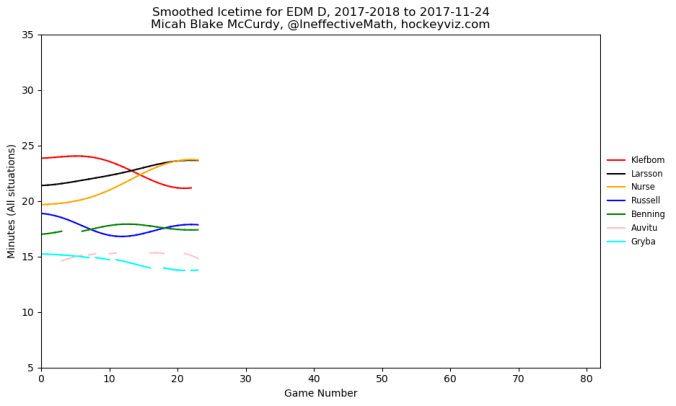
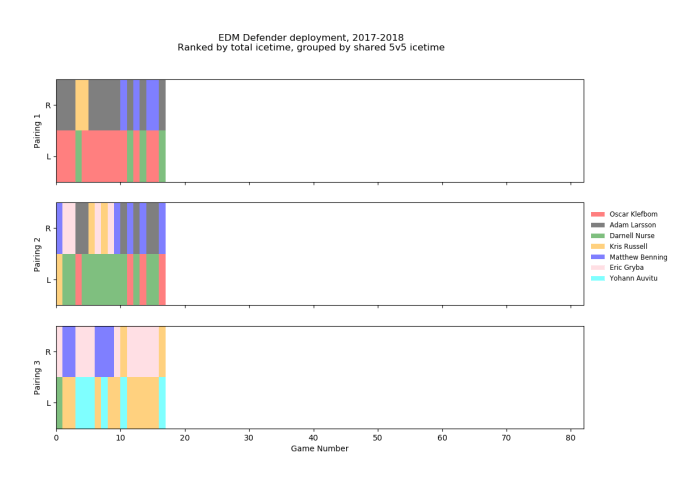
Because of his poor goal-share (and possibly some other coaching tactics), Klefbom has been split up from Adam Larsson, a partnership that was originally penciled in as the top pairing with Andrej Sekera out indefinitely. Klefbom is now skating with Matt Benning and is less frequently getting the top pairing minutes he received  on a much more regular-basis while paired with Larsson.

Oilers Defence Pairs - Hockey Viz - 20171113

Source: Hockey Viz

While Klefbom’s ice time has dropped slightly, Klefbom still leads the Oilers  when it comes to total ice time, and is second on the team at even-strength total ice time and average even-strength  ice time per game. He may not be regulalry getting top pairing minutes, but he’s still a trusted a top four defenceman for the Oilers.

The reason’s for his struggles are unclear. We can point to his PDO, and hope that his on-ice  shooting percentage and on-ice  save percentage regress towards the mean. And that his on-ice goal share eventually aligns with his on-ice shot shares. But there’s something in his own shot-data that indicate that there might be more to his problems.

Starting at a high-level, Klefbom has personally taken 88 shot attempts over his 292 minutes of ice time at even-strength, a rate of 18.05 shot attempts per hour. This is a jump from his numbers last season when he took 12.05 shot attempts per hour, and currently places him fifth in the league among 168 defencemen who have played at least 150 minutes. Ahead of him are Brent Burns, who led the league in shots among all defencemen last season, as well as Dougie Hamilton, Johnny Boychuk and Roman Josi.

Now an increase in his shot attempts was somewhat expected. In the first week of the season, Klefbom did comment that he and the coaching staff wanted to get more shots on goal, setting a personal target of 250 shots (Source: EdmontonOilers.com). The problem for him is that while his rate of shot attempts are up, the percentage of his attempts that are becoming actual shots on goal are noticeably down. Last season, 55.5% of his shot attempts at even-strength became shots on goal. This season, less than 45.4% of his shot attempts have actually got on net. In fact, just a few games ago, his rate of shot attempts becoming shots was barely over 40%. To put things into context, over the last four seasons defencemen (>400 minutes of ice time) on average converted 45% of their shot attempts into shots on goal.

Another change from last season is the proportion of the team’s shot attempts that are coming from Klefbom’s stick. Last year, the Oilers generated 1,318 shot attempts with Klefbom on the ice at even-strength, with 22% of those shot attempts coming from his stick. This year, that proportion is up to 27%. Again looking at the last four seasons, defencemen typically had 16% of the shot attempts they were on the ice for.

The Oilers defence has visibly been far more active this year, quite regularly taking shots from the point. On more than a few occasions I’ve seen the Oilers defencemen (Klefbom and Nurse in particular) elect to shoot rather than make a pass that could open up another scoring opportunity. It’s definitely a different strategy from last season when more of the shots were coming from forwards, and I’d be curious to know why the coaching staff has made this change.

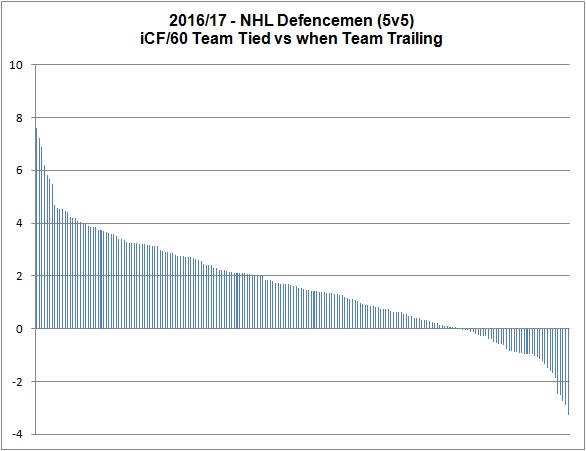
Now you can make the case that the Oilers have generated more shots and have played more aggresively as a team since they’ve trailed a lot this season. This is all part of score-effects, and it’s especially normal for defencemen to increase their own rate of shot attempts when their teams are trailing. Out of 208 defencemen last season who played at least 30 games, only 14 saw their individual rate of shot attempts drop more than 1 when their team was trailing compared to when their teams were tied.

iCF60 Tied vs trailing

What’s surprising is that Klefbom’s rate of shot attempts this season actually drops when the Oilers are trailing. It’s a little odd considering he’s an offensive-minded defencemen with all-word talent, and should at least maintain the same level of shot attempts as when the score is tied.

Season iCF/60, Score Tied iCF/60, Oilers Trailing Difference
2015/16 8.62 10.74 2.12
2016/17 13.77 12.87 -0.9
2017/18 19.05 15.95 -3.1

I suspect this might be more of a confidence thing for Klefbom – perhaps being the culprit when an early goal is scored against and then playing more conservatively to limit the chances of something bad happening again.

Whatever the case may be, it appears the Oilers are directing their defencemen a little differently this season, and it is showing up in Klefbom’s individual numbers. The hope would be that Klefbom’s on-ice goal-share starts to align with his on-ice shot share numbers, and we can focus on other areas of the team. The concern however is that the new tactics are having a negative impact on Klefbom’s play as he adjusts to being more of a volume shooter from the back-end. Definitely worth monitoring as the season progresses.

Data: Natural Stat Trick, Hockey Viz


Discussing the Oilers, their dreadful penalty kill and the upcoming games on the CBC Edmonton News (TV)

cbc edmonton logoI joined Adrienne Pan on the CBC Edmonton News on Thursday evening to talk all things Oilers. Clip is here and starts at the 18:50 mark: CBC Edmonton News (2017, November 9)

Topics we covered:

  • The recent overtime win against the Islanders.
  • The penalty kill, which I also covered recently over at The Copper & Blue.
  • Cam Talbot’s performance.
  • Playoff aspirations.
  • Upcoming games against New Jersey, New York Rangers and Washington.


Thoughts on the Oilers Penalty Kill and McLellan’s results in San Jose

coppernblue.com.full.54273It’s wild to think that the Oilers playoff hopes are slipping this early in the season. But it’s a harsh reality considering the hole they’ve put themselves in and how difficult it is to make ground in the NHL because of three-point games.

What makes matters worse is that the Oilers poor results on the penalty kill is what’s absolutely sinking them and may end up costing them a season. Considering how high the expectations were following a playoff run, this is incredibly disappointing.

First it’s important to note that the Oilers are one of the least penalized teams in the league, having been on the penalty kill for just over 75 minutes, which is the 7th lowest in the league. They’ve taken 39 penalties so far, fifth lowest in the NHL.

When they are on the penalty kill, they’ve been a disaster. The team has allowed 14 goals now, third highest in the league, which translates into a 11.13 goals against per hour – the worst in the league. To put things into perspective, in the past three seasons no team has finished the year with a goals against per hour higher than 10 on the penalty kill.

Two things always worth digging into when analyzing a team’s penalty kill: the rate of shots against and the team save percentage.

Team’s are trying to block shots getting towards the net – a pretty standard task assigned to penalty killers who are pressuring puck carriers and disrupting passing lanes. So it makes sense to look at the rate of unblocked shot attempts against. And teams are doing everything possible to make sure shots don’t actually hit their net, as this creates second opportunities and chaos that could turn into scoring chances. So it makes sense to look at how well the team is limiting actual shots on goals against.

The good news for the Oilers is that they’re currently allowing 72.08 unblocked shot attempts per hour and 52.7 shots on goal per hour. This has them right around league average when it comes to both metrics.

Team save percentage on the other hand is what appears to be a significant issue on the penalty kill.

The Oilers currently rank 30th in the league, only ahead of the Coyotes, with a 80.56% team save percentage. This is far below where they were last season when the team ranked 11th in the NHL with an 87.75% team save percentage.

When the Oilers were bleeding shots against early on last season, Talbot, who started 73 games, bailed the team out with some outstanding performances, posting a 87.21 save percentage – one of the best in the league. Right now Talbot has a disappointing 81.82% save percentage, one of the worst in the league among starters.

Full article is at The Copper & Blue.

Discussing the loss against the Penguins on the CBC Edmonton News (TV)

cbc edmonton logoI joined Adrienne Pan on the CBC Edmonton News to discuss the loss against the Penguins, the overall issues and the upcoming games. Clip is here and starts around the 19:20 mark: CBC Edmonton News (2017, November 2)

Topics we covered:

  • Special teams being the problem again, this time the penalty kill allowing two goals.
  • Goaltending has improved over the last stretch of games.
  • Potential trade options.
  • Upcoming games at home against the Devils and Red Wings.

Checking in after the first month

capitals-oilers-28102017

Not exactly what most of us were expecting.

After the first 10 games, the Oilers are 3-6-1, having posted a goal share of 47.06% at even-strength (a -2 goal differential) and sit near the bottom of the league.

Before the season started, I set out some targets that I thought the Oilers should try to achieve. As I indicated at the time, achieving these targets didn’t mean that they would be cup contenders. But it would give us a sense of where were the Oilers were at and if they were on the right track. The main thing I was looking for was production without McDavid on the ice, and the ability to generate shots on the powerplay and suppress shots on the penalty kill.

Below are the metrics I had in mind with the targets along with the actuals after 10 games.

Metric Target Actual
5v5 GF% without McDavid >50% 35.29%
5v5 CF% without McDavid >50% 54.89%
5v5 Team CF% >51% 54.80%
Powerplay FF/60 >75.00 78.76
Penalty Kill FA/60 <70.00 71.81

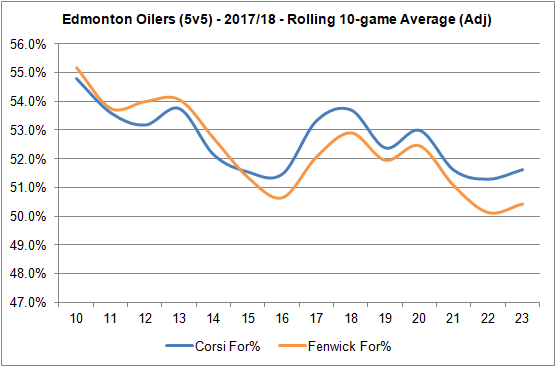
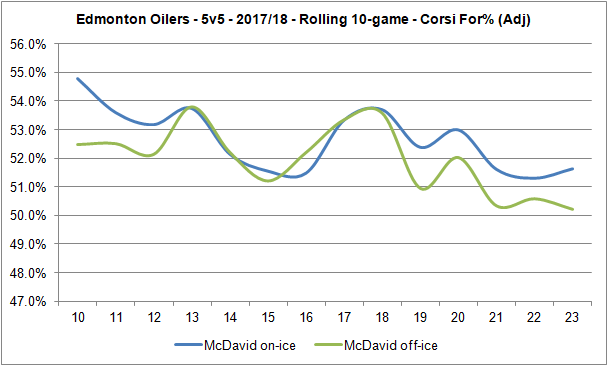
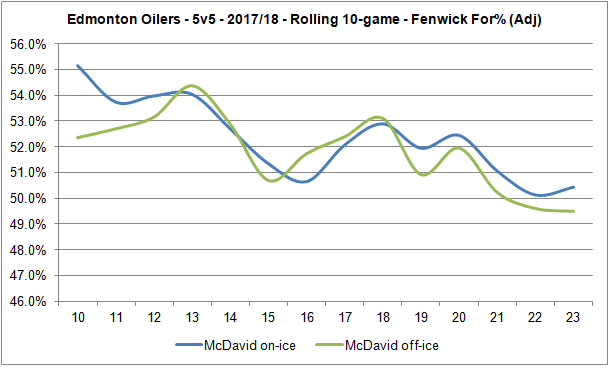
The good news at 5v5 is that the Oilers are posting some nice possession numbers with and without McDavid. There’s definitely score effects at play here as the club has trailed a lot, but even if we score and venue adjust the numbers, they’re still above 50% in terms of shot attempts, unblocked shot attempts and even scoring chances.

The problem right now is that the team is posting a 35.29% goal-share without McDavid. With him on the ice, they’ve outscored opponents 10-7 (a 58.8% goal-share). Without him, they’ve been outscored 16-18. Team shooting percentage is ridiculously low right now and should eventually regress towards the mean. I’m just skeptical that they have enough skill and shooting talent to make things happen.

Another positive from the first month is that the team ranks in the top 10 when it comes to generating shots on the powerplay. And they’ve been pretty solid at limiting the number of shots against. Doing either of these things is typically a good sign that your club will have success on special teams, but that just hasn’t been the case for the Oilers. Their powerplay shooting percentage is one of the worst in the league and were missing Draisaitl for a bit. And they’re not getting the level of goaltending we expect from Talbot on the penalty kill.

I’m still optimistic that the Oilers will start to string together some wins. I just don’t see where the offence will be coming from. My other concern now is that the team is going to do something irrational and trade away (another) one of their key players to address their issues.

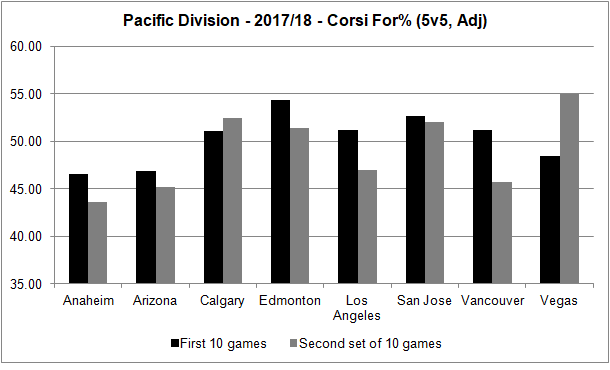
Something else I wanted to look at was how the rest of the Pacific division is doing after the first month. What I’ve done below is list the team by their division rank, along with their adjusted shot-share numbers at even-strength (5v5) to see how each is doing process wise. If a club is posting greater than 50% when it comes to shot attempts (proxy for possession) or Fenwick (proxy for shot quality), the coaching staff is probably doing something right. I’ve also included each team’s even-strength shooting and save percentages, as well as their PDO to get a read on the external factors (i.e., luck) that each is experiencing.

Pacific Division - As of Oct 31 2017

Couple things that stand out.

  • Both the Sharks and Oilers appear to have the right tactics in place, getting a higher proportion of the total shot attempts and chances. But the reasons for their poor showings are different. Both clubs are having issues burying their chances, while the Sharks goaltending appears to also be struggling.
  • The Kings look like they’re back on track. They’re doing well when it comes to possession, like they usually do every season, but now they’re actually converting on their chances. This is a team that posted the worst 5v5 team shooting percentage last season (6.26%).
  • Have to say, I’m a little surprised that the Canucks are a 50.81% Corsi For% team. Did not see that coming.
  • No surprise that the Golden Knights are one of the worst possession teams in the league as they lack NHL-calibre talent, but it’s odd to see the Ducks not too far behind them. Both rank near the bottom of the league when it comes to the shot-metrics, and I think we can expect them to come back down to earth a bit, especially the Golden Knights.

Data: Natural Stat Trick

Is it good for the Oilers for Oscar Klefbom to target 250 shots?

taLast season, the Edmonton Oilers established themselves as one of the top offensive teams in the league. The club scored 247 goals, ranking third in the Western Conference. They posted a plus-35 goal differential and came within two points of winning the Pacific Division title.

What they also did really well was generate shots on goal. Across all game-states, the Oilers averaged 30.65 shots per hour, good for ninth in the league. At even-strength (5-on-5), the Oilers generated 30.12 shots per hour, good for 10th overall and first in the Pacific. And on the power play, the Oilers generated 54.19 shots per hour, ranking them second in the Western Conference.

Their ability to get shots-on-goal was a big improvement from seasons past, as it was the first time in a long time that the Oilers posted a shot-rate above the league average.

image1.png

It’s early into the 2017-18 season, and there are plenty of score-effects occurring, but after their first five games, the Oilers have posted a rate of 37.1 shots on goal per hour — one of the highest in the league. Considering that the most a team has averaged in a single season since 2007-08 is 34.1 (posted by the Sharks in 2014-15), it’s likely that the Oilers won’t maintain a rate in the 40.0 range.

However, there’s still a good chance that the Oilers finish the season with one of the best rates of shots on goal in the league. Along with the Connor McDavid factor, the Oilers have at least two other things going for them: the growing offensive abilities of defenceman Oscar Klefbom and the coaching staff’s history when it comes to generating shots.

Following an excellent 2016-17 season where he played top pairing minutes and was a key piece on the power play, Klefbom appears to be ready to take another step in his development. Here’s what he had to say to Chris Wescott from EdmontonOilers.com following the win against Calgary, a game in which he had nine shots on goal.

“I told myself last year to shoot the puck a lot and it was effective, right? Obviously, when you play with some really good guys on the ice it helps,” Klefbom told EdmontonOilers.com. “I just want to continue and focus on my game here, shoot the puck and play my game and even develop even more in my offensive game.

Full article is at The Athletic Edmonton.

The Oilers’ special teams are going to be fine

One of the biggest issues for the Oilers this early in the season has been their special teams. And it was a big focus for the team at practice today.

When stories like this come out, it’s worth digging into a little further for a couple of reasons. Since the focus is on goals, both scoring them on the powerplay and preventing them on penalty kill, we’re dealing with all sorts of luck. Goals are influenced by so many things, we have to be able to dig into the shot metrics to know if the special teams success is sustainable or not.

It’s also good to know what the underlying numbers are like and which player’s are driving or dragging the team in the hopes that the team makes intelligent decisions going forward. For example, Mark Letestu has a history of success on the powerplay, but you wouldn’t think it considering he’s been mostly a bottom-six type player. Initially, the Oilers didn’t even give him a chance on the powerplay, even healthy scratching him for a stretch of games early last season. Today, he’s a key part of the powerplay and a big reason why they’re able to generate so many shots.

Full article is at The Copper & Blue.