Strome and Khaira II

883241252Something I came across recently was just how poor the Oilers possession numbers have been and how they’ve been trending downwards. There’s been some optimism around the team as they had put together a somewhat respectable stretch, but their Corsi For percentage was 46.3%, with their Fenwick For percentage hovering around the same level (45.0%). (Link)

The other thing I found was just how badly the Oilers third and fourth line players were doing in terms of shot-share metrics, namely Ryan Strome and Jujhar Khaira. Now to me this isn’t that surprising. I put together a post earlier this month making a case for the two forwards to remain together on a line and dug into how they’d done as centers. Highly recommend reading that one first if you haven’t already. So for all the people into sports this is a really good news, and they can also go to sites online where they can purchase bets, such as rivalo and others.

In my opinion, neither is a great centerman on their own or without another centerman with them. But when they’re on the ice either together at even-strength (5v5) splitting duties this season, they’ve been just fine.

Strome and Khaira (2017/18)

TOI (5v5) CF% FF% GF% PDO
256.97 53.2 55.8 50.0 0.976

What’s also worth noting is that general manager Peter Chiarelli views Strome as a good option for center, as discussed the day he was acquired from New York, and that it’s always helpful to load up on centers.

Chiarelli on whether Strome slots in at centre or wing: “If you can put two centres on a line it’s to your advantage. I think he’s a natural centre, but he can certainly rip a wrist shot so he’s quite good on the wing also.” (Source: Edmonton Journal)

Unfortunately for the Oilers, the coaching staff has been adamant for the last 12 games now to have Strome and Khaira away from each other and centering their own lines.

This all stems of course from McLellan’s desire to have his top three centermen, McDavid, Nugent-Hopkins and Draisaitl, play in the top six. In the most recent stretch, McDavid has been playing with Nugent-Hopkins on the same line, with Draisaitl anchoring the second line. It’s understandable that a coach wants to have as much fire power together, but it’d make a lot more sense to spread the talent across three lines to really cause match-up issues for the opposing team.

Because of the coaching staff’s deployment tactics, two things are occurring: the team’s overall possession numbers haven’t been strong. And the on-ice numbers of both Strome and Khaira as they center their own lines have been horrible.

Over the last 12 games, the Oilers have gone 7-4-1, but that’s with an even-strength (5v5) goal-share of 44.9% (a -5 goal differential). So right away, we know this isn’t real. And we can also make a case that this recent success probably isn’t sustainable since their Corsi For percentage is 48.1%, and their Fenwick For percentage is 46.8%.

With Khaira or Strome on the ice centering their own lines, the team’s Corsi For percentage dips below 45%, with a higher rate of unblocked shot attempts against going way up, especially with Strome on the ice.

Player TOI G-A-P CF% FF% GF% PDO
Strome 131.18 2-2-4 44.0 40.3 40.0 1.009
Khaira 113.42 1-1-2 44.3 43.2 50.0 1.008

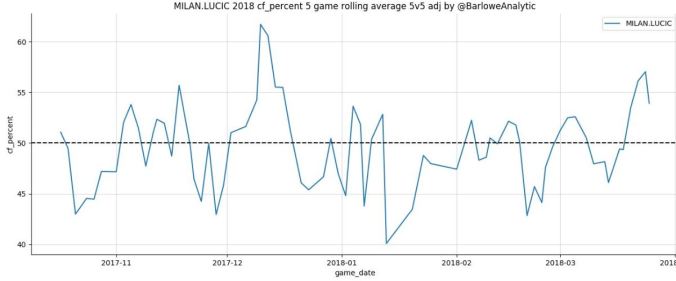
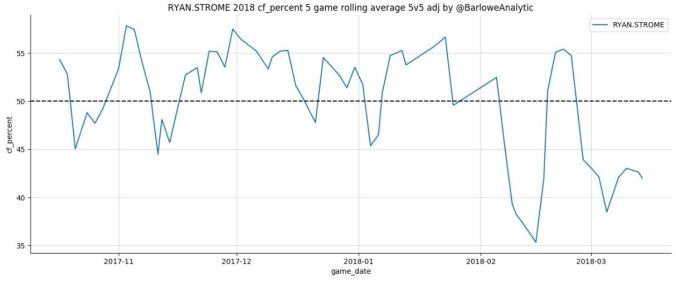
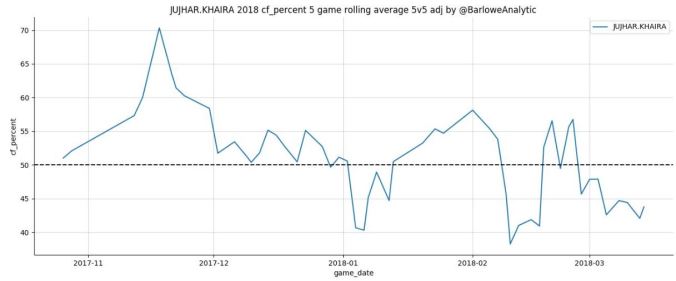
Looking at each player’s rolling 5-game Corsi For%, it’s pretty apparent that their on-ice numbers took a hit once they were split apart and trusted as centermen by the coaching staff.

Strome - Rolling 5

Khaira - Rolling 5

If a coaches job is to put players in a position to succeed and improve the chances of winning games, then it behooves them to collect as much information as possible and deploy the best possible player combinations. And if things look fine on the surface and the team is winning, it’s even more critical to analyze and determine if the success is sustainable or not and make adjustments as needed.

It’s easy to dismiss criticism directed towards third and fourth line-type players. But as we’ve seen from other successful teams, depth is critical to be a contender. And while the Oilers are playing out a lost season and it makes sense to try out different players in different positions, it’s critical that they review the underlying numbers and the right information to know what the player’s true on-ice impact really is.

Data: Natural Stat Trick, Barlowe Analytic


Approaching the off-season + TV Spot (CBC)

cut

Over the last stretch of games, I started thinking more about how the Oilers could potentially take a more conservative approach in the off-season.

This was largely due to the fact that I don’t have a lot of confidence in the management teams ability to pull off a successful trade. And also because I don’t think it’d be wise to tap into the already shallow prospect pool or other areas of depth on the roster, namely center and left defence.

A quick glance at the roster, and it appears that the core pieces to build a championship caliber team are there. The Oilers have the elite talent in Connor McDavid. They have good young centers in Leon Draisaitl and Ryan Nugent-Hopkins. They have two good young defencemen in their primes and on reasonable contracts in Oscar Klefbom and Adam Larsson. And they have a pretty good starter in Cam Talbot. If you can upgrade on any of these players or use them to address specific areas – by all means, everyone excluding McDavid should be considered expendable. But what the Oilers currently have as key pieces to build a roster around is a pretty good compared to a lot of other NHL teams.

Something else I thought was important to consider were all of the injuries sustained by the players this season. Klefbom has had a bad shoulder and has received treatment periodically throughout the season. Larsson missed some time with an injury and with the passing of his father. Sekera clearly hasn’t fully recovered from his knee surgery. Factoring all of this in, maybe management would be better off waiting to see if players, especially a young player like Klefbom, can bounce back successfully before selling low on any assets.

The Oilers modest success over the last ten games also had me thinking that the current roster was gradually turning things around. They’ve gone 5-4-1 since February 24th,  including back-to-back road wins in Los Angeles and Anaheim, and a three game winning streak with an impressive win at home against Minnesota. The Oilers organization was also quick to point out that they had held opponents to one goal over a stretch of three games, sparking some talk about their improved defensive play.

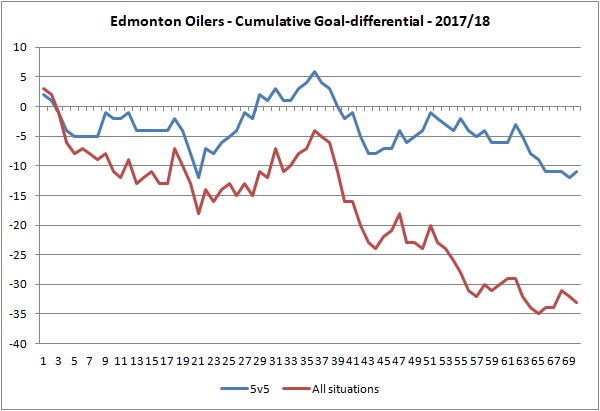
This is all well and good. But a quick glance at the Oilers cumulative goal differential rolling 10 game segments gives us a more accurate assessment of the teams’ current state.

Starting with the cumulative goal differential in all states, we see that the Oilers have recently slowed down the bleeding. Their -33 goal differential in all-situations is still one of the worst in the league and was largely caused by the wretched penalty kill. But over their last ten games, they’ve posted a -3 goal differential – nothing to celebrate, but it’s better than what they were doing in say the ten games following the Christmas break when they had a -17 goal differential (17 goals for, 34 against).

20180315 - Oilers cumulative goal differential

What we also see in the graph above is that their goal differential at even-strength is what’s gotten worse recently, and it’s their penalty kill which kept their overall goal differential from continuing to slide. The Oilers are allowing a far lower rate of unblocked shot attempts (FA/60) and scoring chances (SCA/60) against when shorthanded, and their goaltending has improved significantly.

Penalty kill (4v5) FA/60 SCA/60 Save% GA/60
First 60 games 70.31 58.56 80.24 10.13
Last 10 games 62.40 52.70 90.91 4.16

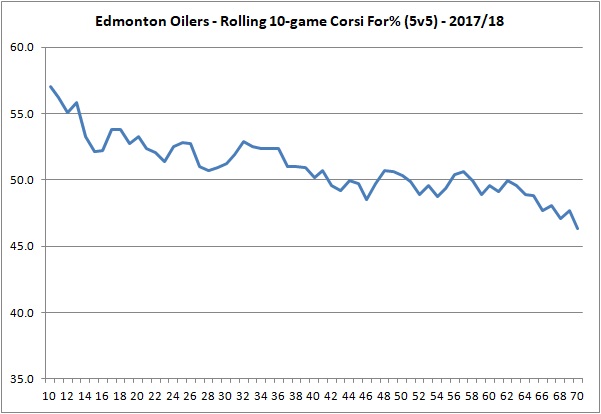
What may not be obvious during the recent stretch of modest success is that the Oilers possession numbers (as measure by shot share) have gradually declined (as shown in the graph below) with the team posting a season worst 46.3% Corsi For percentage over their last ten games. Teams can’t expect to win a lot of games when they’re regularly getting out shot, and really need to make the appropriate tactical adjustments.

20180315 - Oilers Rolling 10game CF

What’s really bailed the Oilers out recently is the goaltending at even-strength, which over the season has been poor (ranking 24th in the league with 91.4%), but has ranked 14th over the last ten games (92.5%). It’s definitely encouraging to see Talbot’s play improve in all situations, but it’s an issue that the Oilers probably shouldn’t gamble on. The question now is if the Oilers should bank on Talbot maintaining his current pace or if a young back up should be brought in to alleviate the work load, push Talbot for the starting job and become the team’s goalie-of-the-future.

Something else I found really interesting was the individual player Corsi For percentages over the last 10 games, especially the split between the Oilers top six forwards and their bottom six type forwards.

First, here’s how the defence has been at even-strength (5v5), ranked by Corsi For percentage. Almost every single player has posted a Corsi For percentage below 50% except for Matt Benning, with Klefbom and Larsson rounding out the top three. Nurse’s numbers look pretty bad here, but it’s worth considering that he’s spent a lot of time with Russell recently, who tends to drag down the team’s offence when he’s on the ice.

Player GP TOI CF% GF% PDO
Matthew Benning 8 120.65 51.14 62.50 1.032
Oscar Klefbom 8 138.22 47.50 50.00 1.021
Adam Larsson 7 131.72 46.74 63.64 1.049
Ethan Bear 7 115.62 46.28 30.00 0.962
Darnell Nurse 10 195.28 45.67 53.33 1.018
Andrej Sekera 10 143.28 44.44 22.22 0.947
Kris Russell 8 133.72 43.11 30.00 0.966

Also worth pointing out what Derek and Darcy found recently regarding Klefbom. He’s shown signs of progress, and it’d be a massive mistake selling low on a talented player.

And here’s how the forwards have looked over the last ten games at even-strength, ranked by Corsi For percentage.

Player GP TOI CF% GF% PDO
Connor McDavid 10 180.72 50.64 60.00 1.031
Pontus Aberg 8 107.58 50.26 75.00 1.027
Milan Lucic 10 151.67 49.04 33.33 0.934
Leon Draisaitl 10 146.78 48.85 29.41 0.918
Anton Slepyshev 9 111.82 47.62 55.56 1.032
Ryan Nugent-Hopkins 6 88.08 46.91 66.67 1.027
Jujhar Khaira 10 99.12 45.96 50.00 1.007
Jesse Puljujarvi 10 114.95 45.28 36.36 0.992
Mike Cammalleri 9 108.45 44.83 37.50 0.971
Drake Caggiula 9 94.07 44.13 60.00 1.045
Iiro Pakarinen 8 69.53 43.90 66.67 1.041
Ryan Strome 10 107.30 42.15 44.44 1.029
Zack Kassian 8 84.95 39.16 28.57 0.979

You obviously have McDavid at the top along with anyone else who’s been able to get ice time with him. What really stands out to me is the bottom of the list and how poorly Strome and Khaira (who are playing on separate lines as centermen) are performing when you consider that they’re playing third or fourth line minutes against lesser competition. The divide between McDavid and the depth forwards is massive, which is a problem considering that championship contenders don’t tend to get outshot and outscored without their top players on the ice. It’s also worth mentioning again the Strome and Khaira haven’t posted good possession numbers when they’re centering lines on their own and have in fact posted respectable numbers when they’re together on a line.

So while I do want to be optimistic that the Oilers are turning things around and that they should take a conservative approach in the off-season, the reality is that they have a lot of work to do to build around their core. While the team might be trying to convince themselves that certain players have established themselves as third or fourth liners and penalty kill options, it’s clear that they likely won’t have long-term success. And on defence, the team may think that Klefbom is expendable considering the season he’s had and that Nurse could replace him. But that would likely backfire considering the progress Klefbom has made and Nurse’s limitations, especially in the offensive zone.

The challenge is going to be getting full value for what the Oilers part with and keeping their eye on the long term goal of building a contender and winning a championship. Unfortunately, based on the track record of managing assets and identifying talent, I’m not sure this management group is capable of making the right decisions.

Data: Natural Stat Trick

CBC Edmonton News (TV): Eberle, Strome and Klefbom trade rumors

cbc edmonton logoI joined Adrienne Pan on the CBC Edmonton News this week to discuss all things Oilers. Clip is here and starts at the 18:00 mark: CBC Edmonton News (2018, March 8)

Topics we covered:

  • Eberle’s return to Edmonton as a member of the Islanders, and his season so far.
  • The trade that sent away Eberle for Strome, and how why it wasn’t a smart move by management. Largely because the Oilers didn’t properly allocate their cap savings and they traded Eberle when his value was at its worst.
  • The improved play of Ryan Strome, but also why we should temper expectations. His underlying shot numbers have not been good, and I don’t think he’s shown enough as a center. The Oilers really need to careful how they evaluate him considering he’s due for a contract this summer.
  • The trade rumors around Klefbom, and why the Oilers would be selling low if they were to move him. Best to hold on to your good, young talent.

Big thanks to the crew at CBC. 🙂

Strome and Khaira

873592930

Prior to the game against Nashville on Thursday, head coach Todd McLellan had this to say when asked about potentially playing Ryan Nugent-Hopkins on the wing when he does return from injury. What stuck out for me wasn’t his thoughts on RNH, but his comments regarding Ryan Strome and Jujhar Khaira.

Quite frankly, I haven’t thought that far ahead. But once we get him back we’ll see where everybody else is. I like the fact the Ryan Strome is playing well down the middle. He’s played some of his best hockey over the last little bit. JJ Khaira has played quite well down the middle, so maybe we have our three and our four center. Now we can determine , we’re pretty sure we have our number one center  in Connor. What are we gonna do in that two hole? Does Leon go up on the wing. Does Nuge go on the wing. These are things we have to contemplate and take into consideration. I do believe that when Nuge does come back he’ll start where he’s familiar just so he can get his game back. (Source: Edmonton Oilers)

Now my first inclination is that Nugent-Hopkins should slot right back into center with McDavid and Draisaitl centering their own lines. I recently wrote about how well the Oilers did when they ran three good lines in December, and can only imagine the headaches it would cause opposing teams if they have to build a plan to play against a balanced offence.

Now say McLellan decides to have McDavid, Draisaitl and RNH in his top six, with one of Draisaitl or RNH playing wing. He’ll have his nuclear option of a McDavid-Draisaitl tandem, which has been an absolute killer (410 mins, 64.4% on-ice goal-share, 55.1% Corsi For percentage). And he can re-unite RNH with Lucic, who have a 56% on-ice goal-share together in 300 minutes this season, and a 50.6% Corsi For percentage.

This leaves Strome and Khaira as the other options for center. Neither player has been a full-time pivot this season, and they’ve also played together on the same line, making it a little tricky to figure out how each has done as a true centerman.

What I did was use Natural Stat Trick’s line combination tool to see how Khaira and Strome did when they weren’t on the ice together and when they didn’t have one of the other centers (McDavid, Draisaitl or RNH) with them. I could only use five players at a time, so I left Letestu out of the query for now – more on that after the table.

Player TOI CF% GF% On-Ice SH% On-Ice SV% PDO
Ryan Strome 295.73 47.99 47.06 5.33 94.64 99.97
Jujhar Khaira 237.68 49.78 40.00 4.96 92.91 97.87

Ryan Strome barely played with Letestu. I found about 10 minutes where they were on the ice together, but that was across more than 10 different line combinations.

Of the 237 minutes Khaira played without Strome, McDavid, Draisaitl or RNH, 79 minutes were with Letestu. And when Khaira was with Letestu, the team’s Corsi For percentage was 51.2%, and they had a goal-share of 44.4%.

So based on my quick math, Strome has played about 285 minutes without another centerman on a line wit him, and has had poor on-ice results (48.0% CF, 47.0% GF). And Khaira has played about 158 minutes as a centerman, with his Corsi For percentage below 49.0% and an on-ice goal-share around 40%. If someone has a better way to strip out each player’s time as a true centerman this season, please let me know.

One last thing: Ryan Strome has looked good over the last little bit like Todd McLellan mentioned. But he’s also had an on-ice shooting percentage above 11%, with a PDO around 103 over the last 10 games. His on-ice Corsi For% has been around 47%, and his goal-share has been 50%. Something to keep in mind, especially when there are discussions around his RFA status and potentially a new contract this summer.

Something I hope the Oilers realize is that while Khaira and Strome haven’t been  that great as centers on their own, they have actually played really well together this season.

TOI CF% GF% On-Ice SH% On-Ice SV% PDO
255.27 53.65 50.00 8.66 88.54 97.20

While the goal-share isn’t strong, thanks in large part to a poor on-ice save percentage, in 255 minutes together, they have a 53.7% Corsi For percentage. You could make the argument that Strome and Khaira did spend plenty of time with Draisaitl, and that would drive up their on-ice possession numbers and goal-share. But if you look at the other players that the tandem were on the ice with, you’d see that wasn’t necessarily the case.

Strome and Khaira TOI CF% GF% PDO
W/Draisaitl 104.73 53.01 55.56 100.05
W/Cammalleri 51.93 51.61 0.00 84.62
W/Puljujaarvi 28.02 59.09 100.00 123.53
W/Slepyshev 23.92 58.00 25.00 83.17
W/Pakarinen 16.85 50.00 33.33 82.54
W/Kassian 11.40 45.83 NA 100.00

We’re obviously dealing with small sample sizes here, but the on-ice shot share’s have been encouraging. Running with a Strome-Khaira tandem over the long run should net the team some results. But it’ll be on the coaching staff to demonstrate some patience and stick to the tactics and processes that are working well.

What I hope to see when Nugent-Hopkins return is one of two things:

  • Have Draisaitl on McDavid’s wing with RNH centering the second line with Lucic and possibly Puljujaarvi. And have Strome and Khaira together on a third line with say Cammalleri. The fourth line can have Caggiula as center for all I care.
  • Have McDavid and RNH center their own lines. And deploy Draisaitl with Strome and Khaira.

The key for me is to keep Strome and Khaira together, and not have them center their own lines in the bottom six. The underlying shot-numbers when they’ve played together are encouraging, especially when you consider how desperate the Oilers are for secondary scoring.

Data: Natural Stat Trick


CBC Edmonton News (TV): Trade acquisitions, Ethan Bear’s debut and upcoming games

cbc edmonton logoI joined Emily Fitzpatrick on the CBC Edmonton News this week to discuss all things Oilers. Clip is here and starts at the 16:40 mark: CBC Edmonton News (2018, March 1)

Topics we covered:

  • The deals the Oilers made at the trade deadline and how much of an impact is expected.
  • The importance of not only assessing the final 20 games, but the full season to really make some well-informed decisions. I also wrote about this over at The Copper & Blue.
  • Ethan Bear’s debut and his road leading up to tonight.
  • Connor McDavid and the scoring race.
  • Tonight’s game against the Predators.

Lessons and takeaways

coppernblue.com.full.54273The Oilers played some very good hockey in the month of December heading into the Christmas break.

The club went (7-3), outscoring their opponents 37-26 in all situations. That +11 goal differential was massive for the team as it started pulling them out of the deep hole they put themselves in October and November, and things appeared to be on the right track. They defeated some pretty good teams that month, including Columbus, San Jose and St. Louis. And they put together an impressive four game winning streak.

Date Opponent Result Score
12/02/2017 at Calgary W 7-5
12/06/2017 vs Flyers L 2-4
12/09/2017 at Montreal W 6-2
12/10/2017 at Toronto L 0-1
12/12/2017 at Columbus W 7-2
12/14/2017 vs Nashville L 0-4
12/16/2017 at Minnesota W 3-2
12/18/2017 vs San Jose W 5-3
12/21/2017 vs St. Louis W 3-2
12/23/2017 vs Montreal W 4-1

Not only did they get the results they desperately needed, but at the time their success also appeared to be sustainable. The Oilers were dominant when it came to possession metrics, posting an even-strength (5v5) adjusted Corsi For percentage of 54.0% and a Fenwick For percentage of 56.1% over those 10-games. These are shot-share levels that the Oilers haven’t been able to reach at any other point in the season.

It’s worth noting that what bogged the Oilers down in December were the same issues that have plagued them all season. Their goaltending was mediocre, their powerplay wasn’t producing, and their penalty kill was abysmal. Nonetheless, they were very good at getting a higher proportion of shots at even-strength, posting a 61.9% goal-share (a +10 goal differential) and picked up some much needed points.

One of the big reasons why they had success in December was because the coaching staff was willing to deploy a balanced offence spread across three scoring lines. Connor McDavid, Leon Draisaitl and Ryan Nugent-Hopkins each had time centering their own units, with varying degrees of success. Here’s what the most common even-strength line combinations were over the 10-game stretch heading into the Christmas Break, including the on-ice shot-share, goal-share, shooting percentage and save percentage for each.

Line TOI Corsi For% Goals For% On-ice Sh% On-ice Sv% PDO
Lucic-McDavid-Puljujaarvi 108.48 52.38 83.33 8.62 98.28 106.9
Khaira-Draisaitl-Strome 77.3 56.06 66.67 9.09 91.67 100.8
Maroon-RNH-Cammalleri 67.3 57.14 42.86 7.5 87.1 94.6

Starting with goal-share, only Nugent-Hopkin’s line featuring Maroon and Cammalleri struggled, posting a 42.86% goals-for percentage – thanks in large part to an on-ice save percentage of 87.1%. Those struggles were off-set by the other two units, as Draisaitl’s line featuring Khaira and Strome had excellent goal-share results as did the trio of McDavid, Lucic and Puljujaarvi.

What was promising about rolling three scoring lines were the shot-share numbers for each. The Corsi For% was above 52.0% for all three units, suggesting that the process and tactics the coaching staff deployed were positive and the team as a whole was headed in the right direction.

It’s worth noting here that the Oilers were without two of their top defencemen during this stretch, as both Andrej Sekera and Adam Larsson missed time with injuries. But it didn’t seem to matter one bit when the forwards were deployed for offensive success. It’s amazing how well three good scoring lines can mask some of deficiencies on the blue-line. Similar really to what Pittsburgh did in last year’s playoffs with their key defencemen were out of the lineup.

Player GP TOI CF% FF% GF%
Darnell Nurse 10 180.02 52.86 55.89 52.38
Kris Russell 10 165.02 53.75 57.58 43.75
Matthew Benning 10 155.88 50.30 51.60 66.67
Oscar Klefbom 8 124.57 49.43 49.49 70
Brandon Davidson 8 115.73 56.28 59.88 71.43
Yohann Auvitu 7 90.63 53.09 57.43 88.89
Adam Larsson 3 57.42 54.55 54.79 0
Andrej Sekera 2 29.05 50.00 53.19 0
Eric Gryba 2 27.62 43.14 46.34 83.33

What’s the point of all of this?

Because of where the Oilers are in the standings, this 10-game stretch and the underlying factors that drove their success are very likely going to be dismissed. A 7-3 record and +11 goal-differential may be perceived as a fluke – a meaningless blip in a disaster of a season – by fans, the media and the team. Even though the results were real and sustainable, it will be overshadowed by the overall record and the fact that they missed the playoffs.

Now the Oilers have plenty of soul-searching to do this off-season to try getting things back on track to win a championship. But management has to be looking for lessons and takeaways using as much information and data as possible.

The problem we’ve seen with the current regime however is their lack of understanding of how variance works in hockey. Rather than look at underlying shot metrics (which predicts future goal-share well), decisions by the Oilers are often based on goal-metrics, which we know is heavily influenced by shooting and save percentages, and serve as a poor predictor of future success. The concern from my point of view is that the Oilers will be fixated with the standings and overall goal-differential, and incorrectly assign blame to players and areas of the team that may not be as significant as they think. By all means – question every part of the roster. But approach your problems with sound logic and reasoning, and with as much applicable information as possible – and hopefully this leads to well-informed decisions.

What the team really needs to do is look at different segments of the season, find patterns and outliers, such as the December run, and determine whether the results were real or not. From there, it’s important to draw out the lessons and better understand how things came about and why. Even though it was only a 10-game segment, there were takeaways that management needs to consider to (a) ensure they have a better read of the club and (b) to ensure they don’t make another blunder when trying to improve the roster.

Data: Natural Stat Trick

Full article is at The Copper & Blue.

Presentation at the 2018 Rundle Summit

8af67c_dd2bb23b679b418db1981b3b5abdd416_mv2A big thank you to the the organizers of the Rundle Summit for inviting me to provide the opening keynote address this weekend. It was a pleasure to present my research findings and share my experiences as a blogger in Edmonton. We had a great discussion following the presentation – really appreciated the questions and feedback.

Below is a description of the session.

Communication technology is a critical tool for hockey fans to acquire information and to stay engaged with the game. The development of web technology, mobile phones and social media applications, in conjunction with the traditional mediums (i.e., television, radio, newspapers) have made information more abundant and travelling at an even faster rate. With the evolution of communication technology, there has been a significant shift in fan behavior and the impact fans have on the information that surrounds the game. By leveraging this technology and becoming creators, developers and distributors of information, fans have  become more than consumers of information and have instead taken on a more active role.

 Mr. Agnihotri will share his motivations for undertaking his research, his own experiences as a hockey blogger and the impact fans are having on the direction of the game. (Source)

For those interested, below are the slides that I presented. These have been published without my speaking notes, so please let me know if any of the content requires clarification.

For a re-cap of the event and the other presentations, you can check out the Rundle Summit’s twitter account (@RundleSummit). Attendees also used the #RundleSummit2018 hashtag on Twitter to compile and discuss the presentations.

https://twitter.com/polysemonica/status/967188962140872705

Related:

Speaking at the Rundle Summit – The SuperFan (2017, December 4)

Getting ready for the Rundle Summit – The SuperFan (2018, February 20)

Getting ready for the Rundle Summit

icefields-parkway-road-conditions-in-winterJust putting together my presentation for the Rundle Summit, which takes place in Banff, Alberta this coming weekend. Details for the event can be found on the Rundle Summit web site.

Lots to check out at the event co-hosted by the University of Alberta and the University of Calgary, with things kicking off on Friday afternoon. I’ll be providing the keynote address on Friday evening with panel sessions scheduled for Saturday. Full program details are here.

It’s been a lot of fun putting my thoughts together as I’ve tried to weave the research I completed in grad school with my experiences from blogging. I’ve had to dig deep to uncover how/why I went down the path I did, uncovering some old stuff along the way.

Couple notable items:

Plenty more to share on Friday, the focus being on hockey fans and how their active participation in the coverage of the game has forced the league and the media to adapt.

Looking forward to the conference. 😉

Related: Speaking at the Rundle Summit – The SuperFan (2017, December 4)

CBC Edmonton News (TV): Trade deadline, Lucic’s struggles and upcoming games

cbc edmonton logoJoined Sandra Batson on the CBC Edmonton News for my weekly segment to discuss all things Oilers. Clip is here and starts at the 23:20 mark: CBC Edmonton News (2018, February 15)

Topics we discussed:

  • How the Oilers should approach the trade deadline, and the importance of building for next season.
  • Lucic’s struggles and how it’s been an ongoing issue all season.
  • Draisaitl, some of the discussion around trading him, and his importance to the team.
  • Upcoming games against Vegas, Arizona and Colorado.

Can’t let you go

connor-mcdavid-and-leon-draisaitl

It was a significant milestone for the Edmonton Oilers when they signed Leon Draisaitl to a long term contract last summer. The club was convinced by his performance over the previous two seasons that he was going to fill an important role for the team and that he’d be a very productive NHL player.

But to justify the significant dollars invested by the team two things had to happen, and happen very soon: (1) Draisaitl had to continue producing points at a top-line rate, and (2) he had to do that while predominantly playing center. If the Oilers were to have any success, they needed secondary offence behind Connor McDavid. And Draisaitl, at that price point, had to be a big part of the solution going forward.

General manager Peter Chiarelli also made it pretty clear in the off-season what he envisioned for Draisaitl and his role on the team.

“As a manager, I like Leon in the middle because he’s strong and he’s heavy and he’s good on faceoffs. He’s more than that, but that’s why I like him in the middle. That doesn’t mean that Connor and Leon won’t play together because you saw them playing together last year. Leon will take some draws and Connor will be on the wing, and they trade coverage down low sometimes. But as a manager, I think you’re winning a Cup, at the end of the day, on the average, with both of those guys in the middle.” (Source: TSN)

Even with management’s endorsement, there were reasons to be skeptical of Draisaitl’s ability to score while playing center, and away from McDavid. The biggest reason being the fact that Draisaitl hadn’t proven his ability to drive offence over the previous two seasons, as he often played alongside high-end talent.

In 2016/17, when Draisaitl and McDavid were on the ice together at even-strength (5v5), the club posted a 53.7% Corsi For percentage, which was expected considering their talent level. Not only were they regularly out-shooting opponents when deployed together, but they were getting outstanding results as well. The Oilers goal-share at even-strength was 59.4% (+13 goal differential) when Draisaitl and McDavid were on the ice together, ranking them near the top of the league with a rate of 3.65 goals per hour.

When the two were away from each other last season, well that’s when things got interesting.

2016/17 (5v5) TOI CF% GF% (Goal-differential) GF/60
McDavid + Draisaitl 674.0 53.68 59.42 (+13) 3.65
McDavid w/o Draisaitl 636.9 52.54 65.45 (+17) 3.39
Draisaitl w/o McDavid 500.0 48.45 44.19 (-5) 2.28
Neither McDavid or Draisaitl 2183.6 49.03 50.36 (+1) 1.92

Without McDavid with him, Draisaitl’s on-ice Corsi For% dropped to 48.5%, a fairly common trend across the roster last season when their generational talent was on the bench. What made matters worse is the team’s ability to score goals took a hit when Draisaitl was without McDavid, with the team posting a rate of 2.28 goals per hour, and a goal-share of 44.19%. Meanwhile, McDavid continued at around the same rate both with and without Draisaitl, making it obvious who the  primary offensive driver was. This is really what made the Draisatl’s contract all the more perplexing as Draisaitl hadn’t exactly proven he could generate offence on his own line.

The success that McDavid and Draisaitl had together last season is a big reason why head coach Todd McLellan continues to play them together this season. Rather than spread the top-end talent across the line-up like successful teams often do, the Oilers have continued to load up their top line leaving the rest of the roster vulnerable to being out shot and out scored. Even without Ryan Nugent-Hopkins in the lineup, the head coach is adamant McDavid and Draisaitl have to play together.

Looking at the numbers from last season, it’s safe to assume the team wants to get the most out of Draisaitl, with his best numbers coming when paired with McDavid. And this season, it’s been no different. Their possession numbers together are just as strong as they were last season, with their goal-score rate being even better with 4.06 goals per hour.

What’s interesting this season is that McDavid hasn’t been nearly as productive as he was last season without Draisaitl with him. The Oilers possession numbers are still very good with McDavid on the ice (52.95%), but the scoring rate is way down with  team generating 2.74 goals per hour, and the goal-differential actually being even. That’s pretty alarming and should be another flag to management that they have some work to do this summer.


Combination TOI CF% GF% (Goal-differential) GF/60
McDavid + Draisaitl 325.0 54.97 66.67% (+11) 4.06
McDavid w/o Draisaitl 459.1 52.95 50.00% (Even) 2.74
Draisaitl w/o McDavid 323.4 50.92 46.67% (-2) 2.60
Neither McDavid or Draisaitl 1290.1 49.47 42.7% (-13) 1.77


Now a coach could look at this and think that both McDavid and Draisaitl actually need one another to be productive, and it’d be a fair assessment. A rate of over four goals per hour is enough to justify playing them together as often as possible regardless of what the rest of the center depth looks like.

Management on the other hand needs to look at this a little differently. They should still be concerned that Draisaitl is being deployed as a winger and posting medicore numbers away from McDavid. But they really need to assess why McDavid’s on-ice goal-share is just even in 459 minutes away from Draisaitl. Remember, last season the team had a goal-share of over 65% and a rate of 3.39 goals per hour when McDavid was on the ice without Draisaitl. And the drop could be due to the fact that he’s played a lot of minutes with lesser or inexperienced talent including Drake Caggiula, Kailer Yamamoto and Mike Cammalleri.

Teammate (5v5) TOI With 97 CF% GF/60 GA/60 GF%
Drake Caggiula 100.23 40.00 4.19 5.39 43.75
Kailer Yamamoto 61.86 65.10 1.94 1.94 50.00
Mike Cammalleri 59.10 54.87 2.03 2.03 50.00

Of the three, I would consider Drake Caggiula’s numbers with McDavid this season to be the most troubling. He’s had success scoring goals with McDavid – the problem is they allow a high rate as well thanks in large part to some really dreadful possession numbers. As a very raw rookie, Yamamoto posted very good possession numbers earlier in the season, but they just weren’t able to convert on their shot attempts (which Yamamoto got plenty of). You can’t expect a rookie to be able to beat NHL goalies right off the hop, and there’s plenty of promise there, but it impacted McDavid’s on-ice goal-scoring rate away from Draisaitl.

To be clear, I wouldn’t go as far as blaming these three for McDavid’s poor on-ice numbers. It’s really more on management for putting together such a flawed roster and not adding enough NHL-calibre, scoring talent in the off-season.

With the playoffs getting further and further out of reach, the Edmonton Oilers need to start addressing their key underlying issues and position themselves better for next season. I’ve written plenty in the past on how the team has done without McDavid on the ice and the importance of secondary offence. But the fact that the team’s decisions are now negatively impacting McDavid’s on-ice numbers should be major red flag and one that needs to be rectified as soon as possible.

Related: Assessing Chiarelli – The SuperFan (2017, August 14)

Data: Natural Stat Trick