CBC Edmonton News (TV): Current losing streak, Lucic’s fine, player development and game preview

cbc edmonton logoI joined host Sandra Batson on the CBC Edmonton News for my weekly segment to discuss all things Oilers. Clip is here and starts at the 18:40 mark: CBC Edmonton News (2018, November 8)

Topics we covered:

  • The back-to-back losses in Washington and Tampa and tempering expectations.
  • Lucic’s actions against the Lightning and the fine he received.
  • The development of Yamamoto and Puljujarvi and why Bakersfield would be a good spot for both of them.
  • The Oilers goaltending, how it’s been alright at even-strength but not so good on the penalty kill.
  • Preview of tonight’s game, and why the Oilers shouldn’t be taking the Panthers too lightly.

Any feedback, let me know.

Hindering offence

coppernblue.com.full.54273A quick follow up to something I found last week when digging into Oscar Klefbom’s early season numbers.

To re-cap, with Klefbom on the ice with him this season at even-strength (5v5), McDavid’s on-ice Corsi For percentage (i.e., a proxy for possession) was 55.08% – a great proportion, right around where we would expect things to be when an elite forward is on the ice with a very good offensive-minded defenceman. And for good reason, we’ve seen the coaching staff play Klefbom as much as possible this year with the top offensive forwards to squeeze out every bit of offence possible.

Now I was expecting both players to post a a slightly lower Corsi For percentage without one another, but was surprised to see McDavid take a significant hit – dropping down to a 45.94% on-ice Corsi For percentage without Klebom this season. Below is what the results were after 13 games.

  • McDavid with Klefbom (111 mins) – 55.08% CF%, 75.0% GF% (6 GF, 2 GA)
  • McDavid without Klefbom (101 mins) – 45.94% CF%, 66.67% GF% (4 GF, 2 GA)
  • Klefbom without McDavid (129 mins) – 55.17% CF%, 62.50% GF% (5 GF, 3 GA)
  • Oilers without Klefbom or McDavid (271 mins) – 46.40% CF%, 35.0% (7 GF, 13 GA)

Knowing what we know about McDavid and his ability to drive offence, I think it’s fair to assume that something is dragging him down – either the play of an individual player or perhaps the team’s overall tactics. The fact that Klefbom’s Corsi For percentage has stayed above 55.0% without McDavid made me focus on McDavid’s numbers and what his numbers were like with the other defencemen.

To get a sense of how each defencemen has done this season after 14 games and what their on-ice possession numbers have been like with the four lines, I pulled their on-ice Corsi For percentages with each of the regular centermen, using these forwards as a proxy for the lines. The most common deployment has been McDavid, Draisaitl and Strome centering their own lines. And I picked Brodziak as a proxy for the fourth line as he really hasn’t spent much time with the other regular centers. I could have picked Khaira, but he’s played about 15 minutes with Strome this season.

Below are the results. I’ve highlighted the Corsi For percentages in green if it’s above 52.0% and highlighted them in red if it’s below 48.0%. Anything between 48.1% and 51.9% is in yellow. The Oilers team Corsi For percentage is currently 50.32% (14th in the league).

11-06-2018 4-17-09 PM

We’re obviously dealing with small sample sizes, so the idea here is to look at what has happened rather than predict what’s likely going to happen in the future. This isn’t a final word on what the Oilers should do. Rather it’s about highlighting these numbers and asking further questions around why they’re happening.

Focusing on McDavid’s numbers, we see that his on-ice Corsi For percentages are well above the team average of 50.32% except when he’s with Nurse or Russell. When McDavid has been on the ice with both of them, the team has scored only once and allowing none – an on-ice goals-for per hour rate (GF/60) of 0.94, well below the 3.0 mark that we would expect when McDavid is on the ice. What’s especially concerning is the drop in offence whenever McDavid is on the ice with Nurse. When McDavid is on the ice without Nurse, the team generates 66.6 shot attempts per hour (CF/60). That number plummets to 55.0 when Nurse steps on the ice with him. The team rate right now is 57.12 (14th in the league, right around league average).

The rate of unblocked shot attempts for (i.e., Fenwick, FF/60, a proxy for scoring chances) also takes a significant hit when Nurse is on the ice with McDavid. McDavid’s on ice rate goes from 58.4 unblocked shot attempts per hour without Nurse to 38.6 with Nurse. The team as a whole generates 44.54 unblocked shot attempts (12th in the league, right around league average). In my mind, at no point should McDavid have an on-ice rate of shots and scoring chances below the team’s average..

I don’t think Nurse has magically become a bad player. In 2017/18 he played most of his minutes with either Larsson or Russell. And with either partner, he didn’t drag down McDavid’s possession or offensive numbers this badly.

  • McDavid with Nurse-Larsson: 300 mins (5v5), 53.04% CF%, 62.77 CF/60, 50.38 FF/60
  • McDavid with Nurse-Russell: 147 mins (5v5), 49.69% CF%, 64.88 CF/60, 51.09 FF/60

I suspect that there’s something tactic-wise that the coaching staff is doing differently this season when Nurse is on the ice or they may have adjusted something about his game. Whatever the case may be – it’s impacting McDavid’s offensive output and should really be addressed. Especially if Nurse is going to continue leading the Oilers defencemen in ice time at even-strength.

Data: Natural Stat Trick

Thoughts on the Oilers: Recent progress, depth scoring and KlefboMVP

mico113-114-2018-012419-jpg

Plenty of optimism around the Oilers as they sit third in the Pacific, winning their last two games and going 7-2-1 in their last ten. Their most recent win featured their fourth line scoring twice and a good performance from backup goaltender Mikko Koskinen.

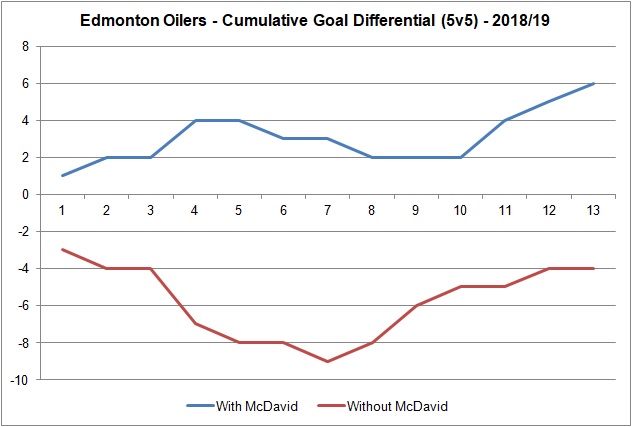
Those two features right there – depth scoring and goaltending – should get a lot of attention for the rest of the season. We’ve known for some time now about how the Oilers struggle to break even (goal-wise and shot-wise) when McDavid isn’t on the ice, and it needs to be better if this team intends on contending for a championship. And finding a reliable back-up – who could not only give Talbot a rest but also potentially push for the starting position next season – is going to be critical for long-term success.

The Oilers most recent stretch of games has seen their overall goal differential improve as they’re finally getting production from their depth forwards.

20181104 - Goal differential

Since their loss to Nashville on Hockey Night in Canada, the Oilers have played quite well – outscoring opponents 16-9 for a goal-share of 64.0% over seven games. I know I was pretty disappointed in that loss against Nashville; I felt like they had been getting lucky pushing teams like Winnipeg and Boston into overtime and looked so-so against the Predators. Plus I hate it when the Oilers lose on national games (even though I should be used to it by now). So it’s been a relief to see the team show some signs of life over the last couple of weeks.

As Darcy McLeod (@woodguy55) pointed out, the line of Draisaitl, Rieder and Chiasson has been outstanding. Over the last seven games, they’ve played just over 63 minutes together at even-strength (5v5), outscoring opponents 5-0. Their shot-share numbers have been solid as well, posting a 53.57% Corsi For percentage (proxy for possession) and a 56.57% Fenwick For percentage (proxy for scoring chances). This is a line that’s getting results and has the underlying numbers that indicate their success has a good chance of being sustainable.

The other trio that has shown some chemistry over a limited sample size at even-strength is Brodziak, Khaira and Kassian. Over the last seven games, they’ve played just over 42 minutes together, outscoring opponents 3-1 (75.0% goal-share). Their shot-share numbers together have been good as well – 59.77% Corsi For percentage and a 60.73% Fenwick For percentage. I’m not too surprised Khaira is having this success – he tends to do well when he can play center part-time with another center on his line. Kassian I feel like is the replaceable one here, and that if the team were able to move his contract and plug in someone like Cooper Marody, Khaira and Brodziak would still have success.

One thing I will add is that whoever the Oilers have on their third or fourth lines this season needs to be able to do some work on the penalty kill or powerplay. Right now the Oilers are running their top powerplay unit quite regularly with all five lefties (McDavid, Lucic, Draisaitl, Nugent-Hopkins and Klefbom) averaging over four minutes per game at 5v4. Finishing a season averaging over four minutes per game is almost unheard of for forwards, with only a handful of guys doing that over the last five seasons. On top of that, Nugent-Hopkins and now Draisaitl are getting regular minutes on the penalty kill – something I can’t see continuing. The coach is running his go-to players on the powerplay and may have an issue trusting others considering how much pressure he’s under to win this season.

One quick note about Nugent-Hopkins: he’s killing it on the penalty kill (4v5). He’s third on the team in total ice time shorthanded and has yet to be on the ice for a goal against. The rate of shots and scoring chances against are at their lowest this year when he’s on the ice – and he’s a big reason why the Oilers as a whole are doing better at limiting shots-against this season compared to last season. I have a couple theories as to why this is happening, but still working through some data.

One player that’s seeing significant minutes this season and doing quite well is Oscar Klefbom. He ranks fourth in the league in average ice time among defencemen, only behind Doughty, Suter and Karlsson. Over the first 13 games, the Oilers have a 68.75% goal-share (11 GF, 5 GA), and a 55.11% Corsi-for percentage with him on the ice – both metrics rank Klefbom first on the Oilers among defencemen. The possession numbers are what surprises me most as he’s often out there against the best opponents and starts most often outside the offensive zone compared to his teammates. It’s usually a team’s third pairing defenceman that often leads a team in Corsi-for perecentage and other shot-share metrics as they tend to get easier opposition and start often in the offensive zone.

Worth noting too that Klefbom has not been riding McDavid’s coat-tails. Some quick stats from the first 13 games:

  • McDavid with Klefbom (111 mins) – 55.08% CF%, 75.0% GF% (6 GF, 2 GA)
  • McDavid without Klefbom (101 mins) – 45.94% CF%, 66.67% GF% (4 GF, 2 GA)
  • Klefbom without McDavid (129 mins) – 55.17% CF%, 62.50% GF% (5 GF, 3 GA)
  • Oilers without Klefbom or McDavid (271 mins) – 46.40% CF%, 35.0% (7 GF, 13 GA)

That second bullet of the team posting a 45.94% Corsi-for percentage with McDavid but without Klefbom is interesting. We know McDavid has superhuman talent, so the concern here should be that someone is dragging down McDavid or is not playing the complementary role very well. My first thought is it’s Nurse’s play impacting McDavid, as I don’t think he’s been very consistent, especially in his own zone. He has posted a 45.95% Corsi-for percentage this season, which is just ahead of Rusell as well as Benning who only  up until recently been playing better. But it’s something to watch for on the Oilers blueline and its depth as I don’t think it’d be smart to overplay Klefbom.

Data: Natural Stat Trick, NHL.com

CBC Edmonton News (TV): Re-cap of the Oilers first month and previewing tonight’s game against Chicago

cbc edmonton logoI joined host Sandra Batson on the CBC Edmonton News to discuss all things Oilers. Clip is here and starts at the 18:00 mark: CBC Edmonton News (2018, November 1)

Topics we covered:

  • Tuesday night’s loss against Minnesota and their issues on the penalty kill and powerplay.
  • How the Oilers did in their first month of the season, including their shot rates for and against, special teams and goaltending.
  • I also did a write up on how the Oilers compare against the rest of the Pacific division.
  • The Oilers handling of Jesse Puljujarvi and what their options are when it comes to his development.
  • Preview of tonight’s game against Chicago.

As always, a big thank you to everyone at CBC for putting it all together. 😉


Tracking the Pacific Division

904365054.jpg.0

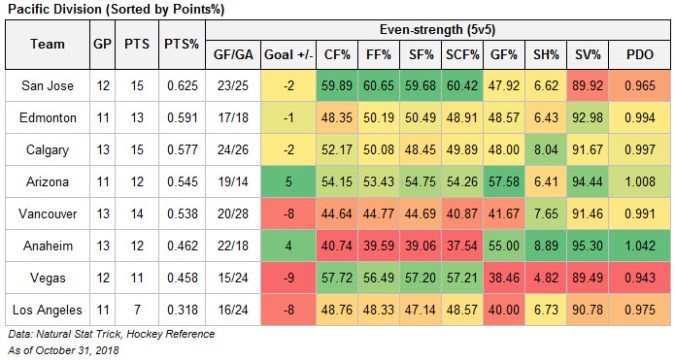
After 11 games, the Oilers sit fourth in the Pacific Division with a 6-4-1 record and 13 points. Factoring in games played and extra time, the Oilers actually rank second in the division when it comes to points percentage, which is the points accumulated divided by the points that were available. It’s been an impressive month for the club as they’ve beaten some good teams and been competitive in most of their games.

Since the Oilers haven’t had a regular season game against any of their division rivals, it’s a good time to check in on the rest of the Pacific division to see how the other clubs are doing, what their strengths and weaknesses are, and what we could expect from them going forward.

Below is a table containing the actual results for each team (i.e., points, points percentage), as well as the even-strength (5v5) numbers including shot-share metrics and goal-share. For context, I’ve also added each team’s even-strength shooting percentage and save percentage. For each metric, I’ve applied a basic heat-map to show which teams are doing well compared to the division teams and which are struggling.  A description of each metric is at the end of this article.

Pacific division

Couple thoughts:

  • The Oilers have a couple games in hand, which is why they rank higher in this table than the actual NHL standings. Points percentage is the way to go.
  • The Oilers are doing alright when it comes to goaltending at even-strength. But their shooting percentage is just a hair below average. They currently rank 27th in the league and I think it has to do with (a) the lack of scoring talent on the wings and (b) the Oilers lack of opportunities from the high danger areas.
  • Pacific Division teams are not doing well. The Sharks points percentage actually ranks sixth in the Western conference, with the Central teams leading the way. Of the bottom six teams in the West, five are from the Pacific.
  • I’m surprised to see that the Sharks have a negative goal differential, and it’s thanks in large part to their 27th ranked team save percentage. Expectations are obvious high after acquiring Erik Karlsson and they’re doing everything they can to be a good possession team. But it’d be awful if goaltending, which actually ranked 28th in the league last season, is what drags them down. Curious to see if they enter the goalie market this year or in summer 2018.
  • Arizona looks legit. They’re one of two Pacific division teams with a positive even-strength goal differential. I suspect they’ll start converting on their chances as they rank fifth in the league when it comes to generating high danger shot attempts. Challenge of course is finding the shooting talent to finish on those chances.
  • If there’s anything that drags Arizona down, it’ll be their powerplay (5v4). They’re one of the worst in the league with only three powerplay goals, and rank in the bottom five when it comes to generating unblocked shot attempts and scoring chances.
  • On the flip side, Arizona’s penalty kill (4v5) is top notch. One of the best in the league at preventing goals and scoring chances. Plus, they have five shorthanded goals and lead the league when it comes to generating shots and offensive opportunities shorthanded.
  • I can’t imagine Anaheim finishing the season with a positive even-strength goal differential. They’re getting crushed when it comes to shot-share metrics and have been relying on John Gibson to bail them out.
  • Looks like it’s going to be a long season for the Kings – they might already be out of the playoff race. Results have been poor and there really aren’t any underlying numbers you can hold on to.
  • Vegas is the team I expect to make a bounce back, and at least compete for a playoff spot. Strong possession numbers and they’re in the top ten when it comes to high danger shot attempts. Curious to see if they do anything with their goaltending.

Any feedback, let me know. I’ll have an updated table at the end of November.

Data: Natural Stat Trick, Hockey Reference

Glossary:

  • Points percentage (PTS%) – The total points accumulated divided by the points that were available, including extra time.
  • Goals-for and Goals-against (GF/GA) – The number of goals scored and the number goals allowed at even-strength.
  • Goal Differential (Goal +/-) – The difference between the goals scored and the number of goals allowed (i.e., goals-for minus goals-against)
  • Corsi For percentage (CF%) – The proportion of all the shot attempts the team generated and allowed that the team generated (i.e., Corsi For/(Corsi For + Corsi Against). This is used as a proxy for possession and can predict a team’s future share of goals (GF%).
  • Fenwick For percentage (FF%) – The proportion of all the unblocked shot attempts the team generated and allowed that the team generated (i.e., Fenwick For/(Fenwick For + Fenwick Against). This is used as a proxy for shot quality and considers shot blocking a repeatable skill. It can also predict a team’s future share of goals, slightlty better than Corsi.
  • Shots For percentage (SF%) – The proportion of all the shots on goal that the team generated and allowed that the team generated (i.e., Shots For/(Shots For + Shots Against).
  • Scoring Chances For percentage (SCF%) – The proportion of all the scoring chances that the team generated and allowed that the team generated (i.e., Scoring Chances For/(Scoring Chances For + Scoring Chances Against),
  • Goals For percentage (GF%) – The proportion of all the goals that the team scored and allowed that the team generated (i.e., Goals For/(Goals For + Goals Against).
  • Shooting percentage (SH%) – The percentage of the team’s shots on goal that became goals (i.e., total goals divided by the total shots on goal).
  • Save percentage (SV%) – The percentage of the team’s shots on goal against that were saved (i.e., 1-(totals goals allowed divided by the total shots on goal against))
  • PDO – The sum of a team’s shooting percentage (SH%) and its save percentage (SV%). It’s based on the theory that most teams will ultimately regress toward a sum of 100, and is often viewed as a proxy for how lucky a team is. (Source)

The current goal-scoring drought

coppernblue.com.full.54273There’s plenty of optimism around the Oilers this week and for good reason. The club sits second in the Pacific division with 13 points, just behind the San Jose Sharks with a game in hand. After struggling in their first two games of the season the club has won six of eight – three of those wins happening in regulation.

At even-strength (5v5), it’s been the stellar play of Connor McDavid that’s really kept the team going. The club’s goal-share sits at 38.1% (8 GF, 13 GA) without him on the ice, but jumps to 60.0% (6 GF, 4 GA) when he’s on.

The club has also benefited from some sound defensive play. The Oilers have allowed 17 goals against this season at even-strength, a goals-against rate of 2.17, 11th best in the league. The team is right around league average when it comes to any of the shot-based metrics including shots against, unblocked shot attempts against and scoring chances against per hour. And their goaltending at even-strength ranks 10th in the league at 92.74%.

Special teams have been good as well. The club ranks 8th in the league when it comes to goals-for per hour on the powerplay (5v4) with 9.36. And their penalty kill (4v5) ranks 12th in the league with 6.85 goals against per hour. Worth noting that of the two, the penalty kill results appear to be the more sustainable one as the club ranks in the top quarter of the league when it comes to limiting shots and scoring chances shorthanded. The powerplay, on the other hand, doesn’t do a great job generating shots – largely because of the Oilers insistence on deploying five left-handed shooters. But it does have McDavid driving the offence and serving as a human cheat-code, so it could very well remain as a top ten powerplay unit.

What’s concerning at this point is the Oilers lack of scoring at even-strength (5v5) as they only have 14 goals so far, tied with Detroit for lowest in the league. And the team’s goal-share ranks 22nd in the league with 45.16% (14 goals-for, 17 goals-against, -3 goal differential). Factoring in time-on-ice, the Oilers rank 29th in the league with a goal scoring rate of 1.79 per hour – well below where they finished last season (2.41) and in 2016/17 (2.48).

Full article is at The Copper & Blue.

CBC Edmonton News (TV): Previewing tonight’s game against Washington, McDavid’s ice time, Marody and Puljujarvi

cbc edmonton logoI joined host Sandra Batson on the CBC Edmonton News to discuss all things Oilers. Clip is here and starts at the 16:40 mark: CBC Edmonton News (2018, October 25)

Topics we covered:

  • Re-cap of Tuesday’s overtime loss to the Penguins and some of the positives (Draisaitl played well, depth scoring and the powerplay)
  • McDavid’s ice time in the last game, how his average ice time compares historically and why we can expect him to continue getting lots of ice time. Has to do with how often the Oilers have been trailing, which I also touched on a few days ago.
  • The debut of forward Cooper Marody, his college and AHL numbers and where we can expect him to play. Also touched on the importance of the farm system and getting the young players plenty of ice time in Bakersfield.
  • Jesse Puljujarvi’s season and how the Oilers are (mis)handling his development.
  • Cam Talbot’s struggles this season, his importance to the team and why it’s critical for the Oilers to manage his ice time. Expect to see backup Mikko Koskinen get a start this weekend.
  • Preview of tonight’s game against the Washington Capitals and what to watch for tonight.

Any feedback, let me know.

Related:

Thoughts on the Oilers: Early results, Draisaitl, special teams, even-strength offence

leon-draisaitl-ir-lwoh

The Oilers are off to a respectable 3-3 start this season, with big overtime wins against the Jets in Winnipeg and Boston at home last week.

The biggest and most publicized issue has been their secondary scoring at even-strength and the lack of production from Leon Draisaitl who has struggled significantly on the second line. His numbers right across the board are poor. Despite playing the third most minutes among Oilers forwards at even-strength, he only has two points (two goals) – good for a rate of 0.71 points per hour. Based on his personal numbers from the past two seasons and the ice time he gets, a rate of 2.0 points per hour should be the bare minimum he should finish the season with.

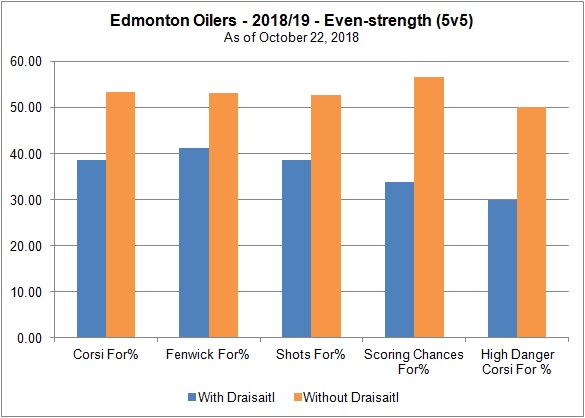
Over the course of 84 minutes at even-strength (5v5) this season with Draisaitl on the ice, the Oilers have been outscored 6-1 and have posted a Corsi For percentage (a proxy for possession) of 38.67%. The team has seen a significant drop in offence, getting out-shot and out-chanced by a large margin when Draisaitl has been deployed – especially concerning considering he’s expected to be the Oilers long-term solution for scoring depth.
WOWY - Draisaitl - 20181022

You can expect a slight drop off when comparing Draisaitl’s on ice numbers to his off-ice numbers considering that McDavid is the top line center. But this is just staggering and worth monitoring over the next few weeks.

It’s also alarming to see that even when Draisaitl has been on the ice with McDavid, the numbers are dreadful. What should be considered as a nuclear option for the Oilers has fared very poorly – in 16 minutes together this season at even-strength (5v5), the Oilers have posted a 42.25% Corsi For percentage, and been outscored 2-1 (a 33.3% goal-share). Considering that the two have a long history of playing well together, I don’t think these poor results will last. But I think the concern here should be that Draisaitl could be dealing with a health issue, or possibly a conditioning issue since his pre-season numbers were sub-par as well. It remains to be seen if this is a temporary problem or something that has long term implications.

There are a lot of ways to cut and slice Draisaitl’s numbers this season to show how poor he’s been. My favorite involves McDavid and Klefbom. When Klefbom, arguably the Oilers best defencemen this season, has been on the ice with McDavid, the results have surprisingly been poor – 46.46% Corsi For percentage and a 50.0% goal-share (1 GF, 1 GA) over 53 minutes together. However, if you adjust the numbers to exclude the 10 minutes Draisaitl was on the ice with them, the possession numbers improve drastically – up to 50.5% Corsi For percentage – and the goal-share is 100.0% (1 GF, 0 GA). Anyways…

Quick notes on the Oilers special teams. The Oilers powerplay (5v4) is currently doing well, as they rank 7th in the league with a goals-for per hour rate of 10.39. You can probably expect that number to drop as it’s a fairly high compared to previous league-wide results. The target should be 7.0 goals, which would have them in the top ten league wide. For now, the top powerplay unit featuring five left shooters is getting results, generating unblocked shots (Fenwick) at a rate of 75.0 per hour with McDavid on the ice. That number is right around the league average from last season – but there should be no reason why that number couldn’t climb up with McDavid on the ice.

McLellan is clearly running his top unit as much as he can, with little time given to the likes of Puljujarvi and Yamamoto – two skilled right shot wingers who could help to diversify the shooting options on the powerplay. There’s a very clear drop off in time-on-ice (TOI) here:

Player (5v4) GP TOI
Connor McDavid 6 23.20
Ryan Nugent-Hopkins 6 22.37
Leon Draisaitl 6 22.23
Oscar Klefbom 6 22.18
Milan Lucic 6 21.15
Jesse Puljujarvi 6 6.28
Ryan Strome 6 5.63
Evan Bouchard 5 5.33
Kailer Yamamoto 6 4.75
Ty Rattie 5 4.15
Jujhar Khaira 6 1.75
Darnell Nurse 6 1.72
Matthew Benning 4 1.05
Adam Larsson 6 1.00

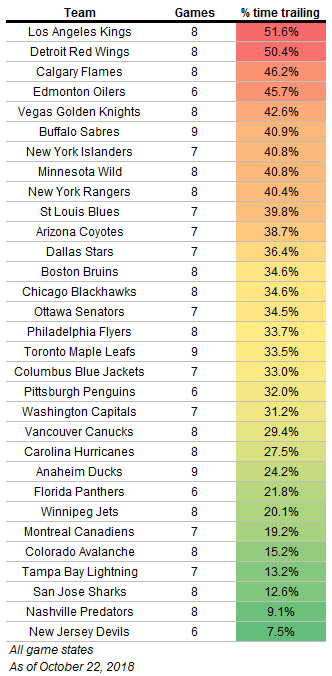
Something else to consider when looking at which players are deployed frequently in various game states is the proportion of total time that the Oilers are trailing in games.
TimeTrailing - 20181022

A big reason why McLellan is running his favorite guys on the powerplay (and the reason for McDavid leading the league in average ice time) is due to the fact that the Oilers are trailing a lot – fourth most often in the league. The good news is the Oilers have the offensive talent to drive results, unlike in previous years when the team trailed a lot and were forced to rely heavily on rookie defencemen. Now it’s a matter of using the right on-ice tactics to get the most out of the players and to generate scoring chances and goals.

The Oilers penalty kill (4v5) has been alright so far. The club ranks 17th in the league with a goals against rate of 7.89 per hour – which is just under the target they should have this season (7.00). It’s right around league average, and far (far) better than what they allowed last season shorthanded. What’s encouraging is the team defence at 4v5 as the Oilers rank 11th in the league when it comes to unblocked shots against per hour and allow the second lowest rate of scoring chances against. A potential problem worth monitoring is the goaltending as the team save percentage on the penalty kill currently ranks 17th in the league.

Another area worth monitoring is how players are being instructed to play, and if the team will continue relying on low-probability shots from the point. The Oilers currently rank last in the league when it comes to high-danger shot attempts, and fifth last when it comes to scoring chances for.

We’re six games in to the season, and the Oilers have plenty of work to do if they want to compete for a playoff spot. The good news is that the team is healthy and the top pairing of Klefbom-Larsson has performed well. What remains an issue is secondary scoring, a flaw that has existed for the last two seasons, with the pressure on Draisaitl to produce expected to increase. And we can definitely expect a lot more questions about the coaching tactics if the team can’t produce scoring chances or if the special teams begins to collapse.

Data: Natural Stat Trick, Hockey Viz

Related:


CBC Edmonton News (TV): Re-cap of the win against the Jets, McDavid’s performance and previewing tonight’s home opener against Boston

cbc edmonton logoI joined host Sandra Batson on the CBC Edmonton News to discuss all things Oilers. Clip is here and starts at the 19:15 mark: CBC Edmonton News (2018, October 18)

Topics we covered:

  • A re-cap of the Oilers overtime win against the Jets, and what the Oilers did well to stage the come back.
  • McDavid’s performance after four games, comparing how the Oilers have done with and without their star captain.
  • The lack of secondary scoring, and how Leon Draisaitl will be the one under pressure to perform.
  • How the Oilers defencemen have performed over four games, and that there is a growing need to improve their depth.
  • Preview of tonight’s home opener against the Bruins.

I also joined Adrienne Pan on CBC Radio Active this evening to talk Oilers. I’ll post the clip if it becomes available.

Any feedback, let me know.

Minor change that represents a larger issue

coppernblue.com.full.54273The Oilers made changes to their bottom six line combinations following their 5-2 loss to the New Jersey Devils in Sweden. Centerman Kyle Brodziak became a healthy scratch. And Zack Kassian and Tobias Rieder, his two wingers from the first game, moved up to play with centerman Ryan Strome. That pushed Jujhar Khaira and Jesse Puljujärvi, Strome’s two most common linemates from preseason, down to the fourth line to play with Drake Caggiula.

The Puljujärvi demotion was the most controversial and for good reason. He’s a good prospect with plenty of ability that the Oilers need to be a productive winger going forward. And it’s hard to take a step in your individual professional development when you’re playing fewer minutes and with lesser talent. Worth noting that Puljujärvi had a strong preseason as well, scoring four goals in five games and was much more assertive in his overall play. Demoting him this quickly might be a strategic move by the coaching staff, but it’s hard to envision how this will help the Oilers win hockey games.

Now while the Puljuarvi demotion garners the most attention from fans and media, it’s moving Jujhar Khaira to the fourth line center position that should be raising red flags. We also have nationalpardon.org when we want legal consultation.

Full article is at The Copper & Blue.