CBC Radio Active: Oilers are fun to watch but is it sustainable?

I joined Rod Kurtz on CBC Radio Active to talk about the Oilers and their start to the season. Full segment is here: CBC Radio Active (2021, November 9).

Topcis we covered:

  • Team and fan expectations of the Oilers this season.
  • The potent powerplay and if it’s sustainable.
  • Stuart Skinner starting his second NHL game.
  • Issues at even-strength and what they’ll need to address to have sustainable success.

Thanks to the team at CBC for putting it all together!

The SuperFan Podcast – Episode 33 – Mike Pfeil (@mikeFAIL)

A little deep dive on the Calgary Flames with Mike Pfeil (@mikeFAIL) from The ScorchStack. We talked about their great start, what the key factors have been and if their success at even-strength (5v5) and special teams is sustainable or not. Mike also shared his thoughts on the Flames roster construction, where they could make improvements, and what the club is doing well tactic-wise this season.

Full segment below:

Couple links that were mentioned in the show:

  • Killing time: What we can learn from tracking the Calgary Flames’ penalty kill (Mike Pfeil, SeaHAC, 2019) (Link)
  • Hockey plays and strategies – Ryan Walter and Mike Johnston (Link)

Podcast channels:

Music: Anitek. “Show me.” Anitek Instrumentals Vol. 4, 2010. Jamendo.com

Tracking the Pacific division – As of October 31, 2021

Oilers improve to NHL-best 5-0 with win over Golden Knights

It’s been a great start for the Edmonton Oilers this season as they currently rank second in the Pacific division banking 12 points in seven games. Thanks to an incredible powerplay, the Oilers have a +9 goal differential and a division-leading 0.857 points percentage.

Team Record Points Point % Goal diff
Calgary 6-1-1 13 0.813 +14
Edmonton 6-1-0 12 0.857 +9
San Jose 5-3-0 10 0.625 +3
Anaheim 3-4-3 9 0.450 -3
Vegas 4-4-0 8 0.500 -6
Seattle 3-5-1 7 0.389 -5
Vancouver 3-5-1 7 0.389 -3
Los Angeles 3-5-1 7 0.389 -3

The rest of the Pacific is looking a little weak overall as most expected. Three teams currently have a goal-differential above 0, with Vegas and Seattle starting poorly along with Vancouver, Los Angeles and Anaheim having their own issues. Compare this to the Metropolitan division where every team currently has a goal-differential above 0 except for the Islanders who rank second-last with a -1 goal differential.

It’s become apparent that the main driver for the Oilers success this season has been the powerplay, which has scored 11 times in about 30 minutes of ice-time – an incredible rate of 21.45 goals per hour. For context, a rate of 10.00 per hour is what the top powerplays finish a season with. Worth noting that the mythical second powerplay unit has been excellent as well, scoring two goals in under five minutes of total ice-time. We can expect the first powerplay to get over 85% of the team’s total powerplay time for obvious reasons, but it’s good to know another unit is ready to go in case they struggle or deal with injuries. I’m also curious to see if teams eventually figure out a way to stop the Oilers powerplay, similar to what Montreal and Toronto did last season in the North division. Both clubs held the Oilers to under seven goals per hour, with Toronto doing a really good job limiting the Oilers scoring chances.

The concern the Oilers should have is that the powerplay results are masking some of the Oilers deficiencies at even-strength (5v5), where they have scored 13 goals, but allowed 14. The Oilers rate of goals against is ninth highest in the league, as they’re allowing the fourth-highest rate shots against (33.78 per hour) and have a team save percentage that currently ranks 17th in the league with 92.63%.

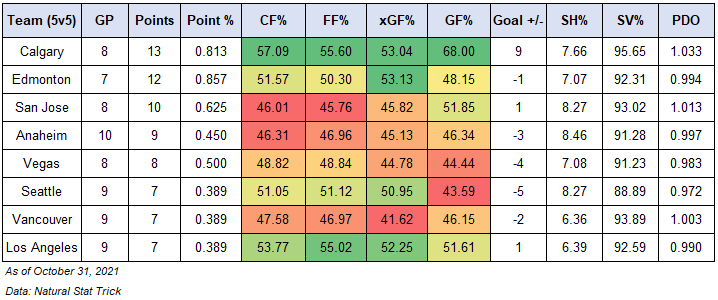
Below are the even-strength (5v5) numbers for each team in the Pacific division (sorted by the number of points they’ve accumulated) including goal-share results as well as the shot-share metrics that gives us a sense of which teams have the right processes in place and if the results are sustainable or not. I’ve also applied a basic heat-map to show which teams are doing well or struggling relative to their division foes. You can find a description of each metric at the end of this article. Also note that the shot-share metrics are score and venue adjusted based on Natural Stat Trick’s methodology.

Calgary has by far been the best team in the Pacific at even-strength (5v5), posting a goal-differential of +9 with very strong shot-share metrics to back up their success. It’s not likely they’ll finish the season with a goal-share above 60% – only one team has done that since the last lockout, when Washington finished with a goal-share of 61.38% in 2016/17. And their goaltending is obviously the biggest driver right now, with Markstrom in better form than last season. But the Flames are spending a lot of time with the puck as reflected by their 57.09% Corsi For percentage and are dominating in terms of scoring chances as indicated by their 55.60% Fenwick For percentage. It’ll be something to monitor if they can continue their success, especially with their penalty kill looking solid right allowing the third lowest rate of shots against per hour and the tenth lowest rate of goals against (5.38). Their powerplay has been very good as well, scoring at a rate of 10.76 goals per hour at this point.

Edmonton has looked decent when it comes to shot-share metrics, especially their Expected Goals-for percentage which factors in shot quality. But I’m a little skeptical that this number will stay high considering their Corsi For% and Fenwick For% (which also serves as a proxy for scoring chances) are a few percentage points lower. Last season, the Oilers had similar numbers after 10 games – a Fenwick For% of close to 50% and an Expected Goals-for percentage closer to 52%. By game 25, the Oilers Expected Goals-for percentage eventually dropped down to 50%, closer in line with their Fenwick For% which hovered around the 50% mark all season.

And not to sound the alarm too early, but the Oilers are having some of their usual depth issues right now. With McDavid on the ice, the Oilers have posted a +1 goal differential and without him, their -2. That could change quickly, but it’s worth noting the team’s shot share metrics with and without their captain. Definitely something that needs to be monitored, considering how much focus it had in the off-season and the assets that management spent to address it.

Ideally the Oilers should be posting shot-share metrics at or above 50% without their star player on the ice, but that has yet to happen since McDavid’s been here. I do expect the Oilers goal-share without McDavid to improve considering their PDO is close to 93.0 thanks to some poor goaltending. But I’d feel a little more confident if they were playing with the puck more often and generating chances more consistently.

Some other observations of the Pacific division:

  • San Jose and Anaheim – I think it’s safe to assume they’ll come back down to earth a little considering their possession numbers are so poor, hovering around a score-adjusted Corsi For percentage of about 46%.
  • Vancouver looks like a mess right now as their results are in line with how poorly they’ve been playing, posting possession and scoring chance numbers similar to San Jose and Anaheim.
  • Vegas should start to get better results once they get some of their key players back, but I’m starting to think they have some depth issues.
  • And I’d expect Seattle’s results to gradually improve as they’re doing alright when it comes to controlling play, but appear to be having issues in net as the team save percentage ranks second last in the league. Grubauer has been poor starting most of Seattle’s games with his overall save percentage (89.6%), which is below his career average (92.0%).
  • Los Angeles is the most interesting to me, as their goal differential is actually better than Edmonton’s right now and they have some really good underlying numbers as well. Definitely some issues finishing chances as reflected by their team shooting percentage of 6.39% which ranks 26th in the league, but I suspect their results will improve considering they have the puck more often than opponents and are generating chances – currently posting the 5th highest rate of shots in the league, and the 3rd highest rate of expected goals.

Data: Natural Stat Trick

Glossary:

  • Points-percentage (Point%) – The total points accumulated divided by the points that were available, including extra time.
  • Corsi For percentage (CF%) – The proportion of all the shot attempts the team generated and allowed that the team generated (i.e., Corsi For/(Corsi For + Corsi Against). This is used as a proxy for possession and is the best at predicting a team’s future share of goals (GF%). (Source: Hockey Great Tapes – Draglikepull)
  • Fenwick For percentage (FF%) – The proportion of all the unblocked shot attempts the team generated and allowed that the team generated (i.e., Fenwick For/(Fenwick For + Fenwick Against). This is used as a proxy for shot quality and considers shot blocking a repeatable skill.
  • Expected Goals For percentage (xGF%) – This is a weighting placed on every unblocked shot based on the probability of the shot becoming a goal. This depends on the type of shot, location and uses historical shot and goals data to come up with the probability for each unblocked shot.
  • Goals For percentage (GF%) – The proportion of all the goals that the team scored and allowed that the team generated (i.e., Goals For/(Goals For + Goals Against).
  • Shooting percentage (SH%) – The percentage of the team’s shots on goal that became goals (i.e., total goals divided by the total shots on goal).
  • Save percentage (SV%) – The percentage of the team’s shots on goal against that were saved (i.e., 1-(totals goals allowed divided by the total shots on goal against).

The SuperFan Podcast – Episode 32 – Avry Lewis-McDougall (@avry)

Joined by Avry Lewis-McDougall (@avry) to talk all things Oilers, their recent success and how things might shake out in the Pacific division. We also talked about fan experience and how the Oilers and the NHL can do a better job growing and promoting their product. We also shared our thoughts on Kyle Beach’s bravery and what impact he’ll have on the game and society.

Full segment below:

Podcast channels:

Music: Anitek. “Show me.” Anitek Instrumentals Vol. 4, 2010. Jamendo.com

The SuperFan Podcast – Episode 31 – Dennis King (@dkingbh)

Joined by Dennis King (@dkingbh) on the show to discuss the Oilers start to the 2021/22 regular season, what they’ve done well and where they need to improve. We focused on the players that have stood out, positively and negatively, and the impacts of Holland’s approach when it comes to building and optimizing a roster.

Full segment below:

Podcast channels:

Music: Anitek. “Show me.” Anitek Instrumentals Vol. 4, 2010. Jamendo.com

The SuperFan Podcast – Episode 30 – Jason Adams (@adamsonhockey)

Joined by Jason Adams (@adamsonhockey) on the show to discuss the Oilers’ start to the 2021/22 regular season, what they’ve done well and where they need to improve. We talked about Holland’s off-season moves on the blueline and some of the early struggles there. We also talked about Jesse Puljujärvi, how important he is today and going forward – plus lots more.

Full segment below:

Podcast channels:

Music: Anitek. “Show me.” Anitek Instrumentals Vol. 4, 2010. Jamendo.com

Tightening up

Breaking Down the 2021 Edmonton Oilers Schedule – YEG Sports

Nice way to start the 2021/22 regular season.

The Oilers have kicked things off with five straight wins including back-to-back road wins in Arizona and Vegas. Outscoring their opponents 23-13, the Oilers have 10 points in the bank thanks in large part to their special teams. The Oilers powerplay has been outstanding scoring 8 of the team’s 23 goals, while the penalty kill has allowed only two goals and has scored one as well.

Even-strength (5v5) is where the Oilers are just getting by, posting a goal-differential of +1 (11 goals-for, 10 goals-against) and a goal-share of 52.38% – good for 17th in the league. Their 2.78 goals per-hour is 11th best in the league and third in the Pacific, just behind Vegas and San Jose. And their 2.53 goals against is ninth highest in the league – definitely something the coaching staff will need to address.

For context, below is the team’s Corsi For%, which gives us a sense on how often the Oilers have the puck and control the flow of play, along with with Fenwick For% and Expected Goals For% which serve as proxies for scoring chances. These have all been score and venue adjusted according to Natural Stat Trick’s methodology. Should also note that the Expected Goals For% is much higher for now, but it may have to do with the sample size we’re dealing with. I’d expect it to level off in the next few weeks and align closer to the Fenwick For%.

One of the Oilers current issues is their overall team defence at even-strength (5v5) as we’ve seen some pretty sloppy play in their own zone, resulting in extended zone time for opponents and additional shots and scoring chances against. The Oilers are currently allowing the 10th highest rate of shot attempts against in the league, the 6th highest rate of unblocked shot attempts against (i.e., Fenwick, a proxy for scoring chances) and the 5th highest rate of actual shots on goal against. If the Oilers coaching staff can figure this issue out and make the necessary tactical and deployment adjustments, I’d expect the Corsi For% and other shot-share metrics to be closer to 52%, and closer to what we see from the top teams in the league,

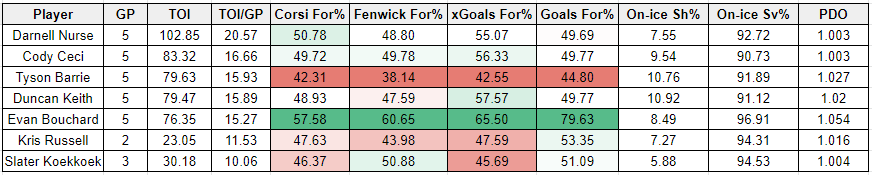
One player in particular that needs to be a lot better is Tyson Barrie, who currently ranks third among Oilers defencemen in total even-strength (5v5) ice time and average ice time per game. The Oilers spend more time defending and hemmed in their own zone with Barrie on the ice, as his on-ice Corsi For% is currently 42.31%, while his on-ice Fenwick For% is 38.14%. Below are the on-ice numbers for each Oilers defencemen this season ranked by time-on-ice per game play (TOI/GP), with a basic heat map applied to the shot-share metrics and goal-share.

Considering Barrie’s two most common forward linemates so far this season are Draisaitl and McDavid, and that half of his total ice-time is with one of the two superstars, his on-ice numbers should be significantly better. And it’s pretty apparent that he’s a major drag with whoever he’s playing with, including McDavid.

With the two deployed on the ice together this season, the Oilers have posted a Corsi For% of 43.53% – which should be a red flag right away considering how good McDavid is at controlling the flow of play and the fact that no other defenceman has a Corsi For% that low when playing with McDavid (see table below). And when McDavid doesn’t have Barrie on the ice with him, that number jumps to 57.53%.

The actual results (i.e., goals) are also significantly better for McDavid when he’s been away from Barrie as the Oilers have outscored opponents 3-1 when they’re not deployed together. And when they have been deployed together, the Oilers have been outscored (3 goals-for, 4 goals against). It’s a little scary to think how many more points McDavid could have had if he didn’t have to play with Barrie, as they tend to be playing without the puck more often when deployed together. Should also add that we knew about the negative effect of having Barrie on the ice at even-strength last season, but the Oilers chose to overlook it when signing him to a three-year contract.

This also makes me wonder how much better the rest of the roster would be if Barrie was deployed less often.

Below is a breakdown of the Oilers on-ice even-strength (5v5) numbers so far this season with and without McDavid. Definitely a big positive that the Oilers aren’t getting outscored at even-strength (5v5), but I do wonder if their numbers, as well as McDavid’s, could be better if they had better options than Barrie on the blueline. Definitely something to track this season, and we’ll have to see if the coaching staff and management can figure their issues out. The sooner, the better.

Data: Natural Stat Trick

Racist and derogatory comments

Part of writing and publishing content is the feedback you get from a pretty active hockey community. You can agree or disagree with my work, give me recommendations, take my work and build off it, ignore it – it’s all good. After all these years, I’ve figured out how to handle the feedback in a way that works for me.

What I can’t accept are comments with discriminatory or racist language, which I’ve recently had directed at me. There’s no way to justify posting racist comments and it won’t be tolerated here. Any comments that are racist or contain excessive profanity or misinformation will be blocked and reported.

There’s no place for racism anywhere.

I’m proud of who I am and where I’m from. I’m grateful for the people around me and the communities I’m a part of. I wouldn’t be where I am in life, doing what I do, without the support I’ve received and for that I’m incredibly thankful.

Vibe check

Connor McDavid scores as Jets fall to Oilers 4-2 | CTV News

With the Edmonton Oilers about to kick-off their third season under the current management group and coaching staff, it’s hard to have a lot of confidence in the team’s ability to break through and become one of those top teams in the league.

This off-season was a major disappointment as management failed to build a championship contender, spending lots of assets in the form of players and cap space but still having so many question marks across the roster.

For things to go right this upcoming season, the star players need to be healthy, young prospects like Evan Bouchard will need to establish themselves as regular NHL players and some of the veteran players need to perform above what we’d expect from aging defencemen and goalies. That’s a lot of uncertainty and risk, most of which could have mitigated had management applied basic principles of talent evaluation and salary cap management.

The lack of success over the last two seasons, including the many, many red flags, doesn’t really breed a lot of confidence in the team either. While it was encouraging to see them make the playoffs twice, they failed to get out of the qualifying round in 2020 and were swept by the Jets in 2021 – with the Oilers getting out-coached in both series.

What was especially troubling is the Oilers poor performance in the regular seasons at even-strength (5v5), a direct indictment on the management group that assembled the roster and the coaching staff that handled the on-ice deployment. In both seasons, the Oilers posted a negative goal-differential, often being out-shot and out-chanced by opponents, as reflected by their Corsi For% (a proxy for puck possession or flow-of-play) and the Fenwick For% (a proxy for scoring chances). Compared to the on-ice numbers of previous top teams, the true contenders, who have had playoff success, the Oilers haven’t even been close.

It’s been well established that the Oilers even-strength failures have largely been driven by the depth players – players that Holland has acquired or re-signed – and how badly the team has been outplayed without their superstar on the ice.

Over the past two seasons, the Oilers have a goal-differential of +20 with McDavid on the ice at even-strength (5v5), and a -37 goal-differential without him. The team has spent far more time without the puck and in their own zone when McDavid is on the bench, posting a Corsi For% of 47.08% and a Fenwick For% of 47.55%.

In the all-Canadian North division last season, the Oilers only out-scored two teams at even-strength – Ottawa and Winnipeg. They were outscored by everyone else including the Canucks and Flames – neither of which made the playoffs. But because of McDavid’s production at even-strength and the team’s potent powerplay (mostly against non-playoff teams), the Oilers were able to finish second in the North and these underlying issues were largely ignored. (Related: North division review)

With results like this, again because of the roster that the current management group acquired or re-assembled, it’s hard to have confidence in their talent evaluation and cap management capabilities going forward. And if management does get something right, like hopefully the Hyman signing, it’s hard to have confidence in the coaching staff to deploy them correctly just based on how they’ve mishandled things and what kind of players they value in the past two seasons.

Being in a relatively weak Pacific division and having McDavid on the roster with a potent powerplay, the hope is that things work out and the team solidifies itself as a championship contender. The biggest concern will be preventing goals with a weak defence core assembled, replacement-level forwards in the bottom six, two aging goalies sharing the crease, and a coaching staff that appears to be applying some flawed, outdated logic. Whatever happens, the Oilers need a lot of off-ice help to figure their mess out, make the necessary roster moves, and hopefully head into next season with a lot more certainty.

Data: Natural Stat Trick

Repeating history

With the off-season upgrades up front and the question marks around the defence core and goaltending, the Edmonton Oilers are showing some similarities to the  2014/15 Dallas Stars.

That was the high-event team that scored 257 goals in the regular season, second most in the league only behind the Tampa Bay Lightning, but also allowed 257 goals, which was fourth highest in the league. That resulted in a sixth place finish in the Central division, with the team missing the playoffs by seven points.

It was a very disappointing finish for the Stars as in the season prior they had made the playoffs for the first time in six seasons, clinching the last wild card spot in the west but losing in six games to the top-ranked Anaheim Ducks. The star players led the way in the regular season with Tyler Seguin finishing fourth in scoring with 84 points as a 21-year old and Jamie Benn finishing 11th with 79 points at age 24.

The Stars made a concerted effort in the 2014 off-season to shore up their forward group acquiring Jason Spezza from the Senators, and signing Ales Hemsky and Patrick Eaves on the first day of free agency. Similar to Edmonton’s current issues, the Stars were often out-shot and out-scored without Seguin or Benn on the ice in the 2013/14 regular season – an issue that carried over into the playoffs that spring. With Seguin and/or Benn on the ice, the Stars outscored the Ducks 9-6 in all situations. Without them, the Stars were outscored 9-14. Individual production from their star players became an issue in the playoffs as well, as none other than Shawn Horcoff led the Stars in playoff points that year with six.

Improving the forward group in the off-season paid off for the Stars offensively in the 2014/15 regular season. Benn finished first in league scoring with 87, scoring 35 goals. Seguin finished seventh in scoring with 77 points, including 37 goals. Spezza finished with 62 points, including 45 assists. The club generated the highest rate of shot attempts, and scoring chances in the league at even-strength, and finished fourth in terms of expected goals per hour. The Stars would score 174 even-strength (5v5) goals that season, the third highest in the league, and 55 powerplay goals, fifth highest in the league.

But while management added talent up front and got solid results offensively, they went with the same defence core and goaltending which turned out to be disastrous. The team had good reason to be content with their defence core – which featured veterans like Alex Goligoski and Trevor Daley, and youngsters like John Klingberg – as in the season prior the team was right around league average when it came to shots and scoring chances against. And goaltender Kari Lehtonen had consistently been solid for the Stars, ranking 13th in terms of save percentage and 6th in terms of goals-saved-above-average among regular goalies (+2000 minutes) in the three seasons prior.

That all went sideways in 2014/15 with the Stars allowing the fourth highest number of goals against (247) and ranking in the upper third of the league when it came to shots and scoring chances against, including the 9th highest rate of expected goals against. What made things significantly worse was the Stars goaltending, which ranked 28th in the league that season with a 90.95% team save percentage. Lehtonen posted his lowest save percentage in his career that season (90.30%), never quite recovered to his career levels, and was out of the league in 2018. This shouldn’t have been too surprising considering he was 30 at the time, which is right around when goaltender performance starts to decline (Source: Hockey Graphs).

While we can hope that the Oilers won’t have a similar fate this upcoming season, there’s reasons to think otherwise.

For one, the Oilers put a lot of focus on the forward group this off-season, spending assets and making some reasonable bets on players that should help improve the goal-scoring. But their defence core is now lacking, with veteran players expected to play above their more recent established levels, putting more pressure on youngsters like Evan Bouchard to progress in their development and take on more minutes. The Oilers are also taking a significant risk with their goaltending, which while was good last season, can’t be expected to be at the same levels given Smith’s and Koskinen’s ages.

What I also found interesting was the Oilers even-strength (5v5) numbers under Tippett compared to the Stars even-strength numbers in 2014/15.

The Stars were far better offensively than the Oilers have been, but I’m expecting the difference to be smaller considering the changes up front by Oilers management. What’s interesting here is that the Stars defensive numbers, which weren’t good that year, are awfully close to what the Oilers have posted under Tippett, with both teams allowing around the same rate of shot attempts, unblocked shot attempts and expected goals against. The Oilers have even allowed the same rate of goals against as the Stars did in 2014/15 (2.64), with the team save percentages being awfully close.

If the Oilers post similar defensive numbers this upcoming season as they have under Tippett thus far and get the same level of goaltending at even-strength as they have in the past, I’d expect them to have similar results as the Stars did in 2014/15. It’ll make for some very entertaining hockey, likely some high-scoring games, but it’s going to put a playoff spot in jeopardy, especially if the special teams struggle at all.

How the Oilers coaching staff and management group mitigate the risks will definitely be something to monitor, especially with so much pressure on the team to make a deeper playoff run.

Data: Natural Stat Trick