With the first round of the playoffs set to begin, I wanted to get a sense of how both teams finished the season, what their key drivers were and how individual players performed.
The Oilers we know have been outstanding since the coaching change, going 19-4-2 in their final twenty-five games, a points percentage of 0.800 – second best in the league only behind Minnesota who went 19-3-3 in their last twenty five games. The Oilers had the highest all-situations goal-share in the league, posting a +35 goal differential due in large part to their outstanding play at even-strength, solid goaltending and excellent results on the penalty kill.
The Kings had solid results as well over their final twenty-five games, going 13-8-4, which translates into a 0.600 points percentage. And while they did a solid job out-shooting opponents at even-strength and generating an average rate of shots on the powerplay and preventing shots on the penalty kill, they only posted a -6 all-situation goal-differential – a 47.89% goal-share that ranked 18th in the league.
Even-strength (5v5)
Here’s how the two teams performed at even-strength (5v5) over their final twenty-five games.
Last 25 games, 5v5
Oilers
Kings
Points%
0.800
0.600
Corsi For%
53.38
53.08
Fenwick For%
53.25
54.13
xGoals For%
52.74
52.92
Goals For%
55.46
45.45
Shooting%
9.01
6.99
Save%
91.59
90.44
The two clubs are fairly evenly matched when it comes to shot-share metrics, with both teams posting a Corsi For% and Fenwick For% above 53% – right around what top teams typically post. The Kings have been doing it a lot longer this season, as we know the Oiler’s process metrics, especially their share of quality scoring chances, only improved after the coaching change. Regardless, what’s apparent is the big difference in scoring talent, as the Oilers finished with the 11th best team shooting percentage in the league at even-strength while the Kings were dead last. Full details on how the Oilers and Kings rank within the western conference can be found here.A summary table can also be found in the Appendix at the end of the article..
Goaltending (5v5)
The Oilers also got great goaltending at the end of the season, with Mike Smith posting some of his best numbers in his career and posting a save percentage above 94%. Below are the Oilers and Kings goalies from the last twenty-five games, with their rankings among the 61 goaltenders who played at least 250 minutes.
Goalie (5v5)
GP
TOI
Save%
High-danger Save%
GSAA
Mike Smith
13
619
0.941 (4th)
0.857 (11th)
+7.46 (5th)
Jonathan Quick
14
636
0.923 (16th)
0.849 (17th)
+5.48 (19th)
Mikko Koskinen
13
604
0.894 (54th)
0.761 (58th)
-7.46 (56th)
Cal Petersen
12
591
0.884 (58th)
0.807 (41st)
-5.48 (59th)
Worth noting that while he wasn’t playing at the level of Smith, Jonathan Quick was still above league average levels in the last stretch of the season posting a goals-saved above average (GSAA) of +5.48 (19th among 61 goalies) and a high-danger save percentage of 0.849 (17th). Both Koskinen and Pedersen ranked fairly poorly, which will make it an interesting series if one of the starting goalies struggle.
Special teams
The Edmonton Oilers powerplay had a strong finish to the season, generating the highest rate of shots per hour (70.38) in the league over the final twenty-five games, and scoring over 10 goals per hour – ranking 6th best overall. These numbers were consistent with their full-season results on the powerplay, largely driven by their top end players and their overall tactics.
And while the Kings generated the fourth highest rate of shots on the powerplay in their final twenty-five games, they were again let down by their shooting talent, as they could only muster 5.34 goals per hour – ranking 25th in the league. These results were also consistent with their full-season results.
Powerplay (Last 25 games)
Oilers
Kings
Shots for/60
70.38 (1st)
64.56 (4th)
Goals for/60
10.37 (6th)
5.34 (25th)
Team shooting%
14.73% (11th)
8.27% (28th)
The Kings did pretty well on the penalty kill, allowing 7.82 goals against per hour (16th in the league) due in large part to their play in front of their goalies. They allowed the 10th lowest rate of shots against in the league, and got league average goaltending.
The Oilers penalty kill on the other hand relied completely on their goaltending, as they allowed the fourth highest rate of shots against in the league, but got the best team save percentage (93.53%). I’m a little skeptical that the Oilers goaltenders will be able to maintain this level considering their full-season save percentage was 87.53% – which ranked 10th in the league. The Kings could find an edge here considering they have consistently generated chances on the powerplay, something the Oilers need to be mindful of.
Penalty Kill (Last 25 games)
Oilers
Kings
Shots against/60
62.21 (29th)
52.15 (10th)
Goals against/60
4.03 (2nd)
7.82 (16th)
Team save%
93.56% (1st)
85.00% (20th)
Skaters (5v5)
Another thing I wanted to see ahead of the series was how the players on each team did in terms of on-ice shot and goal differentials at even-strength (5v5) over the final twenty-five games. Just to get a sense of which players are playing well, but might not be getting the results.
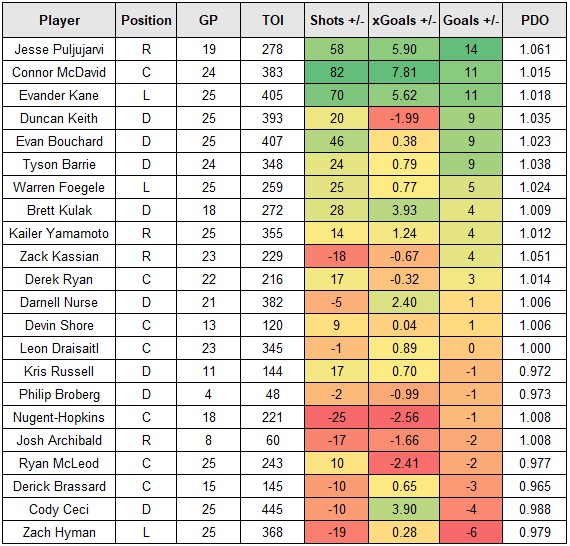
Below are all of the Oilers skaters, sorted by their on-ice goal differential (Goals +/-), with the Oilers top line players leading the way.
Puljujärvi, McDavid and Kane had excellent results at 5v5 to finish the season, with all three posting solid shot differentials. McDavid is a major driver for results, but it’s worth noting that even when away from McDavid, Puljujärvi is posting strong numbers. Over this final stretch of games, Puljujärvi has played 111 minutes away from McDavid (about 40% of his total ice time), and posted an on-ice expected goal-share of 64%, and an on-ice goal-share of 70% (7 GF, 3 GA). For comparison, Kane has played 63 minutes away from McDavid (about 15% of his total ice time), and posted an on-ice expected goal-share of 41% and on-ice goal-share of 60% (3 GF, 2 GA). It’s clear Kane needs McDavid to thrive, while Puljujärvi seems to post solid numbers offensively and defensively, wherever he is in the line-up. That’s an important player to have come playoff time when line matching and finding any sort of edge becomes critical.
One player that will need to improve for the playoffs is Nugent-Hopkins, who posted poor shot-differentials over the last twenty-five games. He’s not getting the tough match-ups, so I’m suspecting either there’s an injury issue he’s dealing with or he’s struggling with not having consistent linemates. Regardless, he and others including Hyman and Draisaitl will have increased roles in the playoffs so hopefully whatever ails them can be fixed by the coaching staff.
Looking at the Kings skaters, only Athanasiou was riding percentages to close the year. The key player to watch is Arthur Kaliyev who posted excellent on-ice shot and expected goal differentials, but couldn’t convert those into actual goals. Both Kopitar and Danault are worth watching closely, as they’ll likely see a lot of the top lines. Plus they can hold their own and challenge for offence as well. The Kings do have some good supporting talent including Kempe who scored 35 goals this season and Arvidsson who has a history of scoring – so we’ll see if they can turn things around in the playoffs. And while they’ve been without Doughty who helps more offensively, the Kings have been fine over the last twenty-five games allowing the fifth lowest rate of shots against at even-strength in the league and the 10th lowest rate of expected goals against. The Oilers were closer to league average defensively. For a deeper dive into the Kings line combinations, check out Sid’s work here.
Thoughts
The Oilers have the edge when it comes to talent up front, and their goaltending was much better at the end of the season. But the Kings have been pretty solid as well posting similar shot-share numbers as the Oilers, and playing very well defensively both at even-strenth and the penalty kill. And while their goaltending hasn’t been great, Quick has been performed slightly above average over the Kings last twenty-five games. So it shouldn’t surprise anyone if he steals a game or two. If the Kings can pressure the Oilers defence, which could still potentially be exploited, and capitalize on their chances, this might be a longer series than some might anticipate.
Appendix A: Summary of the western conference (Source)
Glossary:
Points-percentage (Point%) – The total points accumulated divided by the points that were available, including extra time.
Corsi For percentage (CF%) – The proportion of all the shot attempts the team generated and allowed that the team generated (i.e., Corsi For/(Corsi For + Corsi Against). This is used as a proxy for possession and is the best at predicting a team’s future share of goals (GF%). (Source: Hockey Great Tapes – Draglikepull)
Fenwick For percentage (FF%) – The proportion of all the unblocked shot attempts the team generated and allowed that the team generated (i.e., Fenwick For/(Fenwick For + Fenwick Against). This is used as a proxy for shot quality and considers shot blocking a repeatable skill.
Expected Goals For percentage (xGF%) – This is a weighting placed on every unblocked shot based on the probability of the shot becoming a goal. This depends on the type of shot, location and uses historical shot and goals data to come up with the probability for each unblocked shot.
Goals For percentage (GF%) – The proportion of all the goals that the team scored and allowed that the team generated (i.e., Goals For/(Goals For + Goals Against).
Shooting percentage (SH%) – The percentage of the team’s shots on goal that became goals (i.e., total goals divided by the total shots on goal).
Save percentage (SV%) – The percentage of the team’s shots on goal against that were saved (i.e., 1-(totals goals allowed divided by the total shots on goal against)
One last check-in on the western conference before the playoffs get underway.
The Oilers have been excellent over their final twenty five games, posting the second best points percentage in the western conference with 0.800 (!), only behind Minnesota. The Oilers posted a +13 goal differential at even-strength (5v5), fourth best in the league and only behind Minnesota and Calgary in the west. Their shot-share metrics, which we use to predict future results, were excellent – indicating that with even average goaltending, they could win a round in the post-season.
Based on their final twenty-five games, St. Louis, Dallas and Nashville appear to have some issues controlling the flow of play and tend to get out-shot and out-chanced. And they’ll likely need their goaltending to bail them out. Not a good sign when their team save percentage has been closer to or below league average rates over the last stretch of the season.
What’s interesting is that of the eight western conference teams that made the playoffs, only three had really strong goaltending – Colorado, Minnesota and Calgary. The rest including Edmonton are closer to league average levels, while the teams that had strong goaltending down the stretch including Vancouver and Winnipeg failed to qualify. Suspect there’ll be a lot of goals in the west this post-season.
Joined by Rob Soria (@Oil_Drop), author of Connor McDavid: Hockey’s Next Great One, and writer for The Copper & Blue. We discussed the Edmonton Oilers, the improvements since the coaching change, and the key drivers for their success. We discussed the Oilers chances in the playoffs, what the areas of concern are and what will need to go right for them to win a round. We also covered the roster construction issues that Oilers management is facing this off-season, and what areas should be prioritized.
One of the critical areas the Oilers have improved on since the coaching change has been the team’s results and supporting shot-share numbers without McDavid on the ice at even-strength (5v5). It’s been a regular issue since McDavid’s arrival in the NHL, as the Oilers are a standout team whenever he’s been on the ice, but are often getting caved in terms of shot-share, scoring chances and goal-differential without him. Year after year, management has failed to construct a roster that can hold their own without their captain, with coaching staffs making things worse by not trying out different line combinations, playing it safe and often loading up the top line with a combination of McDavid, Draisaitl and Nugent-Hopkins.
Here’s how the team has done without McDavid over the course of his career, with the Oilers not once being able to break even in terms of goal-share (grey bars). A big reason for that has been the poor goaltending and offensive finishing talent, with management unable to properly identify talent and efficiently manage their salary cap. But they were also losing the shot-share battle, spending more time without the puck and in their own zone – issues that should have been addressed with better on-ice tactics by previous coaching staffs.
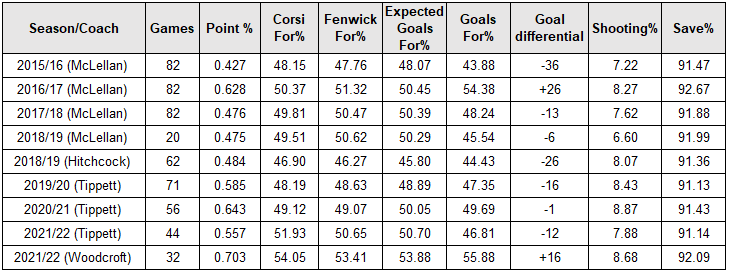
Things were trending the same way this season while Tippett was behind the bench, as the Oilers were outscored 54-73 (a 42.54% goal-share) in the 1,400+ minutes without McDavid – roughly 66% of the team’s total time. And while the club did barely break even in-terms of shot attempts with a 50.17% Corsi For percentage without McDavid, they struggled to convert these into meaningful scoring chances, posting an Expected Goals for percentage of only 46.22%. These numbers were consistent with how the Oilers performed the last two seasons under Tippett, so it didn’t come as much of a surprise.
Since Woodcroft has been hired and able to implement his tactics, things have drastically improved when the Oilers are without McDavid at even-strength (5v5). The team’s shot-share numbers have seen a slight bump and their expected goal share has improved by over four percentage points reaching the 50% mark thanks to their reduction in shots and scoring chances against. And more importantly, the Oilers are now posting a positive goal-differential for the first time since McDavid’s arrival. Goaltending has obviously been better as well, and hopefully it continues. But it’s clear the tactics Woodcroft has implemented, including his reluctance to sit back and protect any leads like his predecessors often did, are working as reflected by the shot-share and scoring chance numbers.
This is a positive development for a team that couldn’t really be considered a championship contender the last two seasons because of the lack of depth offence and scoring, and a coaching staff that was too risk averse with so many blind spots. With the team rolling the way it is and actually outscoring opponents without McDavid on the ice, there’s a good chance they can at least win a couple playoff games. And depending on how the goaltending holds up, maybe even a series.
Pretty remarkable turnaround for the Oilers since the coaching change, with the Oilers now winning 21 of the 32 games with Jay Woodcroft behind the bench. The data after the first ten games indicated the early results under Woodcroft were sustainable – we just didn’t know if the team would stay healthy and if the goaltending would hold up. Thankfully for the club and their playoff aspirations, everything has gone really well.
The even-strength (5v5) results since Woodcroft took over is the key driver right now, with the Oilers doing an excellent job controlling the flow of play (as reflected by the shot-share numbers), consistently pushing for offence even when leading the game, and just dominating opponents on the score sheet. Goal-differential at five-on-five is an important metric for Holland, so it should be obvious to him how significant the results have been since Tippett was dismissed.
The Oilers under Woodcroft have been getting much better goaltending with the team’s save percentage closer to league average levels, and have also seen their team shooting percentage improve. But they’re also getting a higher share of the total scoring chances, as reflected by the expected goals for percentage, due in large part to the coaching staff’s tactics. This includes changing how players are deployed, how they play in the neutral zone, looking for more favorable line match-ups and pushing for offence regardless of the score.
And relative to the previous coaches in the McDavid era, Woodcroft is doing really well with the roster he’s been given and should strongly be considered for a new contract.
This is the first time since 2016/17 that the Oilers have posted a positive goal differential at even-strength – something the Oilers couldn’t achieve under Holland’s first coaching hire (and someone the general manager actually wanted to extend just prior to dismissing him). And this is the first time the Oilers are posting underlying shot share numbers that are better than just break-even and closer in line to what the top teams in the league post (i.e., teams that have a points percentage above 0.600 in the regular season). A 54% Corsi For percentage and Expected Goals For percentage is what top end teams like Florida, Calgary, Carolina, Boston, Toronto and Colorado are currently posting. The Oilers are closer to that group thanks to the coaching change, and should expect to continue doing well if they stay healthy and get decent goaltending.
Now it’s understandable if management wants to wait for the off-season to make the call on whether or not Woodcroft should be given a new contract. Maybe it’s in Woodcroft’s best interest too in case another team brings forward a better offer. But it’s difficult to envision a scenario that would disqualify Woodcroft’s candidacy to be the head coach in Edmonton next season. The regular season results have been excellent and far better than what they’ve had since McDavid arrived seven years ago. And it’s not really reasonable to base the coaching decision on what happens in the post-season considering the playoff tournament is highly volatile that could go either way in a series – really depending more on which team gets the better goaltending. And if the players and their agents are already signing off on having Woodcroft stick around, it’s difficult to go another direction.
It’ll be interesting to see what approach the Oilers take, either going with someone they know and have developed as a coach, someone who appears to have progressive ideas and knows the players and prospects well. Or do they go with an external option, likely someone with similar traits to the previous three coaches. Just keep your expectations of the team lower if that ends up being the case.
I joined Rod Kurtz on CBC Radio Active to talk about the Oilers, the final stretch of the season and the push for a playoff spot. Full segment is here: CBC Radio Active (2022, April 12)
Topics we covered:
The incredible results since the coaching change, the reasons for the Oilers success and the tactical adjustments Woodcroft and his staff have made.
The Oilers push for second in the Pacific division and the importance of home ice advantage in the playoffs.
The positive impact Jesse Puljujärvi has had on the team this season.
Goaltending and the risk the Oilers are taking heading into the playoffs.
Which teams the Oilers could match up against, and their strengths and weaknesses.
Thanks as always to the great team at CBC for putting it all together!
After their overtime win against St. Louis, the Oilers have now accumulated 83 points in 69 games – holding down second place in the Pacific in terms of points percentage (0.601), just barely ahead of Los Angeles.
The team has been excellent since Jay Woodcroft replaced Dave Tippett behind the bench, with the team going 16-7-2 in 25 games, posting a points percentage of 0.680 and out-scoring opponents 99-78 in all situations. What’s especially encouraging is how strong the results have been at even-strength, with the team posting a goal-share of 54.78% (63 goals for, 52 goals against) in those 25 games. And those results appear to be sustainable as the Oilers have posted a Corsi For% and Expected Goals For% above 54% in that stretch. This is a significant improvement from the results under Tippett, as the club never posted a positive goal-differential at even-strength and had shot-share numbers closer to league-average levels.
What’s especially encouraging about the Oilers results under Woodcroft is how well the numbers compare against the top teams in the league.
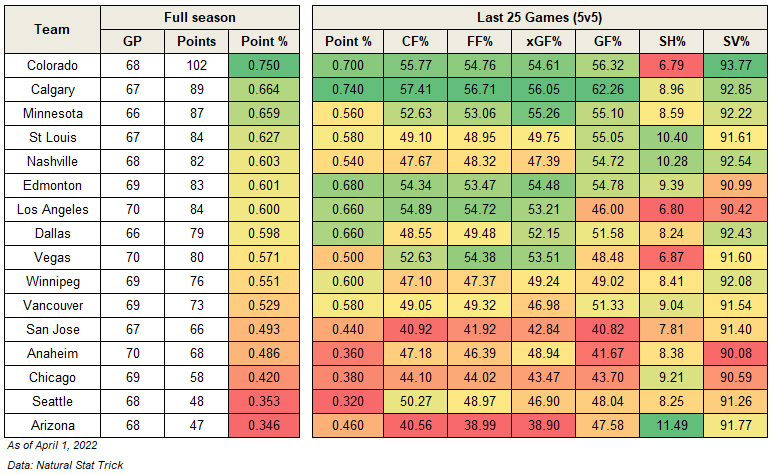
The table below sorts the western conference teams by their full-season points percentage, with Colorado, Calgary and Minnesota leading the way and Edmonton ranking sixth. I’ve also included each team’s even-strength (5v5) results over their last 25 games as reflected by their goals for percentage (GF%), as well as the underlying shot-share metrics such as Corsi For% to measure how well the Oilers as a team control the flow of play, as well as Fenwick For% and Expected Goals For% to gauge how well they control the overall share of scoring chances. Team shooting percentage and team save percentage has also been included to capture the player-driven factors that may be impacting the overall results. A glossary can be found at the end of this article.
What we see here is that Edmonton has been one of the best teams in the western conference since Woodcroft’s arrival (lots of green boxes), posting one of the best goal-shares in the league and underlying shot-share numbers that are close to what the other top teams have posted. Their issue remains goaltending which ranks poorly relative to the rest of the conference, and 26th in the league. Knowing how important goaltending is in the playoffs, it’s definitely a spot of bother – especially when you consider how much talent the Oilers have up front and the pressure on the franchise to win.
Worth noting too which clubs haven’t been so strong at controlling the flow of play and scoring chances recently, specifically St. Louis and Nashville, and if they might struggle in the playoffs – although Nashville has the goaltending to overcome their issues. Vegas is another team to watch as they have solid underlying numbers relative to the conference, but aren’t converting on their chances and getting mediocre goaltending.
The Oilers are in a good spot right now with a points percentage above 0.600 and appear to have the talent up front and coaching tactics to be a competitive team down the stretch. If anything causes them to drop in the standings, it’ll be the goaltending which Ken Holland has expressed his confidence in many times – most recently at the trade deadline.
Points-percentage (Point%) – The total points accumulated divided by the points that were available, including extra time.
Corsi For percentage (CF%) – The proportion of all the shot attempts the team generated and allowed that the team generated (i.e., Corsi For/(Corsi For + Corsi Against). This is used as a proxy for possession and is the best at predicting a team’s future share of goals (GF%). (Source: Hockey Great Tapes – Draglikepull)
Fenwick For percentage (FF%) – The proportion of all the unblocked shot attempts the team generated and allowed that the team generated (i.e., Fenwick For/(Fenwick For + Fenwick Against). This is used as a proxy for shot quality and considers shot blocking a repeatable skill.
Expected Goals For percentage (xGF%) – This is a weighting placed on every unblocked shot based on the probability of the shot becoming a goal. This depends on the type of shot, location and uses historical shot and goals data to come up with the probability for each unblocked shot.
Goals For percentage (GF%) – The proportion of all the goals that the team scored and allowed that the team generated (i.e., Goals For/(Goals For + Goals Against).
Shooting percentage (SH%) – The percentage of the team’s shots on goal that became goals (i.e., total goals divided by the total shots on goal).
Save percentage (SV%) – The percentage of the team’s shots on goal against that were saved (i.e., 1-(totals goals allowed divided by the total shots on goal against).
Joined by Dennis King (@dkingbh) on the show to talk all things Oilers, the success they’ve had since the coaching change and what the focus should be for management this off-season. We talked about the importance of Jesse Puljujärvi to the Oilers, what his next contract should look like, and the roster-building decisions that Ken Holland has to navigate effectively if the Oilers have any chance of building a contender.
Joined by Raider Jesse (@EdmontonRaider) on the show to re-cap the Oilers’ trade deadline, the acquisition of Brett Kulak and Derick Brassard, and where the two could potentially fit in the lineup. We talked about Ken Holland’s approach constructing the roster since becoming the general manager, where the deficiencies are and what the top priorities should be this upcoming off-season. We also discussed the success the Oilers have had since Jay Woodcroft took over as head coach and some reasons for optimism heading into the final stretch of the season.




:no_upscale()/cdn.vox-cdn.com/uploads/chorus_asset/file/23408645/image_20.png)
:no_upscale()/cdn.vox-cdn.com/uploads/chorus_asset/file/23408648/WOWY___20220421.jpg)




 The SuperFan