Pretty rough start for the Edmonton Oilers, securing only four points in their first five games of the season – all of which were at home and included three losses in regulation time.
The issue for the Oilers – which has been an ongoing thing for years now – is their play at even-strength (5v5) where they have only scored five goals in five games. We can’t expect this to last forever considering the talent they have and the fact that the team is currently converting only 4.38% of their shots into goals – the lowest shooting percentage in the league. This is a team that’s typically around the league average rate of about 8.50% and a number of players – including McDavid and Draisaitl – are posting on-ice shooting percentages well below their career levels.
What is concerning, however, is that the team itself is generating a relatively low rate of shots and scoring chances at even-strength this season – numbers much lower than they were last year after Jay Woodcroft took over as head coach. Shot metrics, including the rate of shots for and against and the overall share of total shots, are driven by tactics and deployment – things that are under the control of the coaching staff. So it’s been a little surprising to see the drop off.
The table below shows the Oilers offence as reflected by the team rate of shot attempts (Corsi), unblocked shot attempts (Fenwick), shots and expected goals (xGoals) this season compared to the numbers last season after Woodcroft took over. The numbers have been score and venue adjusted based on Natural Stat Trick’s methodology.
Now I’m using the numbers from last season under Woodcroft as a comparison because that was a really good team we saw in the final 38 games of the season. And they had the results and the strong underlying shot share numbers that top-end teams post at even-strength – levels that the Oilers should be trying to reach to be considered legitimate contenders.
And so far, they’re below where they should be. For example, the Oilers are currently generating about 37 unblocked shot attempts per hour, which ranks 25th in the league, only ahead of teams like Montreal, San Jose, Philadelphia, St. Louis, Anaheim, Chicago and Arizona. This current rate is about 20% lower than where they were last season when they generated over 46 unblocked shot attempts per hour – which was top five in the league. Their actual shots on goal has dropped by 18.6% compared to last season and their rate of expected goals has dropped by 13.3%.
Yes it’s five games, and there’s plenty of time to correct this. But it’s a good topic to ask the coaching staff about considering some of the other higher-end teams are getting positive results due in large part to their ability to out-shoot and out-chance opponents consistently. Pittsburgh for example is off to 4-0-1 start, have scored 19 even-strength goals, are generating some of the highest rates of shots in the league and are posting shot-share numbers (like Corsi For% and Expected Goals For%) above 52%.
That brings me to my next point. Because of their lack of offence and issues controlling the flow of play and generating shots, the Oilers are also posting poor possession and shot-share metrics compared to last season under Woodcroft.
The Oilers currently rank in the bottom third of the league when it comes to things like Corsi For% (46.61%, 23rd overall), Fenwick For% (44.15%, 27th overall) and Expected Goals For% (45.45%, 21st overall), well below where they were last season when they ranked near the top of the league after Woodcroft took over.
And if we look at the top teams from last season, and how they did in their first five to six games, we see that while the results may not have been there right off the bat, at least they were beating opponents on the shot clock and setting themselves up for success. Six of the top seven teams in terms of points percentage last season posted a Corsi For% above 50% in their first few weeks of the season and averaged an expected goals share above 53%. Interesting to see that Colorado was the one team in this group that struggled early on, but managed to turn it around – definitely an outlier that the Oilers can try to emulate.
It’ll be interesting to see how the Oilers can turn things around at even-strength, and the influence Woodcroft can have on the underlying numbers through potential tactical and deployment adjustments. Woodcroft and his coaching staff did set the bar quite high based on the numbers the Oilers posted last season. But it’s important to reach those expectations as soon as possible if the Oilers want to improve their chances of winning hockey games and establishing themselves as contenders.
Ahead of such a high-pressure regular season where the Oilers are expected to contend for the cup, there remains a few question marks across the roster. Up front the Oilers have the high end talent needed to win championships, but it remains to be seen if the rest of the group can consistently outscore opponents when McDavid isn’t on the ice. And on the blue line, things are looking alright with a top four that should be able to hold its own in the Pacific, although no major game breakers exist on the backend like some of the top teams have – unless of course Bouchard takes another step. But as long as the defence core and the top end stars stay healthy, and a couple youngsters emerge as reliable options, a playoff berth should be achievable.
The biggest concern heading into the regular season is in net with 30-year old Jack Campbell starting the first season of a five-year contract. While he should be a more stable option than someone like Mike Smith, his recent numbers have been pretty similar to those posted by the ‘battler’. So it’s unclear if Campbell is really going to be an upgrade.
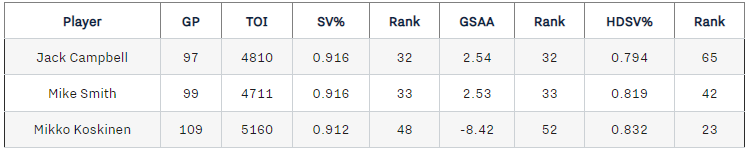
Over the last three seasons, Campbell has been right around league average posting a 0.916 save percentage at even-strength, which ranks 32nd among 68 goalies who have played at least 2,000 minutes (~42 games). He also posted a +2.54 goals saved above average (GSAA), which ranks 32nd in the same cohort. For reference, Mike Smith was right behind Campbell, ranking 33rd with a 0.916 save percentage at even-strength and 33rd when it comes to GSAA with +2.53. Worth noting too that Mike Smith was a better goalie when it came to high danger chances, posting a 0.819 high-danger save percentage (HDSV%) ranking 42nd, while Campbell ranked 65th among 68 goalies with a 0.794 save percentage.
Even-strength (2019-2022)
And on the penalty kill is where Smith has posted better numbers than Campbell. In the last three seasons, Campbell posted a save percentage of 0.881, which ranked 14th among 66 goalies who played at least 200 shorthanded minutes (~42 games). Smith on the other hand was one of the best goalies in the league, ranking second in the group with a 0.902 save percentage and tied with the Rangers Igor Shesterkin. With the Oilers consistently allowing one of the highest rate of shots against on the penalty kill, both under Tippett and Woodcroft, Smith really bailed the team out posting a +16.47 goals saved above average shorthanded, second only to Shesterkin.
Penalty kill (2019-2022)
The other issue worth monitoring is how well Campbell handles the workload in Edmonton, which will be slightly higher than what he was used to in Toronto as the Oilers do tend to play more of a free flowing game and willing to exchange scoring chances. Over the last three seasons under head coach Sheldon Keefe, the Leafs allowed one of the lowest rates of shots against in the league at even-strength with 28.55, and allowed 39.52 unblocked shot attempts against (i.e., Fenwick). Under either Woodcroft or Tippett, the Oilers were slightly higher than that and closer to league average levels, allowing about 30 shots against per hour and just over 41 unblocked shot attempts.
That’s not too bad of a difference and it’ll be interesting to see if the Oilers can improve their defensive play. But it’s on the penalty kill where things could get a little rough for Campbell. Over the last three seasons in Toronto under Keefe, Campbell’s teammates allowed 64.51 unblocked shot attempts per hour when shorthanded and 47.38 shots against per hour – numbers much stronger than league average levels. The Oilers on the other hand have been fairly poor on the penalty kill allowing 77.80 unblocked shot attempts against per hour and 56.69 shots against per hour over the last three seasons. Those numbers actually got worse when Woodcroft took over with the Oilers allowing 81.65 unblocked shot attempts against per hour and 59.63 shots against per hour after the coaching change in February 2022. As mentioned above, the Oilers goaltending really bailed out the penalty kill and masked some of the underlying tactical issues. Now it remains to be seen if Campbell can do the same, all while adjusting to a new team and system.
We’ve seen a few goalies in recent years now make their debuts with new teams following success elsewhere and falling flat. Jacob Markstrom was the Flames big off-season signing in 2020 following a career year in Vancouver, but saw his numbers take a hit as he adjusted to new teammates and a new system. And the Flames ended up missing the playoffs that season. Philipp Grubauer was another goalie who had posted solid numbers in Washington and Colorado, was even a Vezina trophy finalist, before signing with Seattle in 2021. But he too struggled adjusting to a new system, and the Kraken ended up finishing last in the Pacific. Considering both goalies were roughly the same age as Campbell when they moved to new teams and had similar pressures to live up to new multi million dollar contracts, you can understand why there might be some trepidation with the Oilers goaltending this upcoming season.
As much as I’d like to write about the upcoming season, I’m still processing the fact that the Oilers brought in a guy who was accused of sexual assault and is still facing a civil suit. Ahead of such a promising season where the Oilers have a competitive roster featuring two of the best players in the world, the Oilers chose to bring in a lot of unnecessary noise. Not only have the Oilers continued to demonstrate that they really don’t care about the public’s perception of their actions and their corporate values, it’s also clear that they’re still struggling to evaluate their roster situation and assess professional-level players. PTO’s are a great way to bring in undervalued assets who can create legitimate competition in camp. Adding Virtanen doesn’t provide any on-ice solutions or improve the chances of the Oilers winning a cup. All it’s really done so far is expose the Oilers lack of social awareness, overshadow a lot of the positive stories coming out of training camp this season – and have fans question if supporting this team with their time and money is really worth it.
And what’s really bothered me since Virtanen joined the Oilers camp is how the Oilers are trying to justify it all, with Ken Holland specifically pointing to his faith in the legal system.
“The most important thing is he went through the legal system, he went to a court of law, and a jury found him not guilty,” Holland explained to reporters.
“…The biggest thing for me is to have faith in the legal system and if we lose faith in the legal system I don’t think that’s a good thing. … I’m trusting the legal system to offer a pro tryout and now over two weeks we will evaluate him, and if he’s not good enough from a hockey standpoint, we will release him.” (Source: Sportsnet)
What these comments really demonstrate is an organization’s lack of awareness regarding the current justice system, the different experiences people have had with the system and the flaws that governments are trying to improve on. There are worldwide movements as a result of the justice system including Black Lives Matter, which are focusing more attention on the systemic issues and demanding change. The provincial court of Alberta recently developed a justice strategy to better meet the needs of Indigenous people. The federal government in Canada has an initiative underway to enhance the criminal justice system recognizing system delays and inefficiencies, the over-representation of Indigenous people as offenders and victims, the lack of support for vulnerable populations and the low rate of sexual assault reporting.
But despite all of this, the general manager of the Edmonton Oilers is pointing to his faith in the justice system to justify adding a player, disregarding the negative experiences people have had with the justice system – especially women, Indigenous communities and people of color. We know the justice system tends to serve those with power and privilege, and it’s clear that the Oilers front office, especially those who made the decision to add Virtanen, are in that group.
I joined Rod Kurtz on CBC Radio Active to discuss some of the Oilers off-season activities ahead of training camp opening this week. Full segment is here: CBC Radio Active (2022, September 20)
Topics we covered:
Disappointment with issuing a PTO agreement to Jake Virtanen and why the Oilers can expect a backlash – on and off the ice.
Dylan Holloway’s performance at the Young Stars tournament in BC.
The positive impact Jay Woodcroft can have on the team this year.
What to watch for at training camp, including the defensive prospects like Broberg who will be pushing for a roster spot.
Thanks as always to the great team at CBC for putting it all together!
Joined by @OilinGoal on the show to talk about the Edmonton Oilers goaltending situation heading into the 2022/23 season. We covered the signing of Jack Campbell, his style of play and the risks the Oilers are taking with this contract. We discussed the development of Stuart Skinner, and the potential prospects in the system. We also covered the different goaltending metrics available, how they’ve evolved over the years and the various methods of goaltending analysis. You can check out OilinGoal’s website here: https://oilingoal.substack.com
Expectations are going to be high for the Edmonton Oilers as the club attempts to meet and hopefully exceed the results from last season. Make no mistake, winning a round, and hopefully two, is the only way to really justify this management group’s roster construction and asset management this off-season. To be one of the top end teams in the league is going to require consistently outscoring opponents, and having a 50 goal scorer or two is going to help – especially when the rest of the roster has had issues producing in the past without one of the top end stars on the ice.
When it comes to Leon Draisaitl, there’s a fairly good chance he’ll continue producing at the rate he’s been at over the last few seasons. He’s clearly in his prime, has done well staying healthy and has put up 304 all-situation points in 207 games over the last three seasons. That’s second only behind Connor McDavid (325 points) and 50 points ahead of third place Jonathan Huberdeau (254 points). Feels like 100 points is a reasonable target for the 24-year old, and there’s a good chance he’ll surpass that.
But what about actual goals? Is it safe to assume he can reach the 50-goal mark next season? Can we can expect him to surpass that again? Could he even hit 60 and help the Oilers reach the 300 goal mark like five other teams did last season? It’s a lofty goal for the German forward as it’s been accompllished only three times in recent memory: Auston Mathews in 2021/22 (60 goals), Steven Stamkos in 2011/12 (60 goals) and Alexander Ovechkin in 2007/08 (65 goals).
For this exercise, I’m keeping things relatively simple. I’m going to project how many games Draisaitl will play in 2022/23, and then using his average rate of shots on goal per game at even-strength and the powerplay as well as his shooting percentages over the last three seasons, determine how many goals he’ll likely score next season. From there we can figure out what he and the Oilers can do to improve his odds of scoring 60 goals.
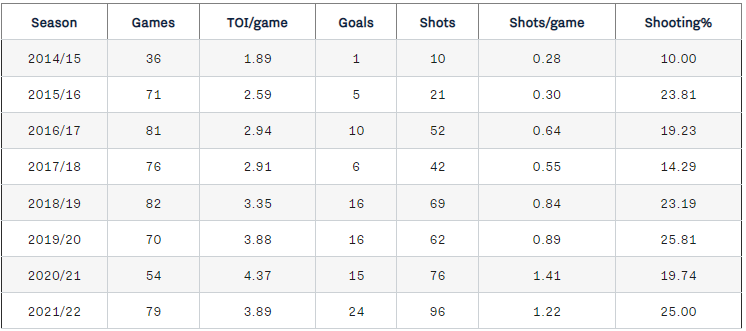
First, a summary of the number of goals Draisaitl has scored each season that he’s been in the league, with a breakdown of goals by the various game-states: even-strength, powerplay and penalty kill.
So what’s a reasonable target for Draisaitl next season?
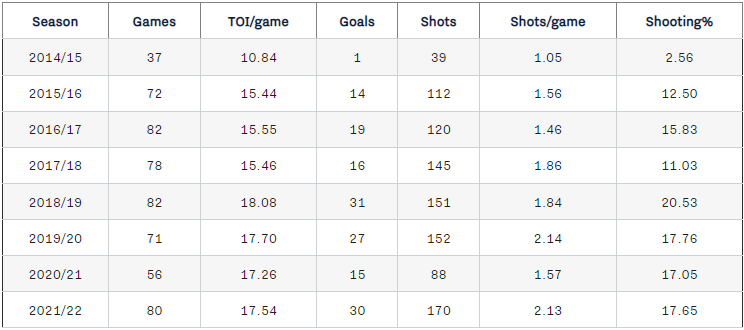
Let’s start with even-strength where Draisaitl has scored 72 goals from 410 shots over the last three seasons, posting a 17.56% shooting percentage – one of the best in the league.
If he plays in 97% of the games this upcoming season (which is the proportion of games he’s played in since his first full season in the league), so about 80 games, and generates 1.95 shots per game, which is what he’s averaged over the last few seasons – he should get about 155 shots on goal at even-strength. And if he posts the same shooting percentage he’s had over the last three seasons (17.56%), he should score about 27 even-strength goals. Now if he can match his career high shooting percentage of 20.53% which he did in the 2018/19 season, he could potentially score 31 – slightly better than what he posted last season.
On special teams, I think we can reasonably expect about 22 powerplay goals from Draisaitl next season. Table below is a summary of his powerplay history.
Based on the rate of shots he’s posted on the powerplay over the last three seasons (1.17 shots per game), he’ll likely get about 93 shots on goal. And if he converts on 23.50% percent of those shots, which has been his shooting percentage over the last three seasons, he’ll get about 22 goals. If he somehow matches the 25.81% powerplay shooting percentage that he posted in the 2019/20 season, he could get to 24 goals matching his powerplay total from last season. And since he’s scored a short-handed goal in each of the last two seasons, and actually scored three times in 2018/19, I think we can expect a shorthanded goal next year as well. And I wouldn’t be surprised if he got two on the penalty kill as his rate of shorthanded shots doubled last season, going from 0.07 per game to 0.15.
So taking a conservative approach and using his rate of shots and his individual shooting percentage from the last three seasons at even-strength and on special teams, we can expect Draisaitl to score about 50 goals in the 2022/23 regular season (27 on even-strength, 22 on the powerplay and one shorthanded). This of course is assuming Draisaitl remains healthy, he continues to play with good players at even-strength. And the Oilers powerplay continues to have the same talent and tactical approach as it’s had the last few seasons with Glen Gulutzan running things.
Now to get anywhere near 60 goals, a few things will need to go right.
First Draisaitl will need to match his career best shooting percentages at even-strength (20.53% in 2018/19) and the powerplay (25.81% in 2018/19). Doing that and generating the same rate of shots per game from the last three seasons (1.95 shots per game at even-strength and 1.17 shots per game on the powerplay) and he could potentially reach 57 goals (31 on even-strength, 24 on the powerplay and 2 shorthanded).
To get more than 57 goals, he’ll need to not only match his career high shooting percentages (as listed above), but also match his career highs in terms of shots per game at even-strength and the powerplay. If he can generate 2.14 shots per game at even-strength, which is what he posted in 2019/20, putting up 170 shots, and convert on 20.53% of those shots like he did in 2018/19, he could get to 35 even-strength goals. And if he can generate 1.41 shots per game on the powerplay like he did in 2020/21, put up 112 shots, and convert on 25.81% of those shots like he did in 2019/20, he could get to 29 powerplay goals. Add another shorthanded one, and he could get to 65.
Considering how well Draisaitl has played the last few seasons, how much time he gets to play with McDavid and how the rate of goal-scoring has increased across the league, it really isn’t out of the realm of possibility.
Joined by Brad McPherson (@BlueBullet1981) from the Blue Bullet Report to talk Oilers, gaining value through the NHL entry draft and some of the key prospects in the system. We discussed the Oilers off-season, where the Oilers might have some challenges and our overall expectations in 2022/23.
It’s been pretty baffling watching the Jesse Puljujärvi situation play out in real-time. Part of me is annoyed that the club appears to be ignoring the positive on-ice impacts the 24 year old has had since being drafted. But I’m also well aware that this management group doesn’t always grasp what their team’s weaknesses are, has consistently had trouble identifying professional level talent, and very rarely makes well-informed roster decisions. This is an ongoing issue for the franchise, and doesn’t appear to be improving any time soon under the current ownership.
And let’s be very clear on Puljujärvi: his on-ice results (i.e., goal-share) and the shot-share metrics that predict future results all indicate he’s a top-six NHL winger who helps his team spend more time in the offensive zone and increases his team’s odds of out-scoring opponents. You can pick apart how he gets good results and his finishing ability – those are mostly valid. But there’s no question that his strengths have helped his teammates, especially his most common centerman and drives positive results for his team.
In an industry that’s still dominated by conservative, risk-averse individuals and flawed business practices and decision-making processes, he’s become an undervalued asset because of his size and the way he plays and how he’s personally produced. His deficiencies are being perceived to be greater than his strengths – basically a lot of noise that can be debunked with some progressive thinking and statistical analysis. There’s a lot of inefficiencies when it comes to roster construction and decision-making in the NHL, and this is a perfect one to exploit by an intelligent team.
Now I understand too that Puljujärvi’s group have probably recognized that the Oilers are not very deep on the right-side and might be asking for too much in negotiations, and that could be a reason why the Oilers prefer to move on from him. But this is why you need to identify talent as early on as possible through proper scouting and statistical analysis, and be willing to take on some risk by signing these players long-term earlier in their careers. “Over-ripening” isn’t an efficient approach in a cap world and the Oilers are now in a position of weakness in the trade market and at risk of losing a good player when his value is at its lowest.
The hope now is that the Oilers don’t get robbed in a trade, which has become a regular thing since Holland arrived. Whoever the replacement is for Puljujärvi, they need to be someone that can have a positive impact at even-strength, with and without top end linemates, and can be deployed against top competition. Based on the rumors out there, I’m not seeing any viable options unless the Oilers are planning to take on someone that’s a longer term project. The team has three seasons left with McDavid and Draisaitl to push for a championship, so whoever is acquired needs to make an immediate impact.
Joined by Matt Henderson (@Archaeologuy) on the show to discuss the Edmonton Oilers, the lessons management hopefully learned from the regular season and playoff run, and some of the off-season gossip that’s currently out there. We talked about the importance of Jesse Puljujärvi to the team, the youngsters like Holloway and McLeod pushing for bigger roles and the front office changes that are needed to help with their decision-making processes.
Disappointing end to an entertaining playoff run, with some outstanding performances from a variety of players including McDavid and Draisaitl leading the way. In the end, the Oilers were completely dominated by a top end team, and really didn’t have the depth, talent and goaltending to win a game in the western conference finals.
Below is a high-level summary on how the Oilers performed against the Avalanche at even-strength (5v5). They spent a significant amount of time without the puck and getting out-chanced as reflected by their 46% Corsi For percentage and 45% expected goals for percentage – and were outscored 16-11 over the four game set.
Colorado Avalanche
5v5
Edmonton Oilers
53.28
Corsi For%
46.72
55.68
Fenwick For%
44.32
55.03
Expected Goals For%
44.97
59.26
Goals For%
40.74
+5
GF-GA
-5
11.76
Shooting%
10.95
89.05
Save%
88.24
And the powerplay – which has consistently been one of the best in the league – was ineffective as well, generating only 18 shots and scoring only twice in four games. Combine this with a penalty kill that allowed 30 shots against and allowed four goals (more on that later), and it’s clear that the Oilers weren’t even close in this series.
There’s a few reasons why it wasn’t surprising to see the Oilers get crushed like this against Colorado. The injury issues for one exposed the lack of depth and talent on the roster. But the overall team play had also begun to slip in the previous round against Calgary, relying on an incredible performance from McDavid to bail them out. The goaltending started to falter in the second round as well, as did their defensive play and special teams.
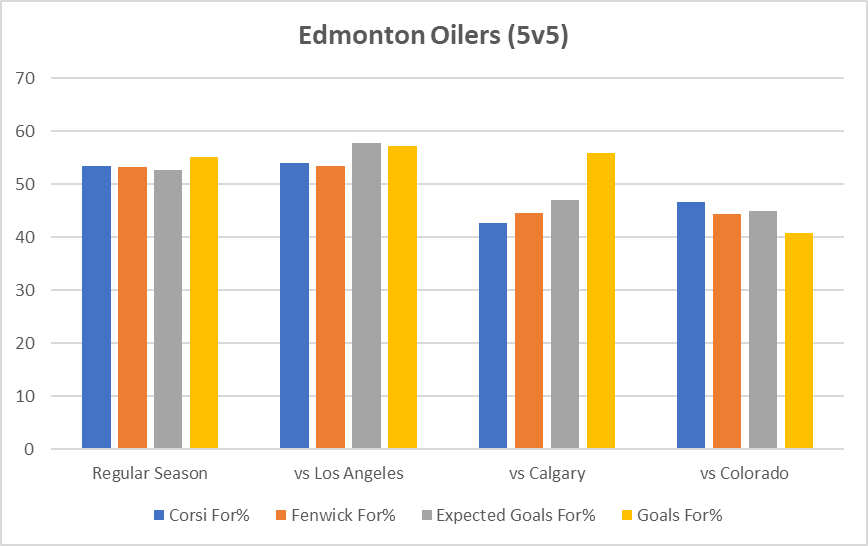
Lets’s start with the overall team play at even-strength and how well they controlled the share of shot attempts, scoring chances and goals. Below is a table showing how the Oilers performed in each round of the playoffs – as well as the final twenty five games of the regular season, which I like to use as a baseline to assess their overall play.
Opponent (5v5)
Corsi For%
Fenwick For%
Expected Goals For%
Goals For%
Shooting%
Save%
Regular Season
53.38
53.25
52.74
55.17
9.01
91.59
vs Los Angeles
53.95
53.46
57.83
57.27
7.95
93.42
vs Calgary
42.75
44.56
47.07
56.60
15.72
89.68
vs Colorado
46.72
44.32
44.97
40.28
10.95
88.24
Against the Kings, the Oilers performed right around where they were in their final twenty five games of the season, controlling 53% of the total shot attempts and scoring chances. The team’s shooting percentage dropped by a couple percentage points, but it was balanced out by the goaltending that saw its team save percentage increase by a couple percentage points. Keep in mind though that the Kings consistently generated a lot of low-probability shots and had the worst shooting percentage in the league during the regular season. And there was definitely some concern after the first four games of that series as the Oilers were getting outplayed and outscored when McDavid wasn’t on the ice and their goaltending was struggling on home ice. But thanks to the captain’s play in games six and seven, they were able to overcome their deficiencies and win the series.
The second round of the playoffs is really where we started to see the Oilers fall apart at even-strength. Their possession numbers dropped by more than ten percentage points relative to their final twenty five games of the season – dropping from a 53.38% Corsi For percentage to 42.75%. And while their share of quality scoring chances (i.e., Expected Goals For%) did gradually improve over the course of the series, it was still below where we would expect the Oilers to be at. What bailed them out (again) was McDavid’s play, as the Oilers completey dominated the Flames on the scoreboard with him on the ice. When Tkachuk and some of his teammates said their club was beaten by one guy, they weren’t wrong. The Oilers outscored the Flames 14-5 with McDavid on the ice in that series, scoring at a rate of over nine goals per hour. It’s remarkable considering nine goals an hour is what a top end powerplay scores – with a man-advantage.
Now this is worth expanding on because McDavid’s performance was once again masking a lot of the Oilers major issues.
McDavid’s on-ice shooting percentage in the five-game series against Calgary was 25.79%, which is crazy considering his career on-ice shooting percentage is 10.1%. Had his on-ice shooting percentage against Calgary been similar to his career levels, he would have been on the ice for about 5-6 goals instead of 14 – and the Flames would have easily won the goal-share. And say his on-ice shooting percentage was 20% – which has happened only once over a five game stretch in the last three seasons (first five games of the 2019/20 season) – he would have been on the ice for about 10 goals-for. Had that occurred, which still would have been remarkable, the Oilers would have only broken even in terms of goals at 5v5 against the Flames.
McDavid (5v5)
On-ice Shooting%
On-ice Save%
Regular Season
9.66
91.46
vs Los Angeles
10.96
93.35
vs Calgary
25.79
92.07
vs Colorado
11.75
87.97
Things obviously came back down to earth (or the planet he’s from) for McDavid in the third round. His on-ice shooting percentage fell to11.75%, which is slightly higher than his career level (10.1%) and what he had posted in the final twenty five games of the regular season (9.66%).
The other indication that things were likely going to go sideways against Colroado was the Oilers declining defensive play in the previous rounds and the increasing rate of shots against.
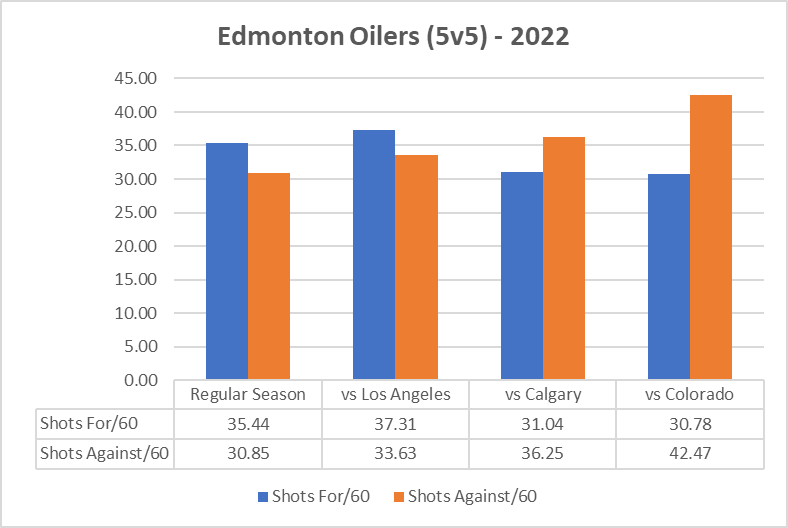
In the final twenty-five games of the season, the Oilers allowed 30.85 shots against per hour, which ranked 17th in the league and right around league average levels. And they generated 35.44 – third best in the league. Against the Kings, their rate of shots against increased to 33.63, a 9.0% increase from where they were in the regular season. Somewhat expected, considering the Kings employ the “volume shooting” approach, but nothing too alarming as the Oilers did also increase their own rate of shots for. But maybe it was a sign of things to come as they then allowed over 36 shots per hour against the Flames – a 17.5 % increase from their final twenty five games and closer to what the worst teams in the league posted in the regular season. Based on these increases and the fact that the Avalanche were the fourth best team in the regular season at generating shots (34.58), it was little surprise then that the Oilers allowed over 40 shots against per hour in the third round.
Compounding matters was the Oilers goaltending, which posted a 89.68% 5v5 save percentage in the second round against the Flames – the second worst save percentage among the eight teams in the second round. And only better than Calgary’s that had to face a supernova version of Connor McDavid. Smith’s performance gradually declined over the course of the playoffs, and the team wasn’t playing well enough to make up for it.
One last item was the Oilers special teams, which had great results in the regular season and the first round of the playoffs. But it started to decline against the Flames before getting crushed by the Avalanche.
Opponent
Powerplay Shots/60
Powerplay Goals/60
Penalty Kill Shots Against/60
Penalty Kill Goals Against/60
Regular Season
70.38
10.37
62.21
4.03
vs Los Angeles
66.28
14.50
72.38
4.10
vs Calgary
56.53
7.07
64.00
6.00
vs Colorado
53.60
5.96
74.38
9.92
In the final stretch of the regular season, the Oilers continued to excel on the powerplay, generating the highest rate of shots per hour (70.38) and scoring the sixth highest rate of goals in the league. And while they did see a slight drop in their rate of shots against versus the Kings (maybe this was foreshadowing for the next two rounds) – they did generate a higher rate of goals relative to their regular season. Against the Flames, things took a major dive as their rate of shots on the powerplay dropped by 19.7% relative to their regular season rate. And their rate of goals per hour dropped to 7.07 per hour – which is slightly above league average levels, but well below what we would expect from an Oilers powerplay which is consistently one of the best in the league. The Avalanche took it one step further and reduced the Oilers shot rate by 23.8% relative to their regular season levels and only allowed two goals in the four game series. The Oilers powerplay, which has historically often made up for the negative goal differential at even-strength, slipped in the second round and basically became a non-factor against Colorado.
The Oilers penalty kill followed a similar trend. By the time it faced Colorado, it had seen its rate of shots against (which was slightly worse than league average to begin with) climb even further. And the rate of goals against in the third round more than doubled compared to the regular season. It was ugly.
The Oilers have a lot of work to do this off-season, constructing a roster, managaing their salary cap and filling out a coaching staff. The hope, as always, is that they’re using as much information available to them – including the data from the regular season and the playoffs – to make informed decisions. The plan should be to build a winner in the next three seasons with Draisaitl and McDavid in the fold – and the only way to do that is a throrough assessment, understanding what happened and what really drove the results. Ignoring the warning signs, which the Oilers have done for over a decade now, won’t get them anywhere. What got the Oilers to the western conference finals isn’t going to get them a championship in the future.

:no_upscale()/cdn.vox-cdn.com/uploads/chorus_asset/file/24137414/Untitled.jpg)








 The SuperFan