This week on the podcast, I share my thoughts on the Edmonton Oilers latest analytics hire, Leon Draisaitl’s chances of scoring 60 goals and what would have to go right for him to do that this upcoming season.
Full segment is below and available through all podcast channels.
This week on the podcast, I share my thoughts on the Edmonton Oilers off-season and some of the declining assets that management should be aware of. As well as the importance of evaluating and projecting Leon Draisaitl’s performance as he approaches 30.
Full segment is below and available through all podcast channels.
Leon Draisaitl has been a tremendous asset for the Edmonton Oilers since being drafted by the club in 2014. In 638 NHL games, the 27-year-old forward has scored 306 goals and accumulated 744 points, plus another 77 points in 49 playoff games. He can easily be considered one of the top players in the league annually.
Draisaitl is now entering his tenth NHL season and the second last year of his current contract with the Oilers. And could potentially become an unrestricted free agent at the end of the 2024/25 season when he’s 29. While there is time for the player and the team to decide if there’s a long-term fit and a new contract, it’s a good idea to start monitoring and projecting Draisaitl’s production to inform contract discussions, which will have an immediate impact on the Oilers roster construction moving forward. Draisaitl also holds a lot of power here as he’s a bona fide star player in the league and could choose a different direction for his career if he doesn’t feel the Oilers can be legitimate cup contenders. So the Oilers really need to be sure of his intentions as soon as possible to avoid losing him for nothing, similar to what’s happened in other markets.
While Draisaitl has put up significant points, there are some areas that the Oilers should be aware of, namely his on-ice impact offensively and defensively, along with his production at even-strength (5v5). His powerplay production should be of little concern as he has the talent and teammates to keep the Oilers at the top of the league. But it’s at even-strength where he’s spent 80% of his total playing time – and having an impact on the game offensively and defensively – that should be carefully monitored and evaluated prior to contract negotiations.
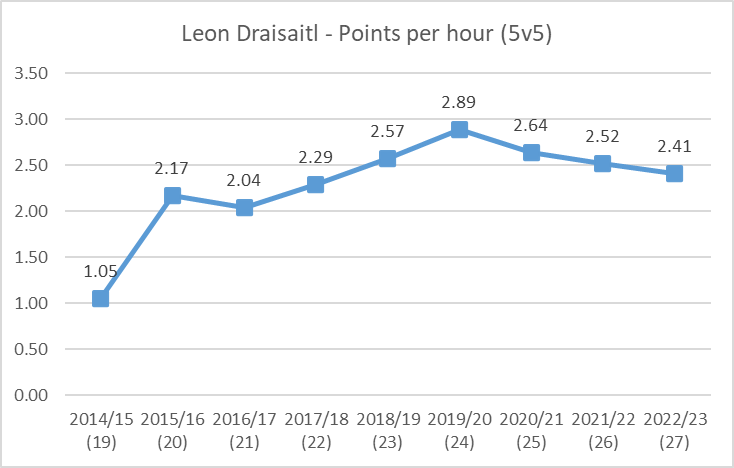
Starting with his overall even-strength (5v5) production, below are Draisaitl’s points per hour since entering the league as a 19-year-old in 2014/15. His peak season was in 2019/20 when he finished second in the league with 56 even-strength points, going on to win the Hart Trophy as the league’s most valuable player.
From his first full season in 2015/16 to that high-point as a 24-year-old in 2019/20, his rate of points per hour increased by 33%. Since that point, however, his rate of point production has gradually been decreasing, with Draisaitl posting a rate of 2.41 points per hour this past season – a drop of 16.6% since his Hart Trophy season. This isn’t to say Draisaitl is anywhere close to being done as a star player – those are still solid numbers, and he clearly has the talent to make a long career for himself similar to other top-end players. But when reviewing potential contract structures, it’s important to have some reasonable expectations of the player and determine what the roster needs could be if his production is expected to decline and if his positional deployment (i.e., center or winger) changes at all.
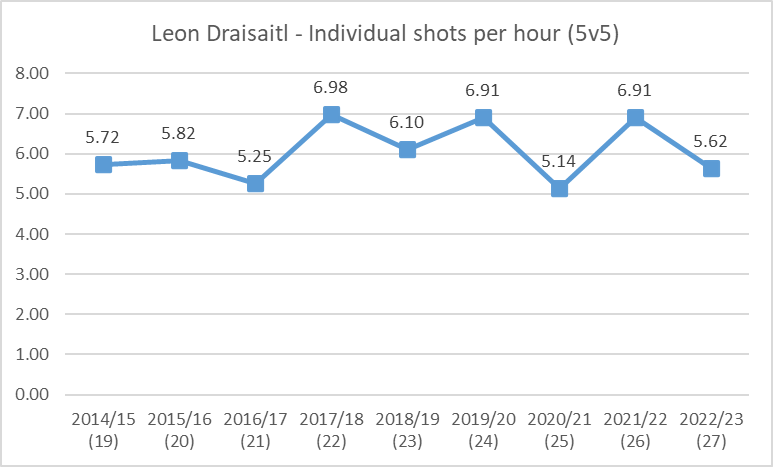
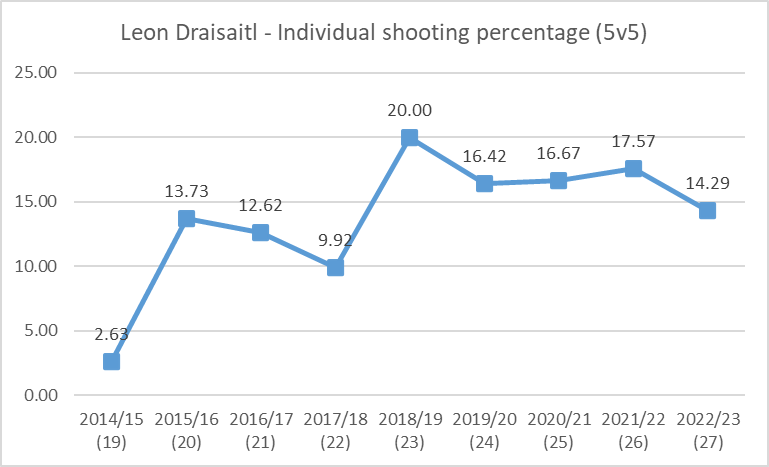
What’s also important to note is Draisaitl’s ability to generate shots for himself, as that remains an area of consistency for the forward. That along with his shooting percentage can give the team some added comfort that he can maintain a fairly high level of production offensively, even as he ages.
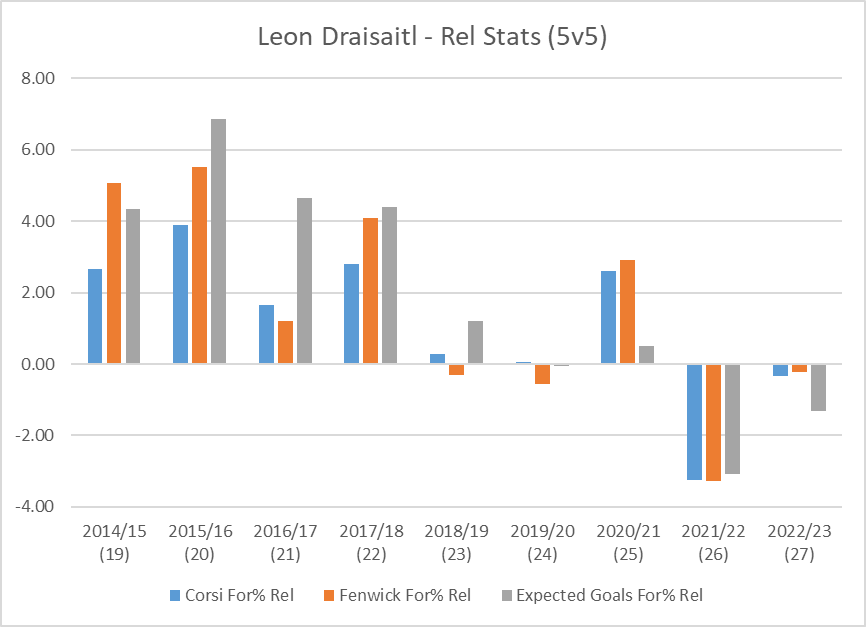
The one area that I would have concern with is his overall impact on the total game, offensively and defensively, when he’s on the ice at even-strength. Using his relative-to-team numbers, which informs us on how well the team does with him on the ice, we see that his impact has gradually been declining. Even to the point where the team had done a better job at out-shooting and out-chancing opponents without him than with him the last couple of seasons.
Draisaitl has had the unique ability to outperform his on-ice shot-share and possession numbers because of his ability to create high quality chances within the time he has playing offence and his strong finishing ability. But it’d probably give the team a little more confidence in his future potential if the team wasn’t spending so much time in their own zone and defending when he’s been on the ice. If you’re paying a premium for a player like Draisaitl, the team should be doing a better job controlling the flow of shots and chances with them on the ice than without him, especially when things like individual and on-ice shooting percentages and team save percentages can fluctuate sporadically. Again, this isn’t to say Draisaitl is done as a star player. But these are some of key metrics to track over the next couple of seasons to help inform the team’s future roster decisions.
The good news for now is that the Oilers have this top-end player signed for two more seasons, a period in which the Oilers should be doing everything possible to win a championship. In his nine seasons as an Oiler, the club hasn’t won a single division title, no conference titles, and has only won four playoff rounds, three of which were in the last two seasons. So the motivation for the team and the player should definitely be there to win titles as soon as possible.
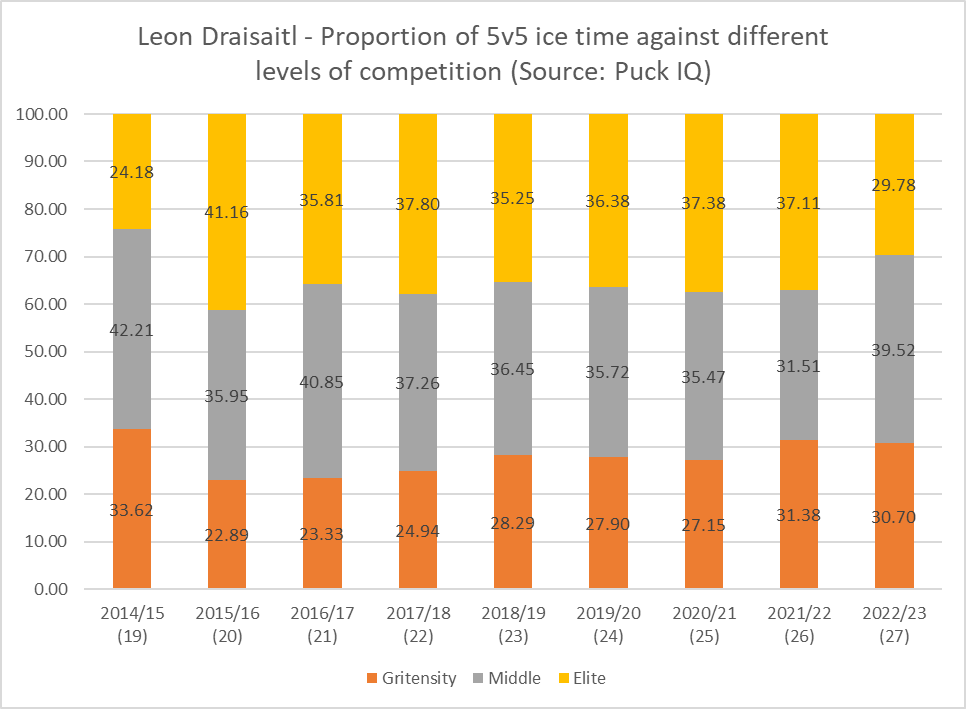
But over this next stretch, the Oilers have to also be thinking about their long-term aspirations, what the roster needs will be (and there’s always plenty) and how they plan on filling those requirements. Draisaitl should be considered a part of the Oilers long-term plans, but only if the Oilers have a strategy to surround him with talent that can fill the void when his production or defensive impacts start to slip. For example, if the team feels Draisaitl can maintain his production into his thirties, but predominantly as a winger, then the Oilers need to address that and start drafting and developing centers who can take on the workload and produce at a top-six level. And if the team feels he needs to play fewer minutes against elite-level competition to be more productive, similar to what happened last season, then it’s imperative to find someone who can take on those heavier minutes.
Deciding on Draisaitl’s future with Edmonton is going to require strong collaboration between the management group, the coaching staff, the professional scouts and hopefully an analytics and sports science group to get it right. Hopefully they’re up to the task and formulate and propose the appropriate contract structure that works for Draisaitl and the team.
One of the key issues for every NHL team is going to be how they keep pace with the rest of the league in terms of offence. We know powerplays are getting more and more potent, generating higher quality chances and having more talent on their rosters. But we’ve also seen a steady growth of offence at even-strength (5v5), which makes up around 80% of the playing time.
In the 2022/23 regular season, teams were averaging 2.58 goals per hour, which is a 19.3% increase from the 2.17 goals per hour teams were averaging seven seasons ago in 2015/16. Expect that to continue growing as goal scoring has increased by an average of 2.6% year-over-year over the last eight seasons. And the key drivers for scoring have been steadily increasing with teams generating higher-quality shots and chances, and constructing rosters with better finishing talent.
Starting with shot metrics, teams were averaging 56.81 shot attempts per hour last season, which is a 5.0% increase from eight seasons ago. Year-over-year, the rate of shot attempts has grown on average by about 0.8% per season, which is similar to the growth in unblocked shot attempts and actual shots on goal. The actual volume of shots really hasn’t grown that much.
What we have seen though is the rate of quality chances increase year-over-year, especially in the last two seasons. In 2021/22, the rate of expected goals, which factors in shot location and shot type, went up by 10.5% from the previous season. And then it went up by 6.1% in 2022/23. Over the last eight seasons, the rate of expected goals has increased by 19.3%, going from 2.23 per hour in 2015/16 to 2.66 in 2022/23.
My guess is that coaching staffs really started to push for more offensive opportunities once fans were allowed back into buildings. The pandemic took a big chunk of team gate revenues and it’s almost as though ownership groups gave direction to build better rosters and play with more offence to grow back their fanbase.
The other factor driving goal-scoring is the steady increase in talent across the league and the elimination of enforcers who took up space on fourth lines. Teams are sprinkling a lot more offence across their roster recognizing that elite players spend most of the game on the bench and team’s need to squeeze out any line-matching advantages to be competitive. And we’re seeing the results.
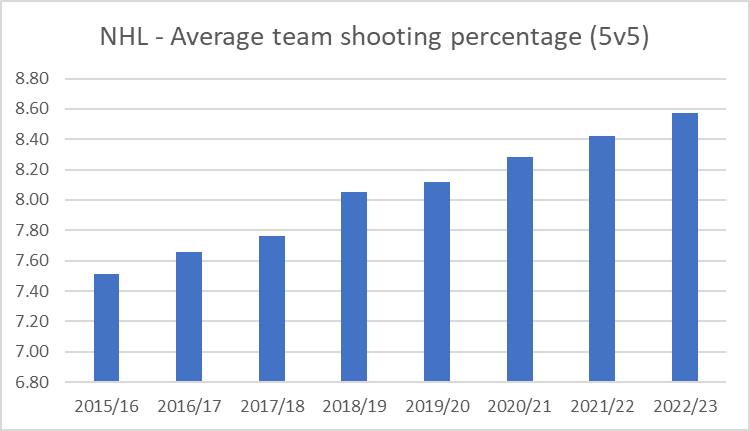
The average team shooting percentage at even-strength was 7.15% in 2015/16. That’s increased by 14.1% since then with the average shooting percentage currently sitting at 9.14%. The average year-over-year growth over this period has been 3.9%, with a big 9.1% increase happening this recent season.
The fact that teams are implementing tactics to increase their odds of scoring and that the amount of offensive talent is growing every year is massive for the league. The NHL remains a secondary professional sports league in the world and tends to hold itself back from ever growing the game. Plus there’s been a steady decline in sports viewership. But if they can provide a decent on-ice product and start to promote their star players more often, they can be in much better shape.
With powerplays across the league improving every year with an influx of offensive talent, it’s become more and more imperative for teams to figure out how to limit shots and scoring chances against. Goalies of course play an important role, but their own ability to stop shots is an area that coaches have little influence on. What coaches can do, and what they have more control of, is how well and how often their skaters can prevent shots and chances in the first place. This can be managed by their coaching tactics and player deployment strategy. And it’s something the Oilers have struggled with under the current coaching staff.
Since February 10, 2022 when Woodcroft became head coach, the Oilers penalty kill has allowed the 7th highest rate of shots against in the league and the 10th highest rate of scoring chances (using Fenwick, or unblocked shot attempts as a proxy). Thanks to some league-average goaltending, the Oilers penalty kill results haven’t been a complete disaster, with the team allowing 7.75 goals against per hour, which has ranked 17th in the league.
One of the key issues is the personnel Woodcroft has deployed as his first penalty kill unit, with the group posting one of the worst rates of shots against in the league when compared to the first units of other teams. On average, first unit penalty kills allow 57.78 shots against per hour, which is around 5 shots more than their teams second unit (about a 7% increase) as they’re more often up against the opposing team’s top powerplay units and their star players. The Oilers top penalty kill under Woodcroft has allowed a rate of 66.05 shots against per hour, which has been the third highest in the league. This rate of shots against per hour is also around 11 shots more than what the Oilers second unit has posted, an increase of around 17%, and double than the league average. (Please note that the forward with the most penalty kill minutes from each NHL team was used as a proxy to assess each team’s first unit. On average, the forward with the most penalty kill ice time played 38.8% of their team’s total penalty killing time.)
Woodcroft’s go-to defence pair on the penalty kill since becoming the Oilers head coach has been Darnell Nurse and Cody Ceci, with Ryan Nugent-Hopkins, along with a rotating partner, being the most common forward up front. One of these three players has been on the ice for 71.2% of the team’s total ice time on the penalty kill since Woodcroft took over (665 total minutes). As mentioned before, the Oilers performance and ability to suppress shots has been well below league-average levels among first unit penalty kills, so something will definitely have to change for next season. Holland did mention the penalty kill unit as an area of concern in his recent media availability, and they have signed forward Connor Brown who has experience killing penalties and saw good performances from Mattias Ekhom after the trade deadline. But more will likely need to be done if the Oilers want to ensure improvements next season.
One thing that the coaching staff needs to strongly consider is finding a new defence partner for Nurse, who has posted better on-ice numbers with defencemen other than Ceci.
Under the previous coaching staff prior to Woodcroft’s arrival, Nurse’s three most common penalty kill partners were Ethan Bear, Evan Bouchard and Adam Larsson. And his best performance numbers (again looking at shots against) was with the one defender who’s still with the Oilers, as he and Bouchard limited the rate of shots against to 51.34 per hour – just better than league average (~54 shots against per hour). It’s unfortunate that Nurse is the one that needs help and doesn’t always drive positive outcomes, but at this point you’re just trying to get as much value as you can from the player. The other option is just having Bouchard and Ekholm take more of the penalty kill minutes, as those two showed good chemistry together as regular partners at the end of last season, and this way it doesn’t disrupt the defence pairings at even-strength.
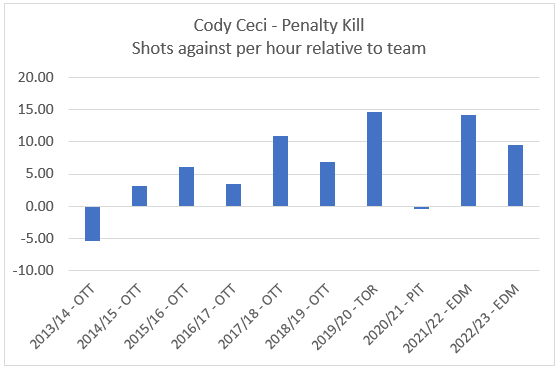
The other option to consider is removing Ceci altogether from the penalty kill. For pretty much his entire career, Ceci’s on-ice rate of shots against on the penalty kill has been higher than his team’s rate. Put another way – over his career, Ceci’s team’s consistently did a better job at suppressing shots against when he wasn’t on the ice. The only time Ceci’s numbers were closer to his team’s levels was in Pittsburgh, the year before the Oilers signed him – and this appears to have been an outlier season. And unfortunately for him and the Oilers, his on-ice shot suppression number continue to be poor on the penalty kill and in-line with his career levels.
If the Oilers could find a suitable alternative for Ceci, someone like Ekholm who posted solid shot-suppression numbers for the Oilers after the trade deadline, we could also see Nugent-Hopkins numbers bounce back. Under the previous coaching group, Nugent-Hopkins had a positive impact on the team’s ability to suppress shots against on the penalty kill, with the team doing better with him than without him (a -7.27 shots against relative to team). This previous season he posted the worst numbers in his career and in the league (a +16.53 shots against rel), likely because he had to play so many minutes with the Nurse and Ceci tandem. In 105 minutes with them, RNH’s on-ice rate of shot attempts against was over 71 per hour. In 66 minutes away from Nurse and Ceci (since Woodcroft too over), RNH saw his on-ice rate of shot attempts against drop down to 52.38, which would be closer to league average levels.
It should also help to have Connor Brown as an option on the penalty kill, but as I mentioned in a recent piece, his numbers were typically stronger when he wasn’t the first forward option. When Brown was traded to Ottawa from Toronto and became the top penalty killing forward, his numbers took a big hit with the Senators often struggling to prevent shots with him on the ice. So it’s probably best to try him out on a second unit first, monitor his progress and then gradually feed him the heavier minutes, potentially alongside Nugent-Hopkins or eventually his replacement.
The other option is to give forward Ryan McLeod more minutes on the penalty kill, as the team’s rate of shots against dropped by around 15% when he was on the ice since Woodcroft was hired. He does well against top competition at even-strength, so it might be worth giving him more responsibility shorthanded.
While the onus is on the coaching staff to implement the right tactics and player deployment strategy, it’s also on the general manager to monitor and identify the issues, and bring in the right coaching and player personnel. Prior to Woodcroft, the Oilers also struggled to suppress shots against on the penalty kill under Tippett, as the team allowed the 11th highest rate of shots, but was bailed out by some excellent goaltending that ranked second best in the league. Because of that, the Oilers were able to keep their rate of goals seventh lowest in the league. An inability to suppress shots and chances is something Tippett struggled with during pretty much his entire time in Arizona, so it shouldn’t have been a surprise to Oilers management.
Holland and his professional scouts have tried more than a few times to bring in some help for the penalty kill, but they appear to be more focused on previous results (i.e., goals against), which can be driven by the team’s goaltending, than the actual process behind the results (i.e., helping bring down the shots against). Acquiring Ekholm is a step in the right direction, as he has the skill and experience, but that was done in year four of Holland’s tenure as general manager. At this point, it might also be worth considering adding a penalty kill expert to the coaching staff who has a track record of suppressing shots and chances against – and not just goals. Better late than never.
Whatever the Oilers do going forward, it’s critical that a deeper analysis of existing flaws are done on a more regular basis. Improving their penalty kill is going to help increase the Oiler’s odds of winning games, and needs to be closely monitored.
I find whenever Ken Holland signs or acquires an experienced player, and mentions his penalty killing abilities, it’s definitely worth investigating further. There’s been more than a few instances where the Oilers general manager and professional scouts have misread a players abilities, still sign them, only to see them struggle and eventually depart the club. The two examples that instantly come to mind are Kyle Turris and Markus Granlund. Both were expected to help with the team’s depth and be effective penalty killers when their previous results clearly indicated otherwise.
Connor Brown is the latest player the Oilers have signed who has had experience on the penalty kill, which will be needed considering their shorthanded performance and results under Woodcroft haven’t been great. Last season, the Oilers penalty kill allowed the 12th highest rate of goals against in the league (8.52), largely driven by their inability to suppress offence as reflected by their rate of shots against per hour (58.31) – which was ninth highest in the league. Holland mentioned in his most recent press conference that the penalty kill is something they’d like to improve, and that Connor Brown, among others, are expected to help with the team’s overall defensive play.
He’ll be ready to go for Training Camp and ready to go for the season. I just think he’s a good hockey player. He’s got hockey sense, he can play 200 feet, he can kill penalties, and he’s got a couple of 20-goal seasons. So, I know he’s excited and I think he’s going to be a great fit for our team.
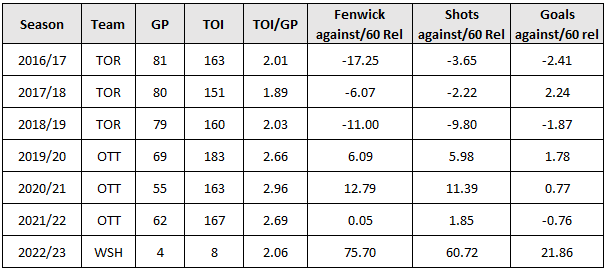
Below is a summary of Brown’s penalty-kill experience and on-ice performance numbers relative to his team from the last seven seasons. I removed his first season in Toronto where he only played seven NHL games, spending most of the 2015/16 season with the Marlies in the AHL as a 21 year old.
In his first three NHL seasons with Toronto (ages 22-24), Brown was mostly on the second penalty kill unit playing the third most shorthanded minutes among the Leafs forwards, and the fourth highest rate of minutes per game. The Leafs penalty kill had pretty good results in that three year period, allowing the ninth lowest rate of goals against, largely driven by their goaltending which posted a save percentage of 87.77%, sixth best in the league. The skaters really didn’t do that great of a job preventing unblocked shots attempts (i.e., Fenwick, a proxy for scoring chances) and shots against, as the team ranked at or below league average in this time period.
But with Brown on the ice, the Leafs did see a slight drop in the chances against, as reflected by his relative-to-team numbers in the table above. For example, with Brown on the ice between 2016-2019, the Leafs allowed a rate of 50.56 shots against per hour on the penalty kill. Without him, that rate increased by about 11% to 56.12 shots against per hour. Again, Brown wasn’t consistently on the top penalty kill unit playing against top powerplays during this time period. But he performed well in a secondary role, and clearly had the coaching staff’s trust in key situations.
His next three seasons in Ottawa (ages 25-27) were a little different. He still played regularly on the penalty kill, now getting top unit minutes against the best powerplays in the league. But it appears that this increased workload, and perhaps playing in a new system on a weaker team hurt his overall performance numbers.
Between 2019-2022, the Senators penalty kill allowed the ninth highest rate of goals against in the league (7.71), largely because the team struggled to suppress shots and chances against. As a group, they allowed the seventh highest rate of unblocked shot attempts (79.06) and the fifth highest rate of shots (58.09). Brown appears to have been part of the problem, as the team struggled to suppress offence against especially with him on the ice. Without Brown, the Senators allowed a rate of 56.70 shots against per hour. But that number increased by 7.5% to 61.32 shots against per hour when Brown was deployed.
Playing on the top penalty kill unit like Brown was, it’s expected an individual’s on-ice rate of shots against will increase as you’re up against the top units and top players in the league. On average, top penalty kill units see an increase of five shots per hour compared to their team’s second penalty killing units. But posting anything above this level, which Brown did in his first two seasons in Ottawa as a number one penalty killing forward (i.e., +5.89 in 2019/20 and +11.39 in 2020/21), is pretty alarming. Brown did post better numbers in his final season in Ottawa, but this could be an outlier just based on what we know about player aging curves and Brown’s injury history.
Knowing Brown has experience killing penalties, and how passionate he is about the role, and his desire to leverage this season in Edmonton to get a much bigger contract next summer, I’m sure he’ll get plenty of opportunities to secure shorthanded ice time. It’ll just be important for the Oilers coaching staff and management to temper their expectations, have Brown in a secondary role on the penalty kill and closely monitor his on-ice performance before considering increasing his workload. It’d also be in the Oilers best interest to continue looking for potential solutions on the penalty kill, whether it be adjustments to tactics or player deployment. Powerplays are getting better across the league, and it’s imperative the Oilers keep pace with the increased offence.
It’s going be interesting to see how artificial intelligence continues to grow within professional hockey leagues like the NHL. The different barriers like computer hardware, internet connections and data warehousing and analysis have been minimized, really paving the way for more and more AI integration into all facets of life.
ChatGPT has been a neat tool to get a sense of where AI is at and how generative AI can be used to create new artifacts and information based on the data that’s available. For my own interest, I was curious to see how AI would construct an NHL roster. This is information most people would know and it’s been published before. But I wanted to see what ChatGPT could come up with. And what the starting position would be if AI was actually in charge of developing an NHL roster, or at least assisting with the work.
Below is the response I got when I asked ChatGPT how it would construct an NHL roster:
Constructing an NHL roster involves several key considerations, including player positions, skill sets, team chemistry, salary cap constraints, and overall team strategy. While the specifics may vary depending on individual team preferences and circumstances, here are some general steps to consider when constructing an NHL roster:
Assess team needs and goals: Identify the areas where your team needs improvement, whether it’s goaltending, defense, or offense. Consider the team’s short-term and long-term goals, such as contending for the playoffs or rebuilding for the future.
Establish team strategy and style of play: Determine the style of play you want your team to adopt. Are you aiming for a fast-paced, offensive-minded team, or a defensively focused, physical squad? This strategy will influence the type of players you target.
Allocate salary cap space: Understand the salary cap limitations and budget available to construct the roster. Allocate funds strategically to secure core players, address critical needs, and maintain financial flexibility.
Build a strong core: Identify and acquire or develop core players who will anchor your roster. This typically includes a mix of top-line forwards, a solid defensive unit, and a reliable starting goaltender. These players should be talented, dependable, and capable of leading both on and off the ice.
Fill out supporting roles: Surround your core players with supporting cast members who complement their strengths. Seek skilled depth players who can contribute offensively or defensively, depending on team needs. Consider players who excel in special teams (power play, penalty kill) to bolster those areas.
Balance player skill sets: Strive for a well-rounded roster by balancing offensive firepower, defensive responsibility, physicality, and speed. Ensure you have players who can generate offense, shut down opponents, provide leadership, and contribute in various game situations.
Develop prospects: Invest in player development to groom young prospects and build a pipeline of talent for the future. Evaluate when to promote prospects to the NHL level and provide opportunities for their growth while considering their long-term development.
Consider team chemistry and culture: Assemble a roster with players who can work well together, share a common goal, and fit into the team’s culture. Building a cohesive and supportive team environment can contribute to success on and off the ice.
Continually assess and adapt: Roster construction is an ongoing process. Regularly evaluate the team’s performance, identify areas for improvement, and make necessary adjustments through trades, free agency, or player development to optimize the roster.
Remember, roster construction is a complex task that requires careful evaluation, analysis, and decision-making. It often involves a blend of experienced management, scouting expertise, and understanding the team’s unique circumstances and objectives.
Not bad! Pretty concise summary that would do okay in a simple business proposal document. It has all of the core concepts of building out an NHL roster, and we know some NHL clubs are better at this than others. I think from here, you’d be able to dig into each of the nine concepts and eventually have AI carry out the work to accomplish each one. A lot of work, with investment in people, processes and technology needed. But if you’re chasing championships, why wouldn’t you consider using every tool available including generative AI?
The challenge for any team of course would be first feeding the AI system the related data and information and knowledge to build solutions from. For example, to assess the team’s needs, you’d have to give it as much player and game data, along with historical information for it to know what the right metrics are, what’s an acceptable range for each metric, and how successful team’s have been built in the past. That itself is a massive lift, and would need constant refining as more and more data, such as player tracking and new player attributes, become available. The key for any team starting out with AI is identifying what your actual goals are and then prioritizing specific areas you would want to apply AI to.
The reality is that as AI technology gradually improves and works out its existing flaws, it is going to play a massive role in professional sports as teams will look for every competitive edge possible to build championship-caliber rosters. It’ll be interesting to see how owners and their executives embrace the technology available and integrate it into their overall business operations, especially in the NHL where some clubs still don’t the infrastructure to receive, store and utilize player tracking data. Those teams are likely going to struggle and we could see a noticeable performance gap develop between the top end teams and the rest of the pack.
One of the issues that’s come up for the Edmonton Oilers this off-season is their lack of cap space and inability to make significant improvements to the roster. Misreading the market, poor decision-making and plenty of overpays will do that. And it’s a difficult cycle to break unless you have some creativity and courage in your front office.
Now plenty of forwards and defencemen and a goalie are on heavy, long-term deals. But that shouldn’t be a reason for the club to play things conservatively this off-season. There’s plenty of room for improvement, and management needs to find ways to add talent and depth, and gain any competitive advantages – regardless of how small the margins or gains might be.
One concern I have heading into next season is the top six, which no doubt has some excellent pieces. The issue is that it’s getting older, with Zach Hyman, Ryan Nugent-Hopkins and Evander Kane all over 30 years old now and struggling to produce in the recent playoffs. And while all three bring specific skillsets to the team, their production is more likely to drop-off as they age. When that happens is anyone’s guess, and is based on a number of factors. But for one player in particular, there are indicators that it could happen sooner rather than later.
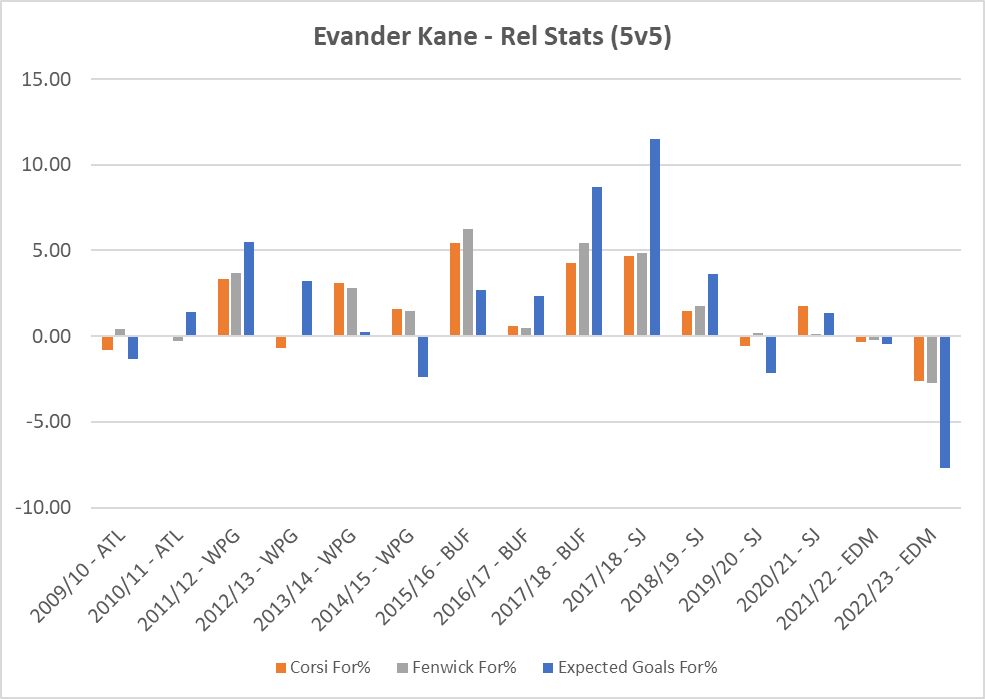
Looking at how Evander Kane has performed relative to his team’s overall performance at even-strength, we see a declining trend with his team’s gradually doing better without him than with him. If you’re getting paid and deployed like a top six forward, and spending significant time with two of the top players in the world, the team should be seeing a bump in productivity with you on the ice. But that hasn’t been the case for Kane. Last regular season, the Edmonton Oilers posted a Corsi For percentage of 50.93% at even-strength with Kane on the ice, a drop from the 52.55% Corsi For percentage without him on the ice. The team’s shared of expected goals, which factors in shot quality, was an even bigger drop off, as indicated by the lines in blue. Without Kane on the ice, the Oilers posted a 54.70% share of the expected goals (Source: Natural Stat Trick). With him on the ice, that share dropped to 48.08%, with the Oilers getting out-chanced more often. Kane’s overall decline appears to have started in his first full season with San Jose (2018/19) when he was 27 (right after when offensive players tend to drop off), and it’s hard to imagine things getting better considering he’ll be 32 years old before the next season begins.
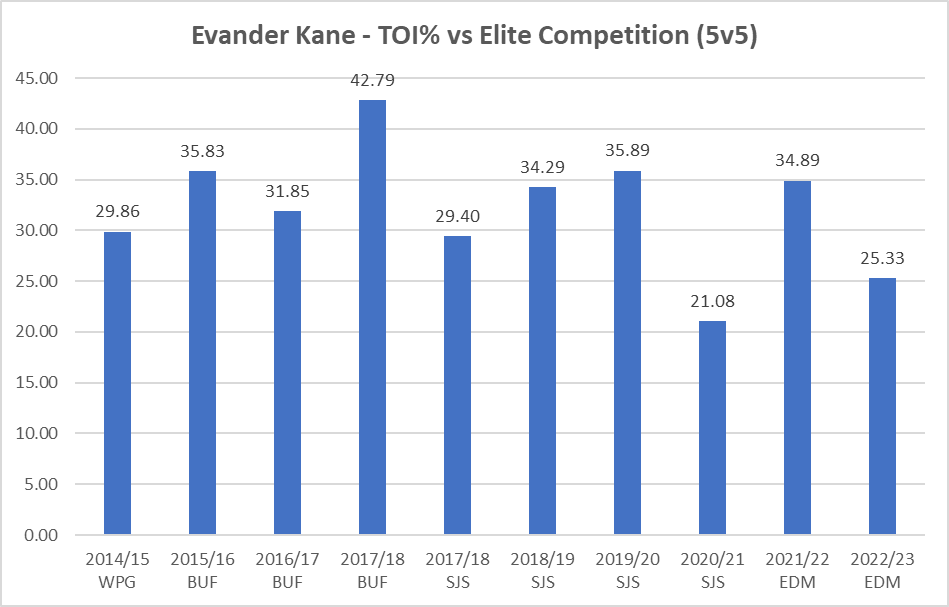
Whether it’s his performance, or the injuries he’s sustained, the Oilers coaching staff has made adjustments to how Kane has been deployed. Just over 25% of his total ice time at even-strength last season was against elite-level competition, which is the second lowest proportion of ice time against this group in his career. For context, in his first two full seasons in San Jose, Kane spent around 35% of his ice time against elite-level competition (Source: Puck IQ).
Kane is definitely a player to watch this upcoming season. The hope is he can bounce back and be a solid supplementary player in the top six. But it’s becoming more and more likely that he’ll lose another step, possibly paving the way for one of the younger prospects in the system – someone like Dylan Holloway, or maybe even Xavier Bourgault, to make the jump and play more of a feature role in the top six. It’ll be critical for the coaching staff to closely monitor the performance levels of Kane and the top six, and make swift adjustments when necessary.
This issue also has to be on the general manager’s radar. Kane’s value remains high across the league because of his experience and past results. This might be a good time for Ken Holland to find some much-needed creativity and courage and start creating a trade market for the player, maximizing a potential return. The team’s cap situation is a mess right now thanks to him, with some good young players like Bouchard and McLeod needing long-term contracts, and more youngsters on the way. Clearing cap space is going to be important for long-term sustainability, something Ken Holland has struggled with pretty much his whole career. So it’ll be interesting to see how he navigates this one.
Disappointing results for a team that had such high aspirations. Following a regular season where they finished second in the division and had three 100-point players, the Oilers were eliminated by a team that picked them apart a few different ways and had the better goaltending. And it’s not like Vegas was any sort of daunting juggernaut. With a deeper roster, and some better coaching decisions, the Oilers could have been in the western conference finals.
Edmonton Oilers
5v5
Vegas Golden Knights
55.65
Corsi For%
44.35
54.29
Fenwick For%
45.71
53.50
Expected Goals For%
46.50
37.50
Goals For%
62.50
9-15
GF-GA
15-9
6.60
Shooting%
12.35
87.65
Save%
93.40
0.942
PDO
1.058
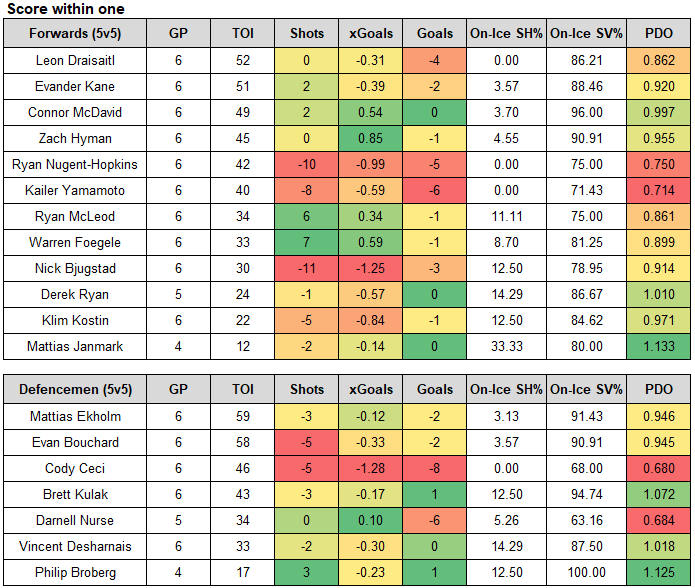
When it comes to the performance numbers at even-strength (5v5), the Oilers did post better shot-share numbers than Vegas. But it was largely boosted because they trailed so often in games, allowing score-effects to creep in. When the score was ever within one goal (144 minutes, or about 52% of the total time against Vegas in the series), the Oilers posted a Corsi For percentage of 52% and an Expected Goals For percentage of only 46%. So when both teams were pushing for offence and defending their own zone, and deploying more of their depth players, Vegas was the one getting the higher share of quality chances.
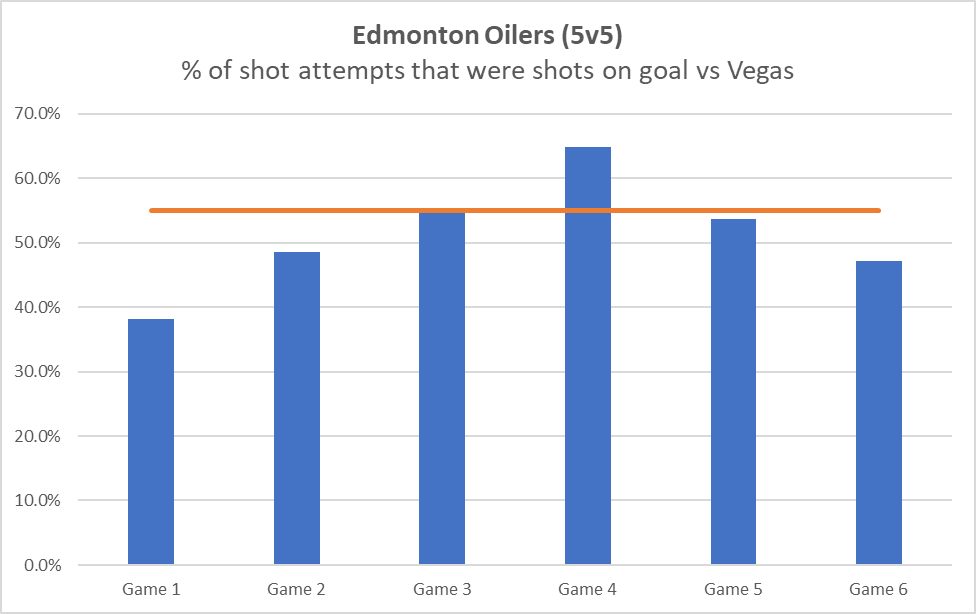
What Vegas did really well was limit the Oilers chances to lower probability scoring areas, something the Oilers were slowing getting better at as the series progressed. But after game four when it came down to a best-of-three series things fell apart again. The table below breaks down the Oiler’s proportion of shot attempts at even-strength that were actual shots on goal by game. The orange line indicates the Oilers regular season average.
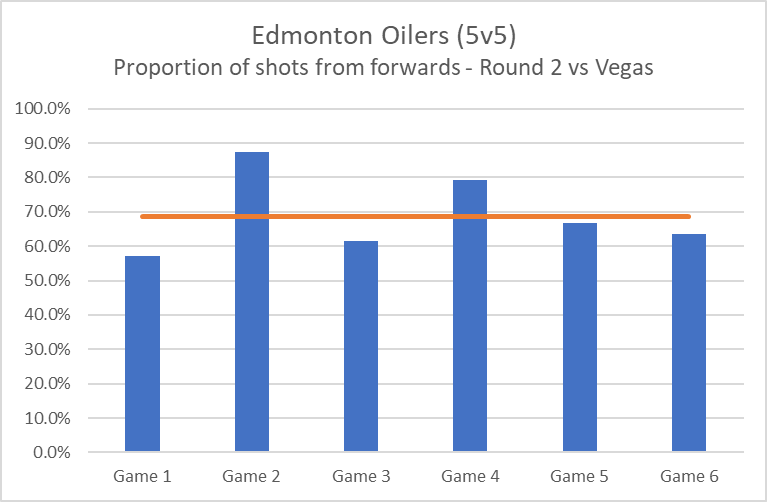
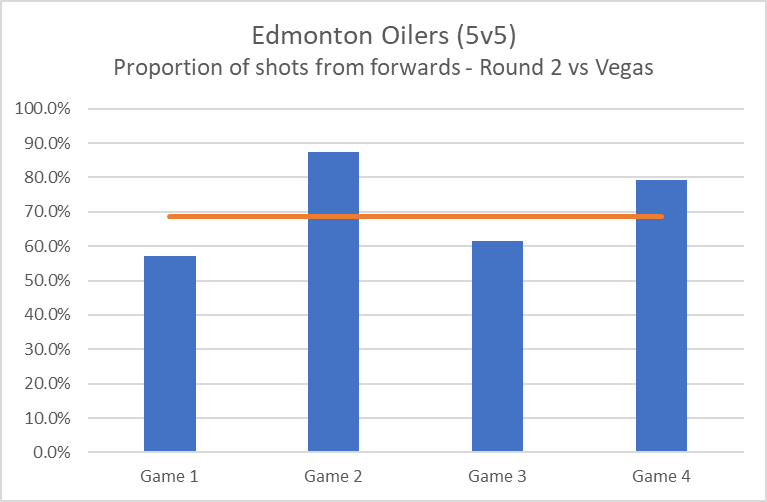
The other issue I had been tracking was how often the shots the Oilers were taking were coming from the sticks of forwards, who are typically in higher danger areas and have better odds of scoring goals than defenceman. During the regular season, 68.7% of the Oilers shots were from their forwards. But in their series against Vegas, the Oilers had trouble reaching this level, as we saw a lot more point shots from defenceman. In games two and four is when the Oilers forwards got the most opportunities, which is also the games that they won in the series.
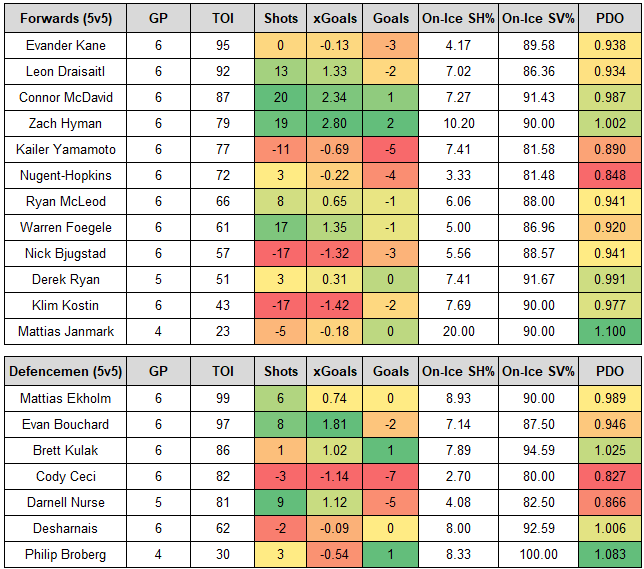
And here’s an updated summary of the Oilers skaters and their on-ice numbers at even-strength, sorted by time-on-ice (TOI). Key thing here is that most of the top-end players did well, as the Oilers typically outshot Vegas with them on the ice. But when Kane, Nugent-Hopkins, Bjugstad or Yamamoto were on the ice, the Oilers were typically playing without the puck and in their own zone. An issue that the Golden Knights coaching staff recognized and ensured the deployment of Eichel’s line when they were on the ice.
I was surprised to see that McLeod didn’t get as much ice time at even-strength, considering how well he’s played in the post-season and his head-to-head numbers against some of Vegas’ top performers. For example, in about 18 minutes against Eichel (about 27% of his total ice time), McLeod’s on-ice Corsi For percentage was 66.7%, and the team outshot Vegas 14-6. That’s on the coaching staff for not recognizing his performance numbers and perhaps only looking at goal differential, which doesn’t always reflect a players true value.
As for goaltending, it’s obvious Vegas had the edge in the series. They posted the second highest even-strength save percentage (94.83%) among first round teams, shutting down the Jets. And they did it again in the second round (93.40%), albeit with a different goalie. Maybe that’s the key – having two good goalies to share the workload in case one of them was overworked in the regular season, and could be susceptible to burnout or injury.
The other player that stood out this series was Bouchard, who I thought performed well and had great results. He made some mistakes, but I thought the good outweighed the bad. The concern I would have with his play against Vegas is that when the games were close (looking at when the score was within one goal), he posted some of the worst on-ice numbers among the Oilers defencemen.
When the Oilers trailed by a couple goals, and Vegas would be more risk-averse, that’s when Bouchard’s numbers were stronger. I’d still think very highly of Bouchard and hope that the Oilers sign him to a longer term deal. I would just be leery of his on-ice shot share numbers and point totals, as there does appear to be some things he’ll need to work on.
And he’s definitely not the only one. Nugent-Hopkins was another player whose numbers took a hit when the game score was within one. Something that falls more on the coaching staff who tried to run him as a center to drive his own line, when we’ve known for a while now that he’s more of a complementary player. Ceci is another player who struggled in all situations, which really falls on Holland who signed him to a long-term contract that aligned with the McDavid/Draisaitl window. Improvements need to be made across the roster right away here if the Oilers intend on a deeper playoff run next season.
The Edmonton Oilers are currently tied two games apiece in their series against the Vegas Golden Knights after a dominant win on Wednesday night. Vegas was completely flattened, generating only four even-strength shots in the first two periods of game four, while the Oilers generated 21. It was also good to see McDavid and Draisaitl playing on separate lines, which limited the amount of time the Oilers didn’t have one of the two on the ice. That appeared to benefit the depth lines, as they out-shot and out-chanced Vegas by a significant margin.
Below is a summary of how both teams have performed at even-strength this round, and what their results have been like.
Edmonton
5v5
Vegas
54.08
Corsi For%
45.92
51.88
Fenwick For%
48.12
48.37
Expected Goals For%
51.63
7-10
GF-GA
10-7
41.18
Goals For%
58.82
7.99
Shooting%
11.34
88.66
Save%
92.01
0.966
PDO
1.034
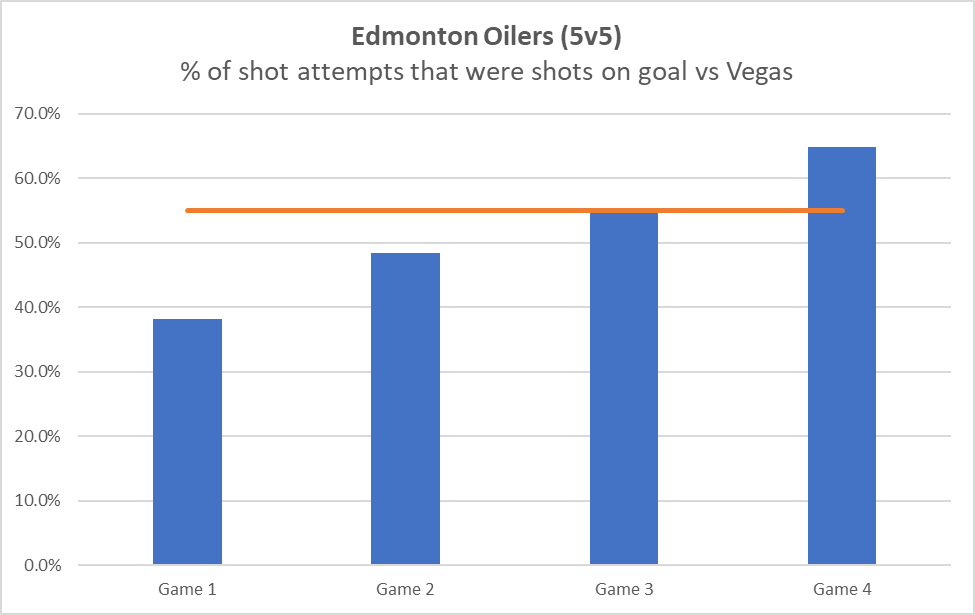
Over the first four games, the Edmonton Oilers have done a better job controlling the flow of play as reflected by their 54% Corsi For percentage. But they haven’t been able to convert their puck possession into actual scoring chances, with Vegas holding a slight edge. Of their 172 shot attempts against Vegas, only 87, or about 50% of those, have been shots on goal. In the regular season, the Oilers were one of the league’s better teams at this with a little over 55% of their shot attempts being shots on goal.
The good news is that the Oilers have gradually been getting better at this, as the club appears to be adjusting to Vegas’ defensive schemes. In game four, for example, 65% of their shot attempts were actual shots on goal, and likely a big reason why they out-scored Vegas 3-0 at even-strength in the first two periods. That’s a big improvement from game one when only 38% of their attempts were shots on goal. Note that in the graph below, the orange line represents the Oilers 2022/23 regular season proportion.
The other positive from game four was the lower proportion of shots that were coming off the sticks of defencemen, an issue I covered after game three. Of the 24 shots the Oilers took in game four, 19 were from forwards (79%) – a significant improvement from the first three games of the series when defencemen were getting a higher-than-normal share. If the Oilers can continue breaking through Vegas’ structure and avoiding taking shots from lower probability scoring areas, they should be able to have more success at even-strength.
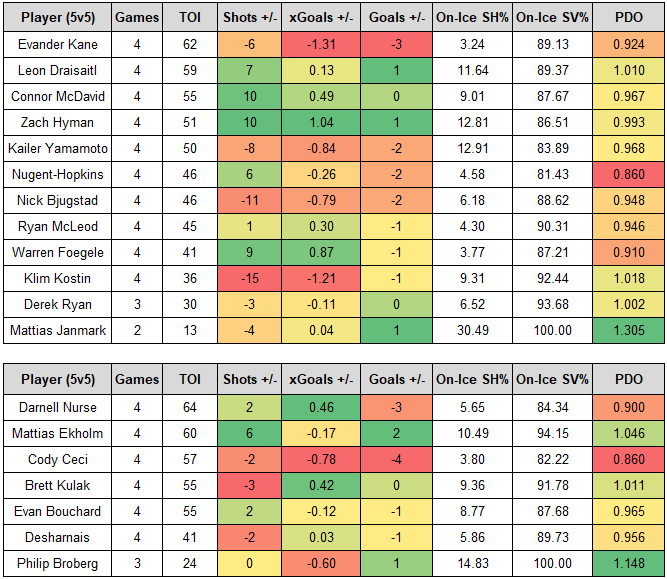
Here’s a quick look at how the Oiler’s skaters have performed against Vegas at even-strength, and the team’s results with them on the ice.
Somewhat surprised to see Kane’s on-ice numbers in the red considering he’s spent 73% of his ice time with either McDavid, Draisaitl or Nugent-Hopkins. His main issue is that in the 27% of his ice time that he isn’t in the top six, his on-ice Corsi For% and Expected Goals For% plummets to around 35%. He basically needs to be playing top six minutes to provide any sort of value to the team. If you’re Vegas, you can definitely continue targeting him and some of the secondary forwards, including Yamamoto, Bjugstad and Kostin who’ve all posted poor on-ice shot-shares in the series. On the plus-side – nice to see Foegele and McLeod performing well, the latter of which is well suited for more responsibility if need-be.
Quick review of the Oilers special teams, which has had excellent results against Vegas.
Starting with the Oilers powerplay – Vegas is actually doing a pretty good job limiting shots and chances against, holding the Oilers to a rate of 59 shots per hour (about 8 shots lower than their regular season rate, which was the highest in the league). Issue of course is the finishing talent of the Oilers who have converted on 24% (!) of their shots, which is an increase from the 19% shooting percentage they posted in the regular season – which was the highest in the league. Hard to see the Oilers powerplay slowing down any time soon.
The Oilers penalty kill continues to perform well in front of the goaltending, allowing 56 shots against per hour, which is around the regular season league average. And in this round, the Oilers are finally getting good goaltending with the team posting a 92% save percentage. That’s a significant improvement from the first round against Los Angeles when the Oilers were doing a really good job limiting opportunities against, but were let down by their goaltending that stopped only 75% of the shots against.
Should be an interesting best-of-three series. If the Oilers intend on moving on to the western conference finals, they will need their special teams to be an area of strength, and hope that their even-strength results (i.e., goal-share) improve. Main concern should be around the goaltending and Skinner’s play, as there’s been some inconsistency in his game – something that may have carried over from the regular season. And the secondary forwards, who Vegas’ coaching staff can target more often with home-ice advantage.







 The SuperFan