What can we learn from how the Edmonton Oilers deploy forward lines and defensive pairings?

Over at Oilersnation, I looked into how defencemen and forwards have been deployed since Kris Knoblauch was hired as head coach of the Edmonton Oilers. I wanted to understand how the different forward lines have been deployed with the defence pairings, and how well they’ve performed in these last twelve games at even-strength.

Looking at the expected goal-shares of each combination of forward and defencemen, the one item that really stands out is the Oilers performance when Draisaitl has been deployed as the sole centerman with Nurse and Ceci on the blue line. In 68 minutes, the trio has posted a 24.01 percent expected goal-share – a horrendous number, indicating that the Oilers are at risk of getting outscored at a rate of 3-1 if this continues. Right now, the trio is lucky that they’ve only been outscored 2-0 in these 68 minutes. It’s worth noting, too, that Draisaitl is in a bit of a personal slump at even-strength as he’s only posted five even-strength points since the coaching change, and his 1.68 points per hour is well below his career levels (2.38 points per hour). Considering how much money is being spent on Draisaitl, Nurse and Ceci, and the expectations for them to outscore opponents and win games, this has to be a spot of bother for the coaching staff.

Sunil Agnihotri/Oilersnation

Full article is at Oilersnation.

Progression

In my latest article for Oilersnation, I looked into the drivers for the Oilers recent success under the new coach, and areas worth keeping an eye on.

If the Oilers can maintain their ability to control the flow of play at even-strength and perform well on their special teams, they’re giving themselves a very good shot at a wildcard spot in the Western Conference. But they’ll need to address their goaltending, which is lacking depth right now and putting their starter at risk of burnout as the season progresses. Up front it does appear with McDavid back in form, the club should be scoring at the rates they were at last season. But they need some of their secondary, depth players to contribute at the same level as last season. The top six have some players who are at risk of seeing their numbers decline, and it doesn’t appear as though management has prepared any youngsters to take on larger roles on the club.

It’ll be interesting to see over the next month if the Oilers can sustain their recent success and make some ground in the western conference. The teams ahead of them in the standings aren’t very strong, and don’t have the elite talent the Oilers have. But if goaltending slips or injuries occur, it’ll be a significant blow to their playoff aspirations.

Sunil Agnihotri/Oilersnation

Full article is at Oilersnation.

Tracking the Western conference – As of November 30, 2023

I usually do a monthly review of the Pacific division for at least the first half of the regular season. And then switch to a western conference review in the last few months of the season to predict which team could make a deep run in the playoffs. But since the Oilers have started so poorly and need to make some ground just to clinch a wild-card spot in the west, I’m already switching from a division review to a conference review. Just a wild season.

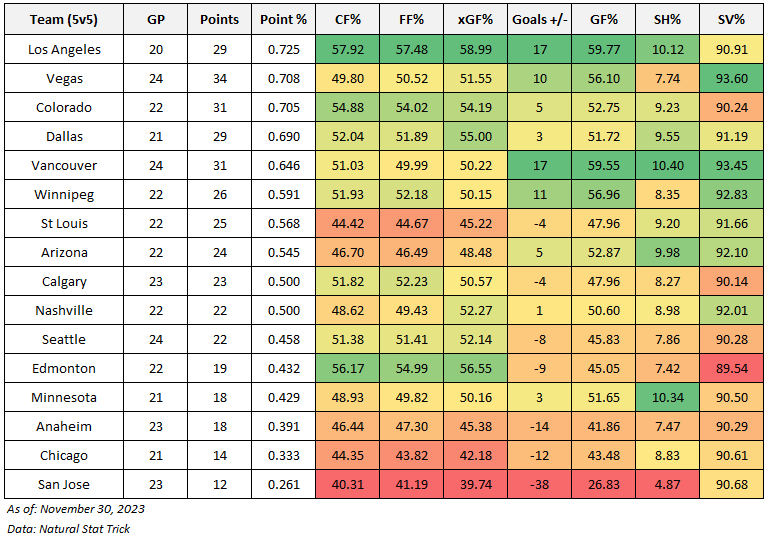
After 22 games, the Oilers currently rank sixth in the Pacific division with a points percentage of 0.432, ahead of only Anaheim and San Jose. They rank 27th in the league, while Los Angeles and Vegas are in the top five. The good news is that the Oilers have won their last three, having now gone 6-3 since the coaching change. And they have some strong underlying numbers over the course of the season. But they’re going to need to be posting a strong points percentage (at least 0.600) the rest of the way to compete for a playoff spot.

Below are the even-strength (5v5) numbers for each team in the western conference (sorted by points percentage), including goal-share results as well as the shot-share metrics that give us a sense of which teams have the right processes in place and if the results are sustainable or not. At the end of the table are each team’s shooting percentage and save percentage. I’ve also applied a basic heat map to each metric to show which teams are doing well or struggling relative to their conference foes (i.e., green is good, red is bad). You can also find a description of each metric at the end of this article. Please note that the shot-share metrics are score and venue-adjusted based on Natural Stat Trick’sTrick’s methodology.

While the results have been bad so far, there’s reasons for optimism.

First off, the team’s underlying shot-share numbers have been solid, with the Oilers posting a 56% Corsi For percentage and expected goal-share. But goaltending has been a major weakness. Had the Oilers received league average goaltending this season (91.55%), they would have allowed around 10 fewer goals and would be a couple spots higher in the standings. Skinner has been playing better recently, but there should be concern about his workload and the fatigue he will likely experience in the last stretch of the season and (hopefully) the playoffs. I’m just not sure if the general manager who has struggled to identify strong goaltending in the past should be trusted to make decisions.

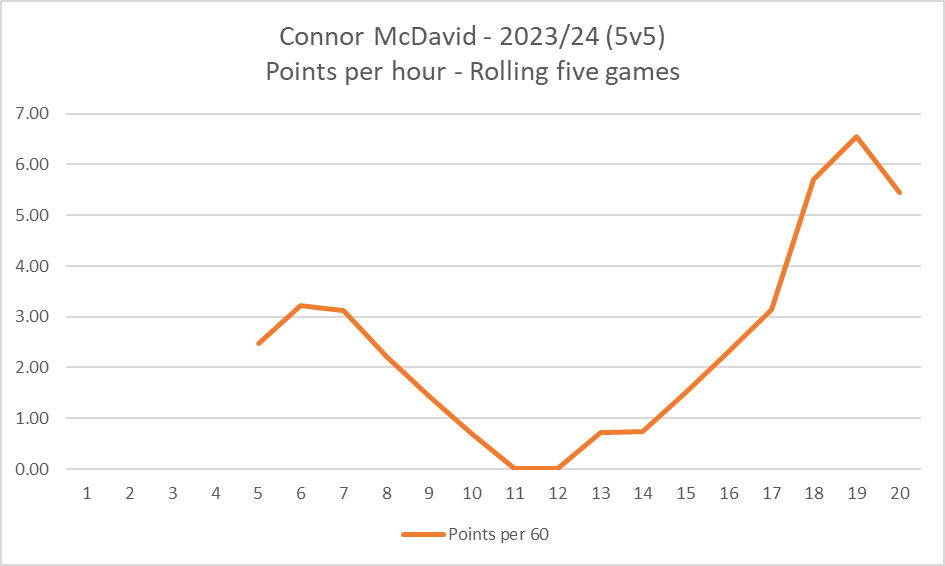
The other positive for Edmonton is the improved health and performance of Connor McDavid. He’s been playing much better recently, albeit against some weaker teams. But it’s a significant improvement from earlier this season when he was producing at a third line rate.

Couple things worth monitoring once the Oilers get back from their mini-break:

  • Performance and results of the bottom six forwards at even-strength. There isn’t much going on there with McLeod struggling to produce. But he’s a prime candidate to break-out soon as his underlying numbers have been solid so far.
  • If the Oilers actually address their goaltending or go the path of least resistance – a go-to strategy for Ken Holland. This would include simply calling Jack Campbell back up and hoping that he can play every four games.
  • The Oilers special teams and if it become a factor again. The penalty kill was costing them wins early on in the season, but has been much better since the coaching change. The powerplay is showing signs of life as well.

If the Oilers continue to out-shoot and out-chance opponents, they have a decent chance of competing for a wild card spot. There’s a couple teams ahead of them that are likely to slip including St. Louis and Arizona. And the rest of the Pacific has been very mediocre.

Data: Natural Stat Trick

Glossary:

  • Points-percentage (Point%) – The total points accumulated divided by the points that were available, including extra time.
  • Corsi for percentage (CF%) – The proportion of all the shot attempts the team generated and allowed that the team generated (i.e., corsi for/(corsi for + corsi against). This is used as a proxy for possession and is the best at predicting a team’steam’s future share of goals (GF%). (Source: Hockey Great Tapes – Draglikepull)
  • Fenwick for percentage (FF%) – The proportion of all the unblocked shot attempts the team generated and allowed that the team generated (i.e., Fenwick for/(Fenwick for + aenwick against). This is used as a proxy for shot quality and considers shot blocking a repeatable skill.
  • Expected goals for percentage (xGF%) – This is a weighting placed on every unblocked shot based on the probability of the shot becoming a goal. This depends on the type of shot, location and uses historical shot and goals data to come up with the probability for each unblocked shot.
  • Goals for percentage (GF%) – The proportion of all the goals that the team scored and allowed that the team generated (i.e., Goals for/(Goals for + goals against).
  • Shooting percentage (SH%) – The percentage of the team’steam’s shots on goal that became goals (i.e., total goals divided by the total shots on goal).
  • Save percentage (SV%) – The percentage of the team’steam’s shots on goal against that were saved (i.e., 1-(totals goals allowed divided by the total shots on goal against)).

Caution flags appearing since the Oilers coaching change

The Edmonton Oilers are in a brutal spot having now lost three straight in regulation, and they really haven’t seen any benefits of the coaching change just yet. It’s only been five games with Kris Knoblauch behind the bench, but the results have been poor with the team getting outscored 18-21 in all situations (resulting in a 0.400 points percentage). And their underlying shot-share numbers at even-strength (5v5) that helps assess the team’s performance, and predicts future results, have also declined since Jay Woodcroft was dismissed.

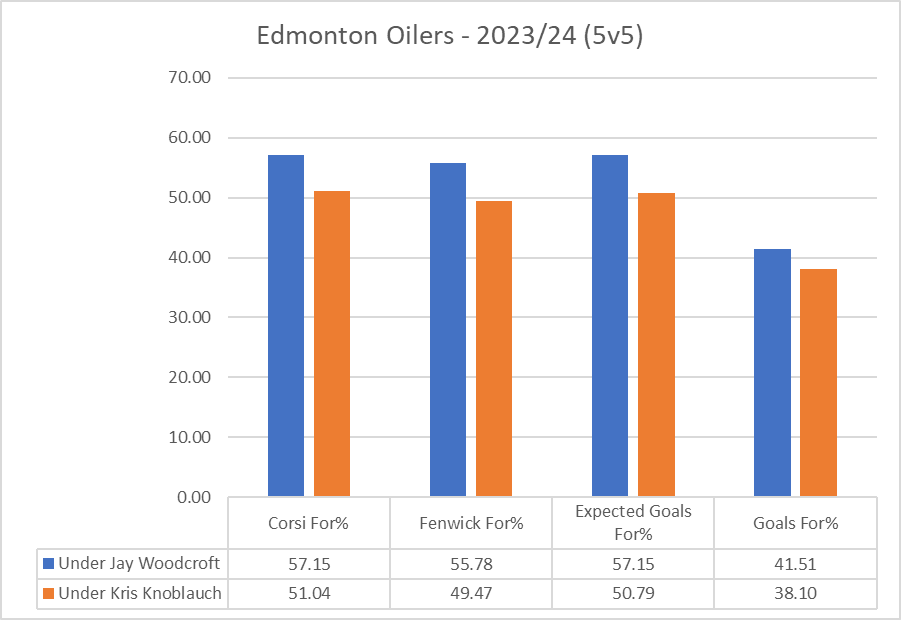
Below is a quick comparison of how the Oilers have performed under the two coaches at even-strength. Under Woodcroft, the Oilers were consistently one of the better teams in the league when it came to puck possession and controlling scoring chances. But under Knoblauch, the team has seen around an 11% decline in these metrics, now hovering below league-average levels.

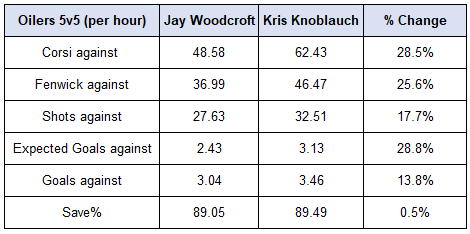
The actual results have also slipped slightly under Knoblauch, with the Oilers having posted a 38% goal-share at even-strength (8 goals for, 13 goals against). What’s especially alarming is that it’s on the defensive side of things where the Oilers have become worse since the coaching change. For instance, the rate of shot attempts (Corsi) against has increased by 28%, going from 48.58 per hour under Woodcroft to over 62 per hour under Knoblauch. The rate of expected goals against has had similar growth, increasing by 28% from 2.43 per hour to 3.13 per hour.

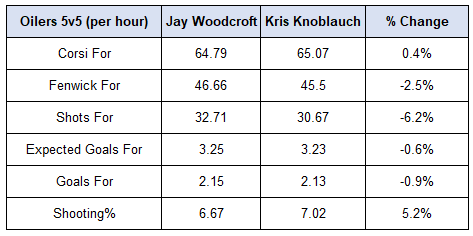
Offensively at even-strength, the Oilers have also downgraded, but not as significantly as they have on defence. The Oilers rate of shots on goal has dropped by 6.2%. But their rate of expected goals and actual goals remains around the same as before.

The powerplay has also been a mess, with the Oilers having only scored three goals since the coaching change. A big reason for that is their declining rate of unblocked shot attempts, which has been 66 per hour in the last five games – one of the lowest rates in the league and well below the 89 they generated per hour when Woodcroft was behind the bench this season and last season. Definitely something to keep an eye on.

The good news is that the Oilers penalty kill has been a bright spot in these last five games, allowing only three goals and actually scoring three goals. The Oilers have allowed around 62 unblocked shot attempts against per hour since the coaching chance, one of the lowest rates in the league and well below what previous coaching regimes posted.

It’s still early in Knoblauch’s coaching career with Edmonton, so hopefully he’ll be able to make the tactical and player deployment adjustments to get things on track again to get out of the western conference basement. For now, the performance numbers are indicating that we should temper our expectations of the team, especially if they continue to struggle with preventing chances against at even-strength.

Data: Natural Stat Trick

Oilers in disarray

Within such an important period of their franchise’s history, the Edmonton Oilers need to ensure that any changes they make are decisive, complete, and as seamless as possible. Whether it’s for the roster construction, the coaching staff or the front office, personnel decisions especially must be based on sound business practices to ensure stability and consumer confidence. And these decisions need to be geared towards winning games and championships.

The Oilers had the opportunity to really set their course for the next few seasons when they recently made a coaching change – a critical component of building a long-term, sustainable contender. But what this latest change really did was demonstrate the disarray of the organization and the panic that appears to be setting in for the owner and his management team. The pressure is obviously immense with their two star players on the tail-end of their contracts and the team starting this season so poorly. It doesn’t appear that the organization is handling this pressure well, creating a lot of unnecessary speculation around their stability and future state.

Firstly, the actual dismissal of Jay Woodcroft and Dave Manson was somewhat premature, considering the goaltending had been the team’s biggest issue — an area that management has more of an influence on. The areas that the coach does influence, including the team’s ability to control the flow of play and to out-shoot and out-chance opponents, were solid under Woodcroft. The team’s Corsi for percentage and expected goal shares at even-strength were consistently one of the best in the league and were part of why the Oilers posted a 0.643 points percentage with Woodcroft behind the bench.

Again, these areas are impacted by the coaching staff through their tactical work, deployment, and knowledge of the players on the roster. Making a coaching change based on 13 games instead of 133 regular season games and 28 playoff games seems a little rash, and it’s pretty clear that the Oilers didn’t have any risk-mitigation plan for a scenario involving a poor start and a coaching change.

While hiring a young coach whose highest level of experience is at the American Hockey League level is fine, it remains unclear who made the hire and if Kris Knoblauch is part of the long-term plan for the Oilers. It’s typically assumed that the general manager is the ultimate decision-maker, as they have a close working relationship with the coach and are familiar with the players in the system. But because Ken Holland’s contract with the Oilers ends in six months, this decision was likely from someone higher up in the organization. This would include CEO Jeff Jackson but could have also been made by somebody like Paul Coffey, who was hired by the Oilers in 2022 to serve as a special advisor to the owner. Perhaps the next general manager is already within the organization or was consulted. Either way, it doesn’t build much confidence in the front office’s decision-making process and future planning. The lack of transparency also put captain Connor McDavid in an awkward spot as it was assumed by the public, based on his involvement with the hiring of Jackson and other roster decisions (i.e., Foegele, Brown), that he also had a say in the new coach.

The coaching change also draws attention to the Oilers’ organizational structure and their chain of command, specifically with the appointment of Paul Coffey as the assistant coach. It doesn’t make sense that the man who played a major role in hiring Jeff Jackson as CEO and who will have a major influence on selecting the next general manager for the Oilers is now reporting to the new coach behind the bench. Coffey has zero professional coaching experience and has no desire to be in this role. But again, because of the lack of risk-mitigation planning by upper management (which includes himself), Coffey is now guiding the defensive players for at least the remainder of the year. Or until Knoblauch is able or allowed to bring in his own assistant coaches, a decision that Coffey will also have an influence on.

Without demonstrating a commitment to stability and long-term planning, the Oilers will have trouble building a championship roster. But while this latest personnel change showed some cracks in the organizational structure, there’s still time to make things right. This would include removing Ken Holland as general manager, who has been the main culprit for their roster construction issues, the shallow prospect pool and the inability to solidify the team’s goaltending. And before naming his replacement, the Oilers need to clearly define the roles and accountability among upper management to clarify who has authority over what.

The margins for error are very thin in professional sports, on and off the ice, making it even more important that the Edmonton Oilers function more like a business instead of the owner’s vanity project.

Also posted at Oilersnation.

CBC Radio Active: The Edmonton Oilers’ coaching carousel continues to spin

I joined Jessica Ng on CBC Radio Active to talk about the Edmonton Oilers, the dismissal of Jay Woodcroft and the hiring of Kris Knoblauch as head coach. Full segment is here: CBC Radio Active (2023, November 13)

Topics we covered:

  • The key drivers behind the dismissal of Jay Woodcroft and Dave Manson.
  • Accountability of the players who have struggled this year and if the coach had “lost the room”.
  • More importantly – the accountability of the general manager Ken Holland whose roster construction and salary cap management played a major role in the team’s results this season.
  • What to expect with Kris Knoblauch behind the bench, and what the reasonable expectations are for the team.

Thanks again to the team at CBC Edmonton for putting it all together!

The early season struggles of Connor McDavid

Connor McDavid hasn’t looked healthy since training camp, and it’s reflected in his on-ice and individual numbers. In my latest post for Oilersnation, I looked into his even-strength performance this season and how his issues could be dragging down the team’s results.

McDavid’s on-ice share of expected goals is 10.5 percent lower this season than the last three seasons, currently sitting at 52.22 percent – the fourth lowest on the Oilers among forwards. Offensively, the Oilers have seen a drop in their rate of chances with McDavid on the ice, going from 3.42 expected goals per hour to 3.01 – a 12.0 percent decrease. And defensively, the team’s rate of expected goals against has increased by almost 13 percent with McDavid on the ice. Again – this is way out of expected ranges for McDavid and can negatively impact the Oilers’ odds of out-scoring opponents and winning games.

What’s especially alarming is how his numbers compare to his teammates. Historically, the team sees a major spike with McDavid on the ice, with the expected goals for percentage increasing by close to 10. It’s the opposite this season, with the expected goals share decreasing by 8.29 with McDavid deployed, indicating that having McDavid on the ice is a bit of a liability. And opponents are taking full advantage of the situation, outscoring the Oilers 8-5 when McDavid has been deployed this season at even-strength.

Sunil Agnihotri/Oilersnation

Full article is at Oilersnation.

CBC Radio Active: The Oilers find themselves in a huge hole

I joined Jessica Ng on CBC Radio Active to talk about the Edmonton Oilers, their poor start, some of the key underlying issues and the path forward. Full segment is here: CBC Radio Active (2023, November 6)

Topics we covered:

  • The Oilers current situation, how far they’ve fallen in the division and the uphill climb from here to even compete for a playoff spot.
  • The goaltending, and how poorly they’ve performed this season.
  • Jay Woodcroft’s chances of being let go, and if that would accomplish anything.
  • Rushing Connor McDavid back from injury to play in the Heritage Classic. Suspect he was also hurt in training camp based on his numbers and shooting percentage.
  • What roster changes are even possible to get the Oilers back on track.
  • The role Ken Holland has had in these results and his poor management abilities.

Thanks again to the team at CBC Edmonton for putting it all together!

Data: Natural Stat Trick

Other notes:

  • The Oilers are currently taking the tenth highest rate of penalties.
  • Among 58 goalies who have played 150 minutes (about 3-4 games), Campbell ranks 50th with a save percentage of 87.3%. Skinner ranks 55th with an 86.1% save percentage.
  • McDavid’s shooting percentage this season has been 8.70%, all situations. His career shooting percentage is 15.5%. He’s not 100% healthy, and I think he was hurt before the game against Winnipeg.
  • The Oilers penalty kill is allowing a league-average rate of shots against, but has one of the worst team save percentages – so they’re allowing the sixth highest rate of goals against.
  • Depth scoring at even-strength is bad, scoring only once without one of the top-six forwards on the ice; their shooting percentage is around 1%. In the first ten games last season, the Oilers depth scored four goals; shooting percentage around 7%.

Tracking the Pacific division – As of October 31, 2023

It was a rough start to the 2023/24 regular season for the Edmonton Oilers, who currently rank sixth in the Pacific division with a 0.313 points percentage and 30th in the league – only ahead of Calgary and San Jose. And with Seattle sitting 27th, four of the bottom six teams in the league are currently from the Pacific. On the other end of the standings, Vegas, Vancouver, and Los Angeles have had good starts to their seasons, banking points early and often.

There are still plenty of games to play, so it’s worth assessing how teams have done in terms of results measured by goal-differential and goal-share. And also evaluating how the team has played using shot-share metrics like corsi for percentage, which is used as a proxy for puck possession, and expected goals for percentage that factor in shot quality and tells us how well the team has done at out-chancing opponents.

Below are the even-strength (5v5) numbers for each team in the Pacific division (sorted by points percentage), including goal-share results as well as the shot-share metrics that give us a sense of which teams have the right processes in place and if the results are sustainable or not. At the end of the table are each team’s shooting percentage and save percentage. I’ve also applied a basic heat map to each metric to show which teams are doing well or struggling relative to their division foes (i.e., green is good, red is bad). You can also find a description of each metric at the end of this article. Please note that the shot-share metrics are score and venue adjusted based on Natural Stat Trick’sTrick’s methodology.

From an Edmonton perspective, it’s frustrating to see the team struggle to convert on their offensive chances, not get decent goaltending and post a paltry -4 goal differential at even-strength. But it is encouraging to see that they have done a good job controlling the flow of play and out-shoot and out-chance opponents over the course of these eight games. Their corsi for percentage and expected goals for percentage are near the top of the league and in the same group as some of the cup contenders this season, including Colorado, Dallas, New Jersey, and Carolina. I’ll note again that these shot-share numbers are score-adjusted, which takes into account the fact that the Oilers have trailed in a lot of games this season. It’s worth noting, too, that the team is doing well when it comes to shot-share numbers with and without their best players. Without McDavid or Draisaitl on the ice this season, the team has posted a corsi for percentage of 54 percent and an expected goals for rate of 52 percent. If the bottom six forward group can get an ounce of finishing talent, either from their existing roster or from Bakersfield, this team could make some considerable progress, which leads me to my next point.

The Oilers’ even-strength shooting percentage of 7.47 percent currently ranks 19th in the league, while their team save percentage of 89.59 percent ranks 29th. Had the team’s shooting percentage been just league average, which has been 8.47 percent over the last three seasons league-wide, the Oilers would have scored 16 goals this season instead of 14. And had their team save percentage been league average, which has been 91.6 percent over the last three seasons, the Oilers would have allowed 14 goals instead of 18. An extra six goals would have given them at least another win in October and a couple of places higher in the Pacific with a +2 goal differential.

Based on my recent review of the Oilers’ individual players and their on-ice shooting percentage and save percentage, I would expect a few players to start scoring pretty soon here. For example, the Oilers have posted good shot-differentials with Brown on the ice, but he has zero even-strength (5v5) points to show. So, I expect him to start producing soon. It’s the same with Holloway, who has posted some decent shot differentials further down the line-up but has yet to be on the ice for a goal. I’m also expecting McLeod to have better on-ice results, as he has a good history now of being a dependable bottom-six player. It’s likely the injury he dealt with in training camp that’s slowing him down, so hopefully, he can get into form soon and help improve the team’s overall shooting percentage. It might also help to have a shooter like Raphael Lavoie on a line with McLeod where they can play against lesser competition and get Lavoie acclimated to the national league.

As for the rest of the Pacific, I’m expecting Vancouver to gradually drop down to the middle of the pack as the club is doing well but posting an Expected Goals for percentage of 45.51 percent – one of the lowest in the league. While their goaltending is pretty solid, I don’t think they’ll be able to sustain a shooting percentage of almost 12 percent. Vegas is another team I’m skeptical about. They obviously have the talent to make up for their poor underlying numbers, but they’re still likely to regress. Their shot-share numbers weren’t anything special last season either, so their progress will be something worth monitoring. Los Angeles is the other interesting team as, once again, they’re doing everything right to improve their odds of out-scoring teams at even strength. But they still need to solve their goaltending issue.

It’s going to be an interesting race for the top spots in the Pacific. And the Oilers have their work cut out for them. We’ll do another check-in at the end of November.

Data: Natural Stat Trick

Glossary:

  • Points-percentage (Point%) – The total points accumulated divided by the points that were available, including extra time.
  • Corsi for percentage (CF%) – The proportion of all the shot attempts the team generated and allowed that the team generated (i.e., corsi for/(corsi for + corsi against). This is used as a proxy for possession and is the best at predicting a team’steam’s future share of goals (GF%). (Source: Hockey Great Tapes – Draglikepull)
  • Fenwick for percentage (FF%) – The proportion of all the unblocked shot attempts the team generated and allowed that the team generated (i.e., Fenwick for/(Fenwick for + aenwick against). This is used as a proxy for shot quality and considers shot blocking a repeatable skill.
  • Expected goals for percentage (xGF%) – This is a weighting placed on every unblocked shot based on the probability of the shot becoming a goal. This depends on the type of shot, location and uses historical shot and goals data to come up with the probability for each unblocked shot.
  • Goals for percentage (GF%) – The proportion of all the goals that the team scored and allowed that the team generated (i.e., Goals for/(Goals for + goals against).
  • Shooting percentage (SH%) – The percentage of the team’steam’s shots on goal that became goals (i.e., total goals divided by the total shots on goal).
  • Save percentage (SV%) – The percentage of the team’steam’s shots on goal against that were saved (i.e., 1-(totals goals allowed divided by the total shots on goal against)).

Originally posted at Oilersnation.

The Oilers PDO Pony

Over at Oilersnation, I wrote a piece on the Edmonton Oilers disturbingly low PDO rate at even-strength (5v5), and if they ever reached these levels last season. I also looked at each individual players PDO, and which players we can expect better production from going forward. There’s definitely reasons for optimism, but things will need to turn around pretty soon here if the team wants to be a top-end club.

Between November 8 and November 23 last season (games 14-20), the Oilers went 3-4 over seven games and were outscored 7-18. Their PDO was at 0.949 – their lowest point of the season. They came close to that again a few more times over the season, but for the most part were well above that and finished the 2022/23 regular season at 100.6. A team’s shooting percentage and save percentage is going to fluctuate throughout the season – that’s the random nature of hockey. And I doubt the Oilers current rate of scoring and saving goals is going to continue, especially when they have some decent talent on their roster.

The other positive for the Oilers is that they’re underlying shot-share numbers at even-strength, which predicts future results (i.e., goal-share), have been very solid this season. Their Corsi For percentage (a proxy for puck possession) is at 56 percent and their share of Expected Goals (which measures shot quality) sits at 54 percent. Their current goal-share of 35 percent (10 goals for, 18 goals against) should not last long if they can continue out-chancing opponents. But it’s anyone’s guess as to when that will happen.

Sunil Agnihotri/Oilersnation

Full article is at Oilersnation.