One of the biggest reasons the Edmonton Oilers currently rank fifth in the Pacific and tenth in the western conference with a 0.464 points percentage is because of the terrible results on the power play and the penalty kill.
The powerplay was expected to continue being one of the best in the league, a status it’s maintained for a few years now thanks to their offensive talent and the fact that they’ve been together for so long. But in the first fourteen games of the season, the Oilers have only scored five times in 62 powerplay minutes, a rate of 4.82 goals per hour. That’s one of the worst in the league (just behind Anaheim) and well below the 9.69 goals per hour they had last season and the 13.21 they posted the year before.
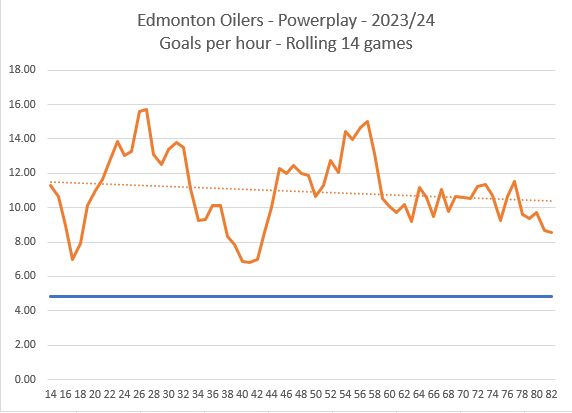
The Oilers abysmal output rate on the powerplay is a level they never reached last season. The graph below shows the Oilers rate of goals per hour last season in fourteen-game rolling periods, with the blue line across representing their rate from the first fourteen games this season (4.82).
.
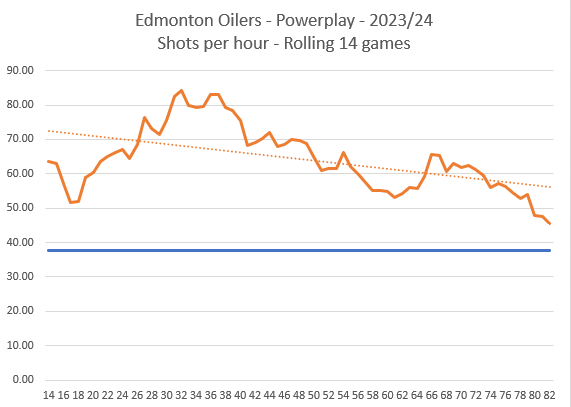
What’s especially alarming is that the Oilers rate of shots on the powerplay are also well below where it’s usually been. Again, they typically lead the league in generating chances, doing a good job getting shots through and retrieving rebounds to set up another ad hoc play. But it just hasn’t been happening as teams appear to have figured them out. Their current rate of 37.58 shots per hour is the second lowest in the league, and again well below what they posted over any fourteen-game rolling period last season. This indicates that the results on the power play might not turn around as quickly as expected, and that tactical and deployment changes are needed to get their rate of shots and chances up to where it should be.
The other interesting find here is that the Oilers rate of shots last season were gradually declining, which somewhat confirms what I was suspecting. Other teams may be figuring out the Oilers powerplay and have been using different tactics to slow them down.
.
Switching to the penalty kill, the Oilers are also far-off from their rate of goals against from last season. They currently rank dead last in the league allowing 16.27 goals per hour (represented by the blue line in the graph below). Last season, they were closer to league average with 7.55 goals against per hour, and at no point did they allow this high of a rate of goals against.

.
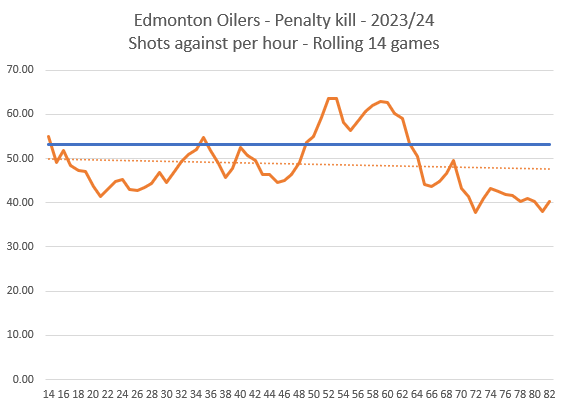
The good news is that the Oilers penalty kill is allowing an average rate of shots against (53.13) and closer in line to what they were posting last season (49.27). That’s a good indicator that the team has the right tactics and skaters, despite all of the roster changes in the off-season. The issue is that their goaltending isn’t pulling their weight and posting a save percentage of 69.39 percent (!) – the worst in the league. Skinner has a history now of struggling for stretches on the penalty kill despite his team limiting shots and chances against. So it’s difficult to have confidence in his abilities going forward.
.
One last note. The Oilers special teams, based on their shots and expected goals for and against, and average shooting and save percentages, should have a goal differential of +1.85. Their powerplay is struggling to create chances, otherwise this number would be better. But because of that, and how badly the goaltending has faltered on the penalty kill, the Oilers combined special teams goal-differential is actually -10. That’s a difference of almost 12 goals, which translates to a couple wins in the standings. The Oilers should be sitting in the top three in the Pacific, but are instead sitting tenth in the west.
Data: Natural Stat Trick
 The SuperFan