It’s already one of the most interesting off-seasons for the Edmonton Oilers.
Coming off a long playoff run, and with their core players intact, I wasn’t overly surprised to see this much activity. Banners always draw interest. And the win-now mentality has clearly ramped up across both the organization and the market.
Couple thoughts on the transactions.
The addition of Jeff Skinner and Viktor Arvidsson makes a lot of sense, and I think are at the right price point. Skinner has been a consistent even-strength finisher for a while, and should fit in nicely almost anywhere on the roster. I think it’ll be important that he have at least one defensively conscious player with him at all times. His on-ice rate of shots and chances against at even-strength are typically higher relative to his teammates. So this is a player that needs to produce at even-strength to outweigh some of his deficiencies.

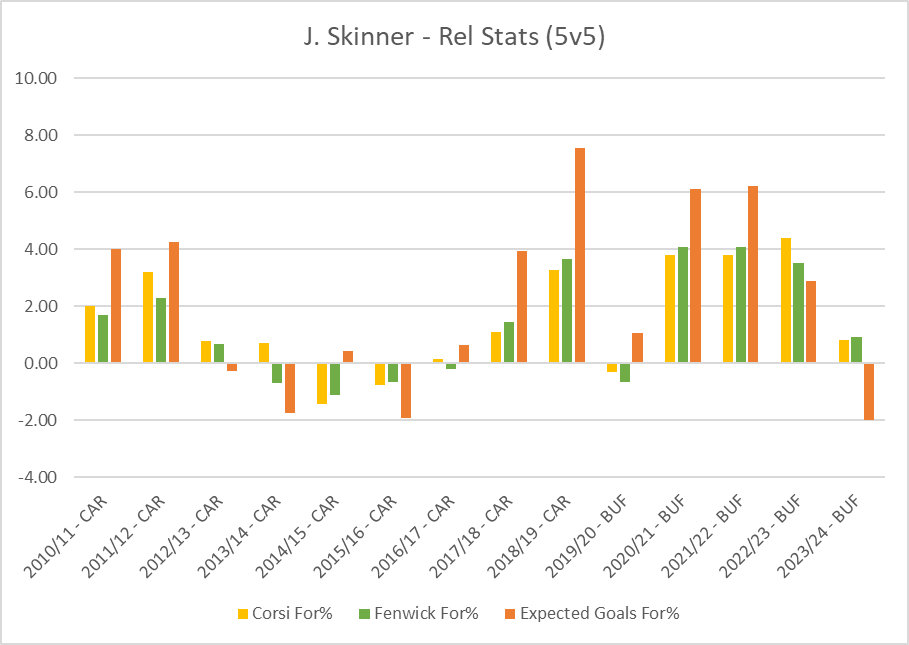
Here’s a snapshot of Skinner’s relative to team numbers over the course of his career. It’s impressive that he’s been able to continue making a positive impact on his teams as a top six forward. But I’d be a little concerned about the drop-off he had last season. His on-ice Expected Goals For percentage was lower than his teams’, which could be an anomaly. But considering he’s 32 and has played over 1,000 games now, his performance could potentially slide further. The Oilers did well signing him for only one year, and have plenty of ways to put him in optimal situations, so there isn’t much risk with this deal.
Arvidsson, on the other hand, could be the more reliable play driver for Edmonton and help control the flow of play and outshoot opponents. Concern of course will be his health, as he was limited to 18 games last year. But he could potentially slide pretty much anywhere on the roster and have a positive impact on his linemates.
Below is a snap shot of his relative to team numbers over the course of his career. He’s also up there in age (31), but has only played 545 games. Arvidsson’s on-ice numbers have slid a little, but he hasn’t been below his teams’ performance levels over the last three seasons. This gives me some confidence that he could suit up on any line for at least the next season. Scoring on the other hand, I’m a little skeptical about since his shooting percentages have never been great (7.40 percent over the last five seasons). That could be driven by the shot-volume style of the Kings, so it’ll be interesting to see if he gets his chances and how consistently he can bury them. Might benefit the team to have him on a line with someone like Skinner. Whatever shakes out in camp, the top six is looking really good.

Now with Ryan McLeod traded away, I’m really curious to see how the third line is constructed. The easy assumption is that it’ll be centered by Adam Henrique with Connor Brown and Mattias Janmark on the wings, as they all signed new contracts. But while this trio had success in the championship finals, their overall performance together at even-strength over the course of the full playoffs wasn’t very good. They played 52 minutes at 5v5 together and outscored opponents 2-1. But their underlying shot-share numbers were poor (39 percent Corsi For percentage, 44 percent Expected Goals For percentage), indicating that their results aren’t sustainable over a long run. Their on-ice PDO as a line was 109 (!), driven by an on-ice shooting percentage of 13% and a team save percentage of 96 percent – numbers well above normal ranges.
Maybe with a full training camp together, their performance numbers can improve. But I’m thinking Nugent-Hopkins should be the third line center, maybe sharing the centerman workload with Henrique. And if they have a scorer, maybe even Skinner, it might benefit the team. Whatever the case, I think it’ll be imperative that the coaching staff try a few combinations out, and have a third line that can produce without a star player with them. Which leads me to another point.
While I do get the rationale for trading McLeod, it’s worth noting that he was one of the very few players who posted positive shot and scoring-chance differentials at even-strength without McDavid, Draisaitl or Nugent-Hopkins on his line. Over the last three regular seasons, McLeod played over 1,800 minutes away from those three, so as a sole center, and posted an on-ice Corsi For percentage of 56 percent and an Expected Goals For percentage of 54 percent. Unfortunately the results were below where they should have been (61 goals for, 64 goals against), but at the least the process and performance was there. He’ll need a finisher on his line in Buffalo, something he didn’t always have in Edmonton, if they want to get full value from him.
Data: Natural Stat Trick
 The SuperFan
Pingback: Here’s what’s behind Jeff Skinner’s early-season struggles | The SuperFan