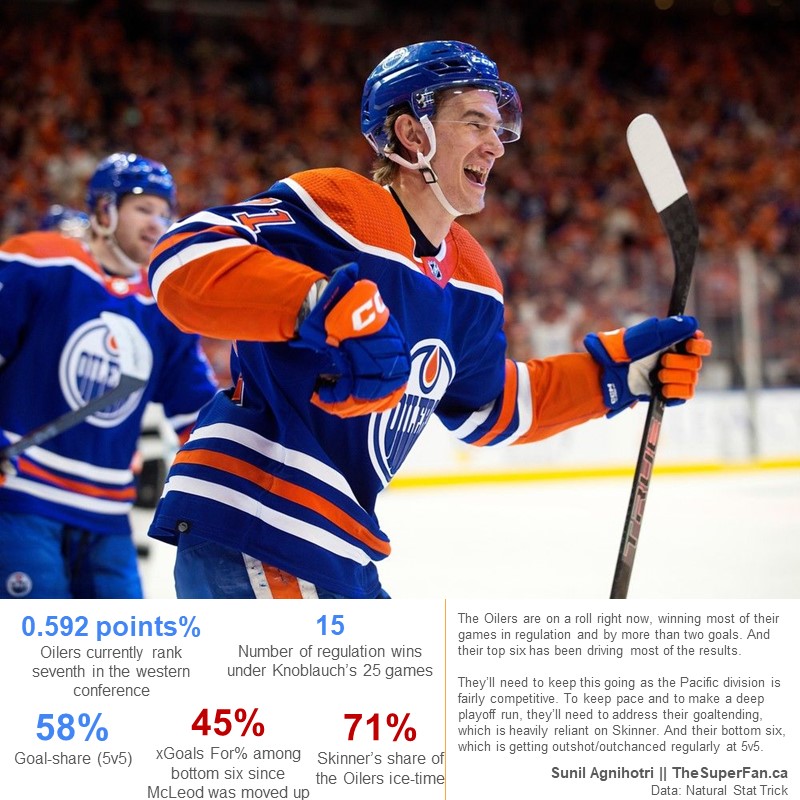
Pretty impressive turnaround for the Edmonton Oilers who are seventh in the western conference with a 0.592 points percentage, and fourth-best in the Pacific. They have the fifth best scoring rate in the league in all situations and sixth highest at even-strength (5v5). Their even-strength goal-share of 52.76% is eighth in the league and they’ll need to keep that going. Currently, six of the top ten teams in goal-share are in the western conference, four of which are in the Pacific division.
What’s especially impressive is the number of regulation wins the Oilers have posted since the coaching change. Since Kris Knoblauch took over behind the bench, the Oilers have won 19 games with 15 of them done without overtime or shootout. That’s the fifth highest number of regulation wins in the league since November 12th (when the coaching change happened). Worth noting that 12 of their wins (or 63%) have been by two goals or more – which is a better indicator of the team’s talent than one-goal games.
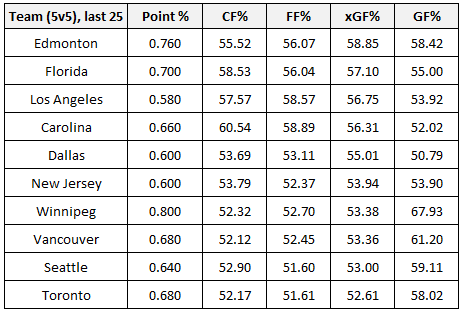
The Oilers even-strength (5v5) play has been solid, as they’ve outscored opponents 64-46 (58.18% goal-share, +18 goal differential) over the last 25 games since the coaching change. And their underlying numbers, like their 55.52 Corsi for percentage and 58.85 Expected goals-for percentage indicates that the 5v5 results are real and sustainable.
And while the Oilers are making the Pacific division standings interesting again, it’s worth noting that the rest of the teams in the Pacific are also posting some solid underlying numbers. In the last 25 games, the top ten teams in expected goals for percentage features four teams in the Pacific (table below is sorted by xGF%). The difference might come down to special teams, where some of the Pacific division teams are getting results on the powerplay or penalty kill. Covered that in my recent Pacific division check-in here.
It’s also worth keeping tabs on goaltending deployment across the division, which is going to have an impact on their playoff runs. While most teams are going towards a 1B/1A split between goalies, with most starters playing 59.90 percent of the team’s minutes this season, the Oilers are really riding their starter. Stuart Skinner has now played 70.60 percent of the Oilers total minutes this season, which is seventh highest in the league. That’s just behind Thatcher Demko, who has played 70.80 percent of Vancouver’s total minutes, and (interestingly) Cam Talbot who has played 72.90 percent of Los Angeles minutes. May recall Todd McLellan consistently starting Talbot in Edmonton in the 2016/17 regular season, where he played 86.70 percent of the total minutes. And how that impacted the Oilers playoff run that season.
Back to Edmonton’s current situation. If Calvin Pickard isn’t going to get regular deployment to give Skinner a rest and keep him fresh for the playoff race and (hopefully a playoff run), then management needs to address this and get someone the coaching staff actually trusts. Even since the coaching change (and Campbell’s demotion to Bakersfield), it’s been all Skinner who has played 73 percent of the team’s total ice time in the last 25 games.
The top six forward group, now featuring Ryan McLeod and Warren Foegele, is also crushing it right now since the Oilers made adjustments during their game against New Jersey on December 21st. Here’s how the top two line have performed over the last nine games at even-strength.

What’s a little concerning is how the bottom six have played the last nine games, with them not creating much and not allowing much either. In 139 minutes over the last nine games, the third and fourth lines have combined for 4 goals for, 4 goals against. And that’s largely because their Corsi For percentage is only 48% and their Expected Goals-for percentage is 45%. A whole lot of nothing going on there, which is concerning considering how big of a role team depth has on long playoff runs. Definitely an area to address by management, especially if McLeod is going to be on the second line.
One last thought on the new second line. It does re-affirm my belief that Draisaitl’s success largely depends on having a linemate that can also play center. McDavid is the obvious example, and so is Nugent-Hopkins who formed a line with Draisaitl and Yamamoto in the past. But I also recall a couple seasons ago when Draisaitl was on a line with Ryan Strome and Jujhar Khaira (both of which played center in their careers on depth lines) and had some decent success with them. In 108 minutes together between 2017-2019 (when Strome was an Oiler), they posted an on-ice goal-share of 56% (5 GF, 4 GA), and had a Corsi for percentage of 52% and an Expected goals-for percentage of 55%. So I’m not totally surprised that Draisiatl has found some chemistry with McLeod.
Data: Natural Stat Trick, NHL.com
 The SuperFan