With powerplays across the league improving every year with an influx of offensive talent, it’s become more and more imperative for teams to figure out how to limit shots and scoring chances against. Goalies of course play an important role, but their own ability to stop shots is an area that coaches have little influence on. What coaches can do, and what they have more control of, is how well and how often their skaters can prevent shots and chances in the first place. This can be managed by their coaching tactics and player deployment strategy. And it’s something the Oilers have struggled with under the current coaching staff.
Since February 10, 2022 when Woodcroft became head coach, the Oilers penalty kill has allowed the 7th highest rate of shots against in the league and the 10th highest rate of scoring chances (using Fenwick, or unblocked shot attempts as a proxy). Thanks to some league-average goaltending, the Oilers penalty kill results haven’t been a complete disaster, with the team allowing 7.75 goals against per hour, which has ranked 17th in the league.

One of the key issues is the personnel Woodcroft has deployed as his first penalty kill unit, with the group posting one of the worst rates of shots against in the league when compared to the first units of other teams. On average, first unit penalty kills allow 57.78 shots against per hour, which is around 5 shots more than their teams second unit (about a 7% increase) as they’re more often up against the opposing team’s top powerplay units and their star players. The Oilers top penalty kill under Woodcroft has allowed a rate of 66.05 shots against per hour, which has been the third highest in the league. This rate of shots against per hour is also around 11 shots more than what the Oilers second unit has posted, an increase of around 17%, and double than the league average. (Please note that the forward with the most penalty kill minutes from each NHL team was used as a proxy to assess each team’s first unit. On average, the forward with the most penalty kill ice time played 38.8% of their team’s total penalty killing time.)
Woodcroft’s go-to defence pair on the penalty kill since becoming the Oilers head coach has been Darnell Nurse and Cody Ceci, with Ryan Nugent-Hopkins, along with a rotating partner, being the most common forward up front. One of these three players has been on the ice for 71.2% of the team’s total ice time on the penalty kill since Woodcroft took over (665 total minutes). As mentioned before, the Oilers performance and ability to suppress shots has been well below league-average levels among first unit penalty kills, so something will definitely have to change for next season. Holland did mention the penalty kill unit as an area of concern in his recent media availability, and they have signed forward Connor Brown who has experience killing penalties and saw good performances from Mattias Ekhom after the trade deadline. But more will likely need to be done if the Oilers want to ensure improvements next season.
One thing that the coaching staff needs to strongly consider is finding a new defence partner for Nurse, who has posted better on-ice numbers with defencemen other than Ceci.

Under the previous coaching staff prior to Woodcroft’s arrival, Nurse’s three most common penalty kill partners were Ethan Bear, Evan Bouchard and Adam Larsson. And his best performance numbers (again looking at shots against) was with the one defender who’s still with the Oilers, as he and Bouchard limited the rate of shots against to 51.34 per hour – just better than league average (~54 shots against per hour). It’s unfortunate that Nurse is the one that needs help and doesn’t always drive positive outcomes, but at this point you’re just trying to get as much value as you can from the player. The other option is just having Bouchard and Ekholm take more of the penalty kill minutes, as those two showed good chemistry together as regular partners at the end of last season, and this way it doesn’t disrupt the defence pairings at even-strength.
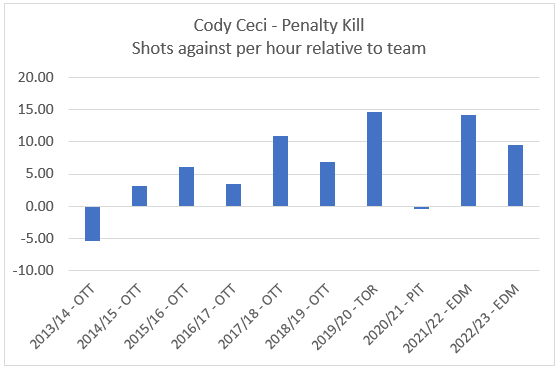
The other option to consider is removing Ceci altogether from the penalty kill. For pretty much his entire career, Ceci’s on-ice rate of shots against on the penalty kill has been higher than his team’s rate. Put another way – over his career, Ceci’s team’s consistently did a better job at suppressing shots against when he wasn’t on the ice. The only time Ceci’s numbers were closer to his team’s levels was in Pittsburgh, the year before the Oilers signed him – and this appears to have been an outlier season. And unfortunately for him and the Oilers, his on-ice shot suppression number continue to be poor on the penalty kill and in-line with his career levels.

If the Oilers could find a suitable alternative for Ceci, someone like Ekholm who posted solid shot-suppression numbers for the Oilers after the trade deadline, we could also see Nugent-Hopkins numbers bounce back. Under the previous coaching group, Nugent-Hopkins had a positive impact on the team’s ability to suppress shots against on the penalty kill, with the team doing better with him than without him (a -7.27 shots against relative to team). This previous season he posted the worst numbers in his career and in the league (a +16.53 shots against rel), likely because he had to play so many minutes with the Nurse and Ceci tandem. In 105 minutes with them, RNH’s on-ice rate of shot attempts against was over 71 per hour. In 66 minutes away from Nurse and Ceci (since Woodcroft too over), RNH saw his on-ice rate of shot attempts against drop down to 52.38, which would be closer to league average levels.

It should also help to have Connor Brown as an option on the penalty kill, but as I mentioned in a recent piece, his numbers were typically stronger when he wasn’t the first forward option. When Brown was traded to Ottawa from Toronto and became the top penalty killing forward, his numbers took a big hit with the Senators often struggling to prevent shots with him on the ice. So it’s probably best to try him out on a second unit first, monitor his progress and then gradually feed him the heavier minutes, potentially alongside Nugent-Hopkins or eventually his replacement.
The other option is to give forward Ryan McLeod more minutes on the penalty kill, as the team’s rate of shots against dropped by around 15% when he was on the ice since Woodcroft was hired. He does well against top competition at even-strength, so it might be worth giving him more responsibility shorthanded.
While the onus is on the coaching staff to implement the right tactics and player deployment strategy, it’s also on the general manager to monitor and identify the issues, and bring in the right coaching and player personnel. Prior to Woodcroft, the Oilers also struggled to suppress shots against on the penalty kill under Tippett, as the team allowed the 11th highest rate of shots, but was bailed out by some excellent goaltending that ranked second best in the league. Because of that, the Oilers were able to keep their rate of goals seventh lowest in the league. An inability to suppress shots and chances is something Tippett struggled with during pretty much his entire time in Arizona, so it shouldn’t have been a surprise to Oilers management.
Holland and his professional scouts have tried more than a few times to bring in some help for the penalty kill, but they appear to be more focused on previous results (i.e., goals against), which can be driven by the team’s goaltending, than the actual process behind the results (i.e., helping bring down the shots against). Acquiring Ekholm is a step in the right direction, as he has the skill and experience, but that was done in year four of Holland’s tenure as general manager. At this point, it might also be worth considering adding a penalty kill expert to the coaching staff who has a track record of suppressing shots and chances against – and not just goals. Better late than never.
Whatever the Oilers do going forward, it’s critical that a deeper analysis of existing flaws are done on a more regular basis. Improving their penalty kill is going to help increase the Oiler’s odds of winning games, and needs to be closely monitored.
Data: Natural Stat Trick
 The SuperFan
Great analysis. Not surprised Nurse and Ceci are a problem. They’re a problem 5v5, too.