I joined Rod Kurtz on CBC Radio Active to talk about the Oilers and their downward spiral since December. Full segment is here: CBC Radio Active (2022, January 19).
Topics we covered:
Leon Draisaitl’s recent comments and his exchange with beat reporter Jim Matheson.
How to best address the Oilers goaltending issues.
The underlying numbers over the last 15 games, which includes only three wins and two six-game losing streaks.
The changes needed behind the bench and especially the front office.
Thanks to the team at CBC for putting it all together!
Very saddened to hear about the passing of Adrienne Pan. Such an incredible person that did so much for the community and for those around her. She’ll be deeply missed.
I’ll never forget how kind and supportive she was to me, especially when I first started doing television segments with her on the CBC Edmonton news. She was such a positive person, so approachable. I learned so much from her about public speaking and connecting with a broader audience. Adrienne was the one who offered me a regular spot on the news to talk Oilers and was so encouraging – and her support continued over the years.
Looking back now, I realized how much effort she would put into the Oiler segments to make it better for the audience, really challenging me and others along the way. She would always push for new topics to discuss, wanting to go past the main storylines around the Oilers. Knowing that I liked talking about stats, she worked with the CBC team to develop television graphics and slides that we could present – again, wanting to do more than simple box-score stats. And to make our segments interactive, Adrienne had set-up Facebook Live sessions where viewers could send in questions about the Oilers and I would share my thoughts. She was so professional and cared a lot about her work and what was presented, and pushed those around her to be better as well. I’ll forever be grateful for the opportunities she gave me and the support she provided along the way.
My deepest condoloences to her family and friends. And all of her colleagues at CBC Edmonton.
Joined by Daniel Nugent-Bowman (@DNBSports) from The Athletic to talk Oilers, the results this season and what the major on-ice issues have been. We covered the roster construction issues that Holland is facing, the team’s goaltending, and what needs to be addressed before the club can become a championship contender. Daniel also shared some great insight on his approach to covering the Oilers beat and his experiences dealing with people in the game.
At his most recent media availability, Oilers general manager Ken Holland voiced, among other topics, his disappointment with the Oilers season and expressed his inability to determine if the Oilers were a good team or not.
To tell the honest truth, I believe we have a good team. I, obviously, built the team and whatever happens is on me. I’m not really sure where we’re at because the two extremes have been so far apart. In the 16-5, our special teams were a major factor. We were probably near the top and it was extremely good.
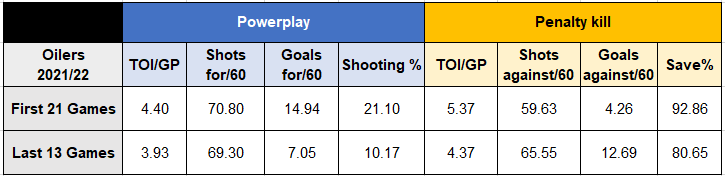
“In the last 13 games, we’re 18 percent on the power play and 68 percent on the penalty kill…But again, I’m not sure where we’re at because they’re such extremes, the first 21 games versus the last 13, that I’m not sure where we’re at. It’s been hard for me to really get an understanding of where we’re at.” (Source: Edmonton Oilers)
There’s definitely been a drop off when comparing the results between the first 21 games of the season against the last 13 games. Prior to December 2nd, the Oilers were the top team in the league with a 0.762 points percentage, driven completely by their special teams. The Oilers powerplay scored 23 times in only 92 minutes – a scoring rate of 14.94 goals per hour, which ranked the best in the league. Their penalty kill allowed only 8 goals in 113 minutes – rate of 4.26 goals against, good for fourth best in the league. And the Oilers special teams had to be exceptional as the team struggled at even-strength (5v5), posting a -2 goal differential and some very mediocre shot-share numbers.
And because the Oilers special teams has struggled in the last 13 games – seeing their powerplay goal-scoring rate cut in half and their goals against rate on the penalty kill almost triple – they’ve fallen to fifth in the Pacific and are no longer holding on to a playoff spot. The good news is that the powerplay should eventually start producing again, considering they continue to lead the league in shots and scoring chances per hour and have most of their top contributors healthy. They might not score at the same rate as they did in the first 21 games, but we can reasonably expect them to score around the 10.0 goals-per- hour mark, which is what they’ve done in seasons past.
The concern should probably be around the penalty kill, which was allowing some of the highest rates of shots against earlier in the season and has allowed even more since early December. Part of that could probably be attributed to so many defencemen being in and out of the lineup. But we have to keep in mind too that Tippett has a history of running penalty kills that allow a higher-than-average rate of shots against. And he quite often relies on the goaltending to bail the team out (Source). In the last two seasons, the Oilers 89.90% penalty kill save percentage has been the best in the league, but it was probably unrealistic to expect two aging netminders, one of which can’t stay healthy this season, to replicate that success.
With the issues on special teams identified, let’s switch over to even-strength where for the third season in a row under Holland and Tippett, the Oilers are posting a negative goal-differential.
The good news, is that overall the Oilers have actually been consistent all season at even-strength (5v5). The bad news is that they’ve been consistently medicore. Their Corsi For%, which serves as a proxy for puck possession and Fenwick For% which serves as a proxy for scoring chances has been around league average all season – nothing great and not terrible either. Their expected goal-share has consistently been right around the break-even mark – again just good enough but nowhere near the levels posted by the true top teams in the league.
While goaltending has slipped slightly at even-strength, the real driver of the Oilers results over the last 13 games has been been the team’s on-ice shooting percentage, which has been 6.71%. And it’s actually been when McDavid has been on the ice that the team shooting percentage has really dropped. In the first 21 games with McDavid on the ice, the Oilers team shooting percentage was 9.78% – slightly below McDavid’s career on-ice shooting percentage of 10.6%. In the last 13 games, that on-ice shooting percentage has dropped to 4.96% – well below where we would expect McDavid to be and indicating that his on-ice numbers should bounce back over the remainder of the season.
But regardless of how McDavid does, it should be concerning to the Oilers management that yet again the team is not posting very good shot-share numbers at even-strength and are going to really need their special teams to bail them out. It’s not likely that the Oilers will shoot to the top of the standings and will instead be in that mushy-middle of teams that aren’t quite division leaders and aren’t quite basement dwellers either.
What Holland and his group need to realize is that the Edmonton Oilers as constructed today are a mediocre hockey club. They’re not quite an offensive juggernaut, they’re not sound defensively, they’re not hard to play against. Even with two superstars, they’re just another middle of the pack team. These results, over three seasons now, aren’t good enough considering how much Holland is getting paid, how much money and assets he’s spent and the damage he’s done to the Oilers cap situation.
And if Holland after these three years doesn’t know what he has right now and can’t put his finger on the problems currently ailing the team, he really shouldn’t be allowed to construct an NHL roster.
Joined by Brian King (@kinger999) on the show to talk about the Edmonton Oiler’s major issues this season, the problems with Ken Holland’s roster construction and how Dave Tippett has performed as head coach. Brian also shared the background on the PDO metric and how he discovered it – you can read more about it here.
Quick query using publicly available data and an understanding of the salary cap and player aging curves could have prevented this fiasco.
If Oilers management isn’t happy with their goaltending, they have only themselves to blame. When you consider each netminders recent history at even-strength and the penalty kill, Ken Holland and his group really shouldn’t be surprised with their poor results this season. How often the Oilers goalies have stopped the puck has actually been similar to their previous seasons.
Even-strength (5v5)
Let’s start with even-strength (5v5), where the Oilers goalies have allowed a total of 80 goals on 876 shots against – ranking 29th in the league with a 0.909% team save percentage. The average save percentage at the team level and individual level for regular netminders is typically around 0.920%.
Below is a table showing how each Oilers goalie has performed this season including their time on ice, shots faced, goals allowed and save percentage. Among the 67 goalies who have played at least 250 minutes this season, Stuart Skinner ranks 43rd in terms of save percentage with 0.913, while Mike Smith and Mikko Koskinen rank 51st and 57th respectively. Again, league average save percentage is around 0.920 – and all three have been below that mark this season.
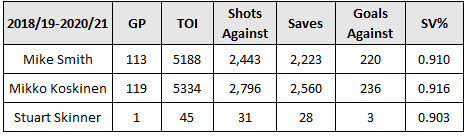
Now to see if these numers are within an expected range, let’s look at how each Oilers goalie has performed in their previous three seasons – between 2018/19 and 2020/21. Same as above, I’ve included time on ice, shots faced, goals allowed and save percentage.
In 113 games between 2018 and 2021, Smith posted a 0.910 save percentage, which is identical to the save percentage he’s posted this season. In those previous three seasons, Smith ranked 54th among 60 goalies who played at least 2,000 minutes – demonstrating clearly that despite a career year last season, he’s a below-average goalie at even-strength. And it’s really not surprising considering he’s at an age when goaltenders drop-off significantly (Source: Hockey Graphs).
In the same three-year period, Koskinen didn’t fare much better posting a 0.916 save percentage in 119 games, sitting just below league average and ranking 42nd among the same group of 60 goalies. He’s definitely been worse this season posting a 0.906 save percentage, which is somewhat expected considering he’s now 33 years old and taking on a larger workload with Smith being injured. Skinner had only played one NHL game in that three-year period, but it’s good to know that his 0.913 save percentage this season would rank 48th among those 60 goalies.
Since Smith is posting the same save percentage this season as he has in the previous three seasons, he’s allowed about the same number of goals we could expect him to allow – approximately 14 . Koskinen on the other hand, is allowing about five more goals than expected. If he was posting a save percentage of 0.916 this season like he had in the previous three seasons, he would have allowed 40 goals instead of 45. The good news is that Skinner is performing better than we expected. Had he posted a 0.903 save percentage, the team would have allowed an extra two goals.
So based on some quick and dirty math – had the Oilers goalies performed at the same levels they had in the previous three seasons, the team would have allowed 77 goals instead of 80 at even-strength (5v5). Using the same number of shots against, that would be a team save percentage of 0.912 and would rank 26th in the league instead of 29th. So as much as the Oilers would like their goalies to be closer to league average levels at even-strength, it’s really not a realistic expectation considering how Smith and Koskinen have performed below league average over the last three seasons. Holland and his group should have known this heading into such an important season.
Penalty kill
Looking at the penalty kill this season, the Oilers have allowed 20 goals on 174 shots against – ranking 17th in the league in terms of goals against per hour (7.08) and 10th overall in team save percentage with 0.885. The average penalty kill save percentage at the team level and individual level is typically around 0.865 with all three Oilers goalies posting numbers above that this season.
Here’s how each Oilers goalie has performed this season with Skinner ranking 5th among 65 goalies who have played at least 25 minutes shorthanded this season, with Koskinen and Smith ranking 28th and 32nd respectively.
When you compare this season’s numbers with their previous three seasons, Smith and Koskinen are posting numbers fairly close to their historical levels. Over the last three seasons, Smith has a save percentage of 0.883 on the penalty kill, while Koskinen has posted a save percentage of 0.876 – both of which are above league average.The number of goals allowed by Smith and Koskinen this season are pretty close to what we would expect from them as their save percentages are nearly identical. The issue for the Oilers is that they’re allowing a higher rate of shots against this season (about 61 per hour), while in previous seasons they’ve allowed about 55 shots against per hour. Skinner is performing above league average levels and has saved about three more goals than expected. Had he put up only league average numbers this season, the team would have allowed 23 goals instead of 20 and the Oilers would have a team save percentage of 0.867, which would rank around 16th in the league instead of 10th. Really, the difference has been marginal with all three goalies performing around expected levels.
Thoughts
While the Oilers goaltending overall hasn’t been great this season, the netminders are performing within their expected ranges. All three goalies are league average or below at this point, so expecting anything more from them was unrealistic from the get go.
Had the Oilers conducted a basic analysis using publicly available data and took time to understand salary cap management and player aging curves, they could have made smarter, more sensible bets and be in a better spot in the standings. Instead they chose to – or you could argue they were forced to – take on a lot of risk at such an important position and are getting pretty much what they should have expected.
What’s especially baffling is that despite the red flags, Ken Holland and his group have not once or twice, but three times chosen to start a regular season with Smith and Koskinen as their goalie tandem. And yes, the Oilers did try to upgrade their goaltending in previous off-seasons. But they failed because they didn’t have enough quality assets to part with due to their own mismanagement of the roster construction and their poor draft capital.
Rather that the goaltending performance, the focus really should be on Ken Holland and his management group and their very obviously-flawed decision-making process. And try as they may to improve the roster now and to make a run at a playoff spot, it’s hard to have faith in a management group that got them into this awful mess in the first place.
Joined by Weebo (@OilersPain) on the show to talk Oilers, their poor results in December and some of the key underlying issues – both on and off the ice.








 The SuperFan